

 登录
登录
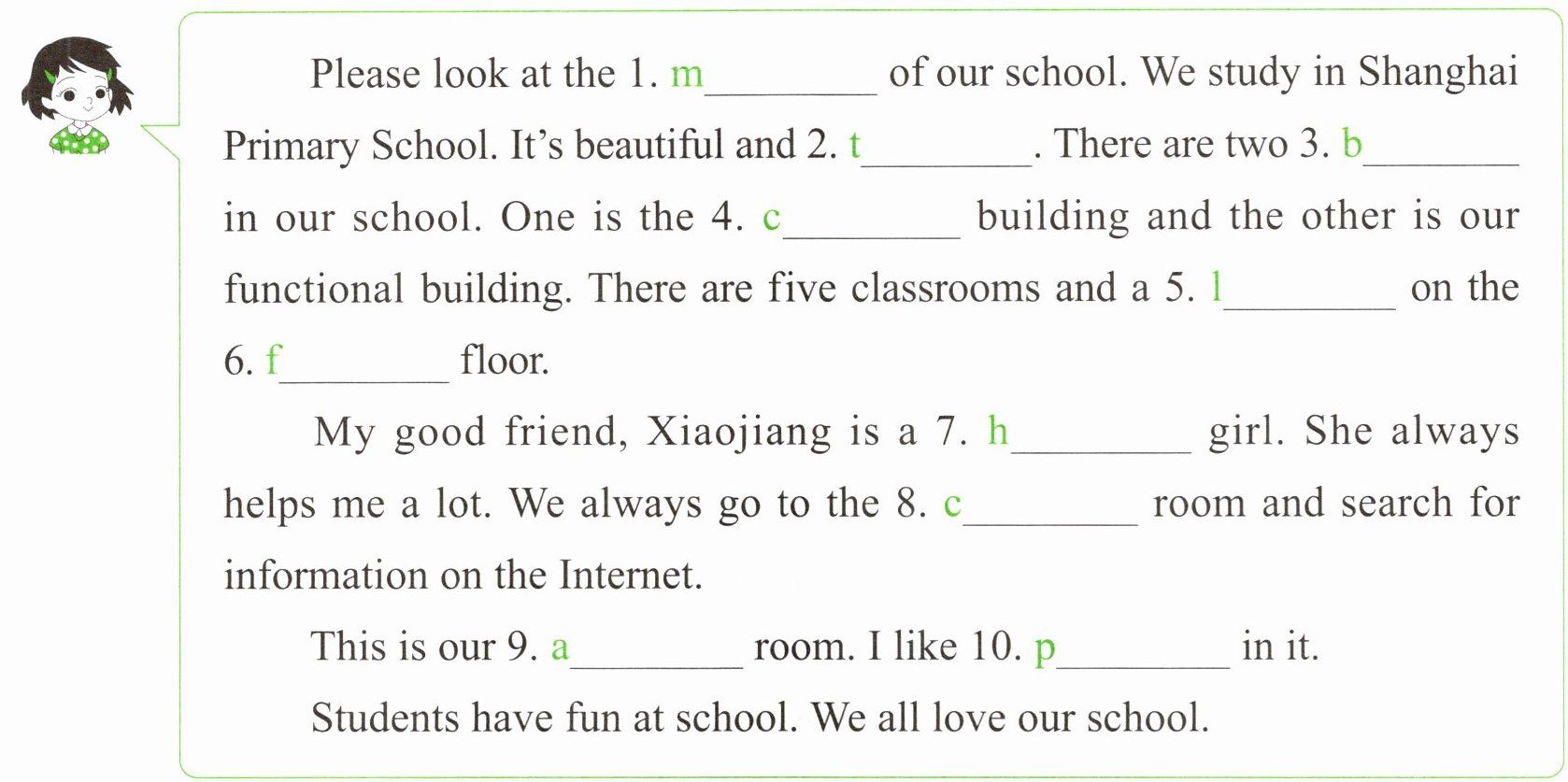
Ⅴ. Read and write(外国友人正在参观Shenshen的学校,Shenshen正在向他们介绍她的学校。请阅读短文,根据首字母提示完成短文)
QUICK TIPS
做首字母填空题时,可以先通读全文,把握大意,再根据上下文意思,“猜”出词语。
QUICK TIPS
做首字母填空题时,可以先通读全文,把握大意,再根据上下文意思,“猜”出词语。
答案
1. map 2. tidy 3. buildings 4. classroom 5. library
6. first 7. helpful 8. computer 9. art 10. painting
重点详解:
在首字母填空这样的题型中,关键在于结合上下文意思来进行文章大意的推测。首先,可以通读全文抓住大意,把握整体语境,然后确定词性。如第2题“It’s beautiful and 2. t______.”,“and”前后的词性一致,所以可以判定是形容词,又如第3题“There are two 3. b______.”,数量词后面跟名词,并且注意要用名词的复数形式。最后,再通读一遍短文,检查一下是否通顺。
6. first 7. helpful 8. computer 9. art 10. painting
重点详解:
在首字母填空这样的题型中,关键在于结合上下文意思来进行文章大意的推测。首先,可以通读全文抓住大意,把握整体语境,然后确定词性。如第2题“It’s beautiful and 2. t______.”,“and”前后的词性一致,所以可以判定是形容词,又如第3题“There are two 3. b______.”,数量词后面跟名词,并且注意要用名词的复数形式。最后,再通读一遍短文,检查一下是否通顺。
解析
【分析】做首字母填空题时,先通读全文把握大意,本文是介绍学校及好友的短文;再结合每个空的上下文逻辑、首字母提示,以及词性(如名词单复数、形容词、动名词等)推测单词;最后通读检查语句通顺。例如第1空,结合“学校的...”及首字母m,可推测是“地图”;第2空与beautiful并列,需形容词,t开头的形容学校的词等。
【解析】1. 根据“the...of our school”及首字母m,可知填map;2. 与beautiful并列,需形容词,结合首字母t,填tidy;3. two后接可数名词复数,结合首字母b及语境“学校的两个...”,填buildings;4. 对应后文“functional building”,结合首字母c,填classroom;5. 与classrooms同属学校场所,结合首字母l,填library;6. 表示楼层,结合首字母f,填first;7. 修饰girl,结合后文“帮助人”及首字母h,填helpful;8. 结合“上网查资料”及首字母c,填computer;9. 结合首字母a及语境“房间”,填art;10. like后接动名词,结合首字母p,填painting。
【答案】1. map 2. tidy 3. buildings 4. classroom 5. library 6. first 7. helpful 8. computer 9. art 10. painting
【知识点】首字母填空、英语词汇运用
【点评】本题为小学英语基础首字母填空题,考查学生对学校相关词汇及词性的掌握,解题关键是结合语境与首字母提示。
【难度系数】0.6
【解析】1. 根据“the...of our school”及首字母m,可知填map;2. 与beautiful并列,需形容词,结合首字母t,填tidy;3. two后接可数名词复数,结合首字母b及语境“学校的两个...”,填buildings;4. 对应后文“functional building”,结合首字母c,填classroom;5. 与classrooms同属学校场所,结合首字母l,填library;6. 表示楼层,结合首字母f,填first;7. 修饰girl,结合后文“帮助人”及首字母h,填helpful;8. 结合“上网查资料”及首字母c,填computer;9. 结合首字母a及语境“房间”,填art;10. like后接动名词,结合首字母p,填painting。
【答案】1. map 2. tidy 3. buildings 4. classroom 5. library 6. first 7. helpful 8. computer 9. art 10. painting
【知识点】首字母填空、英语词汇运用
【点评】本题为小学英语基础首字母填空题,考查学生对学校相关词汇及词性的掌握,解题关键是结合语境与首字母提示。
【难度系数】0.6
Ⅵ. Read and answer(在我们的班级里,有着各种各样的小朋友,每个人都是集体的一份子。请读一读短文,并回答问题)
Our Class Helpers
Alice is very helpful. She often helps classmates carry books and cleans the blackboard. Tom is interesting. He often tells funny stories and everyone laughs. Amy is lovely. She draws cute cats. And we all like her pictures. John is polite. He always says “please” and “thank you.” Lucy is different. She loves quiet games, while others like running.
One day, the class wants to have a party, but no one knows how to plan it. “I can draw invitations!” Amy says. Tom has a great idea for games. Alice helps set up chairs. John asks the teacher politely for help. Lucy makes a list of snacks.
Together, they fix the problem. The party is wonderful. Everyone in the class is important. Different people can help each other a lot!
1. Who is very helpful?
2. What does Tom often do?
3. What does John always say?
4. What problem does the class have?
5. How does Lucy help with the party?
Our Class Helpers
Alice is very helpful. She often helps classmates carry books and cleans the blackboard. Tom is interesting. He often tells funny stories and everyone laughs. Amy is lovely. She draws cute cats. And we all like her pictures. John is polite. He always says “please” and “thank you.” Lucy is different. She loves quiet games, while others like running.
One day, the class wants to have a party, but no one knows how to plan it. “I can draw invitations!” Amy says. Tom has a great idea for games. Alice helps set up chairs. John asks the teacher politely for help. Lucy makes a list of snacks.
Together, they fix the problem. The party is wonderful. Everyone in the class is important. Different people can help each other a lot!
1. Who is very helpful?
Alice (is very helpful).
2. What does Tom often do?
He often tells funny stories.
3. What does John always say?
He always says “please” and “thank you.”
4. What problem does the class have?
The class wants to have a party, but no one knows how to plan it.
5. How does Lucy help with the party?
She makes a list of snacks.
答案
1. Alice (is very helpful).
2. He often tells funny stories.
3. He always says “please” and “thank you.”
4. The class wants to have a party, but no one knows how to plan it.
5. She makes a list of snacks.
2. He often tells funny stories.
3. He always says “please” and “thank you.”
4. The class wants to have a party, but no one knows how to plan it.
5. She makes a list of snacks.
解析
【分析】本题是英语阅读理解细节题,解题时需根据每个问题的核心关键词,在短文中定位对应语句,提取准确信息即可完成作答。
【解析】1. 针对“谁很乐于助人”的问题,定位短文第一段“Alice is very helpful.”,可知答案为Alice;2. 针对“Tom经常做什么”的问题,定位短文第一段“Tom is interesting. He often tells funny stories and everyone laughs.”,提取“He often tells funny stories.”;3. 针对“John总是说什么”的问题,定位短文第一段“John is polite. He always says “please” and “thank you.””,提取对应内容;4. 针对“班级有什么问题”的问题,定位短文第二段第一句“One day, the class wants to have a party, but no one knows how to plan it.”,提取该句;5. 针对“Lucy如何帮忙筹备派对”的问题,定位短文第二段最后一句“Lucy makes a list of snacks.”,提取对应内容。
【答案】
1. Alice (is very helpful).
2. He often tells funny stories.
3. He always says “please” and “thank you.”
4. The class wants to have a party, but no one knows how to plan it.
5. She makes a list of snacks.
【知识点】英语阅读理解、细节理解题
【点评】本题为基础英语阅读理解细节查找题,侧重考查学生从文本中定位并提取关键信息的能力,难度较低,适合巩固英语阅读基础。
【难度系数】0.8
【解析】1. 针对“谁很乐于助人”的问题,定位短文第一段“Alice is very helpful.”,可知答案为Alice;2. 针对“Tom经常做什么”的问题,定位短文第一段“Tom is interesting. He often tells funny stories and everyone laughs.”,提取“He often tells funny stories.”;3. 针对“John总是说什么”的问题,定位短文第一段“John is polite. He always says “please” and “thank you.””,提取对应内容;4. 针对“班级有什么问题”的问题,定位短文第二段第一句“One day, the class wants to have a party, but no one knows how to plan it.”,提取该句;5. 针对“Lucy如何帮忙筹备派对”的问题,定位短文第二段最后一句“Lucy makes a list of snacks.”,提取对应内容。
【答案】
1. Alice (is very helpful).
2. He often tells funny stories.
3. He always says “please” and “thank you.”
4. The class wants to have a party, but no one knows how to plan it.
5. She makes a list of snacks.
【知识点】英语阅读理解、细节理解题
【点评】本题为基础英语阅读理解细节查找题,侧重考查学生从文本中定位并提取关键信息的能力,难度较低,适合巩固英语阅读基础。
【难度系数】0.8
