

 登录
登录
Ⅴ. Complete the dialogue(按要求完成对话)
Ben: Hi, Lily! I heard you visited the Ancient City Wall in Xi'an last weekend. 1.
Lily: It was wonderful! The grand ancient wall really impressed me.
Ben: 2.
Lily: People started to build it over 1, 300 years ago. That was in the Tang Dynasty.
Ben: Wow, that's amazing! 3.
Lily: It was mainly made of rammed earth and huge bricks. You know what? The wall is over twelve metres wide on top. Ancient people could even ride horses on the top of the wall.
Ben: 4.
Lily: The wall was used to protect all the people living inside the city long ago.
Ben: I really want to go there too. 5.
Lily: Of course! I'll go with you next time.
Ben: Hi, Lily! I heard you visited the Ancient City Wall in Xi'an last weekend. 1.
How was your trip/How did you like the place
?(询问旅途感受)Lily: It was wonderful! The grand ancient wall really impressed me.
Ben: 2.
When did people start to build the city wall
?(询问建造时间)Lily: People started to build it over 1, 300 years ago. That was in the Tang Dynasty.
Ben: Wow, that's amazing! 3.
What was it (mainly) made of
?(询问建造材料)Lily: It was mainly made of rammed earth and huge bricks. You know what? The wall is over twelve metres wide on top. Ancient people could even ride horses on the top of the wall.
Ben: 4.
What was the use of the wall/What was the wall used for
?(用特殊疑问句询问城墙的作用)Lily: The wall was used to protect all the people living inside the city long ago.
Ben: I really want to go there too. 5.
Could you go with me next time/Would you like to be my guide next time
?(询问下次是否可以一起去)Lily: Of course! I'll go with you next time.
答案
(供参考)
1. How was your trip/How did you like the place
2. When did people start to build the city wall
3. What was it (mainly) made of
4. What was the use of the wall/What was the wall used for
5. Could you go with me next time/Would you like to be my guide next time
1. How was your trip/How did you like the place
2. When did people start to build the city wall
3. What was it (mainly) made of
4. What was the use of the wall/What was the wall used for
5. Could you go with me next time/Would you like to be my guide next time
解析
【分析】
本题为日常交际类补全对话,需结合上下文语境及括号内的提问要求,填写符合口语习惯的特殊疑问句。解题时要根据答语内容反推问句功能:询问感受用How引导的问句,询问时间用When引导,询问材料用关于制作材质的特殊疑问句,询问作用用涉及用途的问句,询问同行意愿用委婉请求的问句,确保问句与答语匹配。
【解析】
1. 根据答语“It was wonderful!”可知,此处询问旅途感受,应填How was your trip/How did you like the place;
2. 根据答语“People started to build it over 1,300 years ago.”可知,此处询问建造时间,应填When did people start to build the city wall;
3. 根据答语“It was mainly made of rammed earth and huge bricks.”可知,此处询问建造材料,应填What was it (mainly) made of;
4. 根据答语“The wall was used to protect all the people living inside the city long ago.”可知,此处询问城墙的作用,应填What was the use of the wall/What was the wall used for;
5. 根据答语“Of course! I'll go with you next time.”可知,此处询问是否可以一起去,应填Could you go with me next time/Would you like to be my guide next time。
【答案】
1. How was your trip/How did you like the place
2. When did people start to build the city wall
3. What was it (mainly) made of
4. What was the use of the wall/What was the wall used for
5. Could you go with me next time/Would you like to be my guide next time
【知识点】
补全对话,日常交际用语,特殊疑问句
【点评】
本题围绕旅行话题展开,考查学生对不同功能特殊疑问句的运用能力,结合上下文语境即可准确作答,属于基础交际类题目。
【难度系数】
0.3
本题为日常交际类补全对话,需结合上下文语境及括号内的提问要求,填写符合口语习惯的特殊疑问句。解题时要根据答语内容反推问句功能:询问感受用How引导的问句,询问时间用When引导,询问材料用关于制作材质的特殊疑问句,询问作用用涉及用途的问句,询问同行意愿用委婉请求的问句,确保问句与答语匹配。
【解析】
1. 根据答语“It was wonderful!”可知,此处询问旅途感受,应填How was your trip/How did you like the place;
2. 根据答语“People started to build it over 1,300 years ago.”可知,此处询问建造时间,应填When did people start to build the city wall;
3. 根据答语“It was mainly made of rammed earth and huge bricks.”可知,此处询问建造材料,应填What was it (mainly) made of;
4. 根据答语“The wall was used to protect all the people living inside the city long ago.”可知,此处询问城墙的作用,应填What was the use of the wall/What was the wall used for;
5. 根据答语“Of course! I'll go with you next time.”可知,此处询问是否可以一起去,应填Could you go with me next time/Would you like to be my guide next time。
【答案】
1. How was your trip/How did you like the place
2. When did people start to build the city wall
3. What was it (mainly) made of
4. What was the use of the wall/What was the wall used for
5. Could you go with me next time/Would you like to be my guide next time
【知识点】
补全对话,日常交际用语,特殊疑问句
【点评】
本题围绕旅行话题展开,考查学生对不同功能特殊疑问句的运用能力,结合上下文语境即可准确作答,属于基础交际类题目。
【难度系数】
0.3
Ⅰ. Choose the best answer(根据以下内容,选择最恰当的答案)
Paris Sightseeing Guide
Welcome to Paris! Below is the official schedule for our four-day study tour. Please read it carefully before each visit.
| Date | Place (Highlights) | How to get there | Things to remember |
| ---- | ---- | ---- | ---- |
| 12/7 (Mon.) | The Eiffel Tower — climb up to the 2nd floor for the best view of the city; in the evening, watch the golden lights turn on at 21:00 | Metro Line 6, then a 10-minute walk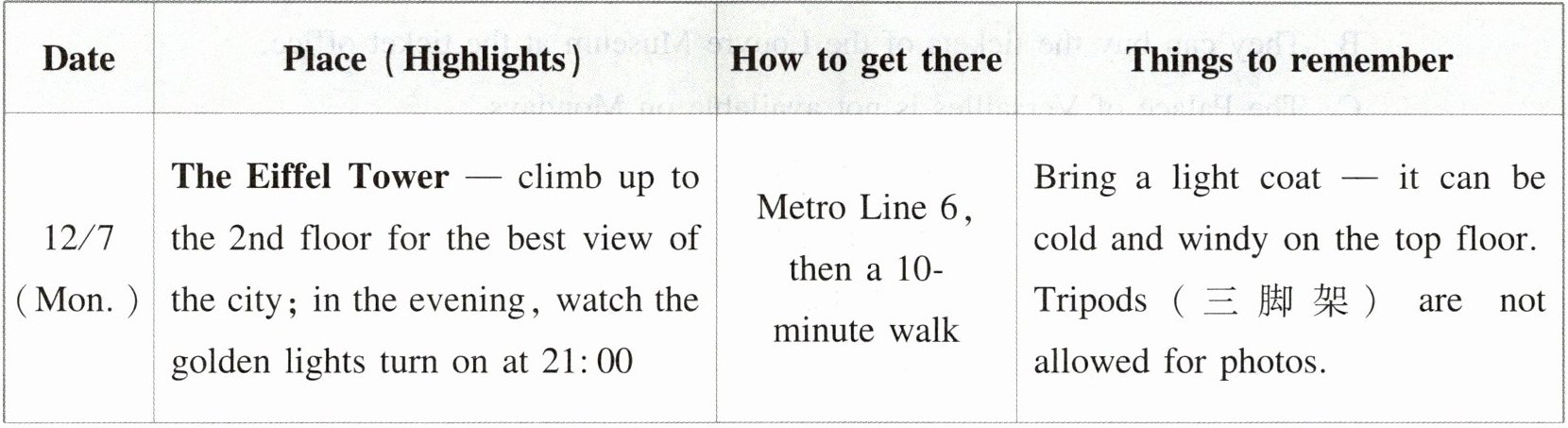 | Bring a light coat — it can be cold and windy on the top floor. Tripods(三脚架) are not allowed for photos. |
续表
| Date | Place (Highlights) | How to get there | Things to remember |
| ---- | ---- | ---- | ---- |
| 13/7 (Tue.) | The Arc de Triomphe(凯旋门)— walk up 284 steps for a 360° view; visit the famous shops on the avenue below | Metro Line 1 | The lift is only for people with walking difficulties. Keep your belongings in a safe place — there are often large crowds here. |
| 14/7 (Wed.) | The Louvre Museum — see the Mona Lisa and the Venus de Milo; allow at least 4 hours for the visit | Metro Line 1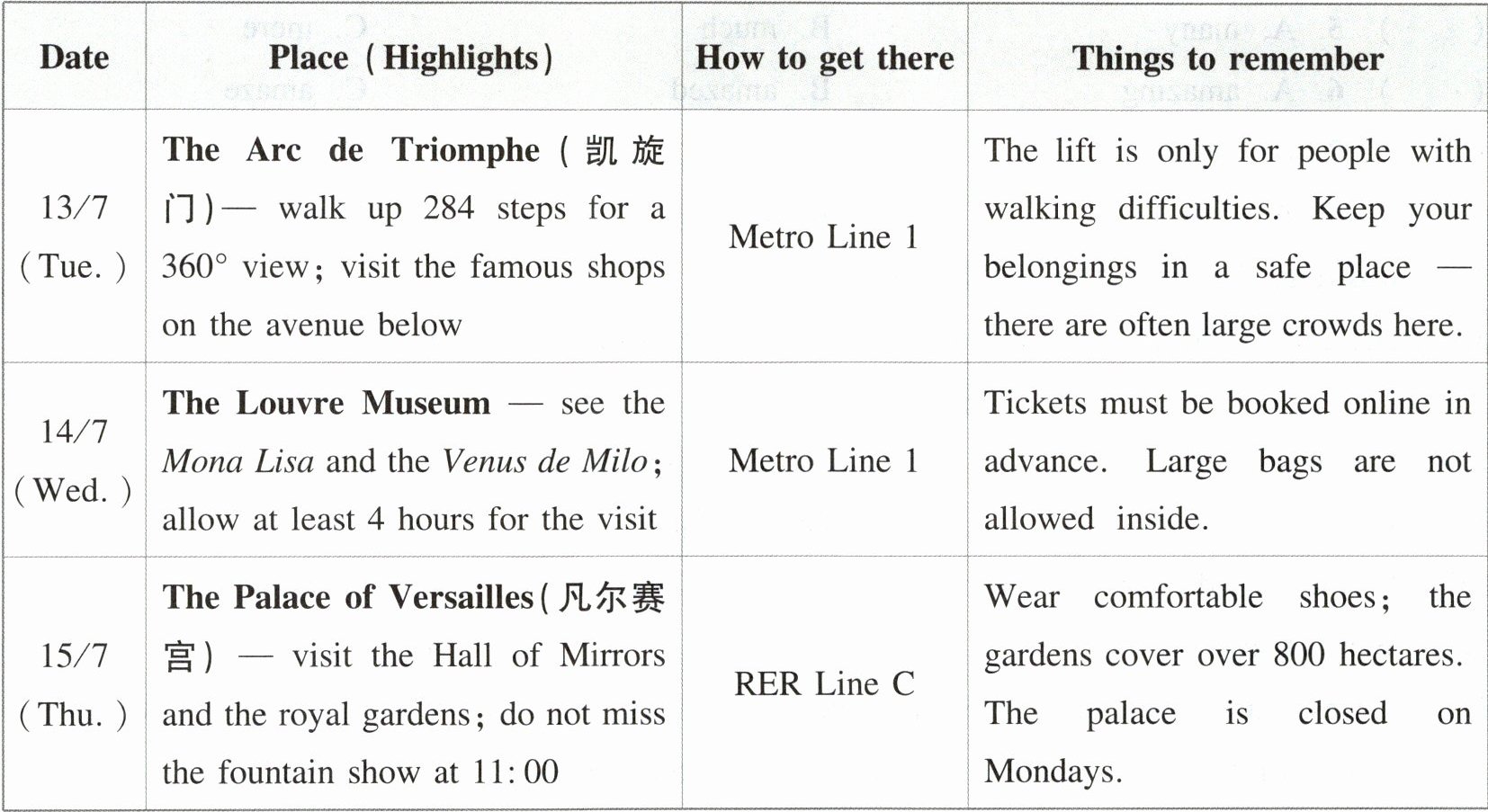 | Tickets must be booked online in advance. Large bags are not allowed inside. |
| 15/7 (Thu.) | The Palace of Versailles(凡尔赛宫)— visit the Hall of Mirrors and the royal gardens; do not miss the fountain show at 11:00 | RER Line C | Wear comfortable shoes; the gardens cover over 800 hectares. The palace is closed on Mondays. |
General tips for the group
◆ Always keep your student card with you. Students under 18 can enter most museums for free.
◆ The official language is French, but most signs and tickets also have English.
◆ Flash is not allowed when taking photos inside the museums.
◆ If you get lost, return to the meeting point or call Mr. Wang at 061 - 435 - 648.
(
A. On Monday. B. On Tuesday. C. On Wednesday. D. On Thursday.
(
A. Metro Line 1 B. Metro Line 6 C. RER Line C D. a school bus
(
A. The Eiffel Tower is open all night long.
B. They can buy the tickets of the Louvre Museum at the ticket office.
C. The Palace of Versailles is not available on Mondays.
D. Flash photos are allowed inside the Louvre.
(
A. take a taxi back to the hotel alone
B. wait quietly at the next metro station
C. go to the police office at once
D. return to the meeting point or call Mr. Wang
(
A. the trip happens in a cold winter
B. all the visits in Paris are free of charge
C. the students on the trip are mainly under 18 years old
D. the Eiffel Tower is closed during daytime
Paris Sightseeing Guide
Welcome to Paris! Below is the official schedule for our four-day study tour. Please read it carefully before each visit.
| Date | Place (Highlights) | How to get there | Things to remember |
| ---- | ---- | ---- | ---- |
| 12/7 (Mon.) | The Eiffel Tower — climb up to the 2nd floor for the best view of the city; in the evening, watch the golden lights turn on at 21:00 | Metro Line 6, then a 10-minute walk
| Bring a light coat — it can be cold and windy on the top floor. Tripods(三脚架) are not allowed for photos. |续表
| Date | Place (Highlights) | How to get there | Things to remember |
| ---- | ---- | ---- | ---- |
| 13/7 (Tue.) | The Arc de Triomphe(凯旋门)— walk up 284 steps for a 360° view; visit the famous shops on the avenue below | Metro Line 1 | The lift is only for people with walking difficulties. Keep your belongings in a safe place — there are often large crowds here. |
| 14/7 (Wed.) | The Louvre Museum — see the Mona Lisa and the Venus de Milo; allow at least 4 hours for the visit | Metro Line 1
| Tickets must be booked online in advance. Large bags are not allowed inside. || 15/7 (Thu.) | The Palace of Versailles(凡尔赛宫)— visit the Hall of Mirrors and the royal gardens; do not miss the fountain show at 11:00 | RER Line C | Wear comfortable shoes; the gardens cover over 800 hectares. The palace is closed on Mondays. |
General tips for the group
◆ Always keep your student card with you. Students under 18 can enter most museums for free.
◆ The official language is French, but most signs and tickets also have English.
◆ Flash is not allowed when taking photos inside the museums.
◆ If you get lost, return to the meeting point or call Mr. Wang at 061 - 435 - 648.
(
C
) 1. On which day will the students see the Mona Lisa?A. On Monday. B. On Tuesday. C. On Wednesday. D. On Thursday.
(
B
) 2. To get to the Eiffel Tower, the students need to take B
.A. Metro Line 1 B. Metro Line 6 C. RER Line C D. a school bus
(
C
) 3. Which of the following is true according to the guide?A. The Eiffel Tower is open all night long.
B. They can buy the tickets of the Louvre Museum at the ticket office.
C. The Palace of Versailles is not available on Mondays.
D. Flash photos are allowed inside the Louvre.
(
D
) 4. If a student gets lost during the trip, he or she should D
.A. take a taxi back to the hotel alone
B. wait quietly at the next metro station
C. go to the police office at once
D. return to the meeting point or call Mr. Wang
(
C
) 5. From the guide, we can infer that C
.A. the trip happens in a cold winter
B. all the visits in Paris are free of charge
C. the students on the trip are mainly under 18 years old
D. the Eiffel Tower is closed during daytime
答案
1. C 2. B 3. C 4. D 5. C
解析
【分析】
本题为巴黎四日学习游观光指南的阅读理解选择题,解题思路是:针对每道题的关键词,回到原文的表格或通用提示中定位对应信息,逐一比对选项,排除错误项,选出正确答案。
【解析】
1. 细节理解题:题目关键词为“Mona Lisa”,定位到表格中14/7(周三)的Louvre Museum部分,提到“see the Mona Lisa”,因此选C。
2. 细节理解题:题目关键词为“Eiffel Tower”和交通方式,定位到表格中12/7(周一)的The Eiffel Tower部分,交通方式为Metro Line 6,因此选B。
3. 细节判断题:A选项埃菲尔铁塔通宵开放原文未提及;B选项卢浮宫需提前网上订票,无法现场购票;C选项凡尔赛宫明确说明“The palace is closed on Mondays”,表述正确;D选项博物馆内禁止闪光灯拍照,与原文“Flash is not allowed when taking photos inside the museums”不符,因此选C。
4. 细节理解题:题目关键词为“gets lost”,定位到通用提示中“If you get lost, return to the meeting point or call Mr. Wang”,因此选D。
5. 推理判断题:A选项原文提到需带薄外套,并非冬季;B选项并非所有参观项目免费;C选项根据“Students under 18 can enter most museums for free”可推断学生主要为18岁以下;D选项埃菲尔铁塔白天不关闭,因此选C。
【答案】
1.C 2.B 3.C 4.D 5.C
【知识点】
英语阅读理解、细节查找、推理判断
【点评】
本题以巴黎观光指南为素材,考查学生提取信息、判断推理的能力,题型为常规阅读理解选择题,难度适中,只要仔细定位原文即可解答。
【难度系数】
0.7
本题为巴黎四日学习游观光指南的阅读理解选择题,解题思路是:针对每道题的关键词,回到原文的表格或通用提示中定位对应信息,逐一比对选项,排除错误项,选出正确答案。
【解析】
1. 细节理解题:题目关键词为“Mona Lisa”,定位到表格中14/7(周三)的Louvre Museum部分,提到“see the Mona Lisa”,因此选C。
2. 细节理解题:题目关键词为“Eiffel Tower”和交通方式,定位到表格中12/7(周一)的The Eiffel Tower部分,交通方式为Metro Line 6,因此选B。
3. 细节判断题:A选项埃菲尔铁塔通宵开放原文未提及;B选项卢浮宫需提前网上订票,无法现场购票;C选项凡尔赛宫明确说明“The palace is closed on Mondays”,表述正确;D选项博物馆内禁止闪光灯拍照,与原文“Flash is not allowed when taking photos inside the museums”不符,因此选C。
4. 细节理解题:题目关键词为“gets lost”,定位到通用提示中“If you get lost, return to the meeting point or call Mr. Wang”,因此选D。
5. 推理判断题:A选项原文提到需带薄外套,并非冬季;B选项并非所有参观项目免费;C选项根据“Students under 18 can enter most museums for free”可推断学生主要为18岁以下;D选项埃菲尔铁塔白天不关闭,因此选C。
【答案】
1.C 2.B 3.C 4.D 5.C
【知识点】
英语阅读理解、细节查找、推理判断
【点评】
本题以巴黎观光指南为素材,考查学生提取信息、判断推理的能力,题型为常规阅读理解选择题,难度适中,只要仔细定位原文即可解答。
【难度系数】
0.7
