

 登录
登录
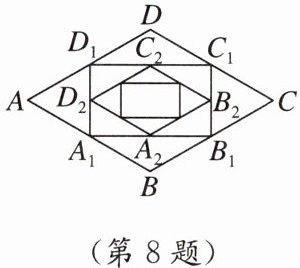
8. ★★ 新视角规律探究题 如图,已知菱形ABCD的边长为2,∠BAD=60°,进行如下操作:第一次,顺次连接菱形ABCD各边的中点,得到四边形$A_1B_1C_1D_1$;第二次,顺次连接四边形$A_1B_1C_1D_1$各边的中点,得到四边形$A_2B_2C_2D_2$;…,如此反复操作下去,则第n次操作后,得到四边形$A_nB_nC_nD_n$的面积是(
A.$\frac{\sqrt{3}}{2^n}$
B.$\frac{\sqrt{3}}{2^{n-1}}$
C.$\frac{\sqrt{3}}{2^{n+1}}$
D.$\frac{\sqrt{3}}{2^{2n}}$
B
)A.$\frac{\sqrt{3}}{2^n}$
B.$\frac{\sqrt{3}}{2^{n-1}}$
C.$\frac{\sqrt{3}}{2^{n+1}}$
D.$\frac{\sqrt{3}}{2^{2n}}$
答案
8.B 【点拨】连接 AC,BD,如图,
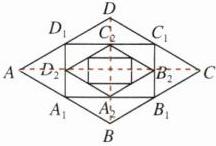 $\because$ 点 $A_1,B_1$ 分别是 AB 和 BC 的中点,点 $C_1,D_1$ 分别是 CD 和 AD 的中点, $\therefore A_1B_1$ 是$△ ABC$ 的中位线,$C_1D_1$ 是$△ ACD$ 的中位线, $\therefore A_1B_1// AC,A_1B_1=\frac{1}{2}AC,C_1D_1// AC,C_1D_1=\frac{1}{2}AC,\therefore A_1B_1// C_1D_1,A_1B_1=C_1D_1,\therefore$ 四边形 $A_1B_1C_1D_1$ 是平行四边形.又$\because$ 四边形 ABCD 是菱形, $\therefore AC⊥ BD.\because A_1,D_1$ 分别是 AB,AD 的中点, $\therefore A_1D_1$ 是$△ ABD$ 的中位线, $\therefore A_1D_1// DB,\therefore A_1D_1⊥ C_1D_1,\therefore ∠ A_1D_1C_1=90°,\therefore$ 四边形 $A_1B_1C_1D_1$ 是矩形. $\because$ 四边形 ABCD 是菱形, $\therefore AD=AB.\because AD_1=\frac{1}{2}AD,AA_1=\frac{1}{2}AB,\therefore AD_1=AA_1$.$\because ∠ DAB=60°,\therefore △ D_1AA_1$ 是等边三角形. 又$\because AA_1=\frac{1}{2}AB=1,\therefore A_1D_1=AA_1=1$. 易得 $C_1D_1=\sqrt{3},\therefore$ 四边形 $A_1B_1C_1D_1$ 的面积为 $\sqrt{3}$; 依次类推, 四边形 $A_2B_2C_2D_2$ 的面积为 $\frac{\sqrt{3}}{2}$, 四边形 $A_3B_3C_3D_3$ 的面积为 $\frac{\sqrt{3}}{2^2},\dots,\therefore$ 四边形 $A_nB_nC_nD_n$ 的面积为 $\frac{\sqrt{3}}{2^{n-1}}$, 故选 B.
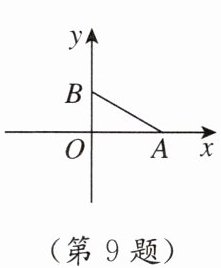
9. ★★ 新考法 转化思想 如图,点A,B分别是x轴和y轴上的动点,且$OA+OB=6$,取AB的中点P,则所有满足条件的点P围成的封闭图形的面积为
18
。答案
9.18 【点拨】设点 P 的坐标为 $(x,y).\because P$ 是 AB 的中点,A 在 x 轴上,B 在 y 轴上, $\therefore A(2x,0),B(0,2y)$,$\therefore OA=|2x|=2|x|,OB=|2y|=2|y|.\because OA+OB=6$,$\therefore |x|+|y|=3$. 如图, 当 $x≥0,y≥0$ 时,点 P 运动的轨迹是线段 CD,其中 $OC=OD=3$, 当 $x≥0,y≤0$ 时,点 P 运动的轨迹是线段 CF,其中 $OC=OF=3$. 当 $x≤0,y≥0$ 时,点 P 运动的轨迹是线段 DE,其中 $OE=OD=3$, 当 $x≤0,y≤0$ 时,点 P 运动的轨迹是线段 EF,其中 $OE=OF=3$.$\because EC⊥ DF,OC=OD=OE=OF,\therefore$ 四边形 CDEF 是正方形,
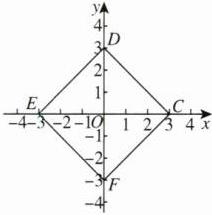 $\therefore$ 所有满足条件的点 P 围成的封闭图形是正方形, $\therefore$ 这个封闭图形的面积为 $\frac{1}{2}×6×6=18$. 故答案为 18.
10. 如图,四边形ABCD为正方形,点E为线段AC上一点,连接DE,过点E作EF⊥DE,交射线BC于点F,以DE,EF为邻边作矩形DEFG,连接CG.
(1)求证:矩形DEFG是正方形;
(2)若AB=2,CE=$\sqrt{2}$,求CG的长度;
(3)当线段DE与正方形ABCD的某条边的夹角是$30°$时,直接写出$∠ EFC$的度数.
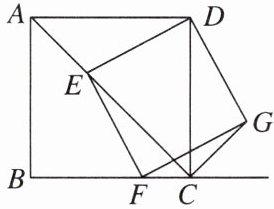
(1)求证:矩形DEFG是正方形;
(2)若AB=2,CE=$\sqrt{2}$,求CG的长度;
(3)当线段DE与正方形ABCD的某条边的夹角是$30°$时,直接写出$∠ EFC$的度数.
答案
10.(1)【证明】作 $EP⊥ CD$ 于点 $P,EQ⊥ BC$ 于点 Q,$\therefore ∠ EQF=∠ EPD=90°$. 由题意知 $∠ DCA=∠ BCA=45°,\therefore EQ=EP,∠ QEC=∠ PEC=45°$.在矩形 DEFG 中, $∠ DEF=90°$,$\therefore ∠ PED+∠ FEC=45°$.又$\because ∠ QEF+∠ FEC=45°,\therefore ∠ QEF=∠ PED$.$\therefore △ EQF≌△ EPD(\mathrm{ASA}).\therefore EF=ED$.$\therefore$ 矩形 DEFG 是正方形.
(2)【解】如图①,
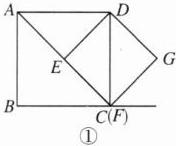 在正方形 ABCD 中,$AB=BC=2,∠ B=90°$,$\therefore AC=\sqrt{2}AB=2\sqrt{2}$.$\because EC=\sqrt{2},\therefore AE=CE$.$\therefore$ 点 F 与点 C 重合,此时$△ DCG$ 是等腰直角三角形,易知 $CG=\sqrt{2}$.
(3)【解】$∠ EFC=120°$ 或 $30°$. 【点拨】① 当 DE 与 AD 的夹角为 $30°$ 时,点 F 在 BC 边上, $∠ ADE=30°$, 如图②
 所示,易得 $∠ ADC=∠ DEF=∠ DCB=90°$, 则 $∠ CDE=90°-30°=60°$. 在四边形 CDEF 中, 由四边形内角和定理得 $∠ EFC=360°-90°-90°-60°=120°$;② 当 DE 与 DC 的夹角为 $30°$ 时,点 F 在 BC 的延长线上, $∠ CDE=30°$, 如图③
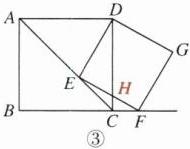 所示,设 EF 与 DC 交于点 H. 易得 $∠ HCF=∠ DEF=90°$. $\because ∠ CHF=∠ EHD,\therefore ∠ EFC=∠ CDE=30°$. 综上所述, $∠ EFC$ 的度数为 $120°$ 或 $30°$.
11. [四川省竞赛] 已知四边形ABCD是正方形,△DEF绕点D旋转(DE<AB),∠EDF=90°,DE=DF,连接AE,CF.
(1)如图①,求证:△ADE≌△CDF;
(2)直线AE与CF相交于点G.
①如图②,BM⊥AG于点M,BN⊥CF于点N,求证:四边形BMGN是正方形;
②如图③,连接BG,若AB=4,DE=2,直接写出在△DEF旋转的过程中,线段BG长度的最小值.
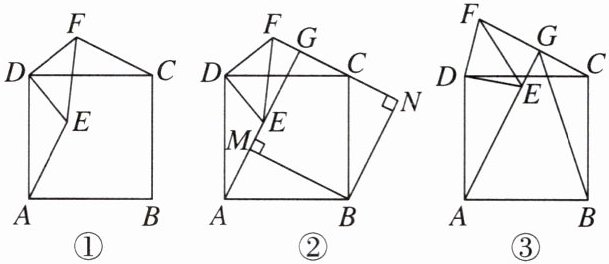
(1)如图①,求证:△ADE≌△CDF;
(2)直线AE与CF相交于点G.
①如图②,BM⊥AG于点M,BN⊥CF于点N,求证:四边形BMGN是正方形;
②如图③,连接BG,若AB=4,DE=2,直接写出在△DEF旋转的过程中,线段BG长度的最小值.
答案
11.(1)【证明】$\because$ 四边形 ABCD 是正方形,$\therefore AD=DC,∠ ADC=90°$.$\because ∠ EDF=90°,\therefore ∠ ADC=∠ EDF$.$\therefore ∠ ADE=∠ CDF$.在$△ ADE$ 和$△ CDF$ 中,$\begin{cases} DA=DC, \\ ∠ ADE=∠ CDF, \\ DE=DF, \end{cases}$$\therefore △ ADE≌△ CDF(\mathrm{SAS})$.
(2)①【证明】设 AG 与 CD 相交于点 P.$\because ∠ ADP=90°,\therefore ∠ DAP+∠ DPA=90°$.$\because △ ADE≌△ CDF,\therefore ∠ DAE=∠ DCF$.又$\because ∠ DPA=∠ GPC$,$\therefore ∠ GPC+∠ GCP=∠ DPA+∠ DAE=90°$.$\therefore ∠ PGN=90°$.又$\because BM⊥ AG,BN⊥ GN$,$\therefore ∠ BMG=∠ BNG=∠ PGN=90°$.$\therefore$ 四边形 BMGN 是矩形. $\therefore ∠ MBN=90°$.$\because$ 四边形 ABCD 是正方形,$\therefore AB=BC,∠ ABC=90°=∠ MBN$.$\therefore ∠ ABM=∠ CBN$.又$\because ∠ AMB=∠ BNC=90°$,$\therefore △ AMB≌△ CNB$.$\therefore MB=NB. \therefore$ 矩形 BMGN 是正方形.
②【解】线段 BG 长度的最小值为 $2\sqrt{6}$.
【点拨】如图,
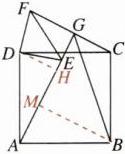 作 $DH⊥ AG$ 交 AG 于点 H,作 $BM⊥ AG$ 交 AG 于点 M. $\because ∠ DHA=∠ AMB=90°,∠ ADH=90°-∠ DAH=∠ BAM,AD=AB,\therefore △ AMB≌△ DHA$.$\therefore BM=AH.\because AH^2=AD^2-DH^2,AD=4$,$\therefore DH$ 最大时,AH 最小. 易知 $DH_{\mathrm{最大值}}=DE=2. \therefore BM_{\mathrm{最小值}}=AH_{\mathrm{最小值}}=2\sqrt{3}$. 由(2)①易知, $△ BGM$ 是等腰直角三角形,$\therefore BG_{\mathrm{最小值}}=\sqrt{2}BM=2\sqrt{6}$.