

 登录
登录
()1. — do you usually go to the old people's home?
—On Saturdays.
A.Why
B.When
C.How
D.What time
—On Saturdays.
A.Why
B.When
C.How
D.What time
答案
B
解析
答语"On Saturdays"是回答泛指的时间。A项Why提问原因,C项How提问方式,均不符合语境;D项What time仅用于提问具体的几点时刻,不能提问星期这类宽泛时间;B项When可提问各类泛指的时间,匹配答语,因此选B。
()2. — is your favourite fruit?
—Apples. An apple a day keeps doctors away.
A.What
B.When
C.Where
D.Who
—Apples. An apple a day keeps doctors away.
A.What
B.When
C.Where
D.Who
答案
A
解析
答语是事物“苹果”,此处要询问“你最喜欢的水果是什么”,What用于对事物提问,When提问时间,Where提问地点,Who提问人物,只有A符合语境。
()3. — does Jim do after he gets up?
—He takes a shower.
A.Who
B.Whose
C.What
D.When
—He takes a shower.
A.Who
B.Whose
C.What
D.When
答案
C
解析
答句回应的是具体做的行为“洗淋浴”,此处需要选询问动作内容的疑问词:A用于询问人物,B用于询问所属关系,C表示“什么”,可用来询问做的具体事情,D用于询问时间,只有C符合语境。
()4. — do you usually come to the bus station?
—At 7:00 a.m.
A.How long
B.How
C.Where
D.What time
—At 7:00 a.m.
A.How long
B.How
C.Where
D.What time
答案
D
解析
答语"At 7:00 a.m."是具体的时间点,对具体时间点提问要用What time。A选项How long用于提问时长或物体长度,B选项How用于提问方式或状态,C选项Where用于提问地点,均不符合语境,因此选D。
()5. — is it now?
—It’s 8:00 a.m.
A.What time
B.What club
C.How many
D.How old
—It’s 8:00 a.m.
A.What time
B.What club
C.How many
D.How old
答案
A
解析
答句回答的是具体的时间“上午8点”,A选项What time用于询问时间,符合语境;B选项What club用于询问俱乐部,C选项How many用于询问可数名词的数量,D选项How old用于询问年龄,均不符合答句内容。
()6. — is the weather like in Shanghai?
— It’s rainy.
A.What
B.How
C.What’s
D.When
— It’s rainy.
A.What
B.How
C.What’s
D.When
答案
A
解析
询问天气的常用固定句型为"What is the weather like...?" 或"How is the weather...?"。本题句中已经出现is和like,B选项How引导询问天气的句中不能搭配like,C选项What's等同于What is,会和句中已有的is重复,D选项When用于询问时间,不符合语境,因此选A。
()7. — do you go to school?
—At 7:30 a.m.
A.What
B.What time
C.How
D.Where
—At 7:30 a.m.
A.What
B.What time
C.How
D.Where
答案
B
解析
答语是具体时间点At 7:30 a.m.,A选项What用于询问事物,C选项How用于询问方式,D选项Where用于询问地点,只有B选项What time用于询问具体时间,符合题意。
()8. — do you usually get up in the morning?
—At six o'clock.
A.What
B.Where
C.When
D.Why
—At six o'clock.
A.What
B.Where
C.When
D.Why
答案
C
解析
答语是具体时间点“在六点”,说明问句是询问时间。A选项用于询问事物,B选项用于询问地点,C选项用于询问时间,D选项用于询问原因,符合题意的是C。
探究点1 weekend 的用法
weekend 意为“周末”,常用固定搭配如下。
on weekends = on the weekend 在周末(美式英语)
at weekends = at the weekend 在周末(英式英语)
How do you usually spend your weekend?
你通常如何度过你的周末?
I usually visit my grandparents at weekends.
我通常在周末去看望我的外祖父母。
情境应用
1. We don't go to school at .
( weekend )
2. We can help them with their study . (在周末)
weekend 意为“周末”,常用固定搭配如下。
on weekends = on the weekend 在周末(美式英语)
at weekends = at the weekend 在周末(英式英语)
How do you usually spend your weekend?
你通常如何度过你的周末?
I usually visit my grandparents at weekends.
我通常在周末去看望我的外祖父母。
情境应用
1. We don't go to school at .
( weekend )
2. We can help them with their study . (在周末)
答案
1. weekends / the weekend
2. on weekends / at weekends
2. on weekends / at weekends
解析
本题考查weekend的相关固定搭配用法:
1. 第一空前已有介词at,根据知识点给出的搭配规则,at weekends或者at the weekend都表示“在周末”,符合“我们周末不上学”的语境,结合提示词weekend,这两个表达都符合要求。
2. 第二题要求填写含义为“在周末”的两个单词的短语,符合要求的常用搭配有美式用法on weekends,或者英式用法at weekends,都契合句子语义。
1. 第一空前已有介词at,根据知识点给出的搭配规则,at weekends或者at the weekend都表示“在周末”,符合“我们周末不上学”的语境,结合提示词weekend,这两个表达都符合要求。
2. 第二题要求填写含义为“在周末”的两个单词的短语,符合要求的常用搭配有美式用法on weekends,或者英式用法at weekends,都契合句子语义。
探究点2 while 的用法
while
名词,意为“一段时间;一会儿”
for a while 一会儿
after a while 过了一会儿
in a while 不久;马上
连词,意为“在……期间;当……的时候”,引导时间状语从句,表示主句的动作是在从句动作发生的过程中发生的,或者主从句的动作同时进行
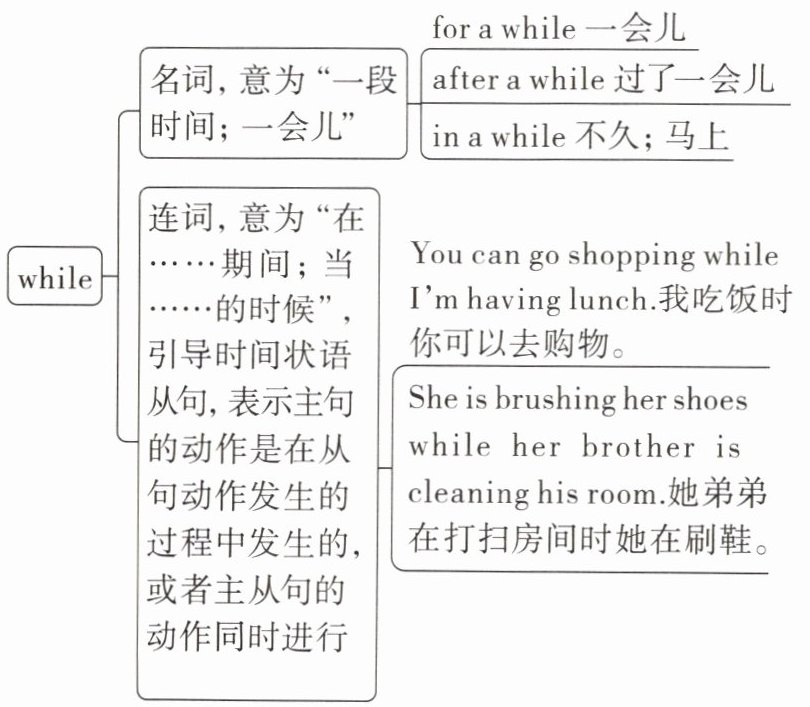
You can go shopping while I’m having lunch.我吃饭时你可以去购物。
She is brushing her shoes while her brother is cleaning his room.她弟弟在打扫房间时她在刷鞋。
情境应用
1. After dinner I can watch TV .(一会儿)
2. Don’t look at your phone you are crossing(穿越) the road.(当……的时候)
while
名词,意为“一段时间;一会儿”
for a while 一会儿
after a while 过了一会儿
in a while 不久;马上
连词,意为“在……期间;当……的时候”,引导时间状语从句,表示主句的动作是在从句动作发生的过程中发生的,或者主从句的动作同时进行
You can go shopping while I’m having lunch.我吃饭时你可以去购物。
She is brushing her shoes while her brother is cleaning his room.她弟弟在打扫房间时她在刷鞋。
情境应用
1. After dinner I can watch TV .(一会儿)
2. Don’t look at your phone you are crossing(穿越) the road.(当……的时候)
答案
1. for a while
2. while
2. while
解析
1. 第一题需要填入含义为“一会儿”的短语,根据知识点中while作名词的固定搭配,for a while意为“一会儿”,放在句中作时间状语,符合句子语境。
2. 第二题需要填入含义为“当……的时候”的词,空后是描述动作正在发生的时间状语从句,用连词while引导该从句,符合while的用法规则,语义通顺。
2. 第二题需要填入含义为“当……的时候”的词,空后是描述动作正在发生的时间状语从句,用连词while引导该从句,符合while的用法规则,语义通顺。
