

 登录
登录
4 Read the interview. 阅读采访。
Journalist: Sara! Huge congratulations on the award! The teahouse you designed has such a peaceful feeling. Did you always want to be a designer?
Sara: Thank you! Actually, I started as a painter. But I wanted beauty to be part of people’s everyday lives — not just something on the wall. So I switched to interior design.
Journalist: That’s a big change! Do you regret studying painting in college?
Sara: Not at all. I loved painting — it taught me how light shapes a space and how colours work together. Now, I handle almost everything in a project — from space planning and material selection to colour schemes (配色方案), lighting and even furniture.
Journalist: You’ve worked on all kinds of projects. How is being an interior designer different from being a painter?
Sara: As a painter, I worked alone; it was personal and quiet. Now, I work with people and for people. My work becomes part of their daily lives — and that’s deeply meaningful.
Journalist: What are some challenges in your work?
Sara: Changing careers wasn’t easy — I’ve had to improve my skills. AI also brings challenges. Some people worry it might replace us. But I don’t think so. Design isn’t just about looks; it’s about understanding people’s emotions and behaviour. AI can’t offer that human touch.
Journalist: That’s good to hear! What would you tell teens who aren’t sure about their future careers?
Sara: Don’t be afraid to change paths if needed. My art training became my strength. Stay curious and keep learning. Also, ask yourself: How can I use my talents to make life better for others? And remember — develop your own style. You can’t please everyone, and that’s okay. The future belongs to those who bring both knowledge and heart to what they do.
Journalist: Thank you. That’s truly inspiring.
Sara: My pleasure. Great spaces aren’t just seen. They’re felt.
4-1 Make notes about the interview. 根据采访补全笔记。
Job
• In the past: A painter
• At present: (1)
Responsibilities
• (2)
• Working on (3)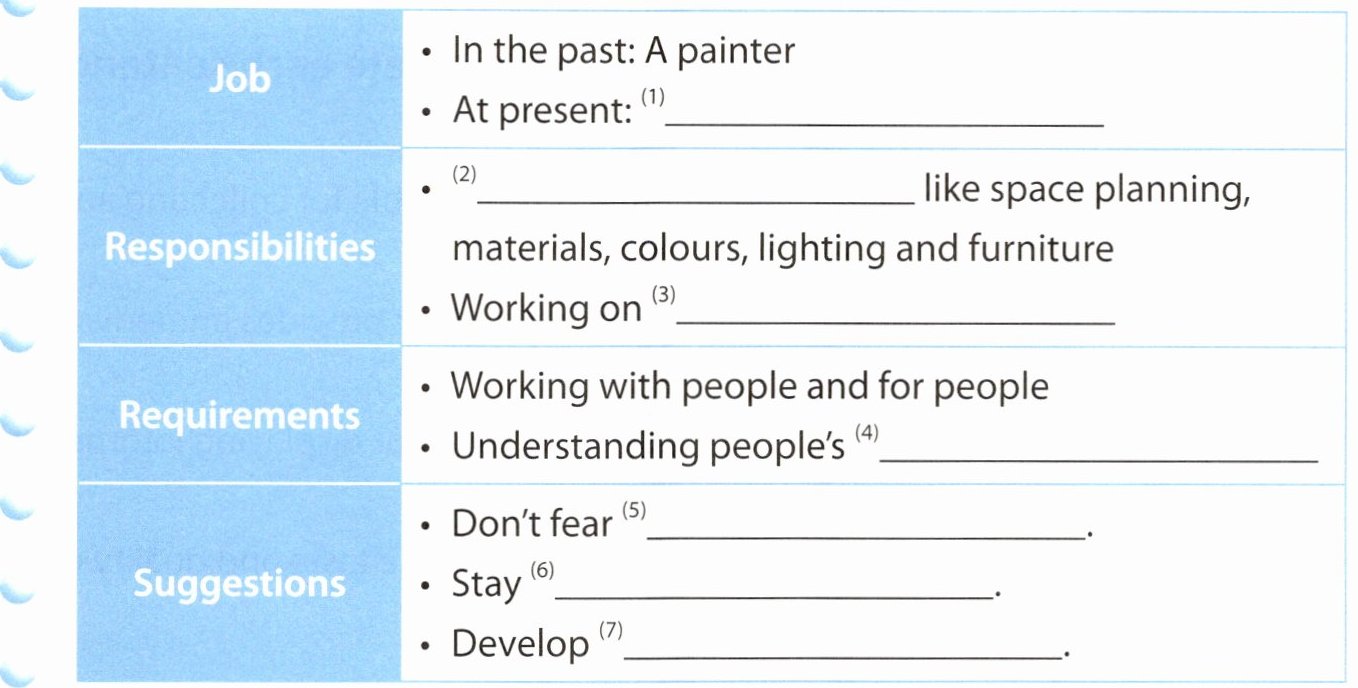
Requirements
• Working with people and for people
• Understanding people’s (4)
Suggestions
• Don’t fear (5)
• Stay (6)
• Develop (7)
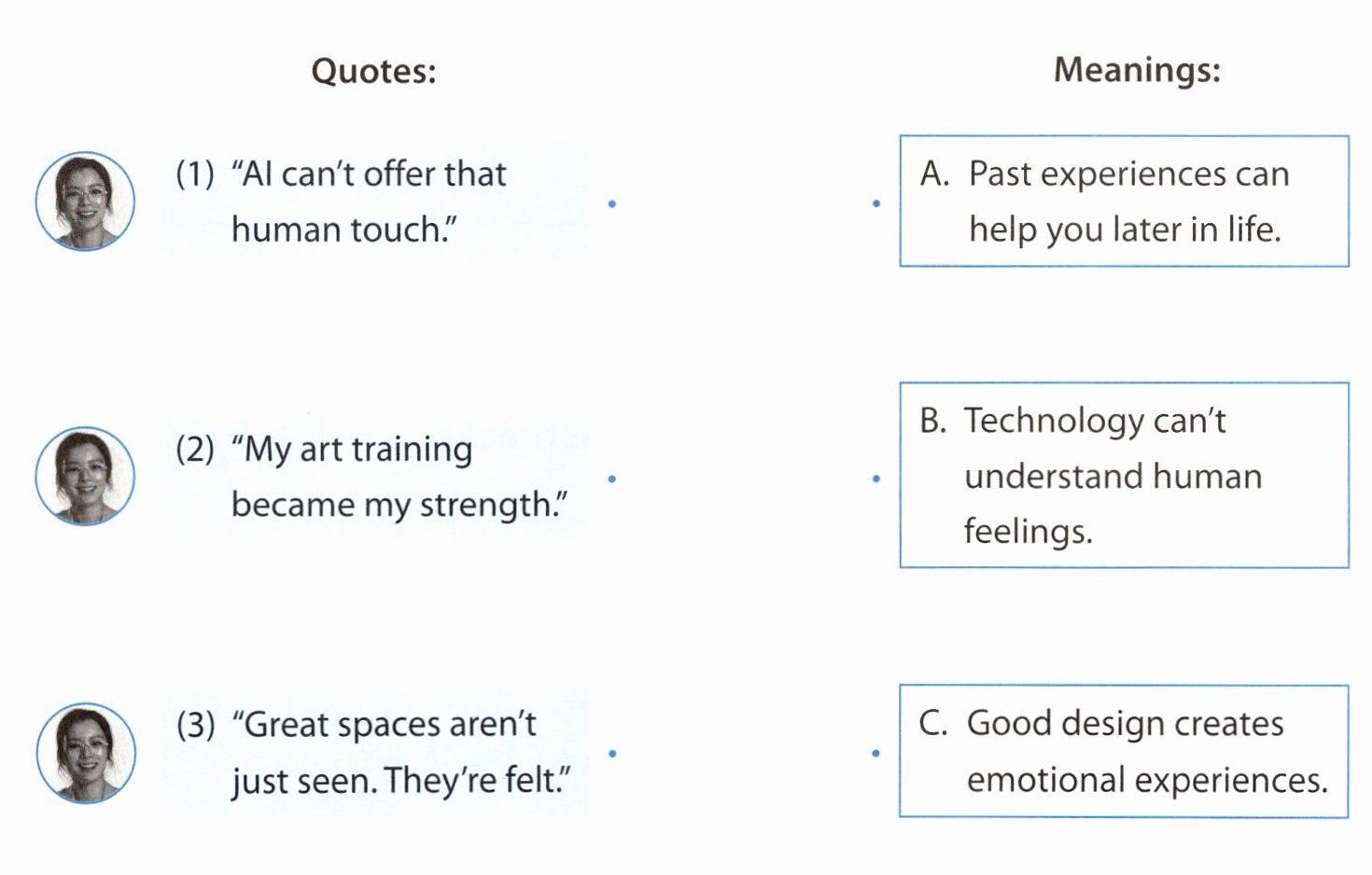
4-2 Match the following quotes by Sara with their meanings. 将下列萨拉的引言与其含义配对。
Journalist: Sara! Huge congratulations on the award! The teahouse you designed has such a peaceful feeling. Did you always want to be a designer?
Sara: Thank you! Actually, I started as a painter. But I wanted beauty to be part of people’s everyday lives — not just something on the wall. So I switched to interior design.
Journalist: That’s a big change! Do you regret studying painting in college?
Sara: Not at all. I loved painting — it taught me how light shapes a space and how colours work together. Now, I handle almost everything in a project — from space planning and material selection to colour schemes (配色方案), lighting and even furniture.
Journalist: You’ve worked on all kinds of projects. How is being an interior designer different from being a painter?
Sara: As a painter, I worked alone; it was personal and quiet. Now, I work with people and for people. My work becomes part of their daily lives — and that’s deeply meaningful.
Journalist: What are some challenges in your work?
Sara: Changing careers wasn’t easy — I’ve had to improve my skills. AI also brings challenges. Some people worry it might replace us. But I don’t think so. Design isn’t just about looks; it’s about understanding people’s emotions and behaviour. AI can’t offer that human touch.
Journalist: That’s good to hear! What would you tell teens who aren’t sure about their future careers?
Sara: Don’t be afraid to change paths if needed. My art training became my strength. Stay curious and keep learning. Also, ask yourself: How can I use my talents to make life better for others? And remember — develop your own style. You can’t please everyone, and that’s okay. The future belongs to those who bring both knowledge and heart to what they do.
Journalist: Thank you. That’s truly inspiring.
Sara: My pleasure. Great spaces aren’t just seen. They’re felt.
4-1 Make notes about the interview. 根据采访补全笔记。
Job
• In the past: A painter
• At present: (1)
An interior designer
Responsibilities
• (2)
Handling (almost) everything (in a project)
like space planning, materials, colours, lighting and furniture• Working on (3)
all kinds of projects
Requirements
• Working with people and for people
• Understanding people’s (4)
emotions and behaviour
Suggestions
• Don’t fear (5)
changing paths
.• Stay (6)
curious and keep learning
.• Develop (7)
your own style
.4-2 Match the following quotes by Sara with their meanings. 将下列萨拉的引言与其含义配对。
答案
(1) An interior designer (2) Handling (almost) everything (in a project)(3) all kinds of projects (4) emotions and behaviour (5) changing paths(6) curious and keep learning (7) your own style
(1) B (2) A (3) C
(1) B (2) A (3) C
解析
【分析】
本题分为两部分,4-1要求依据采访内容补全笔记,需精准定位原文对应细节;4-2为引言与含义配对,需匹配引言的核心含义与原文表述,解题核心是仔细阅读采访文本,找到每个问题对应的原文关键信息,确保提取内容准确。
【解析】
4-1 补全笔记:
(1) 由原文Sara的表述“So I switched to interior design”可知,她现在的职业是室内设计师,故填An interior designer;
(2) 原文提到“Now, I handle almost everything in a project — from space planning and material selection to colour schemes, lighting and even furniture”,对应职责内容,故填Handling (almost) everything (in a project);
(3) 原文Journalist询问“You’ve worked on all kinds of projects”,说明她的工作涉及各类项目,故填all kinds of projects;
(4) 原文Sara指出设计的核心是“understanding people’s emotions and behaviour”,故填emotions and behaviour;
(5) 原文给青少年的建议中提到“Don’t be afraid to change paths”,故填changing paths;
(6) 原文建议“Stay curious and keep learning”,故填curious and keep learning;
(7) 原文建议“develop your own style”,故填your own style;
4-2 配对:根据引言的核心含义与原文对应内容,得出配对结果为(1) B (2) A (3) C。
【答案】
4-1 (1) An interior designer (2) Handling (almost) everything (in a project) (3) all kinds of projects (4) emotions and behaviour (5) changing paths (6) curious and keep learning (7) your own style
4-2 (1) B (2) A (3) C
【知识点】
英语阅读理解、信息提取
【点评】
本题考查学生从采访文本中定位并提取关键信息的能力,属于基础阅读题型,需仔细梳理原文与问题的对应关系,难度适中。
【难度系数】
0.6
本题分为两部分,4-1要求依据采访内容补全笔记,需精准定位原文对应细节;4-2为引言与含义配对,需匹配引言的核心含义与原文表述,解题核心是仔细阅读采访文本,找到每个问题对应的原文关键信息,确保提取内容准确。
【解析】
4-1 补全笔记:
(1) 由原文Sara的表述“So I switched to interior design”可知,她现在的职业是室内设计师,故填An interior designer;
(2) 原文提到“Now, I handle almost everything in a project — from space planning and material selection to colour schemes, lighting and even furniture”,对应职责内容,故填Handling (almost) everything (in a project);
(3) 原文Journalist询问“You’ve worked on all kinds of projects”,说明她的工作涉及各类项目,故填all kinds of projects;
(4) 原文Sara指出设计的核心是“understanding people’s emotions and behaviour”,故填emotions and behaviour;
(5) 原文给青少年的建议中提到“Don’t be afraid to change paths”,故填changing paths;
(6) 原文建议“Stay curious and keep learning”,故填curious and keep learning;
(7) 原文建议“develop your own style”,故填your own style;
4-2 配对:根据引言的核心含义与原文对应内容,得出配对结果为(1) B (2) A (3) C。
【答案】
4-1 (1) An interior designer (2) Handling (almost) everything (in a project) (3) all kinds of projects (4) emotions and behaviour (5) changing paths (6) curious and keep learning (7) your own style
4-2 (1) B (2) A (3) C
【知识点】
英语阅读理解、信息提取
【点评】
本题考查学生从采访文本中定位并提取关键信息的能力,属于基础阅读题型,需仔细梳理原文与问题的对应关系,难度适中。
【难度系数】
0.6
