

 登录
登录
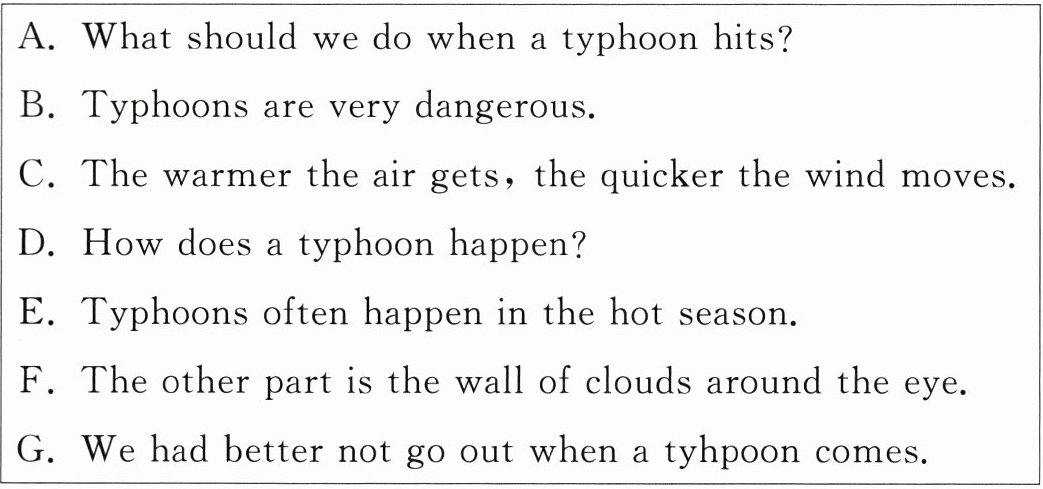
六、信息还原
Typhoons are some of the worst storms, usually around the Pacific Ocean and the South China Sea. Most happen in July, August and September.
______ 1 ______ When lots of sea water gets hot in the summer sun, it evaporates(蒸发)into the air. This makes the air hotter. When the air gets warm enough, it starts to move higher up into the sky. Then cooler air around it rushes in. It fills the space that is left. After the air gets warmer, it starts to move quickly, making wind. The wind goes in circles and it keeps moving higher in the sky. ______ 2 ______ And when the wind moves faster than 30 metres a second, a typhoon begins.
A typhoon has two parts. One is called the “eye”. In the eye, the wind does not move so fast. 3 This is where the strongest winds and hardest rain are.
4 In November 2013, Typhoon Haiyan killed around 6,000 people in the Philippines. More people were badly hurt and some others were missing. 5
• Stay inside. Close all the windows and stay away from them.
• Try to bring all of your things inside. Strong winds could even blow away your bikes!
• Listen to the radio or TV for important information.
• If you're told to go to a safer place, do it right away.
Typhoons are some of the worst storms, usually around the Pacific Ocean and the South China Sea. Most happen in July, August and September.
______ 1 ______ When lots of sea water gets hot in the summer sun, it evaporates(蒸发)into the air. This makes the air hotter. When the air gets warm enough, it starts to move higher up into the sky. Then cooler air around it rushes in. It fills the space that is left. After the air gets warmer, it starts to move quickly, making wind. The wind goes in circles and it keeps moving higher in the sky. ______ 2 ______ And when the wind moves faster than 30 metres a second, a typhoon begins.
A typhoon has two parts. One is called the “eye”. In the eye, the wind does not move so fast. 3 This is where the strongest winds and hardest rain are.
4 In November 2013, Typhoon Haiyan killed around 6,000 people in the Philippines. More people were badly hurt and some others were missing. 5
• Stay inside. Close all the windows and stay away from them.
• Try to bring all of your things inside. Strong winds could even blow away your bikes!
• Listen to the radio or TV for important information.
• If you're told to go to a safer place, do it right away.
答案
1.D 2.C 3.F 4.B 5.A
解析
【分析】本题为信息还原题,需梳理文章各段落的逻辑关系,结合前后文内容匹配合适的句子:第1空所在段落介绍台风的形成过程,需对应询问台风如何发生的句子;第2空衔接“空气变暖形成风”和“风速达标形成台风”,需体现温度与风速的关系;第3空对应台风的两部分结构,需补充另一部分的描述;第4空后举例台风造成伤亡,需对应说明台风危险的句子;第5空后是台风来临时的应对措施,需对应询问该做什么的句子。
【解析】1. 第一段围绕台风的形成展开,因此第1空选D(How does a typhoon happen?),符合段落主题;2. 前文提到空气变暖形成风,后文说明风速超30米/秒形成台风,中间需衔接温度与风速的关联,因此第2空选C(The warmer the air gets, the quicker the wind moves.);3. 前文提到台风有两部分,一部分是“eye”,因此第3空选F(The other part is the wall of clouds around the eye.),补充另一部分的描述;4. 后文举例台风造成大量人员伤亡,说明台风的危险性,因此第4空选B(Typhoons are very dangerous.);5. 后文是台风来临时的具体应对措施,因此第5空选A(What should we do when a typhoon hits?),引出下文的应对方法。
【答案】1.D 2.C 3.F 4.B 5.A
【知识点】信息还原、科普知识(台风)
【点评】本题考查对文章逻辑和上下文关联的理解,需结合段落主题和前后文内容匹配句子,难度适中,适合中等水平学生完成。
【难度系数】0.5
【解析】1. 第一段围绕台风的形成展开,因此第1空选D(How does a typhoon happen?),符合段落主题;2. 前文提到空气变暖形成风,后文说明风速超30米/秒形成台风,中间需衔接温度与风速的关联,因此第2空选C(The warmer the air gets, the quicker the wind moves.);3. 前文提到台风有两部分,一部分是“eye”,因此第3空选F(The other part is the wall of clouds around the eye.),补充另一部分的描述;4. 后文举例台风造成大量人员伤亡,说明台风的危险性,因此第4空选B(Typhoons are very dangerous.);5. 后文是台风来临时的具体应对措施,因此第5空选A(What should we do when a typhoon hits?),引出下文的应对方法。
【答案】1.D 2.C 3.F 4.B 5.A
【知识点】信息还原、科普知识(台风)
【点评】本题考查对文章逻辑和上下文关联的理解,需结合段落主题和前后文内容匹配句子,难度适中,适合中等水平学生完成。
【难度系数】0.5
七、首字母短文填空
How to Protect Ourselves: Essential Tips for Teenagers
Danger is never as far away as we might think. Self-protection is one of the most important skills for teenagers as we are still growing and lack enough life $\underline{e\ 1}$ to face dangers wisely. The
world around us can be full of unexpected risks, both offline and online, so $\underline{l\ 2}$ to protect ourselves is a necessary skill for safe growth. But how can we protect ourselves? Here are some practical tips.
First, stay $\underline{s\ 3}$ when going out. Try not to walk alone at night. If you need to be out late, always stay in busy, well-lit places like shopping streets or near streetlights. Also, tell your parents $\underline{e\ 4}$ where you are and when you'll be home.
$\underline{S\ 5}$, be careful with online privacy(隐私). Never share personal information like home addresses or school names on social media, as it may $\underline{l\ 6}$ to unexpected troubles.
Third, stay calm in emergencies. Memorize important phone numbers, like 110 in China, and don't hesitate(犹豫) to call for help $\underline{i\ 7}$ you feel unsafe. If a stranger follows you, run to a store or restaurant and ask staff for help. In our school's safety drill, we practised shouting "Help! This person is following me!" to get others' $\underline{a\ 8}$.
To improve self-protection awareness, we can start by learning safety knowledge $\underline{f\ 9}$ parents and teachers, such as first-aid skills and traffic rules. We should also pay attention to warning signs in public places and $\underline{a\ 10}$ risky behaviours.
Remember: Being careful isn't about being scared—it's about being smart. Every small step you take to protect yourself makes a big difference. Let's grow up safely by protecting ourselves wisely!
1.
6.
How to Protect Ourselves: Essential Tips for Teenagers
Danger is never as far away as we might think. Self-protection is one of the most important skills for teenagers as we are still growing and lack enough life $\underline{e\ 1}$ to face dangers wisely. The
world around us can be full of unexpected risks, both offline and online, so $\underline{l\ 2}$ to protect ourselves is a necessary skill for safe growth. But how can we protect ourselves? Here are some practical tips.
First, stay $\underline{s\ 3}$ when going out. Try not to walk alone at night. If you need to be out late, always stay in busy, well-lit places like shopping streets or near streetlights. Also, tell your parents $\underline{e\ 4}$ where you are and when you'll be home.
$\underline{S\ 5}$, be careful with online privacy(隐私). Never share personal information like home addresses or school names on social media, as it may $\underline{l\ 6}$ to unexpected troubles.
Third, stay calm in emergencies. Memorize important phone numbers, like 110 in China, and don't hesitate(犹豫) to call for help $\underline{i\ 7}$ you feel unsafe. If a stranger follows you, run to a store or restaurant and ask staff for help. In our school's safety drill, we practised shouting "Help! This person is following me!" to get others' $\underline{a\ 8}$.
To improve self-protection awareness, we can start by learning safety knowledge $\underline{f\ 9}$ parents and teachers, such as first-aid skills and traffic rules. We should also pay attention to warning signs in public places and $\underline{a\ 10}$ risky behaviours.
Remember: Being careful isn't about being scared—it's about being smart. Every small step you take to protect yourself makes a big difference. Let's grow up safely by protecting ourselves wisely!
1.
experience
2. learning
3. safe
4. exactly
5. Second
6.
lead
7. if
8. attention
9. from
10. avoid
答案
1. experience 2. learning 3. safe 4. exactly
5. Second 6. lead 7. if 8. attention 9. from
10. avoid
5. Second 6. lead 7. if 8. attention 9. from
10. avoid
解析
【分析】做首字母短文填空时,需先通读全文把握主旨(本文围绕青少年自我保护的技巧展开),再逐句分析每个空的语境、搭配及首字母提示,结合词汇知识确定正确单词。具体思路:1. 结合“缺乏足够的生活______面对危险”及首字母e,确定对应词汇;2. 分析句子结构,判断空格在句中作主语,结合首字母l确定形式;3. 依据固定搭配及语境确定形容词;4. 修饰地点状语需副词,结合首字母e确定;5. 对应前文First,确定序数词;6. 结合固定搭配lead to及语境确定动词;7. 分析从句逻辑关系,确定连词;8. 结合固定搭配get sb's attention确定名词;9. 结合短语learn from确定介词;10. 结合语境“避免危险行为”及首字母a确定动词。
【解析】1. 语境为“缺乏足够的生活经验来明智面对危险”,首字母e对应名词experience(经验),符合语义;2. 空格在句中作主语,需动名词形式,首字母l对应learning(学习),符合“学习保护自己是必要技能”的语义;3. 固定搭配stay safe(保持安全),首字母s对应形容词safe,符合外出时的要求;4. 修饰地点状语where you are需副词,首字母e对应exactly(确切地),符合告知父母位置的语境;5. 前文用First(第一),此处表第二点,首字母S对应Second(第二),符合逻辑;6. 固定搭配lead to(导致),首字母l对应动词lead,符合“可能导致意外麻烦”的语义;7. 空格引导条件状语从句,首字母i对应连词if(如果),符合“感觉不安全时求助”的逻辑;8. 固定搭配get others' attention(引起他人注意),首字母a对应名词attention,符合呼救的目的;9. 短语learn from(从……学习),首字母f对应介词from,符合向父母老师学习安全知识的语境;10. 语境为“避免危险行为”,首字母a对应动词avoid(避免),符合安全要求。
【答案】1. experience 2. learning 3. safe 4. exactly 5. Second 6. lead 7. if 8. attention 9. from 10. avoid
【知识点】首字母填空、词汇运用、固定搭配
【点评】本文以青少年自我保护为主题,通过首字母填空考查学生对语境的理解、词汇及固定搭配的掌握,内容贴近学生生活,兼具知识性与实用性,有助于提升学生的安全意识。
【难度系数】0.6
【解析】1. 语境为“缺乏足够的生活经验来明智面对危险”,首字母e对应名词experience(经验),符合语义;2. 空格在句中作主语,需动名词形式,首字母l对应learning(学习),符合“学习保护自己是必要技能”的语义;3. 固定搭配stay safe(保持安全),首字母s对应形容词safe,符合外出时的要求;4. 修饰地点状语where you are需副词,首字母e对应exactly(确切地),符合告知父母位置的语境;5. 前文用First(第一),此处表第二点,首字母S对应Second(第二),符合逻辑;6. 固定搭配lead to(导致),首字母l对应动词lead,符合“可能导致意外麻烦”的语义;7. 空格引导条件状语从句,首字母i对应连词if(如果),符合“感觉不安全时求助”的逻辑;8. 固定搭配get others' attention(引起他人注意),首字母a对应名词attention,符合呼救的目的;9. 短语learn from(从……学习),首字母f对应介词from,符合向父母老师学习安全知识的语境;10. 语境为“避免危险行为”,首字母a对应动词avoid(避免),符合安全要求。
【答案】1. experience 2. learning 3. safe 4. exactly 5. Second 6. lead 7. if 8. attention 9. from 10. avoid
【知识点】首字母填空、词汇运用、固定搭配
【点评】本文以青少年自我保护为主题,通过首字母填空考查学生对语境的理解、词汇及固定搭配的掌握,内容贴近学生生活,兼具知识性与实用性,有助于提升学生的安全意识。
【难度系数】0.6
