

 登录
登录
一、阅读理解。
阅读下面三篇语言材料,然后按文后要求做题。
A
Money is more than just a tool to buy things. It's a part of our daily life and carries memories and culture.
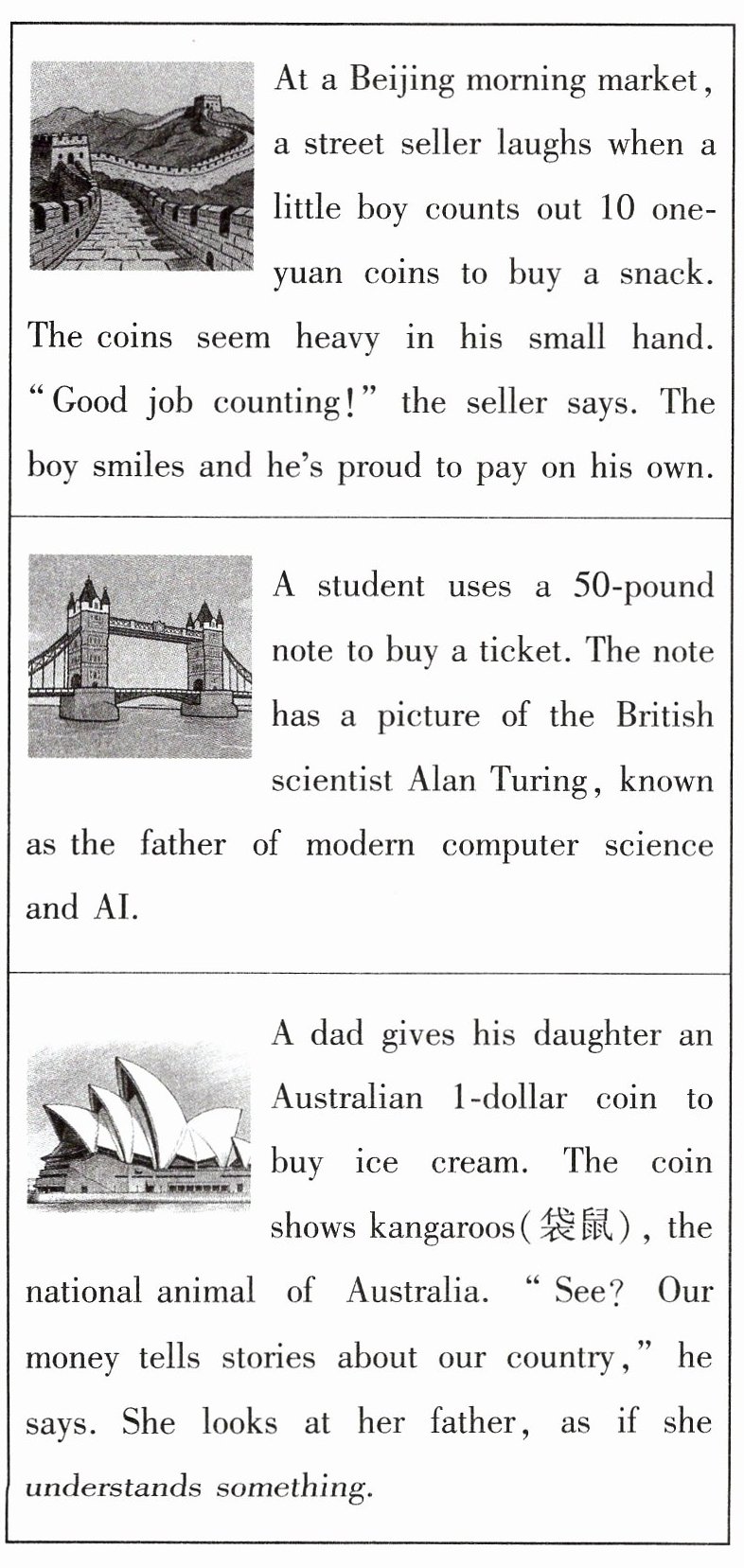
根据材料内容选择最佳答案。
(
A. One yuan.
B. 50 yuan.
C. Ten yuan.
D. 1,000 yuan.
(
A. An animal.
B. A famous scientist.
C. A mountain.
D. A building.
(
A. Australian dollar.
B. American dollar.
C. Pound.
D. Renminbi.
(
A. Money in different countries looks the same.
B. Only adults can use money.
C. Money is connected to culture.
D. Kids don't need to learn about money.
(
A. To introduce different money.
B. To show that money is more than just a tool for buying things.
C. To tell stories about kids and money.
D. To compare money in different countries.
阅读下面三篇语言材料,然后按文后要求做题。
A
Money is more than just a tool to buy things. It's a part of our daily life and carries memories and culture.
根据材料内容选择最佳答案。
(
C
)1. How much did the little boy pay for the snack at a Beijing morning market?A. One yuan.
B. 50 yuan.
C. Ten yuan.
D. 1,000 yuan.
(
B
)2. What's the picture on a 50-pound note?A. An animal.
B. A famous scientist.
C. A mountain.
D. A building.
(
A
)3. Which kind of money do people usually use in Australia?A. Australian dollar.
B. American dollar.
C. Pound.
D. Renminbi.
(
C
)4. What can we infer from the text?A. Money in different countries looks the same.
B. Only adults can use money.
C. Money is connected to culture.
D. Kids don't need to learn about money.
(
B
)5. What is the writer's purpose of writing this text?A. To introduce different money.
B. To show that money is more than just a tool for buying things.
C. To tell stories about kids and money.
D. To compare money in different countries.
答案
1. C 由文中“…… when a little boy counts out 10 one-yuan coins to buy a snack.”一句可知,小男孩数出10个一元硬币买小吃。故选C。
2. B 由文中“The note has a picture of the British scientist ... father of modern computer science and AI”可知,50英镑钞票上印的是一位著名科学家的头像。故选B。
3. A 由文中“A dad gives his daughter an Australian 1-dollar coin to buy ice cream. The coin shows kangaroos(袋鼠), the national symbol of Australia.”可知,澳大利亚元是澳大利亚的货币。故选A。
4. C 文中提到英镑上的科学家图案、澳大利亚元上的袋鼠图案,均体现货币与文化的联系,A、B、D与文意不符。故选C。
5. B 文章第一段即已表明作者的写作目的——货币不仅仅是购物工具。故选B。
2. B 由文中“The note has a picture of the British scientist ... father of modern computer science and AI”可知,50英镑钞票上印的是一位著名科学家的头像。故选B。
3. A 由文中“A dad gives his daughter an Australian 1-dollar coin to buy ice cream. The coin shows kangaroos(袋鼠), the national symbol of Australia.”可知,澳大利亚元是澳大利亚的货币。故选A。
4. C 文中提到英镑上的科学家图案、澳大利亚元上的袋鼠图案,均体现货币与文化的联系,A、B、D与文意不符。故选C。
5. B 文章第一段即已表明作者的写作目的——货币不仅仅是购物工具。故选B。
解析
【分析】
这是一篇介绍不同国家货币的说明类阅读理解,解题时可以先标注每道题干的关键词,再回到原文对应段落定位信息:1-3题都是细节理解题,直接找到原文对应语句比对选项就能得出答案;第4题推理判断题可以用排除法,把和原文内容明显矛盾的选项逐一排除,剩下的就是符合文意的正确选项;第5题主旨大意题直接找文章开篇的主题句,就能快速锁定作者的写作目的。
【解析】
1. 定位文章第一段内容"a little boy counts out 10 one-yuan coins to buy a snack",小男孩数出10枚1元硬币买小吃,总金额为10元,对应选项C。
2. 定位文章第二段内容"The note has a picture of the British scientist Alan Turing, known as the father of modern computer science and AI",50英镑纸币上的图案是著名科学家阿兰·图灵,对应选项B。
3. 定位文章第三段内容"A dad gives his daughter an Australian 1-dollar coin to buy ice cream",可知澳大利亚日常使用的货币是澳元,对应选项A。
4. 推理判断:选项A“不同国家的货币外观一致”和文中三种货币图案完全不同的内容矛盾;选项B“只有成年人可以使用货币”和文中小男孩、学生、小女孩都在使用货币的情节矛盾;选项D“孩子不需要了解货币”和文中父亲给女儿讲解货币上的国家故事、小男孩独立付钱的内容矛盾;只有选项C“货币和文化相关”,可以通过英镑印科学家、澳元印澳大利亚国宝袋鼠的细节得到佐证,符合文意。
5. 文章开篇直接点明核心观点"Money is more than just a tool to buy things. It's a part of our daily life and carries memories and culture",后文列举三个不同国家的货币相关的小故事,都是为了支撑这个核心观点,因此作者的写作目的是说明货币不只是用来购物的工具,对应选项B。
【答案】
1. C 2. B 3. A 4. C 5. B
【知识点】
阅读理解细节定位,主旨大意判断,货币文化常识
【点评】
本篇阅读整体难度偏低,绝大多数题目都可以通过直接回原文定位信息得出答案,仅最后两道题需要结合全文内容做简单推理和主旨提炼,既能锻炼学生快速抓取文本关键信息的阅读能力,也能帮助学生了解不同国家货币承载的独特文化内涵。
【难度系数】
0.8
这是一篇介绍不同国家货币的说明类阅读理解,解题时可以先标注每道题干的关键词,再回到原文对应段落定位信息:1-3题都是细节理解题,直接找到原文对应语句比对选项就能得出答案;第4题推理判断题可以用排除法,把和原文内容明显矛盾的选项逐一排除,剩下的就是符合文意的正确选项;第5题主旨大意题直接找文章开篇的主题句,就能快速锁定作者的写作目的。
【解析】
1. 定位文章第一段内容"a little boy counts out 10 one-yuan coins to buy a snack",小男孩数出10枚1元硬币买小吃,总金额为10元,对应选项C。
2. 定位文章第二段内容"The note has a picture of the British scientist Alan Turing, known as the father of modern computer science and AI",50英镑纸币上的图案是著名科学家阿兰·图灵,对应选项B。
3. 定位文章第三段内容"A dad gives his daughter an Australian 1-dollar coin to buy ice cream",可知澳大利亚日常使用的货币是澳元,对应选项A。
4. 推理判断:选项A“不同国家的货币外观一致”和文中三种货币图案完全不同的内容矛盾;选项B“只有成年人可以使用货币”和文中小男孩、学生、小女孩都在使用货币的情节矛盾;选项D“孩子不需要了解货币”和文中父亲给女儿讲解货币上的国家故事、小男孩独立付钱的内容矛盾;只有选项C“货币和文化相关”,可以通过英镑印科学家、澳元印澳大利亚国宝袋鼠的细节得到佐证,符合文意。
5. 文章开篇直接点明核心观点"Money is more than just a tool to buy things. It's a part of our daily life and carries memories and culture",后文列举三个不同国家的货币相关的小故事,都是为了支撑这个核心观点,因此作者的写作目的是说明货币不只是用来购物的工具,对应选项B。
【答案】
1. C 2. B 3. A 4. C 5. B
【知识点】
阅读理解细节定位,主旨大意判断,货币文化常识
【点评】
本篇阅读整体难度偏低,绝大多数题目都可以通过直接回原文定位信息得出答案,仅最后两道题需要结合全文内容做简单推理和主旨提炼,既能锻炼学生快速抓取文本关键信息的阅读能力,也能帮助学生了解不同国家货币承载的独特文化内涵。
【难度系数】
0.8
