

 登录
登录
二、听下面一篇短文。根据短文内容完成下面的表格,每空一词。短文读两遍。
Time
Sunday 1.
In the library
Some 2.
In the park
Some people are 3.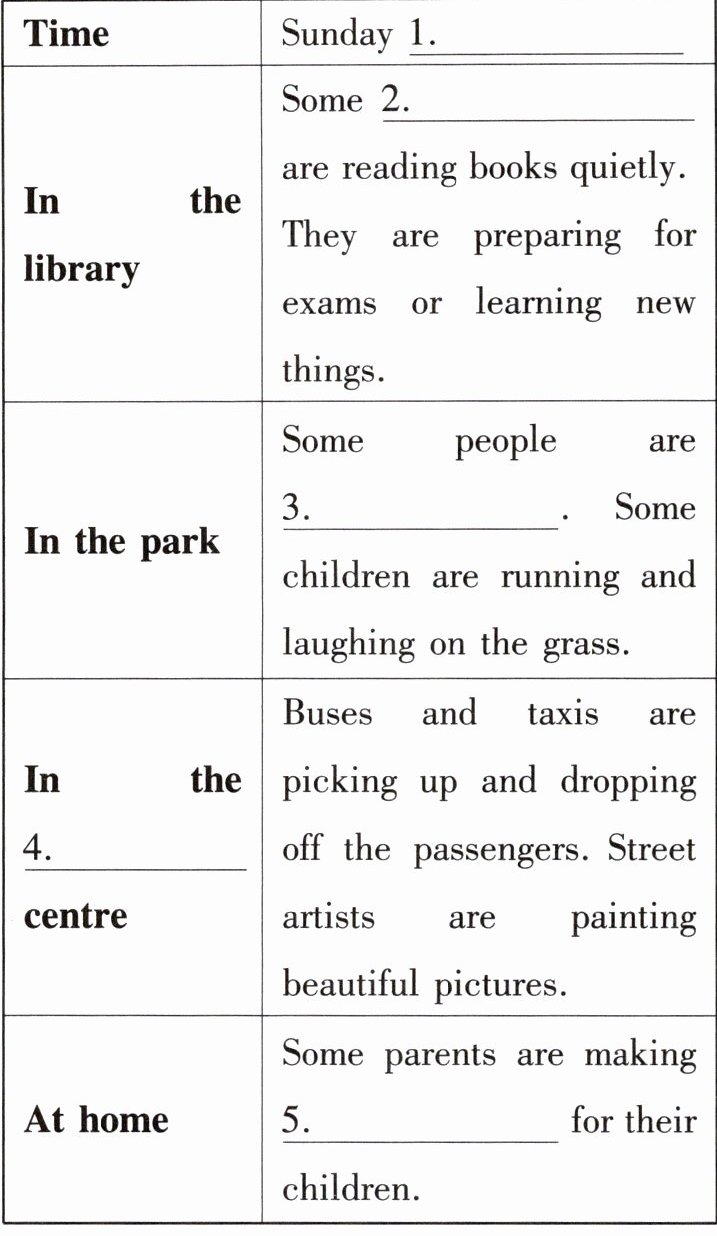 laughing on the grass.
In the 4.
Buses and taxis are picking up and dropping off the passengers. Street artists are painting beautiful pictures.
At home
Some parents are making 5.
Time
Sunday 1.
afternoon
In the library
Some 2.
students
are reading books quietly. They are preparing for exams or learning new things.In the park
Some people are 3.
jogging
. Some children are running and laughing on the grass.In the 4.
city
centreBuses and taxis are picking up and dropping off the passengers. Street artists are painting beautiful pictures.
At home
Some parents are making 5.
cookies
for their children.答案
1. afternoon
2. students
3. jogging
4. city
5. cookies
2. students
3. jogging
4. city
5. cookies
解析
【分析】这是一道听力填空题型,需先结合每个空所在句子的语境,预判所填内容的词性和词义,再通过听力材料捕捉对应细节信息完成填空。具体思路:1. 第一空对应Time栏,需填表示时间的名词;2. 第二空在图书馆里,结合“备考、读书”的语境,应填表示人的名词;3. 第三空在公园场景,需填表示活动的动名词;4. 第四空修饰centre,结合“公交、出租车接送乘客”的场景,应填修饰性名词;5. 第五空对应“父母为孩子做的”,需填食物类名词。
【解析】1. 听力材料中明确时间为Sunday afternoon,故填afternoon;2. 图书馆里安静读书、备考学习的是students(学生),符合语境;3. 公园中除孩子跑跳外,其他人在jogging(慢跑),对应听力内容;4. 公交出租车活动的场景是city centre(城市中心),符合描述;5. 在家父母为孩子做的食物是cookies(饼干),符合日常表达。
【答案】1. afternoon 2. students 3. jogging 4. city 5. cookies
【知识点】听力理解、名词运用、动名词运用
【点评】本题为基础听力细节题,考查学生捕捉听力材料具体信息的能力,结合语境预判词汇的方法能帮助快速定位答案,难度适中。
【难度系数】0.5
【解析】1. 听力材料中明确时间为Sunday afternoon,故填afternoon;2. 图书馆里安静读书、备考学习的是students(学生),符合语境;3. 公园中除孩子跑跳外,其他人在jogging(慢跑),对应听力内容;4. 公交出租车活动的场景是city centre(城市中心),符合描述;5. 在家父母为孩子做的食物是cookies(饼干),符合日常表达。
【答案】1. afternoon 2. students 3. jogging 4. city 5. cookies
【知识点】听力理解、名词运用、动名词运用
【点评】本题为基础听力细节题,考查学生捕捉听力材料具体信息的能力,结合语境预判词汇的方法能帮助快速定位答案,难度适中。
【难度系数】0.5
一、根据画线部分的发音将下列单词正确归类。
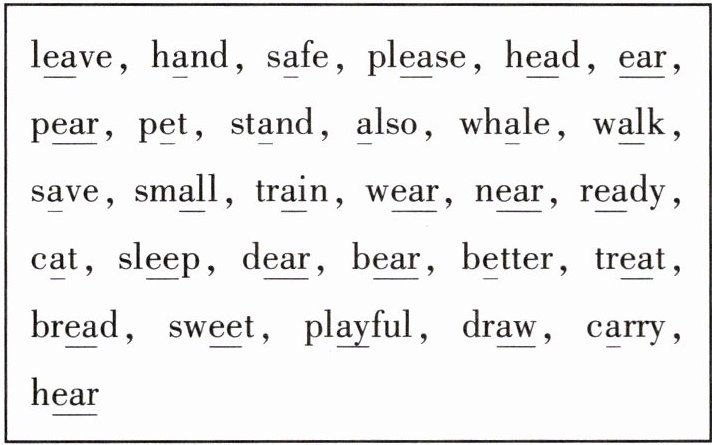
1. /eɪ/
2. /æ/
3. /ɔː/
4. /iː/
5. /e/
6. /ɪə/
7. /eə/
1. /eɪ/
safe, whale, save, train, playful
2. /æ/
hand, stand, cat, carry
3. /ɔː/
also, walk, small, draw
4. /iː/
leave, please, sleep, treat, sweet
5. /e/
head, pet, ready, better, bread
6. /ɪə/
ear, near, dear, hear
7. /eə/
pear, wear, bear
答案
1. safe, whale, save, train, playful
2. hand, stand, cat, carry
3. also, walk, small, draw
4. leave, please, sleep, treat, sweet
5. head, pet, ready, better, bread
6. ear, near, dear, hear
7. pear, wear, bear
2. hand, stand, cat, carry
3. also, walk, small, draw
4. leave, please, sleep, treat, sweet
5. head, pet, ready, better, bread
6. ear, near, dear, hear
7. pear, wear, bear
解析
【分析】
解题时需先明确每个单词画线部分的发音,再将发音相同的单词归入对应的音标类别。要熟练掌握常见字母及字母组合的发音规则,逐一核对每个单词的画线部分读音,保证归类准确。
【解析】
先分析各单词画线部分的发音,再对应归类:
1. 画线部分发/eɪ/的单词:safe(a发/eɪ/)、whale(a发/eɪ/)、save(a发/eɪ/)、train(ai发/eɪ/)、playful(ay发/eɪ/);
2. 画线部分发/æ/的单词:hand(a发/æ/)、stand(a发/æ/)、cat(a发/æ/)、carry(a发/æ/);
3. 画线部分发/ɔː/的单词:also(al发/ɔː/)、walk(al发/ɔː/)、small(al发/ɔː/)、draw(aw发/ɔː/);
4. 画线部分发/iː/的单词:leave(ea发/iː/)、please(ea发/iː/)、sleep(ee发/iː/)、treat(ea发/iː/)、sweet(ee发/iː/);
5. 画线部分发/e/的单词:head(ea发/e/)、pet(e发/e/)、ready(ea发/e/)、better(e发/e/)、bread(ea发/e/);
6. 画线部分发/ɪə/的单词:ear(ear发/ɪə/)、near(ear发/ɪə/)、dear(ear发/ɪə/)、hear(ear发/ɪə/);
7. 画线部分发/eə/的单词:pear(ear发/eə/)、wear(ear发/eə/)、bear(ear发/eə/)。
【答案】
1. safe, whale, save, train, playful
2. hand, stand, cat, carry
3. also, walk, small, draw
4. leave, please, sleep, treat, sweet
5. head, pet, ready, better, bread
6. ear, near, dear, hear
7. pear, wear, bear
【知识点】
英语单词发音、元音字母组合发音
【点评】
本题考查基础音标应用,需学生掌握常见字母及字母组合的发音,通过逐一核对画线部分读音完成归类,是巩固英语发音的典型题型。
【难度系数】
0.6
解题时需先明确每个单词画线部分的发音,再将发音相同的单词归入对应的音标类别。要熟练掌握常见字母及字母组合的发音规则,逐一核对每个单词的画线部分读音,保证归类准确。
【解析】
先分析各单词画线部分的发音,再对应归类:
1. 画线部分发/eɪ/的单词:safe(a发/eɪ/)、whale(a发/eɪ/)、save(a发/eɪ/)、train(ai发/eɪ/)、playful(ay发/eɪ/);
2. 画线部分发/æ/的单词:hand(a发/æ/)、stand(a发/æ/)、cat(a发/æ/)、carry(a发/æ/);
3. 画线部分发/ɔː/的单词:also(al发/ɔː/)、walk(al发/ɔː/)、small(al发/ɔː/)、draw(aw发/ɔː/);
4. 画线部分发/iː/的单词:leave(ea发/iː/)、please(ea发/iː/)、sleep(ee发/iː/)、treat(ea发/iː/)、sweet(ee发/iː/);
5. 画线部分发/e/的单词:head(ea发/e/)、pet(e发/e/)、ready(ea发/e/)、better(e发/e/)、bread(ea发/e/);
6. 画线部分发/ɪə/的单词:ear(ear发/ɪə/)、near(ear发/ɪə/)、dear(ear发/ɪə/)、hear(ear发/ɪə/);
7. 画线部分发/eə/的单词:pear(ear发/eə/)、wear(ear发/eə/)、bear(ear发/eə/)。
【答案】
1. safe, whale, save, train, playful
2. hand, stand, cat, carry
3. also, walk, small, draw
4. leave, please, sleep, treat, sweet
5. head, pet, ready, better, bread
6. ear, near, dear, hear
7. pear, wear, bear
【知识点】
英语单词发音、元音字母组合发音
【点评】
本题考查基础音标应用,需学生掌握常见字母及字母组合的发音,通过逐一核对画线部分读音完成归类,是巩固英语发音的典型题型。
【难度系数】
0.6
二、将下列句子中需要重读的单词用重音符号标出来。
1. Go and bring some water for me.
2. Don't talk.
3. Let's go shopping together.
4. Students have many rules at school.
5. I focus on my writing and I write the words carefully.
1. Go and bring some water for me.
2. Don't talk.
3. Let's go shopping together.
4. Students have many rules at school.
5. I focus on my writing and I write the words carefully.
答案
1. 'Go and 'bring some 'water for me.
2. 'Don't 'talk.
3. 'Let's 'go 'shopping 'together.
4. 'Students 'have 'many 'rules at 'school.
5. I 'focus on my 'writing and I 'write the 'words 'carefully.
2. 'Don't 'talk.
3. 'Let's 'go 'shopping 'together.
4. 'Students 'have 'many 'rules at 'school.
5. I 'focus on my 'writing and I 'write the 'words 'carefully.
解析
【分析】
英语句子朗读时,通常实词(名词、动词、形容词、副词、表强调的代词等)需要重读,虚词(介词、冠词、连词、普通人称代词等)一般不重读,若需特殊强调虚词则可重读。解题时需先识别每个句子中的实词,再在其前标注重音符号('),按常规情况处理即可。
【解析】
根据英语句子重读规则,逐个处理句子:
1. 动词Go、bring,名词water为实词,需重读,标注后为:'Go and 'bring some 'water for me.
2. 助动词Don't(表强调)、动词talk为实词,需重读,标注后为:'Don't 'talk.
3. Let's(表提议核心)、动词go、名词shopping、副词together为实词,需重读,标注后为:'Let's 'go 'shopping 'together.
4. 名词Students、rules,动词have,形容词many,名词school为实词,需重读,标注后为:'Students 'have 'many 'rules at 'school.
5. 动词focus、write,名词writing、words,副词carefully为实词,需重读,标注后为:I 'focus on my 'writing and I 'write the 'words 'carefully.
【答案】
1. 'Go and 'bring some 'water for me.
2. 'Don't 'talk.
3. 'Let's 'go 'shopping 'together.
4. 'Students 'have 'many 'rules at 'school.
5. I 'focus on my 'writing and I 'write the 'words 'carefully.
【知识点】
英语句子重读规则
【点评】
本题考察英语基础语音中的句子重读规则,核心是区分实词与虚词的重读情况,属于常规语音知识应用,难度适中。
【难度系数】
0.5
英语句子朗读时,通常实词(名词、动词、形容词、副词、表强调的代词等)需要重读,虚词(介词、冠词、连词、普通人称代词等)一般不重读,若需特殊强调虚词则可重读。解题时需先识别每个句子中的实词,再在其前标注重音符号('),按常规情况处理即可。
【解析】
根据英语句子重读规则,逐个处理句子:
1. 动词Go、bring,名词water为实词,需重读,标注后为:'Go and 'bring some 'water for me.
2. 助动词Don't(表强调)、动词talk为实词,需重读,标注后为:'Don't 'talk.
3. Let's(表提议核心)、动词go、名词shopping、副词together为实词,需重读,标注后为:'Let's 'go 'shopping 'together.
4. 名词Students、rules,动词have,形容词many,名词school为实词,需重读,标注后为:'Students 'have 'many 'rules at 'school.
5. 动词focus、write,名词writing、words,副词carefully为实词,需重读,标注后为:I 'focus on my 'writing and I 'write the 'words 'carefully.
【答案】
1. 'Go and 'bring some 'water for me.
2. 'Don't 'talk.
3. 'Let's 'go 'shopping 'together.
4. 'Students 'have 'many 'rules at 'school.
5. I 'focus on my 'writing and I 'write the 'words 'carefully.
【知识点】
英语句子重读规则
【点评】
本题考察英语基础语音中的句子重读规则,核心是区分实词与虚词的重读情况,属于常规语音知识应用,难度适中。
【难度系数】
0.5
一、阅读理解
One day, a lion took a break in the forest. A little mouse ran by and he was on his way home. The mouse did not see the lion, so he ran right over the lion's nose.
The lion got up with a loud shout. He caught the little mouse's body with his big paw (爪).
"You woke me up. I'm going to eat you!" the lion shouted and opened his big mouth.
"Dear lion, please do not eat me," said the mouse. "Please let me go. If you do, maybe one day I will help you."
"Ha ha!" the lion laughed at the little mouse, "You think a little mouse can help me? What a funny thing! But I will let you go because I am not hungry."
The little mouse was happy. "Thank you, dear lion!" he said. Then he ran back to his home.
A few days later, the lion walked in the forest. Suddenly, a hunter caught him with a net. The lion shouted and tried to get out but didn't make it. The little mouse heard the lion shout. "The lion needs my help," he said. So he rushed to find the lion. "I will help you," the mouse said to the lion.
"Do not be silly, little mouse!" said the lion.
However, the mouse began working with his teeth. He bit through the net little by little. It took the little mouse a long time. But at last, the lion was free!
根据材料内容选择最佳答案。
(
A. Afraid.
B. Unhappy.
C. Excited.
D. Worried.
(
①A hunter caught the lion with a net.
②The lion didn't eat the mouse and let him go.
③The mouse ran right over the lion's nose.
④The mouse bit through the net and set the lion free.
A. ③①②④
B. ②①④③
C. ③②①④
D. ④①②③
(
A. The mouse laughed at the lion.
B. The lion kept away from the mouse.
C. The lion was angry with the mouse.
D. The mouse and the lion became friends.
(
A. Funny.
B. Scary.
C. Helpful.
D. Shy.
(
A. Don't wake up a lion.
B. Keep away from bad people.
C. Don't eat too much meat.
D. Don't look down on anyone.
One day, a lion took a break in the forest. A little mouse ran by and he was on his way home. The mouse did not see the lion, so he ran right over the lion's nose.
The lion got up with a loud shout. He caught the little mouse's body with his big paw (爪).
"You woke me up. I'm going to eat you!" the lion shouted and opened his big mouth.
"Dear lion, please do not eat me," said the mouse. "Please let me go. If you do, maybe one day I will help you."
"Ha ha!" the lion laughed at the little mouse, "You think a little mouse can help me? What a funny thing! But I will let you go because I am not hungry."
The little mouse was happy. "Thank you, dear lion!" he said. Then he ran back to his home.
A few days later, the lion walked in the forest. Suddenly, a hunter caught him with a net. The lion shouted and tried to get out but didn't make it. The little mouse heard the lion shout. "The lion needs my help," he said. So he rushed to find the lion. "I will help you," the mouse said to the lion.
"Do not be silly, little mouse!" said the lion.
However, the mouse began working with his teeth. He bit through the net little by little. It took the little mouse a long time. But at last, the lion was free!
根据材料内容选择最佳答案。
(
B
) 1. How did the lion feel when the mouse woke him up?A. Afraid.
B. Unhappy.
C. Excited.
D. Worried.
(
C
)2. What is the right order of the story?①A hunter caught the lion with a net.
②The lion didn't eat the mouse and let him go.
③The mouse ran right over the lion's nose.
④The mouse bit through the net and set the lion free.
A. ③①②④
B. ②①④③
C. ③②①④
D. ④①②③
(
D
)3. What might happen at the end of the story?A. The mouse laughed at the lion.
B. The lion kept away from the mouse.
C. The lion was angry with the mouse.
D. The mouse and the lion became friends.
(
C
)4. Which word can best describe the mouse?A. Funny.
B. Scary.
C. Helpful.
D. Shy.
(
D
)5. What can we learn from the story?A. Don't wake up a lion.
B. Keep away from bad people.
C. Don't eat too much meat.
D. Don't look down on anyone.
答案
1.B
2.C
3.D
4.C
5.D
2.C
3.D
4.C
5.D
解析
【分析】
做这类阅读理解题,需先通读全文把握故事脉络,再针对每个小题回到原文定位相关信息,逐一分析选项,排除不符合原文的错误选项,选出正确答案。具体到各题:第1题需查找狮子被吵醒后的情绪;第2题梳理故事发展的先后顺序;第3题根据情节合理推断结尾;第4题总结老鼠的品质;第5题提炼故事蕴含的寓意。
【解析】
1. 第1题:定位原文第二段“The lion got up with a loud shout. He caught the little mouse's body with his big paw.”及第三段狮子要吃老鼠的表述,可知狮子被吵醒后很不高兴,对应选项B。
2. 第2题:梳理故事发展顺序:①老鼠跑过狮子鼻子(③);②狮子放了老鼠(②);③猎人用网抓狮子(①);④老鼠咬断网救狮子(④),正确顺序为③②①④,选C。
3. 第3题:老鼠帮助陷入困境的狮子脱离危险,结合前文狮子放了老鼠的情节,可推断结尾二者可能成为朋友,选D。
4. 第4题:老鼠帮助强大的狮子脱离危险,体现其乐于助人的品质,对应选项C。
5. 第5题:故事中弱小的老鼠救了强大的狮子,告诉我们不要小看任何人,选D。
【答案】
1.B 2.C 3.D 4.C 5.D
【知识点】
英语阅读理解、细节理解、主旨归纳
【点评】
本文是一则富有教育意义的寓言故事,考查学生对文章细节的查找、逻辑顺序梳理、推理判断及主旨提炼能力,是初中英语常见题型,需学生认真阅读原文,精准定位关键信息。
【难度系数】
0.6
做这类阅读理解题,需先通读全文把握故事脉络,再针对每个小题回到原文定位相关信息,逐一分析选项,排除不符合原文的错误选项,选出正确答案。具体到各题:第1题需查找狮子被吵醒后的情绪;第2题梳理故事发展的先后顺序;第3题根据情节合理推断结尾;第4题总结老鼠的品质;第5题提炼故事蕴含的寓意。
【解析】
1. 第1题:定位原文第二段“The lion got up with a loud shout. He caught the little mouse's body with his big paw.”及第三段狮子要吃老鼠的表述,可知狮子被吵醒后很不高兴,对应选项B。
2. 第2题:梳理故事发展顺序:①老鼠跑过狮子鼻子(③);②狮子放了老鼠(②);③猎人用网抓狮子(①);④老鼠咬断网救狮子(④),正确顺序为③②①④,选C。
3. 第3题:老鼠帮助陷入困境的狮子脱离危险,结合前文狮子放了老鼠的情节,可推断结尾二者可能成为朋友,选D。
4. 第4题:老鼠帮助强大的狮子脱离危险,体现其乐于助人的品质,对应选项C。
5. 第5题:故事中弱小的老鼠救了强大的狮子,告诉我们不要小看任何人,选D。
【答案】
1.B 2.C 3.D 4.C 5.D
【知识点】
英语阅读理解、细节理解、主旨归纳
【点评】
本文是一则富有教育意义的寓言故事,考查学生对文章细节的查找、逻辑顺序梳理、推理判断及主旨提炼能力,是初中英语常见题型,需学生认真阅读原文,精准定位关键信息。
【难度系数】
0.6
