

 登录
登录
Do you often feel nervous when you have to speak in front of the class? Do you avoid talking to new people because you're afraid of making mistakes? 1 This feeling is called shyness, and it's common among teenagers.
Shyness doesn't mean you're not good enough. In fact, many shy people are smart and creative. They just need more time to open up to others. 2 He was very shy when he was young and even stuttered(口吃) when he spoke. But he didn't let shyness stop him from pursuing(追求) his dream of being a scientist.
Some shy people worry too much about what others think. They are afraid of being laughed at, so they keep quiet. 3 For example, you might miss a chance to make a new friend or share a great idea in class.
If you want to become braver, here are some simple ways:
- 4 Start with small talk—like saying "Hi" to your classmates or asking a shop assistant for help. Every small step will make you more confident.
- Smile often. A warm smile makes you look friendly and helps others feel comfortable around you.
- Focus on(专注于) others, not yourself. When you talk to someone, listen to what they say instead of worrying about whether you're speaking correctly.
Remember, shyness is not a weakness. 5 With time and practice, you'll become more outgoing and enjoy talking to others.
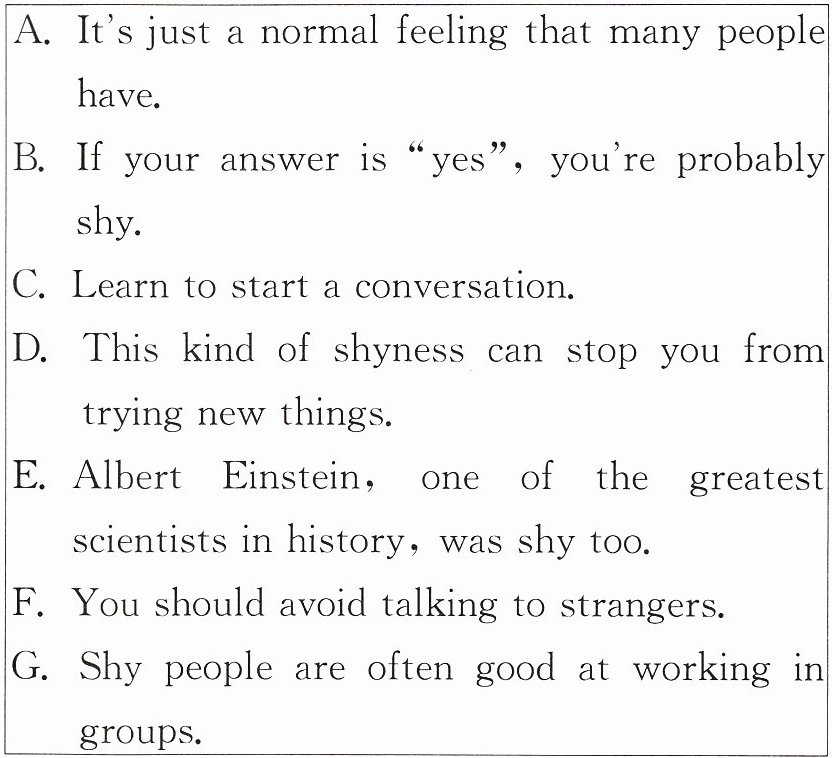
任务1 (2026·句容期中)阅读还原(有两项多余)
1. 2. 3.
4. 5.
任务2 阅读表达
Have you ever been in such a shy situation? If so, how do you overcome it? Share your experience with us. If not, say something about the suggestions that expert gave.
Shyness doesn't mean you're not good enough. In fact, many shy people are smart and creative. They just need more time to open up to others. 2 He was very shy when he was young and even stuttered(口吃) when he spoke. But he didn't let shyness stop him from pursuing(追求) his dream of being a scientist.
Some shy people worry too much about what others think. They are afraid of being laughed at, so they keep quiet. 3 For example, you might miss a chance to make a new friend or share a great idea in class.
If you want to become braver, here are some simple ways:
- 4 Start with small talk—like saying "Hi" to your classmates or asking a shop assistant for help. Every small step will make you more confident.
- Smile often. A warm smile makes you look friendly and helps others feel comfortable around you.
- Focus on(专注于) others, not yourself. When you talk to someone, listen to what they say instead of worrying about whether you're speaking correctly.
Remember, shyness is not a weakness. 5 With time and practice, you'll become more outgoing and enjoy talking to others.
任务1 (2026·句容期中)阅读还原(有两项多余)
1. 2. 3.
4. 5.
任务2 阅读表达
Have you ever been in such a shy situation? If so, how do you overcome it? Share your experience with us. If not, say something about the suggestions that expert gave.
答案
情境1
任务1 [文章大意]本文是一篇说明文。文章主要讲述了青少年害羞这一常见心理现象,并提供了克服害羞的实用建议。
1. B [解析]根据"Do you often feel nervous when you have to speak in front of the class?"及"Do you avoid talking to new people because you're afraid of making mistakes?"可知,前文是两个问句,后文需要总结性回答,B选项"如果你的回答是'是',你可能很害羞"符合语境。故选B。
2. E [解析]根据前文"In fact, many shy people are smart and creative. They just need more time to open up to others."可知,害羞的人也可以很聪明且有创造力,及后文"He was very shy when he was young and even stuttered(口吃)when he spoke."可知,举例说明"他"害羞甚至口吃,E选项"爱因斯坦——历史上最伟大的科学家之一,也曾很害羞",对应后文的例子,衔接前后文,符合语境。故选E。
3. D [解析]根据前文"They are afraid of being laughed at, so they keep quiet."可知,害羞的人太在意他人的看法,害怕被嘲笑而沉默,后文举例"you might miss a chance to make a new friend or share a great idea in class"错失交朋友、分享想法的机会,D选项"这种害羞会阻止你尝试新事物"是对前文"沉默"的消极影响的总结,也引出了后文的例子,符合语境。故选D。
4. C [解析]根据后文"Start with small talk—like saying 'Hi' to your classmates or asking a shop assistant for help."可知,C选项"学习开启对话"是对后文"闲聊"行为的概括,匹配这一建议,是具体建议的标题,符合语境。故选C。
5. A [解析]根据前文"shyness is not a weakness"可知,害羞不是弱点,A选项"它只是很多人都会有的正常情绪"进一步解释其普遍性,也呼应了开头"it's common among teenagers"害羞在青少年中很常见的观点,符合语境。故选A。
任务2
Yes. I used to be too shy to ask for help. By and by, I have more and more difficulties. Afterwards, I changed my opinion and stopped feeling that I should be able to do everything by myself. Instead, I told myself, "I don't know everything. I can get things done better if I ask someone else to help me." Now whenever I have difficulties, I ask for help boldly.(开放性试题,答案言之有理即可)
任务1 [文章大意]本文是一篇说明文。文章主要讲述了青少年害羞这一常见心理现象,并提供了克服害羞的实用建议。
1. B [解析]根据"Do you often feel nervous when you have to speak in front of the class?"及"Do you avoid talking to new people because you're afraid of making mistakes?"可知,前文是两个问句,后文需要总结性回答,B选项"如果你的回答是'是',你可能很害羞"符合语境。故选B。
2. E [解析]根据前文"In fact, many shy people are smart and creative. They just need more time to open up to others."可知,害羞的人也可以很聪明且有创造力,及后文"He was very shy when he was young and even stuttered(口吃)when he spoke."可知,举例说明"他"害羞甚至口吃,E选项"爱因斯坦——历史上最伟大的科学家之一,也曾很害羞",对应后文的例子,衔接前后文,符合语境。故选E。
3. D [解析]根据前文"They are afraid of being laughed at, so they keep quiet."可知,害羞的人太在意他人的看法,害怕被嘲笑而沉默,后文举例"you might miss a chance to make a new friend or share a great idea in class"错失交朋友、分享想法的机会,D选项"这种害羞会阻止你尝试新事物"是对前文"沉默"的消极影响的总结,也引出了后文的例子,符合语境。故选D。
4. C [解析]根据后文"Start with small talk—like saying 'Hi' to your classmates or asking a shop assistant for help."可知,C选项"学习开启对话"是对后文"闲聊"行为的概括,匹配这一建议,是具体建议的标题,符合语境。故选C。
5. A [解析]根据前文"shyness is not a weakness"可知,害羞不是弱点,A选项"它只是很多人都会有的正常情绪"进一步解释其普遍性,也呼应了开头"it's common among teenagers"害羞在青少年中很常见的观点,符合语境。故选A。
任务2
Yes. I used to be too shy to ask for help. By and by, I have more and more difficulties. Afterwards, I changed my opinion and stopped feeling that I should be able to do everything by myself. Instead, I told myself, "I don't know everything. I can get things done better if I ask someone else to help me." Now whenever I have difficulties, I ask for help boldly.(开放性试题,答案言之有理即可)
解析
【分析】
这是一篇贴近青少年生活的阅读还原类题目,解题时首先要通读全文,明确文章围绕“害羞这一常见心理”展开,依次介绍了害羞的定义、害羞人群的特点、过度害羞的负面影响以及克服害羞的实用方法。接下来逐空定位前后文的逻辑线索:1空前文是两个一般疑问句,需要承接问句给出对应回应,同时引出后文对“害羞”的定义;2空后文出现指代男性的He,还提到人物年少时害羞甚至口吃,需要找到对应具体人物举例的选项;3空后文列举了错过交友、错失分享想法机会的例子,需要找到能总领该类负面影响的选项;4空是克服害羞的第一条建议的小标题,后文内容是主动和他人搭话开启闲聊,需要匹配对应概括性的选项;5空前文点明害羞不是缺点,需要补充说明害羞的普遍性,呼应文章开头的表述。最后排除和全文主旨无关、逻辑相悖的两个多余干扰项即可完成作答,任务2的开放题结合自身经历或者结合给出的建议合理表述即可。
【解析】
1. 第一空:前文连续抛出两个关于是否会在公众场合紧张、回避和陌生人交流的问句,B选项“如果你的回答是‘是’,你可能很害羞”完美承接问句的逻辑,自然引出后文对“害羞”的定义,符合语境。
2. 第二空:前文提到很多害羞的人聪明有创造力,后文出现指代男性的He,还介绍了该人物年少时害羞口吃仍坚持追求科学梦想,E选项“历史上最伟大的科学家之一阿尔伯特·爱因斯坦也很害羞”刚好对应人物举例的线索,衔接前后文。
3. 第三空:前文提到害羞的人害怕被嘲笑所以保持沉默,后文举例说明会错过交友、分享想法的机会,D选项“这种害羞会阻止你尝试新事物”总领了过度害羞的负面影响,同时引出后文的具体事例,逻辑通顺。
4. 第四空:该空是第一条建议的总起句,后文内容是从和同学打招呼、向店员求助这类小对话做起,C选项“学会开启对话”刚好概括了该条建议的核心内容,匹配语境。
5. 第五空:前文点明害羞不是弱点,A选项“这只是很多人都拥有的正常感受”进一步解释害羞的普遍性,呼应文章开头“害羞在青少年中很常见”的表述,逻辑连贯。
多余干扰项F“你应该避免和陌生人交谈”和文章鼓励主动交流的主旨相悖,G“害羞的人通常擅长团队协作”全文没有相关表述,均不符合语境。
任务2为开放性试题,结合自身害羞的经历分享克服方法,或者结合文中给出的建议表达自己的看法,表述通顺、符合逻辑即可。
【答案】
任务1:1. B 2. E 3. D 4. C 5. A
任务2:Yes. I used to be too shy to ask for help. By and by, I have more and more difficulties. Afterwards, I changed my opinion and stopped feeling that I should be able to do everything by myself. Instead, I told myself, "I don't know everything. I can get things done better if I ask someone else to help me." Now whenever I have difficulties, I ask for help boldly.(开放性试题,答案言之有理即可)
【知识点】
阅读还原解题,语篇逻辑梳理,英语情景表达
【点评】
本题选材贴合青少年的日常心理状态,话题容易引发学生共鸣,线索指向清晰,既考察学生对语篇上下文指代、逻辑衔接关系的把握能力,最后的开放题也引导学生将文本内容和自身生活结合,兼具语言考察和正向心理引导的作用。
【难度系数】
0.7
这是一篇贴近青少年生活的阅读还原类题目,解题时首先要通读全文,明确文章围绕“害羞这一常见心理”展开,依次介绍了害羞的定义、害羞人群的特点、过度害羞的负面影响以及克服害羞的实用方法。接下来逐空定位前后文的逻辑线索:1空前文是两个一般疑问句,需要承接问句给出对应回应,同时引出后文对“害羞”的定义;2空后文出现指代男性的He,还提到人物年少时害羞甚至口吃,需要找到对应具体人物举例的选项;3空后文列举了错过交友、错失分享想法机会的例子,需要找到能总领该类负面影响的选项;4空是克服害羞的第一条建议的小标题,后文内容是主动和他人搭话开启闲聊,需要匹配对应概括性的选项;5空前文点明害羞不是缺点,需要补充说明害羞的普遍性,呼应文章开头的表述。最后排除和全文主旨无关、逻辑相悖的两个多余干扰项即可完成作答,任务2的开放题结合自身经历或者结合给出的建议合理表述即可。
【解析】
1. 第一空:前文连续抛出两个关于是否会在公众场合紧张、回避和陌生人交流的问句,B选项“如果你的回答是‘是’,你可能很害羞”完美承接问句的逻辑,自然引出后文对“害羞”的定义,符合语境。
2. 第二空:前文提到很多害羞的人聪明有创造力,后文出现指代男性的He,还介绍了该人物年少时害羞口吃仍坚持追求科学梦想,E选项“历史上最伟大的科学家之一阿尔伯特·爱因斯坦也很害羞”刚好对应人物举例的线索,衔接前后文。
3. 第三空:前文提到害羞的人害怕被嘲笑所以保持沉默,后文举例说明会错过交友、分享想法的机会,D选项“这种害羞会阻止你尝试新事物”总领了过度害羞的负面影响,同时引出后文的具体事例,逻辑通顺。
4. 第四空:该空是第一条建议的总起句,后文内容是从和同学打招呼、向店员求助这类小对话做起,C选项“学会开启对话”刚好概括了该条建议的核心内容,匹配语境。
5. 第五空:前文点明害羞不是弱点,A选项“这只是很多人都拥有的正常感受”进一步解释害羞的普遍性,呼应文章开头“害羞在青少年中很常见”的表述,逻辑连贯。
多余干扰项F“你应该避免和陌生人交谈”和文章鼓励主动交流的主旨相悖,G“害羞的人通常擅长团队协作”全文没有相关表述,均不符合语境。
任务2为开放性试题,结合自身害羞的经历分享克服方法,或者结合文中给出的建议表达自己的看法,表述通顺、符合逻辑即可。
【答案】
任务1:1. B 2. E 3. D 4. C 5. A
任务2:Yes. I used to be too shy to ask for help. By and by, I have more and more difficulties. Afterwards, I changed my opinion and stopped feeling that I should be able to do everything by myself. Instead, I told myself, "I don't know everything. I can get things done better if I ask someone else to help me." Now whenever I have difficulties, I ask for help boldly.(开放性试题,答案言之有理即可)
【知识点】
阅读还原解题,语篇逻辑梳理,英语情景表达
【点评】
本题选材贴合青少年的日常心理状态,话题容易引发学生共鸣,线索指向清晰,既考察学生对语篇上下文指代、逻辑衔接关系的把握能力,最后的开放题也引导学生将文本内容和自身生活结合,兼具语言考察和正向心理引导的作用。
【难度系数】
0.7
情境2
成长过程中,困境与烦恼是常见的,罕见的是身处困境时仍能坦然从容,积极应对,并找到解决问题的方法。考场紧张,这是每个人都有过的感受,如何化解进场前的紧张情绪,从容面对考试,各人有各人的方法。读读下文,了解下作者是怎样消除紧张情绪而后全身心地投入考试,最后取得优异成绩的。
Dilemmas(困境) are very common in our daily lives. What's less common is the ability to solve 1.
At the beginning of a writing test, I got the paper and carefully ______ 2 ______ it with a little fear in my heart. Suddenly, I came across a key word, which I'd ______ 3 ______ seen before. My hands shook ______ 4 ______ a moment and my ears were ringing. A part of me really wanted to run away from the classroom, but I knew I had no ______ 5 ______ but to complete the task. What a dilemma!
I couldn't give up because the writing test 6 a lot to me, and I had to take it seriously. I tried to calm myself down by taking a deep breath and 7 the meaning of the word from the text.
Finally, I had an idea of 8 this word meant. How excited I was! I 9 began to write. When the bell rang at the end of the test, I stood up calmly and went out of the classroom with 10. Half a month later, I got my results on the internet. I stood out from the other competitors and got (the) 11 prize.
12 is impossible. Every dilemma will be solved 13 we act with positivity(积极性) and courage. The process of solving these dilemmas is like 14 a mountain. It might be difficult at first, but overcoming difficulties will take you to new heights. The 15 is really wonderful from the top. The feeling of joy makes us feel that every effort made before is worthwhile.
任务1 完形填空
1. A. it B. them C. her D. him
2. A. looked through B. looked after
C. looked up D. looked for
3. A. always B. never
C. often D. almost
4. A. with B. in C. for D. about
5. A. chance B. idea C. advice D. choice
6. A. learned B. meant
C. helped D. did
7. A. write B. discuss
C. guess D. give
8. A. how B. when C. what D. which
9. A. sadly B. slowly
C. carelessly D. immediately
10. A. pride B. fear
C. anger D. care
11. A. first B. second
C. third D. last
12. A. Nothing B. Something
C. Everything D. Anything
13. A. so B. though
C. if D. because
14. A. drawing B. watching
C. finding D. climbing
15. A. view B. activity
C. picture D. test
任务2 阅读表达
Do you have the same experience? How do you solve the problem? Share it with us.
成长过程中,困境与烦恼是常见的,罕见的是身处困境时仍能坦然从容,积极应对,并找到解决问题的方法。考场紧张,这是每个人都有过的感受,如何化解进场前的紧张情绪,从容面对考试,各人有各人的方法。读读下文,了解下作者是怎样消除紧张情绪而后全身心地投入考试,最后取得优异成绩的。
Dilemmas(困境) are very common in our daily lives. What's less common is the ability to solve 1.
At the beginning of a writing test, I got the paper and carefully ______ 2 ______ it with a little fear in my heart. Suddenly, I came across a key word, which I'd ______ 3 ______ seen before. My hands shook ______ 4 ______ a moment and my ears were ringing. A part of me really wanted to run away from the classroom, but I knew I had no ______ 5 ______ but to complete the task. What a dilemma!
I couldn't give up because the writing test 6 a lot to me, and I had to take it seriously. I tried to calm myself down by taking a deep breath and 7 the meaning of the word from the text.
Finally, I had an idea of 8 this word meant. How excited I was! I 9 began to write. When the bell rang at the end of the test, I stood up calmly and went out of the classroom with 10. Half a month later, I got my results on the internet. I stood out from the other competitors and got (the) 11 prize.
12 is impossible. Every dilemma will be solved 13 we act with positivity(积极性) and courage. The process of solving these dilemmas is like 14 a mountain. It might be difficult at first, but overcoming difficulties will take you to new heights. The 15 is really wonderful from the top. The feeling of joy makes us feel that every effort made before is worthwhile.
任务1 完形填空
1. A. it B. them C. her D. him
2. A. looked through B. looked after
C. looked up D. looked for
3. A. always B. never
C. often D. almost
4. A. with B. in C. for D. about
5. A. chance B. idea C. advice D. choice
6. A. learned B. meant
C. helped D. did
7. A. write B. discuss
C. guess D. give
8. A. how B. when C. what D. which
9. A. sadly B. slowly
C. carelessly D. immediately
10. A. pride B. fear
C. anger D. care
11. A. first B. second
C. third D. last
12. A. Nothing B. Something
C. Everything D. Anything
13. A. so B. though
C. if D. because
14. A. drawing B. watching
C. finding D. climbing
15. A. view B. activity
C. picture D. test
任务2 阅读表达
Do you have the same experience? How do you solve the problem? Share it with us.
答案
情境2
任务1
[文章大意]本文讲述了困境常见,解决困境的能力却稀缺。我们应该直面困境,积极应对,终能攀登高峰,领略战胜困难后的喜悦。
1. B [解析]考查代词辨析。句意:不太常见的是解决它们的能力。it 它;them 他/她/它们;her 她;him 他。根据"Dilemmas(困境) are very common in our daily lives."可知,此处指"解决困境",代指"dilemmas"用代词 them。故选B。
2. A [解析]考查动词短语辨析。句意:在写作测试开始时,我拿到试卷,心里有点害怕,仔细浏览了一遍。look through 浏览;look after 照顾;look up 查阅;look for 寻找。根据"I got the paper"可知,拿到试卷仔细浏览,其他选项均不符合句意。故选A。
3. B [解析]考查副词辨析。句意:突然,我遇到了一个我以前从未见过的关键词。always 总是;never 从未;often 经常;almost 几乎。根据"My hands shook... a moment and my ears were ringing. A part of me really wanted to run away from the classroom"可知,此处指"从未见过",所以想逃离。故选B。
4. C [解析]考查介词辨析。句意:我的手颤抖了一会儿,耳朵嗡嗡作响。with 和;in 在一段时间之内;for 表示一段时间;about 关于。根据"a moment"可知,此处表示一段时间。故选C。
5. D [解析]考查名词辨析。句意:我内心的一部分真的很想逃离教室,但我知道我别无选择,只能完成任务。chance 机会;idea 想法;advice 建议;choice 选择。根据"I had no... but to complete the task"可知,此处考查固定句型 have no choice but to do sth,意为"别无选择只能做某事"。故选D。
6. B [解析]考查动词辨析。句意:我不能放弃,因为写作测试对我来说意义重大,我必须认真对待它。learn 学习;mean 意味着;help 帮助;do 做。根据"I had to take it seriously"可知,考试对"我"意义重大。故选B。
7. C [解析]考查动词辨析。句意:我试着让自己冷静下来,深吸一口气,从文中猜测这个词的意思。write 书写;discuss 讨论;guess 猜测;give 给予。根据"from the text"可知,此处指"根据文本猜测意思"。故选C。
8. C [解析]考查词汇辨析。句意:最后,我明白了这个词的意思。how 怎样;when 什么时候;what 什么;which 哪一个。根据"this word meant"可知,此处缺"meant"的内容,所以填 what。故选C。
9. D [解析]考查副词辨析。句意:我立刻开始写作。sadly 伤心地;slowly 慢慢地;carelessly 粗心地;immediately 立即地。根据"Finally, I had an idea... How excited I was!"可知,"我"猜出单词意思后,立刻开始写作,其他选项均不符合句意。故选D。
10. A [解析]考查名词辨析。句意:当考试结束的铃声响起时,我平静地站起来,骄傲地走出教室。pride 骄傲;fear 恐惧;anger 生气;care 照顾。根据"When the bell rang at the end of the test, I stood up calmly and went out of the classroom with..."可知,"我"作文写出来了,所以骄傲地走出了教室,其他选项均不符合句意。故选A。
11. A [解析]考查词汇辨析。句意:半个月后,我在网上拿到了结果。我从其他参赛者中脱颖而出,获得了第一名。first 第一;second 第二;third 第三;last 最后。根据"I stood out from the other competitors"可知,"我"获得了第一名。故选A。
12. A [解析]考查代词辨析。句意:没有什么是不可能的。nothing 没有东西;something 一些东西;everything 一切东西;anything 任何东西。根据"I stood out from the other competitors and got (the)... prize."可知,通过"我"拿了第一证明没有什么是不可能的。故选A。
13. C [解析]考查连词辨析。句意:如果我们以积极的态度和勇气采取行动,每个困境都将得到解决。so 所以;though 虽然;if 如果;because 因为。根据"Every dilemma will be solved... we act with positivity(积极性) and courage."可知,此处是指"解决困境的条件",所以应用 if 引导条件状语从句。故选C。
14. D [解析]考查动词辨析。句意:解决这些困境的过程就像爬山。draw 画画;watch 观看;find 寻找;climb 攀爬。根据"take you to new heights"可知,此处指"爬山"。故选D。
15. A [解析]考查名词辨析。句意:从顶部看出去的景色真的很美妙。view 景色;activity 活动;picture 图片;test 测试。根据"is really wonderful from the top"可知,从山顶看到的应是景色。故选A。
任务2 Yes. I used to be nervous when I took exams. The more nervous I am, the less possible it is for me to work out the problem. Afterwards, I told my problem to our teacher. Now I follow my teacher's advice: when I get the test paper, take a deep breath to make myself calm down, and then go through the paper quickly. Skip the difficult problems and answer the easy ones first. As most of the problems are worked out, I won't be nervous any more. Then focus on the difficult problems. It will not be so difficult to finish them.(开放性试题,答案言之有理即可)
任务1
[文章大意]本文讲述了困境常见,解决困境的能力却稀缺。我们应该直面困境,积极应对,终能攀登高峰,领略战胜困难后的喜悦。
1. B [解析]考查代词辨析。句意:不太常见的是解决它们的能力。it 它;them 他/她/它们;her 她;him 他。根据"Dilemmas(困境) are very common in our daily lives."可知,此处指"解决困境",代指"dilemmas"用代词 them。故选B。
2. A [解析]考查动词短语辨析。句意:在写作测试开始时,我拿到试卷,心里有点害怕,仔细浏览了一遍。look through 浏览;look after 照顾;look up 查阅;look for 寻找。根据"I got the paper"可知,拿到试卷仔细浏览,其他选项均不符合句意。故选A。
3. B [解析]考查副词辨析。句意:突然,我遇到了一个我以前从未见过的关键词。always 总是;never 从未;often 经常;almost 几乎。根据"My hands shook... a moment and my ears were ringing. A part of me really wanted to run away from the classroom"可知,此处指"从未见过",所以想逃离。故选B。
4. C [解析]考查介词辨析。句意:我的手颤抖了一会儿,耳朵嗡嗡作响。with 和;in 在一段时间之内;for 表示一段时间;about 关于。根据"a moment"可知,此处表示一段时间。故选C。
5. D [解析]考查名词辨析。句意:我内心的一部分真的很想逃离教室,但我知道我别无选择,只能完成任务。chance 机会;idea 想法;advice 建议;choice 选择。根据"I had no... but to complete the task"可知,此处考查固定句型 have no choice but to do sth,意为"别无选择只能做某事"。故选D。
6. B [解析]考查动词辨析。句意:我不能放弃,因为写作测试对我来说意义重大,我必须认真对待它。learn 学习;mean 意味着;help 帮助;do 做。根据"I had to take it seriously"可知,考试对"我"意义重大。故选B。
7. C [解析]考查动词辨析。句意:我试着让自己冷静下来,深吸一口气,从文中猜测这个词的意思。write 书写;discuss 讨论;guess 猜测;give 给予。根据"from the text"可知,此处指"根据文本猜测意思"。故选C。
8. C [解析]考查词汇辨析。句意:最后,我明白了这个词的意思。how 怎样;when 什么时候;what 什么;which 哪一个。根据"this word meant"可知,此处缺"meant"的内容,所以填 what。故选C。
9. D [解析]考查副词辨析。句意:我立刻开始写作。sadly 伤心地;slowly 慢慢地;carelessly 粗心地;immediately 立即地。根据"Finally, I had an idea... How excited I was!"可知,"我"猜出单词意思后,立刻开始写作,其他选项均不符合句意。故选D。
10. A [解析]考查名词辨析。句意:当考试结束的铃声响起时,我平静地站起来,骄傲地走出教室。pride 骄傲;fear 恐惧;anger 生气;care 照顾。根据"When the bell rang at the end of the test, I stood up calmly and went out of the classroom with..."可知,"我"作文写出来了,所以骄傲地走出了教室,其他选项均不符合句意。故选A。
11. A [解析]考查词汇辨析。句意:半个月后,我在网上拿到了结果。我从其他参赛者中脱颖而出,获得了第一名。first 第一;second 第二;third 第三;last 最后。根据"I stood out from the other competitors"可知,"我"获得了第一名。故选A。
12. A [解析]考查代词辨析。句意:没有什么是不可能的。nothing 没有东西;something 一些东西;everything 一切东西;anything 任何东西。根据"I stood out from the other competitors and got (the)... prize."可知,通过"我"拿了第一证明没有什么是不可能的。故选A。
13. C [解析]考查连词辨析。句意:如果我们以积极的态度和勇气采取行动,每个困境都将得到解决。so 所以;though 虽然;if 如果;because 因为。根据"Every dilemma will be solved... we act with positivity(积极性) and courage."可知,此处是指"解决困境的条件",所以应用 if 引导条件状语从句。故选C。
14. D [解析]考查动词辨析。句意:解决这些困境的过程就像爬山。draw 画画;watch 观看;find 寻找;climb 攀爬。根据"take you to new heights"可知,此处指"爬山"。故选D。
15. A [解析]考查名词辨析。句意:从顶部看出去的景色真的很美妙。view 景色;activity 活动;picture 图片;test 测试。根据"is really wonderful from the top"可知,从山顶看到的应是景色。故选A。
任务2 Yes. I used to be nervous when I took exams. The more nervous I am, the less possible it is for me to work out the problem. Afterwards, I told my problem to our teacher. Now I follow my teacher's advice: when I get the test paper, take a deep breath to make myself calm down, and then go through the paper quickly. Skip the difficult problems and answer the easy ones first. As most of the problems are worked out, I won't be nervous any more. Then focus on the difficult problems. It will not be so difficult to finish them.(开放性试题,答案言之有理即可)
解析
【分析】
拿到这道题首先要先通读全文,理清文章的叙事主线:作者在写作考试中遇到陌生关键词一度慌乱,最终冷静下来积极应对,顺利完成考试拿到一等奖,感悟到只要积极面对就没有跨不过的困境。做完形填空时,每道题都要先定位前后文的提示信息:代词类题目要找到前文对应的指代对象,短语辨析类要结合场景匹配动作,逻辑类题目要梳理前后句的因果/条件关系,全部选完后再复读一遍全文验证逻辑是否通顺。开放性阅读表达题要贴合主题,结合自己遇到困境的真实经历,清晰说明问题和对应的解决方法,保证表达通顺即可。
【解析】
任务1 完形填空:
1. 前文提到的名词dilemmas是复数形式,要指代复数的“困境”需用代词them,排除指代单数的it、her、him,选B。
2. 拿到试卷后的常规合理动作是浏览试卷内容,look through意为“浏览”,其余选项look after(照顾)、look up(查阅)、look for(寻找)均不符合考场场景,选A。
3. 后文出现手抖、耳鸣、想要逃离考场的慌乱反应,说明作者遇到的是之前从未见过的关键词,never符合语境,选B。
4. for a moment是固定搭配,意为“一会儿”,用来描述动作持续的时长,选C。
5. have no choice but to do sth是固定常用短语,含义为“别无选择只能做某事”,完全匹配语境,选D。
6. 后文提到作者必须认真对待这场考试,说明这场考试对作者而言意义重大,mean a lot to sb意为“对某人来说意义重大”,选B。
7. 遇到完全陌生的单词,作者只能结合文本内容猜测词义,guess符合当时的场景逻辑,选C。
8. 此处为宾语从句,从句中谓语meant后缺少指代事物的宾语,用连接代词what引导,表达“这个单词的含义是什么”,选C。
9. 作者终于猜出单词的含义十分兴奋,接下来自然是立刻开始答题,immediately(立即地)符合逻辑,选D。
10. 作者顺利完成了整场考试,走出考场时的心情是骄傲的,pride(骄傲)符合语境,选A。
11. 前文提到作者从所有参赛者中脱颖而出,说明取得了最高的一等奖,first prize符合描述,选A。
12. 结合全文传递的主旨,此处对应经典表述“没有什么是不可能的”,Nothing is impossible,选A。
13. 后半句“我们带着积极性和勇气行动”是前半句“所有困境都能被解决”的前提条件,用if引导条件状语从句,选C。
14. 后文提到“到达新高度、站在山顶”,对应的动作是爬山,climb a mountain符合搭配,选D。
15. 站在山顶看到的美好事物是风景,view意为“视野、风景”,完全匹配语境,选A。
任务2 阅读表达:本题为开放性试题,作答时要贴合“遇到困境积极应对”的主题,清晰说明自身的类似经历和对应的解决方法,保证语法正确、逻辑通顺即可。
【答案】
任务1:
1.B 2.A 3.B 4.C 5.D 6.B 7.C 8.C 9.D 10.A 11.A 12.A 13.C 14.D 15.A
任务2 Yes. I used to be nervous when I took exams. The more nervous I am, the less possible it is for me to work out the problem. Afterwards, I told my problem to our teacher. Now I follow my teacher's advice: when I get the test paper, take a deep breath to make myself calm down, and then go through the paper quickly. Skip the difficult problems and answer the easy ones first. As most of the problems are worked out, I won't be nervous any more. Then focus on the difficult problems. It will not be so difficult to finish them.(开放性试题,答案言之有理即可)
【知识点】
代词辨析、固定搭配、语境逻辑推理
【点评】
本题选材贴合学生的日常学习生活,容易引发学生的情感共鸣,既考查了初中阶段核心的词汇、短语、语法基础知识点,又引导学生思考如何正确应对学习和生活中的困境,兼具检测性和教育意义。做完形填空时切忌脱离上下文仅凭单个句子选答案,多挖掘前后文的暗示线索,就能大幅提升答题的准确率。
【难度系数】
0.7
拿到这道题首先要先通读全文,理清文章的叙事主线:作者在写作考试中遇到陌生关键词一度慌乱,最终冷静下来积极应对,顺利完成考试拿到一等奖,感悟到只要积极面对就没有跨不过的困境。做完形填空时,每道题都要先定位前后文的提示信息:代词类题目要找到前文对应的指代对象,短语辨析类要结合场景匹配动作,逻辑类题目要梳理前后句的因果/条件关系,全部选完后再复读一遍全文验证逻辑是否通顺。开放性阅读表达题要贴合主题,结合自己遇到困境的真实经历,清晰说明问题和对应的解决方法,保证表达通顺即可。
【解析】
任务1 完形填空:
1. 前文提到的名词dilemmas是复数形式,要指代复数的“困境”需用代词them,排除指代单数的it、her、him,选B。
2. 拿到试卷后的常规合理动作是浏览试卷内容,look through意为“浏览”,其余选项look after(照顾)、look up(查阅)、look for(寻找)均不符合考场场景,选A。
3. 后文出现手抖、耳鸣、想要逃离考场的慌乱反应,说明作者遇到的是之前从未见过的关键词,never符合语境,选B。
4. for a moment是固定搭配,意为“一会儿”,用来描述动作持续的时长,选C。
5. have no choice but to do sth是固定常用短语,含义为“别无选择只能做某事”,完全匹配语境,选D。
6. 后文提到作者必须认真对待这场考试,说明这场考试对作者而言意义重大,mean a lot to sb意为“对某人来说意义重大”,选B。
7. 遇到完全陌生的单词,作者只能结合文本内容猜测词义,guess符合当时的场景逻辑,选C。
8. 此处为宾语从句,从句中谓语meant后缺少指代事物的宾语,用连接代词what引导,表达“这个单词的含义是什么”,选C。
9. 作者终于猜出单词的含义十分兴奋,接下来自然是立刻开始答题,immediately(立即地)符合逻辑,选D。
10. 作者顺利完成了整场考试,走出考场时的心情是骄傲的,pride(骄傲)符合语境,选A。
11. 前文提到作者从所有参赛者中脱颖而出,说明取得了最高的一等奖,first prize符合描述,选A。
12. 结合全文传递的主旨,此处对应经典表述“没有什么是不可能的”,Nothing is impossible,选A。
13. 后半句“我们带着积极性和勇气行动”是前半句“所有困境都能被解决”的前提条件,用if引导条件状语从句,选C。
14. 后文提到“到达新高度、站在山顶”,对应的动作是爬山,climb a mountain符合搭配,选D。
15. 站在山顶看到的美好事物是风景,view意为“视野、风景”,完全匹配语境,选A。
任务2 阅读表达:本题为开放性试题,作答时要贴合“遇到困境积极应对”的主题,清晰说明自身的类似经历和对应的解决方法,保证语法正确、逻辑通顺即可。
【答案】
任务1:
1.B 2.A 3.B 4.C 5.D 6.B 7.C 8.C 9.D 10.A 11.A 12.A 13.C 14.D 15.A
任务2 Yes. I used to be nervous when I took exams. The more nervous I am, the less possible it is for me to work out the problem. Afterwards, I told my problem to our teacher. Now I follow my teacher's advice: when I get the test paper, take a deep breath to make myself calm down, and then go through the paper quickly. Skip the difficult problems and answer the easy ones first. As most of the problems are worked out, I won't be nervous any more. Then focus on the difficult problems. It will not be so difficult to finish them.(开放性试题,答案言之有理即可)
【知识点】
代词辨析、固定搭配、语境逻辑推理
【点评】
本题选材贴合学生的日常学习生活,容易引发学生的情感共鸣,既考查了初中阶段核心的词汇、短语、语法基础知识点,又引导学生思考如何正确应对学习和生活中的困境,兼具检测性和教育意义。做完形填空时切忌脱离上下文仅凭单个句子选答案,多挖掘前后文的暗示线索,就能大幅提升答题的准确率。
【难度系数】
0.7
