

 登录
登录
B(2025·南京鼓楼区期中改编)
阅读短文,根据短文内容在文章后表格中的空格里填入最恰当的单词并回答文章后第8小题的问题。(第1~7题每个空格只填1个单词;第8题答案不超过6个单词)
A national survey was carried out in Australia on how children aged eight to sixteen read news. The survey found children as young as eight were interested in news. However, the spread of wrong information makes it difficult for children to understand events. The survey also found only one-third of young people felt they could tell whether the news they read was real or not.
Here are some things adults can do to help children think critically(批判地) about news.
To help decide if a source can be trusted, they can ask the following questions. Is it clear who created this news? Viewers need to be able to ask the person or organization why and how they created the story. Does it show facts straight or does it include opinions? If opinions are presented as facts, this may lead to wrong ideas. Does it include all the important people? If a story speaks up for organizations or groups of people, they should have the chance to reply to these opinions.
Some media may make use of people's feelings. Discussing children's feelings about news helps them decide which news programmes to watch. The research shows sensational(耸人听闻的) news titles can receive more clicks online. Adults can also explain to children why people spread wrong information, such as changing people's minds on whom to vote for or attracting more clicks.
News media talk about events in different ways. Parents and teachers can help children be careful while reading stories. In some stories people don't present their ideas honestly. In these cases, it's best to find other news sources to see how they are reporting the story. Discussing what children think of the news can help build their critical thinking skills.
News that can be trusted is important to society. People need it to help make decisions in their lives. Seeing how wrong information is different from real news is a difficult task for everyone at present. Listening to children's experiences is a useful starting point for improving their critical thinking abilities.
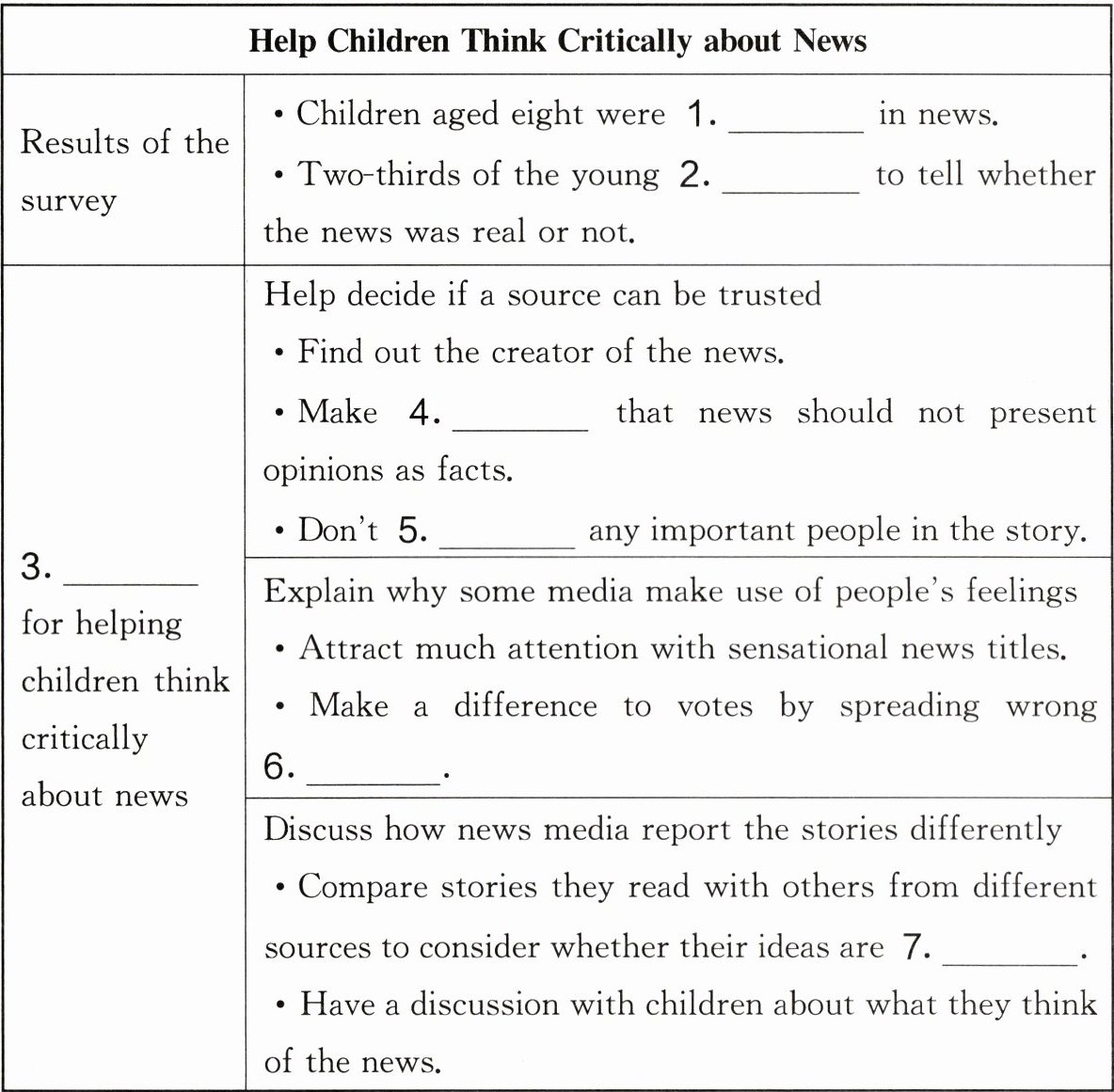
8. Why do people need trustworthy news?
阅读短文,根据短文内容在文章后表格中的空格里填入最恰当的单词并回答文章后第8小题的问题。(第1~7题每个空格只填1个单词;第8题答案不超过6个单词)
A national survey was carried out in Australia on how children aged eight to sixteen read news. The survey found children as young as eight were interested in news. However, the spread of wrong information makes it difficult for children to understand events. The survey also found only one-third of young people felt they could tell whether the news they read was real or not.
Here are some things adults can do to help children think critically(批判地) about news.
To help decide if a source can be trusted, they can ask the following questions. Is it clear who created this news? Viewers need to be able to ask the person or organization why and how they created the story. Does it show facts straight or does it include opinions? If opinions are presented as facts, this may lead to wrong ideas. Does it include all the important people? If a story speaks up for organizations or groups of people, they should have the chance to reply to these opinions.
Some media may make use of people's feelings. Discussing children's feelings about news helps them decide which news programmes to watch. The research shows sensational(耸人听闻的) news titles can receive more clicks online. Adults can also explain to children why people spread wrong information, such as changing people's minds on whom to vote for or attracting more clicks.
News media talk about events in different ways. Parents and teachers can help children be careful while reading stories. In some stories people don't present their ideas honestly. In these cases, it's best to find other news sources to see how they are reporting the story. Discussing what children think of the news can help build their critical thinking skills.
News that can be trusted is important to society. People need it to help make decisions in their lives. Seeing how wrong information is different from real news is a difficult task for everyone at present. Listening to children's experiences is a useful starting point for improving their critical thinking abilities.
8. Why do people need trustworthy news?
To help make decisions in life.
答案
1. interested [解析]根据第一段中的“The survey found children as young as eight were interested in news.”可知,调查发现8岁的孩子对新闻感兴趣。be interested in 意为“对……感兴趣”。故填 interested。
2. failed [解析]根据第一段中的“The survey also found only one-third of young people felt they could tell whether the news they read was real or not.”可知,只有三分之一的年轻人认为他们能分辨出所读新闻的真假。因此,有三分之二的年轻人无法分辨新闻的真假。fail to do sth 意为“未能做某事”,且句子为一般过去时,动词用过去式。故填 failed。
3. Tips/Suggestions/Advice [解析]根据第二段“Here are some things adults can do to help children think critically(批判地) about news.”可知,本文给出了几个成年人可以帮助孩子进行批判性思考新闻的方法;再结合空后的“for helping”可知,tip“提示”符合语境,注意首字母应大写,且应用复数形式。故填 Tips/Suggestions/Advice。
4. sure [解析]根据第三段中的“Does it show facts straight or does it include opinions? If opinions are presented as facts, this may lead to wrong ideas.”可知,应该确保新闻不应将观点当作事实。make sure 意为“确保”。故填 sure。
5. miss [解析]根据第三段中的“Does it include all the important people?”可知,要了解新闻中的重要人物有没有被遗漏,miss“错过”符合语境,且助动词“Don't”后用动词原形。故填 miss。
6. information [解析]根据第四段中的“Adults can also explain to children why people spread wrong information, such as changing people's minds on whom to vote for or attracting more clicks.”可知,为了改变人们投票给谁的想法,人们可能会传播错误的信息。故填 information。
7. honest [解析]根据倒数第二段中的“In some stories people don't present their ideas honestly. In these cases, it's best to find other news sources to see how they are reporting the story.”可知,需要将孩子们阅读的故事与其他不同来源的故事进行比较,以判断其观点是否真实可信。honest 意为“诚实的”,形容词作表语。故填 honest。
8. To help make decisions in life. [解析]根据最后一段中的“News that can be trusted is important to society. People need it to help make decisions in their lives.”可知,可信的新闻对社会很重要,因为在生活中人们需要它来帮忙做出决定。故填 To help make decisions in life.。
2. failed [解析]根据第一段中的“The survey also found only one-third of young people felt they could tell whether the news they read was real or not.”可知,只有三分之一的年轻人认为他们能分辨出所读新闻的真假。因此,有三分之二的年轻人无法分辨新闻的真假。fail to do sth 意为“未能做某事”,且句子为一般过去时,动词用过去式。故填 failed。
3. Tips/Suggestions/Advice [解析]根据第二段“Here are some things adults can do to help children think critically(批判地) about news.”可知,本文给出了几个成年人可以帮助孩子进行批判性思考新闻的方法;再结合空后的“for helping”可知,tip“提示”符合语境,注意首字母应大写,且应用复数形式。故填 Tips/Suggestions/Advice。
4. sure [解析]根据第三段中的“Does it show facts straight or does it include opinions? If opinions are presented as facts, this may lead to wrong ideas.”可知,应该确保新闻不应将观点当作事实。make sure 意为“确保”。故填 sure。
5. miss [解析]根据第三段中的“Does it include all the important people?”可知,要了解新闻中的重要人物有没有被遗漏,miss“错过”符合语境,且助动词“Don't”后用动词原形。故填 miss。
6. information [解析]根据第四段中的“Adults can also explain to children why people spread wrong information, such as changing people's minds on whom to vote for or attracting more clicks.”可知,为了改变人们投票给谁的想法,人们可能会传播错误的信息。故填 information。
7. honest [解析]根据倒数第二段中的“In some stories people don't present their ideas honestly. In these cases, it's best to find other news sources to see how they are reporting the story.”可知,需要将孩子们阅读的故事与其他不同来源的故事进行比较,以判断其观点是否真实可信。honest 意为“诚实的”,形容词作表语。故填 honest。
8. To help make decisions in life. [解析]根据最后一段中的“News that can be trusted is important to society. People need it to help make decisions in their lives.”可知,可信的新闻对社会很重要,因为在生活中人们需要它来帮忙做出决定。故填 To help make decisions in life.。
