

 登录
登录
Ⅲ. 传统节日 Julia 对于中国传统节日已经有了初步的认识。在这个过程中,她逐渐理解了为什么这些节日对中国人如此重要,也认识到中国的传统节日不仅仅是一些庆祝活动,更是承载着深厚文化内涵和民族精神的载体。(有一项多余)
The Chongyang Festival has a history of over 2,000 years. It falls on the ninth day of the ninth month in the Chinese lunar calendar. According to tradition, we should celebrate the festival by going mountain climbing, but how many people today still celebrate this tradition? 1. However, they are an important part of Chinese culture and we must protect them.
2. The Dragon Boat Festival, for example, is celebrated in memory of Qu Yuan, a great poet living in ancient China. By celebrating the Dragon Boat Festival with rice dumplings and dragon boat races, the story of Qu Yuan is passed down from generation to generation. Celebrating traditional festivals helps spread knowledge about our national history.
Moreover, traditional festivals enable us to learn more about fine Chinese values. Many festivals, such as the Mid-Autumn Festival, have a caring, family-centred message at their hearts. The full moon on the festival is considered to stand for family togetherness. 3. With the celebrations of these festivals, younger generations learn to honour fine Chinese values.
Finally, traditional festivals are a source of national pride and help shape our national identity(民族认同). For example, we celebrate the Hanshi Festival and the Laba Festival with special customs, and these shared experiences bring us together as a nation. Traditional festivals tell us who we are. 4.
Traditional festivals have been passed down to us. 5.
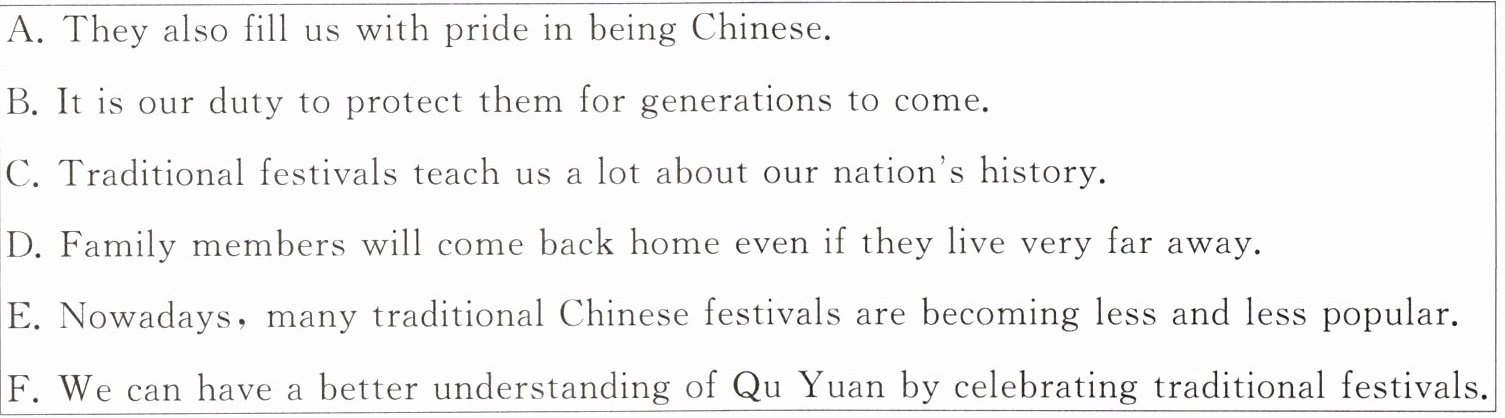
Questions: 新考法 开放性试题 1. How can we make traditional Chinese festivals more attractive(有吸引力的) to people from other cultures?
2. What traditional Chinese festival do you think is the easiest for foreigners to understand? Why?
The Chongyang Festival has a history of over 2,000 years. It falls on the ninth day of the ninth month in the Chinese lunar calendar. According to tradition, we should celebrate the festival by going mountain climbing, but how many people today still celebrate this tradition? 1. However, they are an important part of Chinese culture and we must protect them.
2. The Dragon Boat Festival, for example, is celebrated in memory of Qu Yuan, a great poet living in ancient China. By celebrating the Dragon Boat Festival with rice dumplings and dragon boat races, the story of Qu Yuan is passed down from generation to generation. Celebrating traditional festivals helps spread knowledge about our national history.
Moreover, traditional festivals enable us to learn more about fine Chinese values. Many festivals, such as the Mid-Autumn Festival, have a caring, family-centred message at their hearts. The full moon on the festival is considered to stand for family togetherness. 3. With the celebrations of these festivals, younger generations learn to honour fine Chinese values.
Finally, traditional festivals are a source of national pride and help shape our national identity(民族认同). For example, we celebrate the Hanshi Festival and the Laba Festival with special customs, and these shared experiences bring us together as a nation. Traditional festivals tell us who we are. 4.
Traditional festivals have been passed down to us. 5.
Questions: 新考法 开放性试题 1. How can we make traditional Chinese festivals more attractive(有吸引力的) to people from other cultures?
2. What traditional Chinese festival do you think is the easiest for foreigners to understand? Why?
答案
1.E 2.C 3.D 4.A 5.B
【语篇解读】本文是一篇议论文,主要论述了在现代社会中推广中国传统节日的重要性。
Questions:
1. We can hold cultural exchange activities. For example, we can invite foreigners to join in dragon boat races during the Dragon Boat Festival.(答案不唯一)
2. The Mid-Autumn Festival. Because it's all about family getting together, just like Christmas in many Western countries.(答案不唯一)
【语篇解读】本文是一篇议论文,主要论述了在现代社会中推广中国传统节日的重要性。
Questions:
1. We can hold cultural exchange activities. For example, we can invite foreigners to join in dragon boat races during the Dragon Boat Festival.(答案不唯一)
2. The Mid-Autumn Festival. Because it's all about family getting together, just like Christmas in many Western countries.(答案不唯一)
解析
【分析】
本题为英语句子还原题,解题思路如下:首先通读全文,明确文章主旨是论述中国传统节日的重要性及保护的必要性;接着分析每个空格前后句子的逻辑关系(转折、举例、承接等);再逐一匹配选项,排除多余项,最终确定答案。例如第1空后有转折词However,需选表达节日不受欢迎的选项;第2空后举端午节例子,对应节日与历史的内容,以此类推。
【解析】
1. 第1空:空格后由However表转折,后文强调传统节日是中国文化重要部分需保护,故空格处应体现节日不受欢迎的现状,对应选项E,选E。
2. 第2空:空格后以端午节为例,说明庆祝节日能传播民族历史,对应选项C(传统节日教我们很多民族历史知识),选C。
3. 第3空:空格前提到中秋节代表家庭团聚,空格后承接年轻一代传承价值观,故空格处应围绕家庭团聚展开,对应选项D(家人即使住得远也会回家),选D。
4. 第4空:空格前指出传统节日是民族自豪感的来源,对应选项A(它们也让我们作为中国人充满自豪),选A。
5. 第5空:空格前说明传统节日已传承下来,对应选项B(我们有责任为后代保护它们),选B。
【答案】
1.E 2.C 3.D 4.A 5.B
【知识点】
句子还原题、英语阅读理解、传统文化
【点评】
本题围绕中国传统节日展开,考查学生对语篇逻辑关系的理解,渗透了传统文化教育,难度适中,需学生结合上下文语境分析句子间的逻辑匹配度。
【难度系数】
0.5
本题为英语句子还原题,解题思路如下:首先通读全文,明确文章主旨是论述中国传统节日的重要性及保护的必要性;接着分析每个空格前后句子的逻辑关系(转折、举例、承接等);再逐一匹配选项,排除多余项,最终确定答案。例如第1空后有转折词However,需选表达节日不受欢迎的选项;第2空后举端午节例子,对应节日与历史的内容,以此类推。
【解析】
1. 第1空:空格后由However表转折,后文强调传统节日是中国文化重要部分需保护,故空格处应体现节日不受欢迎的现状,对应选项E,选E。
2. 第2空:空格后以端午节为例,说明庆祝节日能传播民族历史,对应选项C(传统节日教我们很多民族历史知识),选C。
3. 第3空:空格前提到中秋节代表家庭团聚,空格后承接年轻一代传承价值观,故空格处应围绕家庭团聚展开,对应选项D(家人即使住得远也会回家),选D。
4. 第4空:空格前指出传统节日是民族自豪感的来源,对应选项A(它们也让我们作为中国人充满自豪),选A。
5. 第5空:空格前说明传统节日已传承下来,对应选项B(我们有责任为后代保护它们),选B。
【答案】
1.E 2.C 3.D 4.A 5.B
【知识点】
句子还原题、英语阅读理解、传统文化
【点评】
本题围绕中国传统节日展开,考查学生对语篇逻辑关系的理解,渗透了传统文化教育,难度适中,需学生结合上下文语境分析句子间的逻辑匹配度。
【难度系数】
0.5
