

 登录
登录
Ⅰ. 根据句意及所给首字母提示,补全句中所缺单词。
1. People in Japan usually b
2. It's important to learn about local c
3. You should use your right hand to eat in India, because using the left hand is considered r
4. As soon as we arrived at the party, the host gave us a warm h
5. The table m
1. People in Japan usually b
ow
to greet each other instead of shaking hands.2. It's important to learn about local c
ustoms
before travelling to a foreign country.3. You should use your right hand to eat in India, because using the left hand is considered r
ude
.4. As soon as we arrived at the party, the host gave us a warm h
ug
.5. The table m
anners
in France are quite different from those in China.答案
1. bow
2. customs
3. rude
4. hug
5. manners
2. customs
3. rude
4. hug
5. manners
解析
【分析】
解答此类题目时,需先理解句子语境,再结合所给首字母提示,回忆符合语义的单词,同时注意单词的词性、单复数或形式变化(如名词复数、动词原形等)。具体思路:1. 结合日本的问候礼仪,不用握手的动作,首字母b对应“鞠躬”;2. 去外国旅游需了解当地的文化相关内容,首字母c对应“习俗”,用复数表泛指;3. 印度的饮食禁忌,左手吃饭被视为负面行为,首字母r对应“粗鲁的”;4. 主人对客人的热情动作,固定搭配“give sb a warm + 名词”,首字母h对应“拥抱”;5. 中西方餐桌礼仪差异,首字母m对应“礼仪”,用复数构成固定短语。
【解析】
1. 句意:日本人通常鞠躬问候彼此,而非握手。bow意为“鞠躬”,主语people为复数,一般现在时谓语用原形,符合语境和首字母b。
2. 句意:去外国旅游前了解当地习俗很重要。custom意为“习俗”,此处表泛指用复数customs,符合首字母c和语境。
3. 句意:在印度你应该用右手吃饭,因为用左手被认为是粗鲁的。rude意为“粗鲁的”,符合首字母r和文化常识。
4. 句意:我们一到达派对,主人就给了我们一个热情的拥抱。固定搭配give sb a warm hug(给某人热情拥抱),hug意为“拥抱”,符合首字母h和搭配。
5. 句意:法国的餐桌礼仪与中国的大不相同。manner意为“礼仪”,table manners是固定短语“餐桌礼仪”,此处用复数manners,符合首字母m和语境。
【答案】
1. bow
2. customs
3. rude
4. hug
5. manners
【知识点】
英语单词拼写、名词单复数、固定搭配
【点评】
本题为根据句意及首字母补全单词的基础题型,考查日常交际、文化相关的常用词汇,需结合语境和词汇积累完成,难度适中,适合巩固基础词汇运用能力。
【难度系数】
0.5
解答此类题目时,需先理解句子语境,再结合所给首字母提示,回忆符合语义的单词,同时注意单词的词性、单复数或形式变化(如名词复数、动词原形等)。具体思路:1. 结合日本的问候礼仪,不用握手的动作,首字母b对应“鞠躬”;2. 去外国旅游需了解当地的文化相关内容,首字母c对应“习俗”,用复数表泛指;3. 印度的饮食禁忌,左手吃饭被视为负面行为,首字母r对应“粗鲁的”;4. 主人对客人的热情动作,固定搭配“give sb a warm + 名词”,首字母h对应“拥抱”;5. 中西方餐桌礼仪差异,首字母m对应“礼仪”,用复数构成固定短语。
【解析】
1. 句意:日本人通常鞠躬问候彼此,而非握手。bow意为“鞠躬”,主语people为复数,一般现在时谓语用原形,符合语境和首字母b。
2. 句意:去外国旅游前了解当地习俗很重要。custom意为“习俗”,此处表泛指用复数customs,符合首字母c和语境。
3. 句意:在印度你应该用右手吃饭,因为用左手被认为是粗鲁的。rude意为“粗鲁的”,符合首字母r和文化常识。
4. 句意:我们一到达派对,主人就给了我们一个热情的拥抱。固定搭配give sb a warm hug(给某人热情拥抱),hug意为“拥抱”,符合首字母h和搭配。
5. 句意:法国的餐桌礼仪与中国的大不相同。manner意为“礼仪”,table manners是固定短语“餐桌礼仪”,此处用复数manners,符合首字母m和语境。
【答案】
1. bow
2. customs
3. rude
4. hug
5. manners
【知识点】
英语单词拼写、名词单复数、固定搭配
【点评】
本题为根据句意及首字母补全单词的基础题型,考查日常交际、文化相关的常用词汇,需结合语境和词汇积累完成,难度适中,适合巩固基础词汇运用能力。
【难度系数】
0.5
Ⅱ. 根据句意,从方框中选择恰当的单词,并用其适当形式补全句子。
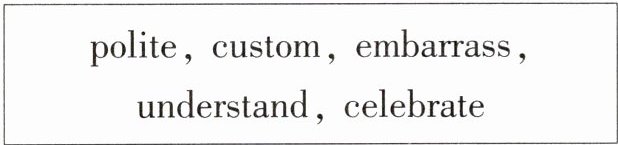
1. It's
2. We need to
3. She felt
4. Different countries have different
5. They
1. It's
polite
to wait for the host to start eating first in many cultures.2. We need to
understand
cultural differences when communicating with foreigners.3. She felt
embarrassed
when she realized she had used the wrong gesture to greet the boss.4. Different countries have different
customs
for festivals.5. They
celebrated
their success with a big dinner after the project was finished.答案
1. polite
2. understand
3. embarrassed
4. customs
5. celebrated
2. understand
3. embarrassed
4. customs
5. celebrated
解析
【分析】本题要求根据句意从方框内选择单词并使用适当形式填空,需先理解每个句子的语境,再结合单词的词义、词性及句子结构(如固定搭配、时态、单复数等)选择并变形单词。
【解析】
1. 句意:在很多文化中,等待主人先开始吃饭是礼貌的。此处需形容词作表语,方框中polite(礼貌的)符合语境,直接填原形。
2. 句意:和外国人交流时我们需要理解文化差异。need to后接动词原形,方框中understand(理解)符合,填原形。
3. 句意:当她意识到用错手势问候老板时,她感到尴尬。feel后需形容词修饰人,embarrass的形容词形式为embarrassed(尴尬的),符合语境。
4. 句意:不同国家的节日有不同的习俗。different后接可数名词复数,custom(习俗)的复数形式为customs,符合句意。
5. 句意:项目完成后,他们用一顿大餐庆祝了他们的成功。根据时间状语“after the project was finished”可知动作发生在过去,需用一般过去时,celebrate的过去式为celebrated,符合时态要求。
【答案】
1. polite
2. understand
3. embarrassed
4. customs
5. celebrated
【知识点】
形容词用法;动词形式;名词复数
【点评】
本题考查词汇在具体语境中的运用,需掌握方框内单词的词义及不同形式的变化,结合句子结构和时态等知识完成填空,是基础词汇运用题。
【难度系数】
0.7
【解析】
1. 句意:在很多文化中,等待主人先开始吃饭是礼貌的。此处需形容词作表语,方框中polite(礼貌的)符合语境,直接填原形。
2. 句意:和外国人交流时我们需要理解文化差异。need to后接动词原形,方框中understand(理解)符合,填原形。
3. 句意:当她意识到用错手势问候老板时,她感到尴尬。feel后需形容词修饰人,embarrass的形容词形式为embarrassed(尴尬的),符合语境。
4. 句意:不同国家的节日有不同的习俗。different后接可数名词复数,custom(习俗)的复数形式为customs,符合句意。
5. 句意:项目完成后,他们用一顿大餐庆祝了他们的成功。根据时间状语“after the project was finished”可知动作发生在过去,需用一般过去时,celebrate的过去式为celebrated,符合时态要求。
【答案】
1. polite
2. understand
3. embarrassed
4. customs
5. celebrated
【知识点】
形容词用法;动词形式;名词复数
【点评】
本题考查词汇在具体语境中的运用,需掌握方框内单词的词义及不同形式的变化,结合句子结构和时态等知识完成填空,是基础词汇运用题。
【难度系数】
0.7
(
A.so; that
B.such; that
C.too; to
D.enough; to
A
) 1. The Indian greeting is special many tourists don’t know how to respond.A.so; that
B.such; that
C.too; to
D.enough; to
答案
1. A
解析
【分析】本题考查英语结果状语从句相关句型的辨析。首先明确各选项的用法:①so...that:so后接形容词/副词,引导结果状语从句,意为“如此……以至于……”;②such...that:such后接名词(短语),引导结果状语从句;③too...to:too+形容词+to do sth,表“太……而不能”,后接动词原形;④enough...to:形容词+enough to do sth,表“足够……去做”,后接动词原形。题目中第二个空后是完整的句子(从句),因此排除后接动词原形的C、D选项;第一个空后是形容词special,需用so修饰,故选择A选项。
【解析】逐一分析选项:A项so...that中so修饰形容词special,后接结果状语从句,符合句子结构;B项such后需接名词短语,此处后接形容词,不符合;C、D项均需后接动词原形,而题目中第二个空后是从句,故排除。因此正确答案为A。
【答案】A
【知识点】结果状语从句;so...that句型;such...that句型
【点评】本题为英语基础句型辨析题,主要考查结果状语从句的常用引导结构,需准确区分so...that、such...that、too...to、enough...to的用法差异,属于学生应掌握的基础知识点,难度不大。
【难度系数】0.6
【解析】逐一分析选项:A项so...that中so修饰形容词special,后接结果状语从句,符合句子结构;B项such后需接名词短语,此处后接形容词,不符合;C、D项均需后接动词原形,而题目中第二个空后是从句,故排除。因此正确答案为A。
【答案】A
【知识点】结果状语从句;so...that句型;such...that句型
【点评】本题为英语基础句型辨析题,主要考查结果状语从句的常用引导结构,需准确区分so...that、such...that、too...to、enough...to的用法差异,属于学生应掌握的基础知识点,难度不大。
【难度系数】0.6
(
A.Unless
B.If
C.As soon as
D.Although
A
) 2. you learn about local customs, you will feel uncomfortable during your trip.A.Unless
B.If
C.As soon as
D.Although
答案
2. A
解析
【分析】首先明确本题考查连词的用法辨析,需先梳理句子逻辑关系,再逐一分析选项连词的含义,判断哪个连词符合句子逻辑。句子表达的是“______你了解当地习俗,你旅行期间会感到不舒服”,核心逻辑是“不了解当地习俗→会不舒服”,属于反向条件关系。
【解析】逐一分析选项:A. Unless意为“除非,如果不”,相当于if not,代入句子后语义为“除非你了解当地习俗,否则你旅行期间会感到不舒服”,符合逻辑;B. If意为“如果”,代入后句子语义为“如果你了解当地习俗,你会不舒服”,逻辑矛盾;C. As soon as意为“一…就…”,代入后句子逻辑不通;D. Although意为“虽然”,表让步关系,代入后不符合句子逻辑。因此正确选项为A。
【答案】A
【知识点】条件状语从句、连词辨析
【点评】本题考查连词在条件状语从句中的运用,核心是理清句子的逻辑关系,属于基础题型,需掌握常见连词的含义及适用语境。
【难度系数】0.7
【解析】逐一分析选项:A. Unless意为“除非,如果不”,相当于if not,代入句子后语义为“除非你了解当地习俗,否则你旅行期间会感到不舒服”,符合逻辑;B. If意为“如果”,代入后句子语义为“如果你了解当地习俗,你会不舒服”,逻辑矛盾;C. As soon as意为“一…就…”,代入后句子逻辑不通;D. Although意为“虽然”,表让步关系,代入后不符合句子逻辑。因此正确选项为A。
【答案】A
【知识点】条件状语从句、连词辨析
【点评】本题考查连词在条件状语从句中的运用,核心是理清句子的逻辑关系,属于基础题型,需掌握常见连词的含义及适用语境。
【难度系数】0.7
(
A.as soon as
B.unless
C.so that
D.until
A
) 3. He will call you he arrives in Paris.A.as soon as
B.unless
C.so that
D.until
答案
3. A
解析
【分析】这道题考查连词的词义辨析及状语从句引导词的用法。解题时需先明确句子逻辑:句子表达“他一到巴黎就会给你打电话”,需要选表示“一……就……”的连词;再逐一分析选项含义,结合语境判断正确答案。
【解析】逐一分析选项:A选项as soon as意为“一……就……”,引导时间状语从句,遵循“主将从现”原则(主句用一般将来时,从句用一般现在时表将来),符合句子“一到巴黎就打电话”的语境;B选项unless意为“除非”,表条件,不符合句意;C选项so that意为“以便、为了”,表目的,不符合;D选项until意为“直到……为止”,不符合句子逻辑。因此正确答案为A。
【答案】A
【知识点】时间状语从句;连词词义辨析
【点评】本题为基础连词辨析题,结合时间状语从句的引导词用法,考查学生对常用连词的掌握,属于初中英语基础考点。
【难度系数】0.5
【解析】逐一分析选项:A选项as soon as意为“一……就……”,引导时间状语从句,遵循“主将从现”原则(主句用一般将来时,从句用一般现在时表将来),符合句子“一到巴黎就打电话”的语境;B选项unless意为“除非”,表条件,不符合句意;C选项so that意为“以便、为了”,表目的,不符合;D选项until意为“直到……为止”,不符合句子逻辑。因此正确答案为A。
【答案】A
【知识点】时间状语从句;连词词义辨析
【点评】本题为基础连词辨析题,结合时间状语从句的引导词用法,考查学生对常用连词的掌握,属于初中英语基础考点。
【难度系数】0.5
(
A.too; to
B.so; that
C.such; that
D.enough; to
B
)4. It's impolite to point at people with chopsticks in China we should never do it.A.too; to
B.so; that
C.such; that
D.enough; to
答案
4. B
解析
【分析】首先明确各选项短语的结构用法:A选项too...to后接动词原形,表“太……而不能”;B选项so...that中so修饰形容词/副词,后接结果状语从句,表“如此……以至于”;C选项such...that中such修饰名词,后接从句;D选项enough...to后接动词原形,表“足够……做”。题目中第一空后是形容词impolite,第二空后是完整句子,需匹配符合“so+adj+that+从句”结构的选项。
【解析】逐一排除错误选项:A项too...to后接动词原形,无法搭配从句,排除;C项such需修饰名词,此处后为形容词impolite,不符合搭配,排除;D项enough...to后接动词原形,不能接从句,排除;B项so修饰形容词impolite,后接that引导的结果状语从句,符合句子结构,因此选B。
【答案】B
【知识点】so...that句型;常用连词短语辨析
【点评】本题考查初中英语基础语法中连词短语的用法辨析,需掌握不同短语的结构差异,属于常规基础题。
【难度系数】0.6
【解析】逐一排除错误选项:A项too...to后接动词原形,无法搭配从句,排除;C项such需修饰名词,此处后为形容词impolite,不符合搭配,排除;D项enough...to后接动词原形,不能接从句,排除;B项so修饰形容词impolite,后接that引导的结果状语从句,符合句子结构,因此选B。
【答案】B
【知识点】so...that句型;常用连词短语辨析
【点评】本题考查初中英语基础语法中连词短语的用法辨析,需掌握不同短语的结构差异,属于常规基础题。
【难度系数】0.6
(
A.if
B.unless
C.as soon as
D.so that
B
)5. You can't use someone's first name in Mexico they invite you to do so.A.if
B.unless
C.as soon as
D.so that
答案
5. B
解析
【分析】首先理解句子意思:“在墨西哥,你不能使用别人的名字,________他们邀请你这么做”,需要判断空格处的连词,要体现“除非”的条件关系。接着逐一分析选项的含义和用法,匹配句子逻辑即可得出答案。
【解析】先翻译句子:“在墨西哥,你不能使用别人的名字,除非他们邀请你这么做”。对选项逐一分析:A. if(如果),代入后逻辑不通;B. unless(除非),相当于if not,引导条件状语从句,符合句子逻辑;C. as soon as(一……就),引导时间状语从句,不符合语境;D. so that(以便),引导目的状语从句,不符合语境。因此正确答案为B。
【答案】B
【知识点】从属连词(unless用法)、条件状语从句
【点评】本题考查条件状语从句中连词的辨析,需准确理解句意及各连词的含义,属于基础语法题,难度适中。
【难度系数】0.6
【解析】先翻译句子:“在墨西哥,你不能使用别人的名字,除非他们邀请你这么做”。对选项逐一分析:A. if(如果),代入后逻辑不通;B. unless(除非),相当于if not,引导条件状语从句,符合句子逻辑;C. as soon as(一……就),引导时间状语从句,不符合语境;D. so that(以便),引导目的状语从句,不符合语境。因此正确答案为B。
【答案】B
【知识点】从属连词(unless用法)、条件状语从句
【点评】本题考查条件状语从句中连词的辨析,需准确理解句意及各连词的含义,属于基础语法题,难度适中。
【难度系数】0.6
Ⅳ. 阅读理解,选择最佳选项。
In our globalized world, we often meet people from different cultural backgrounds—at school, at work, or even online. But why is it so important to understand these different cultures? The answer lies in the basic need for connection and respect, and the logic behind it goes far beyond just “being polite”.
Understanding cultures helps avoid unnecessary misunderstandings. Every culture has its own “unwritten rules” for daily life.
For example, in some Middle Eastern countries, it’s rude to show the sole (脚底) of your foot to others; in parts of Europe, people kiss cheeks to greet each other, while in Asia, shaking hands or bowing is more common. If we don’t know these rules, we might accidentally make others uncomfortable. A simple mistake—like refusing a cup of tea in Saudi Arabia ( where it’s a sign of disrespect)—could hurt a relationship before it even starts. These misunderstandings happen not because people are “rude”, but because they don’t know each other’s cultural norms.
Also, cultural understanding builds real respect. When we learn about other cultures, we start to see that there are many valid ways to live. For instance, some cultures value collective success (like working as a team to achieve a goal), while others focus more on individual achievements. Neither way is “better”—they’re just different responses to the challenges of life. When we recognize this, we stop judging others by our own cultural standards and start respecting their choices. This respect is the foundation of any strong relationship, whether it’s between friends, colleagues, or even countries.
Understanding cultures helps us grow as individuals. Learning about how people in other countries celebrate festivals, solve problems, or express emotions exposes us to new ideas. For example, learning about Japanese “ikigai” (the reason for being) can make us think about our own life goals; trying Indian “jugaad” (creating a cheap alternative solution) can teach us to be more flexible. These new ideas broaden our horizons and
make us more open-minded—skills that are valuable in every part of life.
The logic of understanding different cultures is clear: It helps us connect with others, respect differences and grow as people. It’s not just a nice skill to have—it’s essential for living in our global community.
(
A. To show that Saudi Arabia has strict rules.
B. To compare gift-giving customs in different countries.
C. To prove that tea is important in Middle Eastern countries.
D. To explain how cultural ignorance causes misunderstandings.
(
A. Different cultures have different ways to solve problems.
B. We should never judge others by our own cultural standards.
C. Learning about other cultures helps us build respect for others.
D. Collective success is more important than individual achievements.
(
A. How to Avoid Cultural Misunderstandings?
B. Different Cultural Norms Around the World
C. How to Build Respect Between Different Cultures?
D. Why Is Understanding Different Cultures Important?
In our globalized world, we often meet people from different cultural backgrounds—at school, at work, or even online. But why is it so important to understand these different cultures? The answer lies in the basic need for connection and respect, and the logic behind it goes far beyond just “being polite”.
Understanding cultures helps avoid unnecessary misunderstandings. Every culture has its own “unwritten rules” for daily life.
For example, in some Middle Eastern countries, it’s rude to show the sole (脚底) of your foot to others; in parts of Europe, people kiss cheeks to greet each other, while in Asia, shaking hands or bowing is more common. If we don’t know these rules, we might accidentally make others uncomfortable. A simple mistake—like refusing a cup of tea in Saudi Arabia ( where it’s a sign of disrespect)—could hurt a relationship before it even starts. These misunderstandings happen not because people are “rude”, but because they don’t know each other’s cultural norms.
Also, cultural understanding builds real respect. When we learn about other cultures, we start to see that there are many valid ways to live. For instance, some cultures value collective success (like working as a team to achieve a goal), while others focus more on individual achievements. Neither way is “better”—they’re just different responses to the challenges of life. When we recognize this, we stop judging others by our own cultural standards and start respecting their choices. This respect is the foundation of any strong relationship, whether it’s between friends, colleagues, or even countries.
Understanding cultures helps us grow as individuals. Learning about how people in other countries celebrate festivals, solve problems, or express emotions exposes us to new ideas. For example, learning about Japanese “ikigai” (the reason for being) can make us think about our own life goals; trying Indian “jugaad” (creating a cheap alternative solution) can teach us to be more flexible. These new ideas broaden our horizons and
make us more open-minded—skills that are valuable in every part of life.
The logic of understanding different cultures is clear: It helps us connect with others, respect differences and grow as people. It’s not just a nice skill to have—it’s essential for living in our global community.
(
D
) 1. Why does the writer mention refusing tea in Saudi Arabia?A. To show that Saudi Arabia has strict rules.
B. To compare gift-giving customs in different countries.
C. To prove that tea is important in Middle Eastern countries.
D. To explain how cultural ignorance causes misunderstandings.
(
C
) 2. What is the main idea of Paragraph 3?A. Different cultures have different ways to solve problems.
B. We should never judge others by our own cultural standards.
C. Learning about other cultures helps us build respect for others.
D. Collective success is more important than individual achievements.
(
D
) 3. Which of the following is the best title for the passage?A. How to Avoid Cultural Misunderstandings?
B. Different Cultural Norms Around the World
C. How to Build Respect Between Different Cultures?
D. Why Is Understanding Different Cultures Important?
答案
1. D
2. C
3. D
2. C
3. D
解析
【分析】
解题思路:1. 第1题是细节理解题,需定位原文中“拒绝沙特的茶”的例子所在段落,结合段落核心主旨判断例子的作用;2. 第2题是段落主旨题,需分析对应段落的核心句(通常为段首句),提炼段落核心观点;3. 第3题是全文主旨题,需梳理各段核心内容,总结全文围绕的核心问题。
【解析】
1. 细节理解题:定位到原文第3段,该段首句明确“文化理解有助于避免不必要的误解”,随后通过“拒绝沙特的茶”的例子,说明因不了解当地文化规范(文化无知)会导致误解,对应选项D。A选项“沙特阿拉伯有严格规则”、B选项“比较不同国家的送礼习俗”、C选项“证明茶在中东国家的重要性”均与例子的作用不符,故选D。
2. 段落主旨题:对应段落(原文第4段)段首句为“Also, cultural understanding builds real respect”,后续内容围绕“文化理解如何建立对他人的尊重”展开,对应选项C。A选项“不同文化有不同的解决问题的方式”、B选项“不应以自身文化标准评判他人”、D选项“集体成功比个人成就更重要”均非该段主旨,故选C。
3. 全文主旨题:全文围绕“为什么理解不同文化重要”展开,分别从避免误解、建立尊重、促进个人成长三个方面阐述,对应选项D。A选项“如何避免文化误解”、B选项“世界各地的文化规范”、C选项“如何建立不同文化间的尊重”均为文章局部内容,非全文主旨,故选D。
【答案】
1.D 2.C 3.D
【知识点】
英语阅读理解、细节理解、主旨大意
【点评】
本题为英语阅读理解常规题型,考查细节定位、段落主旨及全文主旨的把握,需学生准确梳理原文逻辑,提炼核心信息。
【难度系数】
0.6
解题思路:1. 第1题是细节理解题,需定位原文中“拒绝沙特的茶”的例子所在段落,结合段落核心主旨判断例子的作用;2. 第2题是段落主旨题,需分析对应段落的核心句(通常为段首句),提炼段落核心观点;3. 第3题是全文主旨题,需梳理各段核心内容,总结全文围绕的核心问题。
【解析】
1. 细节理解题:定位到原文第3段,该段首句明确“文化理解有助于避免不必要的误解”,随后通过“拒绝沙特的茶”的例子,说明因不了解当地文化规范(文化无知)会导致误解,对应选项D。A选项“沙特阿拉伯有严格规则”、B选项“比较不同国家的送礼习俗”、C选项“证明茶在中东国家的重要性”均与例子的作用不符,故选D。
2. 段落主旨题:对应段落(原文第4段)段首句为“Also, cultural understanding builds real respect”,后续内容围绕“文化理解如何建立对他人的尊重”展开,对应选项C。A选项“不同文化有不同的解决问题的方式”、B选项“不应以自身文化标准评判他人”、D选项“集体成功比个人成就更重要”均非该段主旨,故选C。
3. 全文主旨题:全文围绕“为什么理解不同文化重要”展开,分别从避免误解、建立尊重、促进个人成长三个方面阐述,对应选项D。A选项“如何避免文化误解”、B选项“世界各地的文化规范”、C选项“如何建立不同文化间的尊重”均为文章局部内容,非全文主旨,故选D。
【答案】
1.D 2.C 3.D
【知识点】
英语阅读理解、细节理解、主旨大意
【点评】
本题为英语阅读理解常规题型,考查细节定位、段落主旨及全文主旨的把握,需学生准确梳理原文逻辑,提炼核心信息。
【难度系数】
0.6
