

 登录
登录
一、用所给单词的适当形式填空。
1. Mary
2. The waiters are very friendly, and we're happy with their
3. —Do you still feel
—Yes, I do. I can't get enough sleep.
4. After getting dressed, I start to wash my face and brush my
5. We all want to know how to make healthy
1. Mary
usually
(usual) rides her bike to get to school. She thinks it is a good way to exercise.2. The waiters are very friendly, and we're happy with their
service
(serve).3. —Do you still feel
sleepy
(sleep), David?—Yes, I do. I can't get enough sleep.
4. After getting dressed, I start to wash my face and brush my
teeth
(tooth).5. We all want to know how to make healthy
balanced
(balance) meals.答案
1. usually
2. service
3. sleepy
4. teeth
5. balanced
2. service
3. sleepy
4. teeth
5. balanced
解析
【分析】本题为英语词汇适当形式填空题,解题核心是结合句子成分判断所需词性,再运用词汇变形规则完成填空。具体思路:1. 修饰动词需用副词;2. 形容词性物主代词后接名词;3. 系动词后接形容词作表语;4. 表示身体部位的名词常用复数;5. 修饰名词需用形容词。
【解析】1. 句中修饰动词rides,需将形容词usual变为副词usually;2. their是形容词性物主代词,后接名词,将动词serve变为名词service;3. feel是系动词,后接形容词,将动词sleep变为形容词sleepy;4. 刷牙时牙齿用复数,名词tooth的复数形式为teeth;5. 修饰名词meals需用形容词,将名词balance变为形容词balanced。
【答案】1. usually 2. service 3. sleepy 4. teeth 5. balanced
【知识点】词性转换、词汇运用
【点评】本题为基础英语词汇变形题,考察常见词汇的词性转换规则,属于英语基础题型,难度适中。
【难度系数】0.8
【解析】1. 句中修饰动词rides,需将形容词usual变为副词usually;2. their是形容词性物主代词,后接名词,将动词serve变为名词service;3. feel是系动词,后接形容词,将动词sleep变为形容词sleepy;4. 刷牙时牙齿用复数,名词tooth的复数形式为teeth;5. 修饰名词meals需用形容词,将名词balance变为形容词balanced。
【答案】1. usually 2. service 3. sleepy 4. teeth 5. balanced
【知识点】词性转换、词汇运用
【点评】本题为基础英语词汇变形题,考察常见词汇的词性转换规则,属于英语基础题型,难度适中。
【难度系数】0.8
二、补全对话。
Waiter:Can I help you?
Helen:6.
Waiter:Of course, here you are.
(5 minutes later)
Waiter:OK, so what can I get you?
Helen:7.
Waiter:And what would you like to drink?
Helen:8.
Waiter:And would you like a dessert?
Helen:9.
Waiter:OK, so that's a cheese omelette, an orange juice and a strawberry ice cream.
(20 minutes later)
Helen:10.
Waiter:Of course. That's £20.
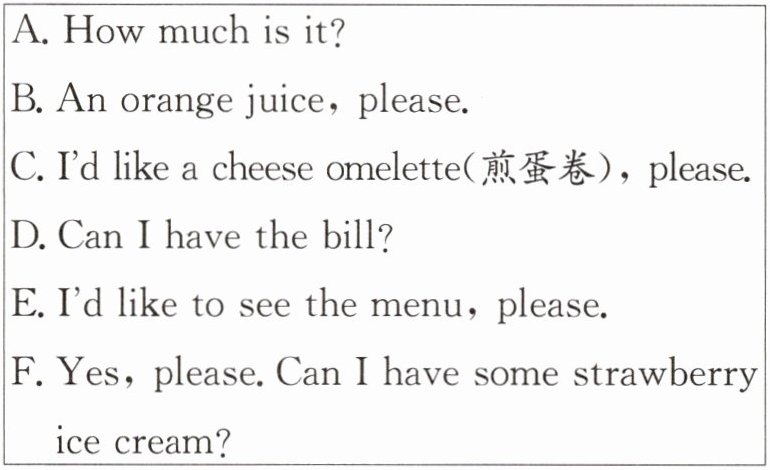
Waiter:Can I help you?
Helen:6.
E
Waiter:Of course, here you are.
(5 minutes later)
Waiter:OK, so what can I get you?
Helen:7.
C
Waiter:And what would you like to drink?
Helen:8.
B
Waiter:And would you like a dessert?
Helen:9.
F
Waiter:OK, so that's a cheese omelette, an orange juice and a strawberry ice cream.
(20 minutes later)
Helen:10.
D
Waiter:Of course. That's £20.
答案
6. E
7. C
8. B
9. F
10. D
7. C
8. B
9. F
10. D
解析
【分析】本题是餐厅点餐场景的补全对话,需结合上下文的问答逻辑匹配对应选项:第6空服务员提供帮助,海伦需要菜单,对应选项E;第7空服务员询问餐品,对应选项C;第8空询问饮品,对应选项B;第9空询问甜点,对应选项F;第10空需结账,对应选项D。
【解析】1. 第6空:服务员问"Can I help you?",后续服务员回应"Of course, here you are.",说明海伦需要菜单,匹配选项E(I'd like to see the menu, please.),故填E。2. 第7空:服务员问"what can I get you?"(你要点什么餐),匹配选项C(I'd like a cheese omelette, please.),故填C。3. 第8空:服务员问"what would you like to drink?"(想喝什么),匹配选项B(An orange juice, please.),故填B。4. 第9空:服务员问"would you like a dessert?"(要甜点吗),匹配选项F(Yes, please. Can I have some strawberry ice cream?),故填F。5. 第10空:服务员报完餐品后,海伦要结账,匹配选项D(Can I have the bill?),故填D。
【答案】6.E 7.C 8.B 9.F 10.D
【知识点】英语日常交际用语、补全对话
【点评】本题为餐厅点餐场景的补全对话,考查日常交际用语的运用,需结合上下文语境分析,属于基础题型,难度较低。
【难度系数】0.7
【解析】1. 第6空:服务员问"Can I help you?",后续服务员回应"Of course, here you are.",说明海伦需要菜单,匹配选项E(I'd like to see the menu, please.),故填E。2. 第7空:服务员问"what can I get you?"(你要点什么餐),匹配选项C(I'd like a cheese omelette, please.),故填C。3. 第8空:服务员问"what would you like to drink?"(想喝什么),匹配选项B(An orange juice, please.),故填B。4. 第9空:服务员问"would you like a dessert?"(要甜点吗),匹配选项F(Yes, please. Can I have some strawberry ice cream?),故填F。5. 第10空:服务员报完餐品后,海伦要结账,匹配选项D(Can I have the bill?),故填D。
【答案】6.E 7.C 8.B 9.F 10.D
【知识点】英语日常交际用语、补全对话
【点评】本题为餐厅点餐场景的补全对话,考查日常交际用语的运用,需结合上下文语境分析,属于基础题型,难度较低。
【难度系数】0.7
三、根据短文内容,选择合适的句子填入文中空缺处,使文章意思通顺,内容完整。
There are many eating habits in the world. What are the eating habits in your country? How many meals do you have every day in your country? 11.
In England, people have breakfast at any time from seven to nine in the morning. 12.
A. For dinner, they have soup first.
B. They have porridge, eggs or bread.
C. What time do you have each meal?
D. For lunch, they often have rice and meat.
E. But not all the English people eat like that.
F. In many English families, people eat four meals a day.
G. At dinner, all the family members come home to eat together.
There are many eating habits in the world. What are the eating habits in your country? How many meals do you have every day in your country? 11.
F
They have breakfast, lunch, afternoon tea, and dinner.In England, people have breakfast at any time from seven to nine in the morning. 12.
B
English people also drink tea or coffee for breakfast. People usually eat lunch at 1:00 in the afternoon. Afternoon tea is from 4:00 p. m. to 5:00 p. m. and dinner is at about 7:30 p. m. 13. A
Then they have meat or fish with vegetables. After that, they eat some fruit like bananas, apples, and oranges. 14. E
Some of them have their dinner in the middle of the day—at about 12:00 at noon. 15. G
They think the dinner time is very important. They call the last meal of the day "supper".A. For dinner, they have soup first.
B. They have porridge, eggs or bread.
C. What time do you have each meal?
D. For lunch, they often have rice and meat.
E. But not all the English people eat like that.
F. In many English families, people eat four meals a day.
G. At dinner, all the family members come home to eat together.
答案
11. F
12. B
13. A
14. E
15. G
12. B
13. A
14. E
15. G
解析
【分析】
这是一道英语补全短文题,解题思路为:先通读全文明确主题是介绍英国的饮食习惯(一天四餐),再逐句分析空缺处的上下文语境、话题衔接及逻辑关系,结合选项内容匹配对应空缺。比如第11空后列举四餐,需对应“一天四餐”的表述;第12空对应早餐食物;第13空对应晚餐顺序;第14空对应转折的不同情况;第15空对应晚餐的家庭场景。
【解析】
1. 第11空:前文询问一天几餐,后文列举四餐,需选“一天四餐”的表述,对应选项F(In many English families, people eat four meals a day.)。
2. 第12空:前文介绍早餐时间,后文提到早餐喝茶或咖啡,中间需补充早餐食物,对应选项B(They have porridge, eggs or bread.)。
3. 第13空:后文提到“然后吃肉或鱼加蔬菜”,此处是晚餐第一步,对应选项A(For dinner, they have soup first.)。
4. 第14空:前文讲英国人晚餐在晚上,后文提到有些人中午吃正餐,是转折关系,对应选项E(But not all the English people eat like that.)。
5. 第15空:后文提到“晚餐时间重要,家人一起吃”,对应选项G(At dinner, all the family members come home to eat together.)。
【答案】
11.F 12.B 13.A 14.E 15.G
【知识点】
英语补全短文、语境衔接、逻辑推理
【点评】
本题为英语阅读理解中的补全短文题型,考查学生对文章语境、话题一致性及逻辑关系的把握,需结合上下文细节匹配选项,难度适中,适合初中阶段学生练习。
【难度系数】
0.6
这是一道英语补全短文题,解题思路为:先通读全文明确主题是介绍英国的饮食习惯(一天四餐),再逐句分析空缺处的上下文语境、话题衔接及逻辑关系,结合选项内容匹配对应空缺。比如第11空后列举四餐,需对应“一天四餐”的表述;第12空对应早餐食物;第13空对应晚餐顺序;第14空对应转折的不同情况;第15空对应晚餐的家庭场景。
【解析】
1. 第11空:前文询问一天几餐,后文列举四餐,需选“一天四餐”的表述,对应选项F(In many English families, people eat four meals a day.)。
2. 第12空:前文介绍早餐时间,后文提到早餐喝茶或咖啡,中间需补充早餐食物,对应选项B(They have porridge, eggs or bread.)。
3. 第13空:后文提到“然后吃肉或鱼加蔬菜”,此处是晚餐第一步,对应选项A(For dinner, they have soup first.)。
4. 第14空:前文讲英国人晚餐在晚上,后文提到有些人中午吃正餐,是转折关系,对应选项E(But not all the English people eat like that.)。
5. 第15空:后文提到“晚餐时间重要,家人一起吃”,对应选项G(At dinner, all the family members come home to eat together.)。
【答案】
11.F 12.B 13.A 14.E 15.G
【知识点】
英语补全短文、语境衔接、逻辑推理
【点评】
本题为英语阅读理解中的补全短文题型,考查学生对文章语境、话题一致性及逻辑关系的把握,需结合上下文细节匹配选项,难度适中,适合初中阶段学生练习。
【难度系数】
0.6
