

 登录
登录
C(2026·南京鼓楼区期末)
请认真阅读下面短文,根据所读内容在文章后表格中第1—8小题的空格里填入一个最恰当的单词,第9题不少于20词。
On 7 February 1812, Charles Dickens was born in Portsmouth, England. Charles was the eldest child in the family. The Dickens family often had money troubles, so they had to borrow money from their friends and relatives. What's more, Charles' father's job required the family to move from place to place quite often.
In February 1824, his father owed(欠) money and was put into prison. The Dickens family had to sell all their things. Charles was sent to work in his uncle's factory to make money. There were many rats in the factory, and Charles hated this job very much.
Two months later, Charles' grandmother died. His father used £450 she left to pay back his debts(债务) and was set free from prison. Charles went back to school and studied at Wellington House Academy for two years. However, his father got into debt again, so he had to leave school to work. This time, he worked in a lawyer's office, but he didn't like the job. So he left and became a reporter for newspapers. He travelled around the country to collect news, and wrote his reports in an uncomfortable stagecoach(驿站马车) when he was on his way back to London.
In 1833, Charles Dickens sold his first short story, and his works soon became very popular. In 1836, he married Catherine Hogarth. When Dickens walked around London to look for ideas for his novels, people could easily know who he was. He even went to America to speak about his works. He put all the things he had seen in real life into his books, telling people how hard and unhappy the life of poor people was.
In 1864, he was in a serious train crash. Although he was not hurt, ten people died and Dickens helped the wounded. This frightening experience left him so nervous about travelling by train that he hardly ever took it for the rest of his life. He passed away at his home on 9 June 1870. Following his wishes for a simple ceremony, only 12 people went to his burial(葬礼). At the time of his death, he was still working on a new novel.
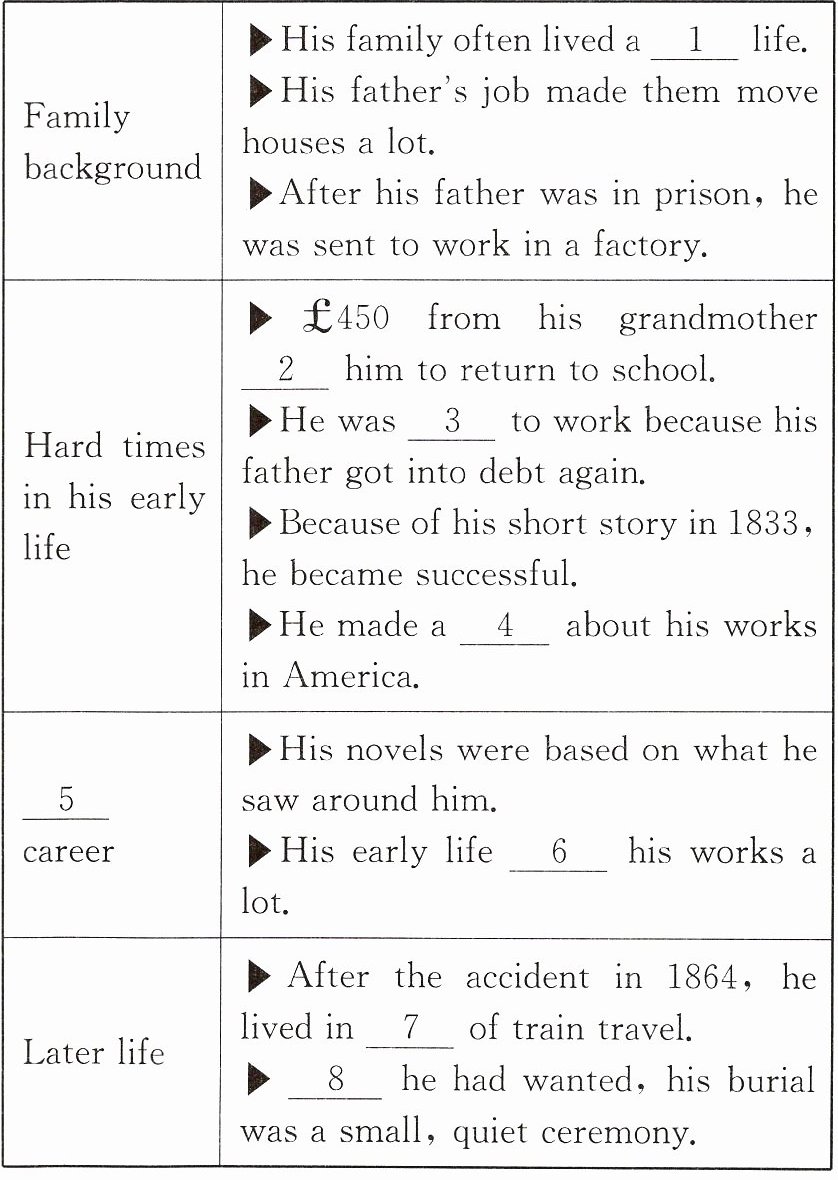
9. 新考法 开放式谈收获 What can you learn from Charles Dickens' story? (At least 20 words)
1.
2.
3.
4.
5.
6.
7.
8.
请认真阅读下面短文,根据所读内容在文章后表格中第1—8小题的空格里填入一个最恰当的单词,第9题不少于20词。
On 7 February 1812, Charles Dickens was born in Portsmouth, England. Charles was the eldest child in the family. The Dickens family often had money troubles, so they had to borrow money from their friends and relatives. What's more, Charles' father's job required the family to move from place to place quite often.
In February 1824, his father owed(欠) money and was put into prison. The Dickens family had to sell all their things. Charles was sent to work in his uncle's factory to make money. There were many rats in the factory, and Charles hated this job very much.
Two months later, Charles' grandmother died. His father used £450 she left to pay back his debts(债务) and was set free from prison. Charles went back to school and studied at Wellington House Academy for two years. However, his father got into debt again, so he had to leave school to work. This time, he worked in a lawyer's office, but he didn't like the job. So he left and became a reporter for newspapers. He travelled around the country to collect news, and wrote his reports in an uncomfortable stagecoach(驿站马车) when he was on his way back to London.
In 1833, Charles Dickens sold his first short story, and his works soon became very popular. In 1836, he married Catherine Hogarth. When Dickens walked around London to look for ideas for his novels, people could easily know who he was. He even went to America to speak about his works. He put all the things he had seen in real life into his books, telling people how hard and unhappy the life of poor people was.
In 1864, he was in a serious train crash. Although he was not hurt, ten people died and Dickens helped the wounded. This frightening experience left him so nervous about travelling by train that he hardly ever took it for the rest of his life. He passed away at his home on 9 June 1870. Following his wishes for a simple ceremony, only 12 people went to his burial(葬礼). At the time of his death, he was still working on a new novel.
9. 新考法 开放式谈收获 What can you learn from Charles Dickens' story? (At least 20 words)
We can learn that even if we face many difficulties in life, we can turn them into valuable experiences and achieve great things through hard work and persistence.(开放性试题,答案言之有理即可)
1.
poor/hard/difficult
2.
allowed/helped
3.
forced/made
4.
speech
5.
Writing
6.
influenced/affected
7.
fear/terror
8.
As
答案
1. poor/hard/difficult
2. allowed/helped
3. forced/made
4. speech
5. Writing
6. influenced/affected
7. fear/terror
8. As
9. We can learn that even if we face many difficulties in life, we can turn them into valuable experiences and achieve great things through hard work and persistence.(开放性试题,答案言之有理即可)
2. allowed/helped
3. forced/made
4. speech
5. Writing
6. influenced/affected
7. fear/terror
8. As
9. We can learn that even if we face many difficulties in life, we can turn them into valuable experiences and achieve great things through hard work and persistence.(开放性试题,答案言之有理即可)
解析
【分析】
这是人物传记类的阅读填词题,解题思路如下:1. 先通读全文梳理狄更斯的完整生平脉络,对应表格的四个模块(家庭背景、早年艰难时光、事业、晚年生活)明确每个空的语义方向;2. 逐个空回到原文定位对应的描述语句,结合上下文的语义、语法规则(时态、语态、固定搭配)推导最恰当的单词;3. 最后开放题结合人物经历提炼正向感悟,满足不少于20词的要求即可。
【解析】
1. 定位原文第一段"The Dickens family often had money troubles",可知他家生活拮据、十分艰难,可填poor/hard/difficult。
2. 定位原文第三段"His father used £450 she left to pay back his debts...Charles went back to school",这笔来自祖母的钱帮助/让他得以重返校园,描述过去发生的事,用过去式allowed/helped。
3. 定位原文第三段"his father got into debt again, so he had to leave school to work",他是被迫去工作的,本句为被动语态,符合be done结构,填forced/made。
4. 定位原文第四段"He even went to America to speak about his works",对应固定搭配make a speech(做演讲),填speech。
5. 本栏介绍狄更斯和创作相关的职业经历,对应后文的小说、作品相关内容,填首字母大写的Writing。
6. 定位原文第四段"He put all the things he had seen in real life into his books",可知他的早年生活对他的作品影响很大,描述过去的事件用过去式,填influenced/affected。
7. 定位原文最后一段"This frightening experience left him so nervous about travelling by train that he hardly ever took it for the rest of his life",对应固定搭配in fear of(对……感到恐惧),填fear/terror。
8. 定位原文最后一段"Following his wishes for a simple ceremony",表示“正如他之前所期望的那样”,句首首字母大写,填As。
9. 开放题围绕狄更斯在困境中坚持奋斗、将人生经历转化为创作财富的角度作答,言之有理、不少于20词即可,示例答案符合要求。
【答案】
1. poor/hard/difficult
2. allowed/helped
3. forced/made
4. speech
5. Writing
6. influenced/affected
7. fear/terror
8. As
9. We can learn that even if we face many difficulties in life, we can turn them into valuable experiences and achieve great things through hard work and persistence.(开放性试题,答案言之有理即可)
【知识点】
阅读信息提取,动词时态语态,固定短语搭配
【点评】
本题属于人物传记类综合阅读题型,既考查学生快速定位原文细节的能力,也要求学生结合语法规则灵活转换词汇,部分空无法直接照搬原文原词,需要结合语义推导,最后的开放设问引导学生从人物生平中获得正向成长启发,兼顾基础能力考查和素养引导。
【难度系数】
0.6
这是人物传记类的阅读填词题,解题思路如下:1. 先通读全文梳理狄更斯的完整生平脉络,对应表格的四个模块(家庭背景、早年艰难时光、事业、晚年生活)明确每个空的语义方向;2. 逐个空回到原文定位对应的描述语句,结合上下文的语义、语法规则(时态、语态、固定搭配)推导最恰当的单词;3. 最后开放题结合人物经历提炼正向感悟,满足不少于20词的要求即可。
【解析】
1. 定位原文第一段"The Dickens family often had money troubles",可知他家生活拮据、十分艰难,可填poor/hard/difficult。
2. 定位原文第三段"His father used £450 she left to pay back his debts...Charles went back to school",这笔来自祖母的钱帮助/让他得以重返校园,描述过去发生的事,用过去式allowed/helped。
3. 定位原文第三段"his father got into debt again, so he had to leave school to work",他是被迫去工作的,本句为被动语态,符合be done结构,填forced/made。
4. 定位原文第四段"He even went to America to speak about his works",对应固定搭配make a speech(做演讲),填speech。
5. 本栏介绍狄更斯和创作相关的职业经历,对应后文的小说、作品相关内容,填首字母大写的Writing。
6. 定位原文第四段"He put all the things he had seen in real life into his books",可知他的早年生活对他的作品影响很大,描述过去的事件用过去式,填influenced/affected。
7. 定位原文最后一段"This frightening experience left him so nervous about travelling by train that he hardly ever took it for the rest of his life",对应固定搭配in fear of(对……感到恐惧),填fear/terror。
8. 定位原文最后一段"Following his wishes for a simple ceremony",表示“正如他之前所期望的那样”,句首首字母大写,填As。
9. 开放题围绕狄更斯在困境中坚持奋斗、将人生经历转化为创作财富的角度作答,言之有理、不少于20词即可,示例答案符合要求。
【答案】
1. poor/hard/difficult
2. allowed/helped
3. forced/made
4. speech
5. Writing
6. influenced/affected
7. fear/terror
8. As
9. We can learn that even if we face many difficulties in life, we can turn them into valuable experiences and achieve great things through hard work and persistence.(开放性试题,答案言之有理即可)
【知识点】
阅读信息提取,动词时态语态,固定短语搭配
【点评】
本题属于人物传记类综合阅读题型,既考查学生快速定位原文细节的能力,也要求学生结合语法规则灵活转换词汇,部分空无法直接照搬原文原词,需要结合语义推导,最后的开放设问引导学生从人物生平中获得正向成长启发,兼顾基础能力考查和素养引导。
【难度系数】
0.6
