

 登录
登录
我们经常听人们说这个梯子放得“陡”,那个梯子放得“平缓”,人们是如何判断的?
“陡”或“平缓”是用来描述梯子的什么?
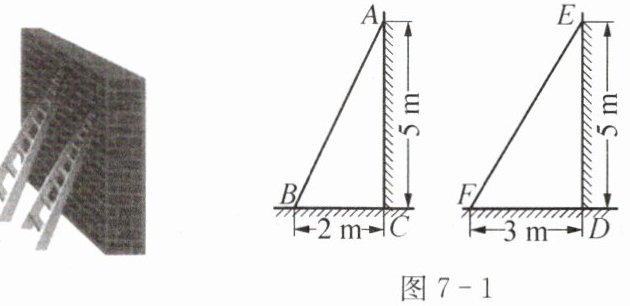
观察图7-1中的梯子AB和EF,哪个更陡?你是怎样判断的?
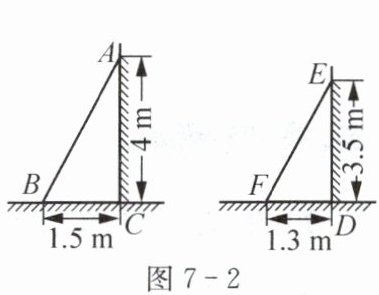
观察图7-2中的梯子AB和EF,哪个更陡?你是怎样判断的?
“陡”或“平缓”是用来描述梯子的什么?
观察图7-1中的梯子AB和EF,哪个更陡?你是怎样判断的?
观察图7-2中的梯子AB和EF,哪个更陡?你是怎样判断的?
答案
解:
人们通过观察梯子的倾斜程度判断,“陡”或“平缓”是用来描述梯子的倾斜程度。
图7-1中:
计算梯子竖直高度与水平宽度的比值:
梯子AB:$\frac{AC}{BC}=\frac{5}{2}=2.5$,
梯子EF:$\frac{ED}{FD}=\frac{5}{3}\approx1.67$,
因为$2.5>1.67$,竖直高度相同时,水平宽度越小,梯子越陡,故梯子AB更陡。
图7-2中:
计算梯子竖直高度与水平宽度的比值:
梯子AB:$\frac{AC}{BC}=\frac{4}{1.5}\approx2.67$,
梯子EF:$\frac{ED}{FD}=\frac{3.5}{1.3}\approx2.69$,
因为$2.69>2.67$,该比值越大,梯子倾斜程度越大,越陡,故梯子EF更陡。
人们通过观察梯子的倾斜程度判断,“陡”或“平缓”是用来描述梯子的倾斜程度。
图7-1中:
计算梯子竖直高度与水平宽度的比值:
梯子AB:$\frac{AC}{BC}=\frac{5}{2}=2.5$,
梯子EF:$\frac{ED}{FD}=\frac{5}{3}\approx1.67$,
因为$2.5>1.67$,竖直高度相同时,水平宽度越小,梯子越陡,故梯子AB更陡。
图7-2中:
计算梯子竖直高度与水平宽度的比值:
梯子AB:$\frac{AC}{BC}=\frac{4}{1.5}\approx2.67$,
梯子EF:$\frac{ED}{FD}=\frac{3.5}{1.3}\approx2.69$,
因为$2.69>2.67$,该比值越大,梯子倾斜程度越大,越陡,故梯子EF更陡。
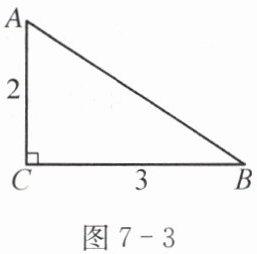
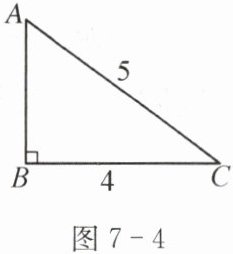
例1 分别求出图7-3、图7-4中Rt△ABC的边AB的长及$\tan A$的值.
分析 想要求出$\tan A$的值,只要抓住正切的定义即可.
解 如图7-3,在Rt△ABC中,$AC=2$,$BC=3$,
$\therefore AB=\sqrt{AC^{2}+BC^{2}}=\sqrt{4+9}=\sqrt{13}$.
$\therefore \tan A=\dfrac{BC}{AC}=\dfrac{3}{2}$.
如图7-4,在Rt△ABC中,$BC=4$,$AC=5$,
$\therefore AB=\sqrt{AC^{2}-BC^{2}}=\sqrt{25-16}=3$.
$\therefore \tan A=\dfrac{BC}{AB}=\dfrac{4}{3}$.
分析 想要求出$\tan A$的值,只要抓住正切的定义即可.
解 如图7-3,在Rt△ABC中,$AC=2$,$BC=3$,
$\therefore AB=\sqrt{AC^{2}+BC^{2}}=\sqrt{4+9}=\sqrt{13}$.
$\therefore \tan A=\dfrac{BC}{AC}=\dfrac{3}{2}$.
如图7-4,在Rt△ABC中,$BC=4$,$AC=5$,
$\therefore AB=\sqrt{AC^{2}-BC^{2}}=\sqrt{25-16}=3$.
$\therefore \tan A=\dfrac{BC}{AB}=\dfrac{4}{3}$.
答案
解:
如图7-3,在$\mathrm{Rt}△ ABC$中,$∠ C=90°$,$AC=2$,$BC=3$,
$\therefore AB=\sqrt{AC^{2}+BC^{2}}=\sqrt{2^{2}+3^{2}}=\sqrt{4+9}=\sqrt{13}$,
$\therefore \tan A=\dfrac{BC}{AC}=\dfrac{3}{2}$。
如图7-4,在$\mathrm{Rt}△ ABC$中,$∠ B=90°$,$BC=4$,$AC=5$,
$\therefore AB=\sqrt{AC^{2}-BC^{2}}=\sqrt{5^{2}-4^{2}}=\sqrt{25-16}=3$,
$\therefore \tan A=\dfrac{BC}{AB}=\dfrac{4}{3}$。
如图7-3,在$\mathrm{Rt}△ ABC$中,$∠ C=90°$,$AC=2$,$BC=3$,
$\therefore AB=\sqrt{AC^{2}+BC^{2}}=\sqrt{2^{2}+3^{2}}=\sqrt{4+9}=\sqrt{13}$,
$\therefore \tan A=\dfrac{BC}{AC}=\dfrac{3}{2}$。
如图7-4,在$\mathrm{Rt}△ ABC$中,$∠ B=90°$,$BC=4$,$AC=5$,
$\therefore AB=\sqrt{AC^{2}-BC^{2}}=\sqrt{5^{2}-4^{2}}=\sqrt{25-16}=3$,
$\therefore \tan A=\dfrac{BC}{AB}=\dfrac{4}{3}$。
例2 如图7-5,在Rt△ABC中,$∠ C=90°$,$AB:BC=5:3$,求$\tan A$和$\tan B$的值.
解 在Rt△ABC中,$∠ C=90°$,$AB:BC=5:3$,
可设$AB=5k$,$BC=3k(k≠0)$.
依据勾股定理,得$AC=\sqrt{AB^{2}-BC^{2}}=\sqrt{(5k)^{2}-(3k)^{2}}=4k$.
所以$\tan A=\dfrac{BC}{AC}=\dfrac{3k}{4k}=\dfrac{3}{4}$,$\tan B=\dfrac{AC}{BC}=\dfrac{4k}{3k}=\dfrac{4}{3}$.
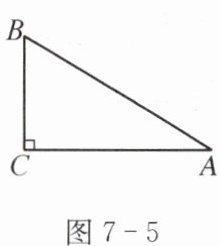
解 在Rt△ABC中,$∠ C=90°$,$AB:BC=5:3$,
可设$AB=5k$,$BC=3k(k≠0)$.
依据勾股定理,得$AC=\sqrt{AB^{2}-BC^{2}}=\sqrt{(5k)^{2}-(3k)^{2}}=4k$.
所以$\tan A=\dfrac{BC}{AC}=\dfrac{3k}{4k}=\dfrac{3}{4}$,$\tan B=\dfrac{AC}{BC}=\dfrac{4k}{3k}=\dfrac{4}{3}$.
答案
解:在Rt△ABC中,$∠ C=90°$,$AB:BC=5:3$,
可设$AB=5k$,$BC=3k(k≠0)$。
由勾股定理,得$AC=\sqrt{AB^{2}-BC^{2}}=\sqrt{(5k)^{2}-(3k)^{2}}=4k$。
所以$\tan A=\dfrac{BC}{AC}=\dfrac{3k}{4k}=\dfrac{3}{4}$,
$\tan B=\dfrac{AC}{BC}=\dfrac{4k}{3k}=\dfrac{4}{3}$。
可设$AB=5k$,$BC=3k(k≠0)$。
由勾股定理,得$AC=\sqrt{AB^{2}-BC^{2}}=\sqrt{(5k)^{2}-(3k)^{2}}=4k$。
所以$\tan A=\dfrac{BC}{AC}=\dfrac{3k}{4k}=\dfrac{3}{4}$,
$\tan B=\dfrac{AC}{BC}=\dfrac{4k}{3k}=\dfrac{4}{3}$。
