

 登录
登录
15.如图,$△ ABC$中,$AC=AB$,$CD⊥ AB$于点$D$,且$BD:AD:CD=2:3:4$,$S_{△ ABC}=40\ \mathrm{cm}^2$,点$M$从点$B$出发以$1\ \mathrm{cm/s}$的速度沿线段$BA$向点$A$运动,同时动点$N$从点$A$出发以相同速度沿线段$AC$向点$C$运动,当其中一点到达终点时整个运动都停止.设点$M$运动的时间为$t\ \mathrm{s}$.
(1)当$△ DMN$的边与$BC$平行时,求$t$的值;
(2)在点$N$运动的过程中,$△ ADN$能否成为等腰三角形?若能,求出$t$的值;若不能,请说明理由.
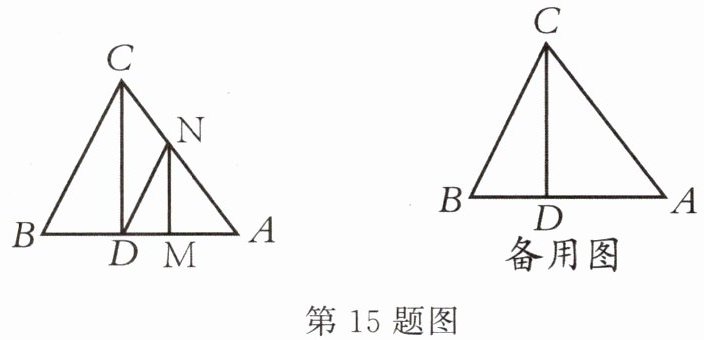
(1)当$△ DMN$的边与$BC$平行时,求$t$的值;
(2)在点$N$运动的过程中,$△ ADN$能否成为等腰三角形?若能,求出$t$的值;若不能,请说明理由.
答案
15.(1) 解:设 $BD=2x,AD=3x,CD=4x$,
则 $AC=AB=BD+AD=5x$,
$\because S_{△ ABC}=\dfrac{1}{2}×5x×4x=40\ \mathrm{cm}^2,x>0$,
$\therefore x=2\ \mathrm{cm}$,
$\therefore BD=4\ \mathrm{cm}, AD=6\ \mathrm{cm}, CD=8\ \mathrm{cm}$,
$AC=AB=10\ \mathrm{cm}$.
$\because AB=AC$,
$\therefore ∠ ACB=∠ B$,
①当 $MN// BC$ 时,$∠ ANM=∠ ACB$,
$∠ AMN=∠ B$,
$\therefore ∠ ANM=∠ AMN$,
$\therefore AM=AN$,即 $10-t=t$,
$\therefore t=5$;
②当 $DN// BC$ 时,$AD=AN=6\ \mathrm{cm}$,
$\therefore t=6$;
综上所述,若$△ DMN$ 的边与 $BC$ 平行时,$t$ 值为 5 或 6.
(2) $△ ADN$ 能成为等腰三角形,分三种情况:
①当 $AN=AD=6\ \mathrm{cm}$ 时,$t=6$;
②当 $DN=AN$ 时,$∠ ADN=∠ A$,
$\because CD⊥ AB$,
$\therefore ∠ CDN+∠ ADN=90°,∠ DCN+∠ A=90°$,
$\therefore ∠ CDN=∠ DCN$,
$\therefore CN=DN$,
$\therefore AN=CN=\dfrac{1}{2}AC=5\ \mathrm{cm}$,
$\therefore t=5$;
③当 $ND=AD=6\ \mathrm{cm}$ 时,过 $D$ 作 $DG⊥ AC$ 于点 $G$,
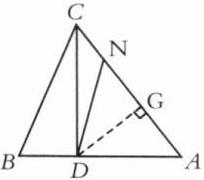
则 $NG=AG=\dfrac{1}{2}AN$,
$\therefore CD⊥ AB$,
$\therefore ∠ ADC=90°$,
$\therefore S_{△ ACD}=\dfrac{1}{2}AC· DG=\dfrac{1}{2}AD· CD$,
$\therefore DG=\dfrac{AD· CD}{AC}=\dfrac{6×8}{10}=\dfrac{24}{5}(\mathrm{cm})$,
$\therefore AG=\sqrt{AD^2-DG^2}=\sqrt{6^2-(\dfrac{24}{5})^2}=\dfrac{18}{5}(\mathrm{cm})$,
$\therefore AN=2AG=\dfrac{36}{5}(\mathrm{cm})$,
$\therefore t=\dfrac{36}{5}$;
综上所述,$△ ADN$ 能成为等腰三角形,$t$ 的值为 5 或 6 或 $\dfrac{36}{5}$.
