

 登录
登录
() 6. I have not been to the Great Wall. I there next month.
A.go
B.am going to
C.will go to
D.am going
A.go
B.am going to
C.will go to
D.am going
答案
D
解析
根据时间状语next month可知句子要用一般将来时,先排除表一般现在时的A选项;there是地点副词,前面不能加介词to,B选项am going to后缺少谓语动词且to多余,C选项的to多余,均不符合语法规则;D选项am going用现在进行时表将来,结构正确,符合题意。
() 7. I am so excited because there a school trip next week.
A.is going to be
B.are going to have
C.is going to have
D.are going to be
A.is going to be
B.are going to have
C.is going to have
D.are going to be
答案
A
解析
首先本题考查there be句型的一般将来时用法。there be句型本身表示“存在有”,不能和have同时使用,因此直接排除B、C选项。句中主语a school trip是单数,且时间状语next week表示将来,be going to结构中的be动词要和单数主语匹配,用is,所以正确结构为there is going to be。
() 8. — are you going to when you grow up?
—I want to be a pianist.
A.How;be
B.What;doing
C.What;be
D.How;doing
—I want to be a pianist.
A.How;be
B.What;doing
C.What;be
D.How;doing
答案
C
解析
根据答语“我想成为一名钢琴家”,可知问句是询问长大后打算成为什么职业,第一空表“什么”要用特殊疑问词What,排除A、D选项;be going to结构后需接动词原形,因此第二空用be,排除B选项,最终选C。
探究点1 miss 的用法
miss 作动词,意为“想念;错过”,后跟名词、代词或动词-ing 形式作宾语。
He missed (taking) the early bus.
他没赶上早班公交车。
Long time no see. I miss you a lot.
好久没见了。我非常想念你们。
[知识拓展]
Miss 表示“女士;小姐”。
Miss Li is our English teacher.
李女士是我们的英语老师。
情境应用
1. Hurry up! We're late. I don't want to the start of the movie.
A. catch B. get
C. miss D. lose
2. I missed the ticket to the movie.
(buy)
miss 作动词,意为“想念;错过”,后跟名词、代词或动词-ing 形式作宾语。
He missed (taking) the early bus.
他没赶上早班公交车。
Long time no see. I miss you a lot.
好久没见了。我非常想念你们。
[知识拓展]
Miss 表示“女士;小姐”。
Miss Li is our English teacher.
李女士是我们的英语老师。
情境应用
1. Hurry up! We're late. I don't want to the start of the movie.
A. catch B. get
C. miss D. lose
2. I missed the ticket to the movie.
(buy)
答案
1. C 2. buying
解析
1. 第一题:句意为“快点!我们要迟到了,我不想错过电影的开场”,结合miss作动词表示“错过”的词义,选项A catch(赶上)、B get(得到)、D lose(丢失)都不符合语境,只有C选项符合句意。
2. 第二题:根据miss的用法规则,miss后接动词作宾语时,要使用动词的-ing形式,因此括号内的buy要变为buying。
2. 第二题:根据miss的用法规则,miss后接动词作宾语时,要使用动词的-ing形式,因此括号内的buy要变为buying。
探究点2 be tired of 的用法
be tired of 意为“对……感到厌倦”。
I am tired of the food here.
我厌烦了这儿的食物。
I am tired of working all day.
我厌倦整天工作。
[知识拓展]辨析 tired 与 tiring
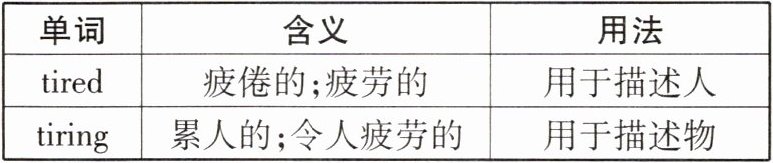
The task was so tiring that we felt tired after finishing it.
这项任务太累人了,以至于我们完成它后感到疲惫不堪。
情境应用
1. The work is . I want to sleep. (tire)
2. After climbing the mountain, she was very
. (tire)
3. I living in the house. (厌倦)
be tired of 意为“对……感到厌倦”。
I am tired of the food here.
我厌烦了这儿的食物。
I am tired of working all day.
我厌倦整天工作。
[知识拓展]辨析 tired 与 tiring
The task was so tiring that we felt tired after finishing it.
这项任务太累人了,以至于我们完成它后感到疲惫不堪。
情境应用
1. The work is . I want to sleep. (tire)
2. After climbing the mountain, she was very
. (tire)
3. I living in the house. (厌倦)
答案
1. tiring
2. tired
3. am tired of
2. tired
3. am tired of
解析
1. 此处修饰主语the work(工作,属于事物),根据知识点,描述事物“累人的、令人疲劳的”要用tiring,因此填tiring。
2. 此处修饰主语she(人),根据知识点,描述人“疲倦的、疲劳的”要用tired,因此填tired。
3. 对应中文提示“厌倦”,使用固定短语be tired of,主语是I,be动词用am,因此填am tired of。
2. 此处修饰主语she(人),根据知识点,描述人“疲倦的、疲劳的”要用tired,因此填tired。
3. 对应中文提示“厌倦”,使用固定短语be tired of,主语是I,be动词用am,因此填am tired of。
