

 登录
登录
4. 如图,在$△ ABC$中,$∠ B=40°,∠ C=20°$,$AD$平分$∠ BAC$,交$BC$于点$D$,过点$D$作$DE// AB$,交$AC$于点$E$.
(1)求$∠ ADC$的度数;
(2)若$△ ADC$与$△ EDC$的周长分别为11和9,求$DE$的长.
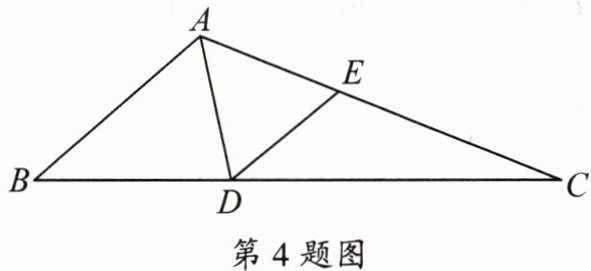
(1)求$∠ ADC$的度数;
(2)若$△ ADC$与$△ EDC$的周长分别为11和9,求$DE$的长.
答案
解:(1)$\because ∠ B=40°,∠ C=20°,\therefore ∠ BAC=180°-∠ B-∠ C=180°-40°-20°=120°.$$\because AD$平分$∠ BAC,\therefore ∠ DAC=\dfrac{1}{2}∠ BAC=\dfrac{1}{2}×120°=60°.$在$△ ADC$中,$∠ DAC=60°,∠ C=20°,\therefore ∠ ADC=180°-60°-20°=100°.$
(2)$\because DE// AB,\therefore ∠ BAD=∠ EDA=∠ DAE=60°.\therefore △ ADE$是等边三角形.$\therefore AD=DE=AE.$$\because △ ADC$与$△ EDC$的周长分别为11和9,$\therefore AD+DC+AC-(DC+CE+DE)=11-9=2.$$\therefore AD+DC+AE+EC-DC-CE-DE=2.$$\therefore DE=2.$
(2)$\because DE// AB,\therefore ∠ BAD=∠ EDA=∠ DAE=60°.\therefore △ ADE$是等边三角形.$\therefore AD=DE=AE.$$\because △ ADC$与$△ EDC$的周长分别为11和9,$\therefore AD+DC+AC-(DC+CE+DE)=11-9=2.$$\therefore AD+DC+AE+EC-DC-CE-DE=2.$$\therefore DE=2.$
解析
【分析】
(1) 求∠ADC的度数时,首先利用三角形内角和为180°算出△ABC中∠BAC的度数,再结合角平分线的定义求出∠DAC的度数,最后在△ADC中再次运用三角形内角和定理即可得到结果。
(2) 求DE的长时,先根据平行线的性质得到内错角相等,结合角平分线的结论推出△ADE为等边三角形,得到AD=DE=AE的等量关系,再将两个三角形的周长作差,抵消公共部分后代入等边三角形的边的等量关系,即可求出DE的长度。
【解析】
(1) 在$△ ABC$中,根据三角形内角和定理:
$\because ∠ B=40°,∠ C=20°$,
$\therefore ∠ BAC=180°-∠ B-∠ C=180°-40°-20°=120°$。
$\because AD$平分$∠ BAC$,
$\therefore ∠ DAC=\dfrac{1}{2}∠ BAC=\dfrac{1}{2}×120°=60°$。
在$△ ADC$中,再次运用三角形内角和定理:
$∠ ADC=180°-∠ DAC-∠ C=180°-60°-20°=100°$。
(2) $\because DE// AB$,根据两直线平行,内错角相等,可得$∠ BAD=∠ EDA$。
$\because AD$平分$∠ BAC$,$\therefore ∠ BAD=∠ DAE=60°$,
$\therefore ∠ EDA=∠ DAE=60°$,即$△ ADE$是等边三角形,$\therefore AD=DE=AE$。
已知$△ ADC$的周长为11,$△ EDC$的周长为9,可得:
$AD+DC+AC=11$,$DC+CE+DE=9$,
将两式作差得:$AD+DC+AC-(DC+CE+DE)=11-9=2$,
又$\because AC=AE+CE$,且$AD=DE=AE$,代入化简:
$DE+DC+AE+CE-DC-CE-DE=2$,
解得$DE=2$。
【答案】
(1) $∠ ADC=100°$;(2) $DE=2$
【知识点】
三角形内角和定理,角平分线的定义,平行线的性质
【点评】
本题是三角形相关的基础综合题,结合角度计算和周长计算进行考查,解题核心是利用角平分线、平行线的性质完成角的等量转化,再通过周长作差抵消公共部分得到所求线段的长度,属于三角形模块的常考题型。
【难度系数】
0.7
(1) 求∠ADC的度数时,首先利用三角形内角和为180°算出△ABC中∠BAC的度数,再结合角平分线的定义求出∠DAC的度数,最后在△ADC中再次运用三角形内角和定理即可得到结果。
(2) 求DE的长时,先根据平行线的性质得到内错角相等,结合角平分线的结论推出△ADE为等边三角形,得到AD=DE=AE的等量关系,再将两个三角形的周长作差,抵消公共部分后代入等边三角形的边的等量关系,即可求出DE的长度。
【解析】
(1) 在$△ ABC$中,根据三角形内角和定理:
$\because ∠ B=40°,∠ C=20°$,
$\therefore ∠ BAC=180°-∠ B-∠ C=180°-40°-20°=120°$。
$\because AD$平分$∠ BAC$,
$\therefore ∠ DAC=\dfrac{1}{2}∠ BAC=\dfrac{1}{2}×120°=60°$。
在$△ ADC$中,再次运用三角形内角和定理:
$∠ ADC=180°-∠ DAC-∠ C=180°-60°-20°=100°$。
(2) $\because DE// AB$,根据两直线平行,内错角相等,可得$∠ BAD=∠ EDA$。
$\because AD$平分$∠ BAC$,$\therefore ∠ BAD=∠ DAE=60°$,
$\therefore ∠ EDA=∠ DAE=60°$,即$△ ADE$是等边三角形,$\therefore AD=DE=AE$。
已知$△ ADC$的周长为11,$△ EDC$的周长为9,可得:
$AD+DC+AC=11$,$DC+CE+DE=9$,
将两式作差得:$AD+DC+AC-(DC+CE+DE)=11-9=2$,
又$\because AC=AE+CE$,且$AD=DE=AE$,代入化简:
$DE+DC+AE+CE-DC-CE-DE=2$,
解得$DE=2$。
【答案】
(1) $∠ ADC=100°$;(2) $DE=2$
【知识点】
三角形内角和定理,角平分线的定义,平行线的性质
【点评】
本题是三角形相关的基础综合题,结合角度计算和周长计算进行考查,解题核心是利用角平分线、平行线的性质完成角的等量转化,再通过周长作差抵消公共部分得到所求线段的长度,属于三角形模块的常考题型。
【难度系数】
0.7
5. 如图,在$△ ABC$中,$∠ C=90°$,点$P$在$AC$上运动,点$D$在$AB$上,$PD$始终保持与$PA$相等,$BD$的垂直平分线交$BC$于点$E$,交$BD$于点$F$,连接$DE$.
(1)判断$DE$与$DP$的位置关系,并说明理由;
(2)若$AC=6$,$BC=8$,$PA=2$,求线段$DE$的长.
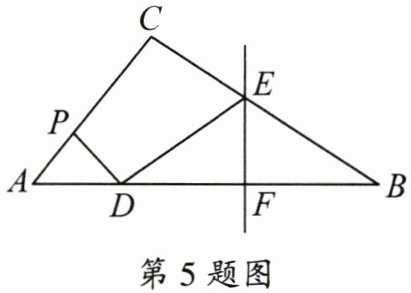
(1)判断$DE$与$DP$的位置关系,并说明理由;
(2)若$AC=6$,$BC=8$,$PA=2$,求线段$DE$的长.
答案
解:(1)$DE⊥ DP$,理由如下:$\because PD=PA,\therefore ∠ A=∠ PDA.$$\because EF$是$BD$的垂直平分线,$\therefore EB=ED.$$\therefore ∠ B=∠ EDB.$$\because ∠ C=90°,$$\therefore ∠ A+∠ B=90°.$$\therefore ∠ PDA+∠ EDB=90°.$$\therefore ∠ PDE=180°-90°=90°.$$\therefore DE⊥ DP.$
(2)连接$PE$,设$DE=x$,则$EB=ED=x$,$CE=8-x$,$\because ∠ C=∠ PDE=90°,\therefore PC^2+CE^2=PE^2=PD^2+DE^2.$$\therefore 4^2+(8-x)^2=2^2+x^2$,解得$x=4.75.$则$DE=4.75.$
(2)连接$PE$,设$DE=x$,则$EB=ED=x$,$CE=8-x$,$\because ∠ C=∠ PDE=90°,\therefore PC^2+CE^2=PE^2=PD^2+DE^2.$$\therefore 4^2+(8-x)^2=2^2+x^2$,解得$x=4.75.$则$DE=4.75.$
解析
【分析】
(1)判断DE与DP的位置关系优先考虑是否垂直,即求证∠PDE=90°。首先利用等腰三角形等边对等角的性质,由PD=PA得∠A=∠PDA;再根据线段垂直平分线的性质得EB=ED,推出∠B=∠EDB;结合Rt△ABC两锐角互余的性质,将角等量代换后可推出∠PDA+∠EDB=90°,最后根据平角为180°即可得∠PDE=90°,证明垂直关系。
(2)求DE的长时,因DE=EB,可设DE为x,用x表示出CE的长度。连接PE后,Rt△PCE和Rt△PDE共用斜边PE,根据勾股定理可列出含x的等式,解方程即可求出DE的长度。
【解析】
(1) $DE ⊥ DP$,理由如下:
$\because PD=PA$,$\therefore ∠ A = ∠ PDA$。
$\because EF$是$BD$的垂直平分线,$\therefore EB=ED$,$\therefore ∠ B = ∠ EDB$。
$\because ∠ C=90°$,$\therefore ∠ A + ∠ B = 90°$,
$\therefore ∠ PDA + ∠ EDB = 90°$,
$\therefore ∠ PDE = 180° - (∠ PDA + ∠ EDB) = 90°$,
$\therefore DE ⊥ DP$。
(2) 连接$PE$,设$DE=x$,
$\because EB=ED$,$\therefore EB=x$,$CE = BC - EB = 8 - x$。
$\because PA=2$,$AC=6$,$\therefore PC = AC - PA = 4$,$PD=PA=2$。
$\because ∠ C = ∠ PDE = 90°$,
$\therefore$在$\mathrm{Rt}△ PCE$中,$PE^2 = PC^2 + CE^2$,
在$\mathrm{Rt}△ PDE$中,$PE^2 = PD^2 + DE^2$,
$\therefore PC^2 + CE^2 = PD^2 + DE^2$,
代入得:$4^2 + (8 - x)^2 = 2^2 + x^2$,
展开计算:$16 + 64 - 16x + x^2 = 4 + x^2$,
化简得$16x=76$,
解得$x=4.75$。
【答案】
(1) $DE ⊥ DP$;(2) $DE=4.75$
【知识点】
等腰三角形的性质,线段垂直平分线的性质,勾股定理
【点评】
本题属于三角形基础综合题,第一问侧重角的等量代换推导,第二问结合方程思想与勾股定理求解线段长,能够有效考查几何基础推导能力和方程思想的应用能力。
【难度系数】
0.7
(1)判断DE与DP的位置关系优先考虑是否垂直,即求证∠PDE=90°。首先利用等腰三角形等边对等角的性质,由PD=PA得∠A=∠PDA;再根据线段垂直平分线的性质得EB=ED,推出∠B=∠EDB;结合Rt△ABC两锐角互余的性质,将角等量代换后可推出∠PDA+∠EDB=90°,最后根据平角为180°即可得∠PDE=90°,证明垂直关系。
(2)求DE的长时,因DE=EB,可设DE为x,用x表示出CE的长度。连接PE后,Rt△PCE和Rt△PDE共用斜边PE,根据勾股定理可列出含x的等式,解方程即可求出DE的长度。
【解析】
(1) $DE ⊥ DP$,理由如下:
$\because PD=PA$,$\therefore ∠ A = ∠ PDA$。
$\because EF$是$BD$的垂直平分线,$\therefore EB=ED$,$\therefore ∠ B = ∠ EDB$。
$\because ∠ C=90°$,$\therefore ∠ A + ∠ B = 90°$,
$\therefore ∠ PDA + ∠ EDB = 90°$,
$\therefore ∠ PDE = 180° - (∠ PDA + ∠ EDB) = 90°$,
$\therefore DE ⊥ DP$。
(2) 连接$PE$,设$DE=x$,
$\because EB=ED$,$\therefore EB=x$,$CE = BC - EB = 8 - x$。
$\because PA=2$,$AC=6$,$\therefore PC = AC - PA = 4$,$PD=PA=2$。
$\because ∠ C = ∠ PDE = 90°$,
$\therefore$在$\mathrm{Rt}△ PCE$中,$PE^2 = PC^2 + CE^2$,
在$\mathrm{Rt}△ PDE$中,$PE^2 = PD^2 + DE^2$,
$\therefore PC^2 + CE^2 = PD^2 + DE^2$,
代入得:$4^2 + (8 - x)^2 = 2^2 + x^2$,
展开计算:$16 + 64 - 16x + x^2 = 4 + x^2$,
化简得$16x=76$,
解得$x=4.75$。
【答案】
(1) $DE ⊥ DP$;(2) $DE=4.75$
【知识点】
等腰三角形的性质,线段垂直平分线的性质,勾股定理
【点评】
本题属于三角形基础综合题,第一问侧重角的等量代换推导,第二问结合方程思想与勾股定理求解线段长,能够有效考查几何基础推导能力和方程思想的应用能力。
【难度系数】
0.7
6. 如图,在△ABC中,∠BAC的平分线与外角∠CBM的平分线相交于点D,射线BD交AC的延长线于点N,连接CD.
(1)若AB=14,BC=8,CN=12,△BCN的面积为20,求△ABD的面积;
(2)若BC是AN的垂直平分线,求∠ADC的度数.
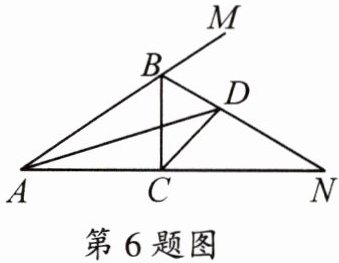
(1)若AB=14,BC=8,CN=12,△BCN的面积为20,求△ABD的面积;
(2)若BC是AN的垂直平分线,求∠ADC的度数.
答案
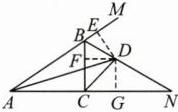
解:(1)如图,过点$D$分别作$AB$,$AC$,$BC$的垂线,垂足分别为$E$,$G$,$F$,$\because BD$和$AD$分别平分$∠ CBM$和$∠ BAC$,且$DE⊥ AB$,$DF⊥ BC$,$DG⊥ AC$,$\therefore DE=DF=DG.$$\because △ BCN$的面积为20,$\therefore \dfrac{1}{2}BC· DF+\dfrac{1}{2}CN· DG=20.$$\therefore DF=DG=2.$$\therefore DE=DF=2.$$\therefore S_{△ ABD}=\dfrac{1}{2}AB· DE=\dfrac{1}{2}×14×2=14.$
(2)$\because BC$是$AN$的垂直平分线,$\therefore AB=NB.$$\therefore ∠ ABC=∠ NBC.$$\because BN$平分$∠ CBM$,$\therefore ∠ NBC=∠ MBN.$$\therefore ∠ NBC=∠ MBN=∠ ABC=60°.$$\because DF=DG$且$DF⊥ BC$,$DG⊥ CN$,$\therefore CD$平分$∠ BCN.$$\therefore ∠ DCN=\dfrac{1}{2}∠ BCN.$$\because ∠ DAC=\dfrac{1}{2}∠ BAC$,$\therefore ∠ ADC=∠ DCN-∠ DAC=\dfrac{1}{2}(∠ BCN-∠ BAC).$$\because ∠ BCN-∠ BAC=∠ ABC=60°$,$\therefore ∠ ADC=\dfrac{1}{2}×60°=30°.$
解析
【分析】
(1) 遇到含角平分线的几何计算,首先考虑角平分线的性质:角平分线上的点到角两边的距离相等。本题中D是∠BAC平分线和外角∠CBM平分线的交点,因此D到AB、BC、AC三边的距离相等,可过D作三边的垂线,三条垂线段长度相等。△BCN的面积可拆分为△BCD和△DCN的面积之和,两个三角形的高恰好是上述相等的垂线段,结合已知的BC、CN长度和△BCN的面积,可求出垂线段的长度,也就是△ABD中AB边上的高,进而求出△ABD的面积。
(2) 先根据垂直平分线的性质得到AB=NB,推出对应角相等,再结合BN是外角平分线,可求出∠ABC的度数;再根据D到BC、CN的距离相等,判定CD是∠BCN的平分线,最后利用三角形外角的性质,将∠ADC转化为两个半角的差,结合∠ABC和所求角的关系得到结果。
【解析】
(1) 过点$D$分别作$AB$,$AC$,$BC$的垂线,垂足分别为$E$,$G$,$F$。
$\because BD$和$AD$分别平分$∠ CBM$和$∠ BAC$,且$DE⊥ AB$,$DF⊥ BC$,$DG⊥ AC$,
$\therefore$ 根据角平分线的性质,得$DE=DF=DG$。
$\because △ BCN$的面积为20,且$S_{△ BCN}=S_{△ BCD}+S_{△ DCN}$,
$\therefore \dfrac{1}{2}BC· DF+\dfrac{1}{2}CN· DG=20$。
将$BC=8$,$CN=12$,$DF=DG$代入得:$4DF+6DF=20$,
解得$DF=DG=2$,即$DE=2$。
$\therefore S_{△ ABD}=\dfrac{1}{2}AB· DE=\dfrac{1}{2}×14×2=14$。
(2) $\because BC$是$AN$的垂直平分线,
$\therefore$ 根据垂直平分线的性质得$AB=NB$,$\therefore ∠ ABC=∠ NBC$。
$\because BN$平分$∠ CBM$,$\therefore ∠ NBC=∠ MBN$,
$\therefore ∠ NBC=∠ MBN=∠ ABC$,又$\because ∠ ABC+∠ NBC+∠ MBN=180°$,
$\therefore ∠ ABC=60°$。
$\because DF=DG$且$DF⊥ BC$,$DG⊥ CN$,
$\therefore CD$平分$∠ BCN$,$\therefore ∠ DCN=\dfrac{1}{2}∠ BCN$。
$\because AD$平分$∠BAC$,$\therefore ∠ DAC=\dfrac{1}{2}∠ BAC$。
根据三角形外角性质,$∠ DCN$是$△ ADC$的外角,$\therefore ∠ DCN=∠ DAC + ∠ ADC$,
整理得$∠ ADC=∠ DCN-∠ DAC=\dfrac{1}{2}(∠ BCN-∠ BAC)$。
又$\because ∠ BCN$是$△ ABC$的外角,$\therefore ∠ BCN-∠ BAC=∠ ABC=60°$,
$\therefore ∠ ADC=\dfrac{1}{2}×60°=30°$。
【答案】
解:(1)如图,过点$D$分别作$AB$,$AC$,$BC$的垂线,垂足分别为$E$,$G$,$F$,$\because BD$和$AD$分别平分$∠ CBM$和$∠ BAC$,且$DE⊥ AB$,$DF⊥ BC$,$DG⊥ AC$,$\therefore DE=DF=DG.$$\because △ BCN$的面积为20,$\therefore \dfrac{1}{2}BC· DF+\dfrac{1}{2}CN· DG=20.$$\therefore DF=DG=2.$$\therefore DE=DF=2.$$\therefore S_{△ ABD}=\dfrac{1}{2}AB· DE=\dfrac{1}{2}×14×2=14.$
(2)$\because BC$是$AN$的垂直平分线,$\therefore AB=NB.$$\therefore ∠ ABC=∠ NBC.$$\because BN$平分$∠ CBM$,$\therefore ∠ NBC=∠ MBN.$$\therefore ∠ NBC=∠ MBN=∠ ABC=60°.$$\because DF=DG$且$DF⊥ BC$,$DG⊥ CN$,$\therefore CD$平分$∠ BCN.$$\therefore ∠ DCN=\dfrac{1}{2}∠ BCN.$$\because ∠ DAC=\dfrac{1}{2}∠ BAC$,$\therefore ∠ ADC=∠ DCN-∠ DAC=\dfrac{1}{2}(∠ BCN-∠ BAC).$$\because ∠ BCN-∠ BAC=∠ ABC=60°$,$\therefore ∠ ADC=\dfrac{1}{2}×60°=30°.$
【知识点】
角平分线的性质与判定,线段垂直平分线的性质,三角形外角定理
【点评】
本题综合考查了三角形相关的几何计算与证明,解题时需熟练运用角平分线、垂直平分线的性质,通过作辅助线构造等高三角形、利用外角性质转化角的数量关系是解题的关键,能够很好地锻炼几何逻辑推理能力。
【难度系数】
0.6
(1) 遇到含角平分线的几何计算,首先考虑角平分线的性质:角平分线上的点到角两边的距离相等。本题中D是∠BAC平分线和外角∠CBM平分线的交点,因此D到AB、BC、AC三边的距离相等,可过D作三边的垂线,三条垂线段长度相等。△BCN的面积可拆分为△BCD和△DCN的面积之和,两个三角形的高恰好是上述相等的垂线段,结合已知的BC、CN长度和△BCN的面积,可求出垂线段的长度,也就是△ABD中AB边上的高,进而求出△ABD的面积。
(2) 先根据垂直平分线的性质得到AB=NB,推出对应角相等,再结合BN是外角平分线,可求出∠ABC的度数;再根据D到BC、CN的距离相等,判定CD是∠BCN的平分线,最后利用三角形外角的性质,将∠ADC转化为两个半角的差,结合∠ABC和所求角的关系得到结果。
【解析】
(1) 过点$D$分别作$AB$,$AC$,$BC$的垂线,垂足分别为$E$,$G$,$F$。
$\because BD$和$AD$分别平分$∠ CBM$和$∠ BAC$,且$DE⊥ AB$,$DF⊥ BC$,$DG⊥ AC$,
$\therefore$ 根据角平分线的性质,得$DE=DF=DG$。
$\because △ BCN$的面积为20,且$S_{△ BCN}=S_{△ BCD}+S_{△ DCN}$,
$\therefore \dfrac{1}{2}BC· DF+\dfrac{1}{2}CN· DG=20$。
将$BC=8$,$CN=12$,$DF=DG$代入得:$4DF+6DF=20$,
解得$DF=DG=2$,即$DE=2$。
$\therefore S_{△ ABD}=\dfrac{1}{2}AB· DE=\dfrac{1}{2}×14×2=14$。
(2) $\because BC$是$AN$的垂直平分线,
$\therefore$ 根据垂直平分线的性质得$AB=NB$,$\therefore ∠ ABC=∠ NBC$。
$\because BN$平分$∠ CBM$,$\therefore ∠ NBC=∠ MBN$,
$\therefore ∠ NBC=∠ MBN=∠ ABC$,又$\because ∠ ABC+∠ NBC+∠ MBN=180°$,
$\therefore ∠ ABC=60°$。
$\because DF=DG$且$DF⊥ BC$,$DG⊥ CN$,
$\therefore CD$平分$∠ BCN$,$\therefore ∠ DCN=\dfrac{1}{2}∠ BCN$。
$\because AD$平分$∠BAC$,$\therefore ∠ DAC=\dfrac{1}{2}∠ BAC$。
根据三角形外角性质,$∠ DCN$是$△ ADC$的外角,$\therefore ∠ DCN=∠ DAC + ∠ ADC$,
整理得$∠ ADC=∠ DCN-∠ DAC=\dfrac{1}{2}(∠ BCN-∠ BAC)$。
又$\because ∠ BCN$是$△ ABC$的外角,$\therefore ∠ BCN-∠ BAC=∠ ABC=60°$,
$\therefore ∠ ADC=\dfrac{1}{2}×60°=30°$。
【答案】
解:(1)如图,过点$D$分别作$AB$,$AC$,$BC$的垂线,垂足分别为$E$,$G$,$F$,$\because BD$和$AD$分别平分$∠ CBM$和$∠ BAC$,且$DE⊥ AB$,$DF⊥ BC$,$DG⊥ AC$,$\therefore DE=DF=DG.$$\because △ BCN$的面积为20,$\therefore \dfrac{1}{2}BC· DF+\dfrac{1}{2}CN· DG=20.$$\therefore DF=DG=2.$$\therefore DE=DF=2.$$\therefore S_{△ ABD}=\dfrac{1}{2}AB· DE=\dfrac{1}{2}×14×2=14.$
(2)$\because BC$是$AN$的垂直平分线,$\therefore AB=NB.$$\therefore ∠ ABC=∠ NBC.$$\because BN$平分$∠ CBM$,$\therefore ∠ NBC=∠ MBN.$$\therefore ∠ NBC=∠ MBN=∠ ABC=60°.$$\because DF=DG$且$DF⊥ BC$,$DG⊥ CN$,$\therefore CD$平分$∠ BCN.$$\therefore ∠ DCN=\dfrac{1}{2}∠ BCN.$$\because ∠ DAC=\dfrac{1}{2}∠ BAC$,$\therefore ∠ ADC=∠ DCN-∠ DAC=\dfrac{1}{2}(∠ BCN-∠ BAC).$$\because ∠ BCN-∠ BAC=∠ ABC=60°$,$\therefore ∠ ADC=\dfrac{1}{2}×60°=30°.$
【知识点】
角平分线的性质与判定,线段垂直平分线的性质,三角形外角定理
【点评】
本题综合考查了三角形相关的几何计算与证明,解题时需熟练运用角平分线、垂直平分线的性质,通过作辅助线构造等高三角形、利用外角性质转化角的数量关系是解题的关键,能够很好地锻炼几何逻辑推理能力。
【难度系数】
0.6
