

 登录
登录
一、回归教材 根据课文内容(P14)补全图表中所缺的信息。
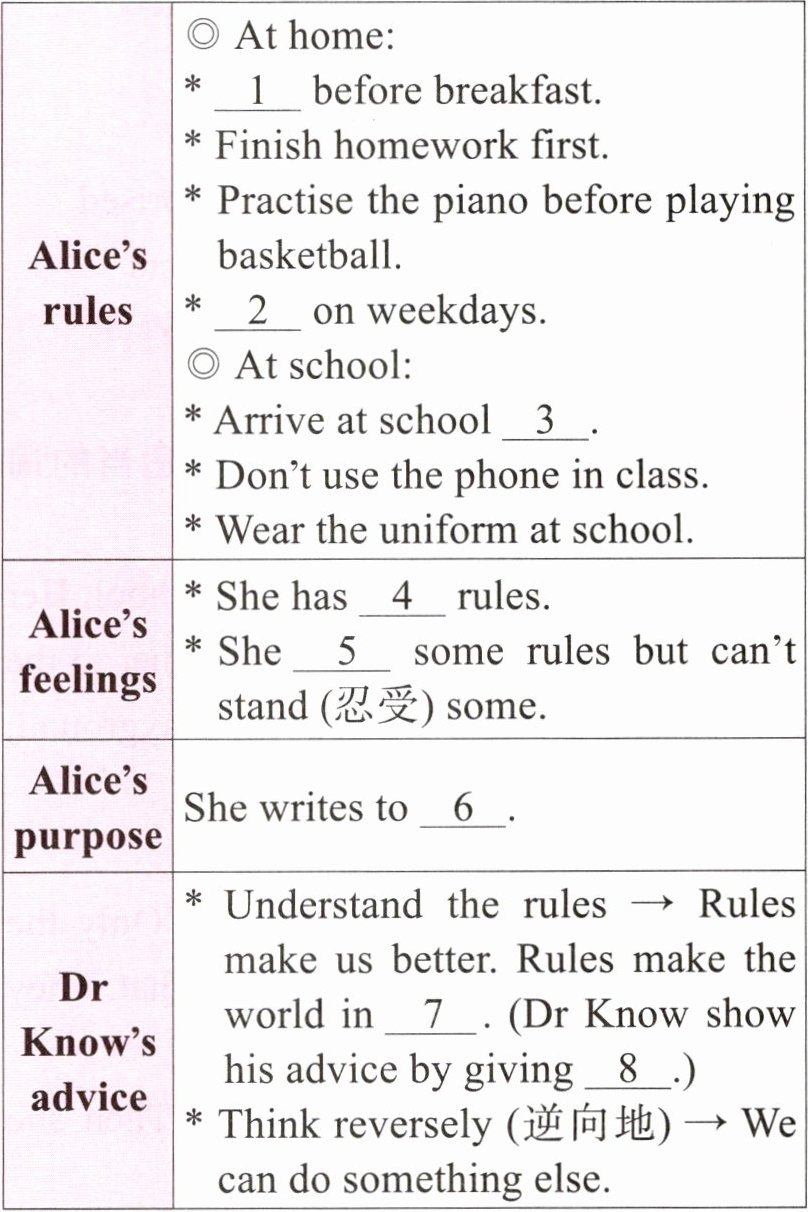
1.
2.
3.
4.
5.
6.
7.
8.
1.
Make her bed
2.
Don't hang out with friends
3.
on time
4.
too many
5.
understands
6.
ask for help / advice
7.
order
8.
examples
答案
1. Make her bed 2. Don't hang out with friends 3. on time 4. too many 5. understands 6. ask for help / advice 7. order 8. examples
解析
翻译:
1. 整理她的床铺
2. 不要和朋友闲逛
3. 按时
4. 太多
5. 理解(此处为动词的第三人称单数形式)
6. 寻求帮助/建议
7. 命令;订购;点菜(根据语境不同有不同释义,此处结合教材语境可理解为“命令”等相关合理释义)
8. 例子(复数形式)
1. 整理她的床铺
2. 不要和朋友闲逛
3. 按时
4. 太多
5. 理解(此处为动词的第三人称单数形式)
6. 寻求帮助/建议
7. 命令;订购;点菜(根据语境不同有不同释义,此处结合教材语境可理解为“命令”等相关合理释义)
8. 例子(复数形式)
二、根据首字母及句意写出完整单词。
1. H
2. — Keeping a snake as a pet is a
— I think so. The snake is really scary.
3. On w
4. The s
5. Cindy is a warm-hearted p
6. Children with the same hobbies are easy to b
7. H
8. I don't like hamburgers, and my brother doesn't like them, e
9. P
10. — We'll b
— Great! If so, the children don't need to walk for hours every day to school.
1. H
urry
up! The car is coming!2. — Keeping a snake as a pet is a
wful
.— I think so. The snake is really scary.
3. On w
eekdays
, I can't go out. How about Sunday?4. The s
pirit
of Lei Feng tells us to help people in need.5. Cindy is a warm-hearted p
erson
and she likes helping others.6. Children with the same hobbies are easy to b
ecome
friends.7. H
ang
your jacket behind the door, please. Don't put it on the sofa.8. I don't like hamburgers, and my brother doesn't like them, e
ither
.9. P
ractice
makes perfect. You should do it again and again to become better.10. — We'll b
uild
a school in the village.— Great! If so, the children don't need to walk for hours every day to school.
答案
1. Hurry 2. awful 3. weekdays 4. spirit 5. person 6. become 7. Hang 8. either 9. Practice 10. build
解析
翻译:
二、根据首字母及句意写出完整单词。
1. 快点!汽车来了!
2. ——养蛇当宠物很可怕。
——我也这么认为。蛇真的很吓人。
3. 在工作日,我不能出去。星期天怎么样?
4. 雷锋精神告诉我们要帮助有需要的人。
5. 辛迪是个热心的人,她喜欢帮助别人。
6. 有相同爱好的孩子很容易成为朋友。
7. 请把你的夹克挂在门后。别把它放在沙发上。
8. 我不喜欢汉堡包,我弟弟也不喜欢。
9. 熟能生巧。你应该反复做这件事来变得更好。
10. ——我们将在村里建一所学校。
——太棒了!如果是这样的话,孩子们就不需要每天走几个小时去上学了。
二、根据首字母及句意写出完整单词。
1. 快点!汽车来了!
2. ——养蛇当宠物很可怕。
——我也这么认为。蛇真的很吓人。
3. 在工作日,我不能出去。星期天怎么样?
4. 雷锋精神告诉我们要帮助有需要的人。
5. 辛迪是个热心的人,她喜欢帮助别人。
6. 有相同爱好的孩子很容易成为朋友。
7. 请把你的夹克挂在门后。别把它放在沙发上。
8. 我不喜欢汉堡包,我弟弟也不喜欢。
9. 熟能生巧。你应该反复做这件事来变得更好。
10. ——我们将在村里建一所学校。
——太棒了!如果是这样的话,孩子们就不需要每天走几个小时去上学了。
三、阅读短文,从方框内的选项中选出可以填入空白处的最佳选项。
A. too many
B. become a better person
C. focusing on
D. build school spirit
E. make our bed
F. think about
G. hang out
As students, there are 1 rules in our life. And there are some common rules we have to follow. For example, we must 2 when we get up. And on school nights, we can't 3 with friends. At school, we must wear school uniforms. We can't use mobile phones and we mustn't eat in class.
Many students don't like these rules. But 4 them carefully. You'll find that they are really important because they make us 5. For example, wearing school uniforms helps 6. And no phone means 7 learning.
Maybe some rules are unreasonable (不合理的). You can have a talk with your parents or school to show your ideas.
1.
2.
3.
4.
5.
6.
7.
A. too many
B. become a better person
C. focusing on
D. build school spirit
E. make our bed
F. think about
G. hang out
As students, there are 1 rules in our life. And there are some common rules we have to follow. For example, we must 2 when we get up. And on school nights, we can't 3 with friends. At school, we must wear school uniforms. We can't use mobile phones and we mustn't eat in class.
Many students don't like these rules. But 4 them carefully. You'll find that they are really important because they make us 5. For example, wearing school uniforms helps 6. And no phone means 7 learning.
Maybe some rules are unreasonable (不合理的). You can have a talk with your parents or school to show your ideas.
1.
2.
3.
4.
5.
6.
7.
答案
1 - 7 AEGFBDC
解析
翻译:
三、阅读短文,从方框内的选项中选出可以填入空白处的最佳选项。
A. 太多
B. 成为一个更好的人
C. 专注于
D. 营造学校精神
E. 整理我们的床铺
F. 思考
G. 闲逛
作为学生,我们生活中有1条规则。并且有一些我们必须遵守的通用规则。例如,我们起床后必须2。在上学日的晚上,我们不能3和朋友在一起。在学校,我们必须穿校服。我们不能使用手机,而且我们禁止在课堂上吃东西。
很多学生不喜欢这些规则。但是4它们。你会发现它们真的很重要,因为它们能让我们5。例如,穿校服有助于6。而且没有手机意味着7学习。
1.
2.
3.
4.
5.
6.
7.
三、阅读短文,从方框内的选项中选出可以填入空白处的最佳选项。
A. 太多
B. 成为一个更好的人
C. 专注于
D. 营造学校精神
E. 整理我们的床铺
F. 思考
G. 闲逛
作为学生,我们生活中有1条规则。并且有一些我们必须遵守的通用规则。例如,我们起床后必须2。在上学日的晚上,我们不能3和朋友在一起。在学校,我们必须穿校服。我们不能使用手机,而且我们禁止在课堂上吃东西。
很多学生不喜欢这些规则。但是4它们。你会发现它们真的很重要,因为它们能让我们5。例如,穿校服有助于6。而且没有手机意味着7学习。
1.
2.
3.
4.
5.
6.
7.
四、根据短文内容选择最佳选项。
Of all the subjects, David doesn't like Chinese. "Chinese is so boring!" he says. But his mother thinks he is just not hard-working at school. So she makes some rules for him.
David has to finish his homework before he goes out for fun. On school nights, he can't watch TV. He has to read Chinese books for an hour. His mother buys two Chinese books for him every week. And he even has to listen to Chinese songs for some time every day because his mother says that helps build up his language sense (语感). David is unhappy with these new rules but he has to follow them.
One day, in Chinese class, Mr Wang asks a very difficult question. Even the best students don't know the answer. At this time, David gives the right answer. Both Mr Wang and the other students look at him and then start to applaud (鼓掌). David learns the answer from the books he reads.
When David gets home, he says, "Mom, thank you so much. Because you make these rules, I become better."
(
A. To make him work hard.
B. To help him study Chinese better.
C. To teach him how to learn Chinese.
(
① Don't hang out.
② Listen to Chinese songs.
③ Read two books every week.
④ Don't watch TV on weekdays.
A. ①②③
B. ①②④
C. ②③④
(

(
A. He wants to make some rules for his mom, too.
B. He thanks his mom because the rules are useful.
C. He has to listen to his mom and become a good student.
(
A. We should learn from our teacher.
B. It's important to follow some rules.
C. Reading books can help us become welcome.
Of all the subjects, David doesn't like Chinese. "Chinese is so boring!" he says. But his mother thinks he is just not hard-working at school. So she makes some rules for him.
David has to finish his homework before he goes out for fun. On school nights, he can't watch TV. He has to read Chinese books for an hour. His mother buys two Chinese books for him every week. And he even has to listen to Chinese songs for some time every day because his mother says that helps build up his language sense (语感). David is unhappy with these new rules but he has to follow them.
One day, in Chinese class, Mr Wang asks a very difficult question. Even the best students don't know the answer. At this time, David gives the right answer. Both Mr Wang and the other students look at him and then start to applaud (鼓掌). David learns the answer from the books he reads.
When David gets home, he says, "Mom, thank you so much. Because you make these rules, I become better."
(
B
) 1. Why does David's mother make the rules?A. To make him work hard.
B. To help him study Chinese better.
C. To teach him how to learn Chinese.
(
C
) 2. Which are the new rules for David?① Don't hang out.
② Listen to Chinese songs.
③ Read two books every week.
④ Don't watch TV on weekdays.
A. ①②③
B. ①②④
C. ②③④
(
C
) 3. How does the teacher feel when David gives the right answer?(
B
) 4. What does David mean in the last paragraph (段落)?A. He wants to make some rules for his mom, too.
B. He thanks his mom because the rules are useful.
C. He has to listen to his mom and become a good student.
(
B
) 5. What can we learn from David's story?A. We should learn from our teacher.
B. It's important to follow some rules.
C. Reading books can help us become welcome.
答案
1 - 5 BCCBB
解析
翻译:
四、根据短文内容选择最佳选项。
在所有科目中,大卫不喜欢语文。“语文太无聊了!”他说。但他的妈妈认为他只是在学校不够努力。所以她为他制定了一些规则。
大卫出去玩之前必须完成作业。在上学日的晚上,他不能看电视。他必须读一个小时的语文书。他的妈妈每周给他买两本语文书。而且他甚至每天都得听一段时间的中文歌,因为他妈妈说这有助于培养他的语感。大卫对这些新规则不满意,但他必须遵守。
有一天,在语文课上,王老师问了一个非常难的问题。即使是最好的学生也不知道答案。这时,大卫给出了正确答案。王老师和其他学生都看着他,然后开始鼓掌。大卫从他读的书中学会了这个答案。
当大卫回到家,他说:“妈妈,非常感谢你。因为你制定了这些规则,我变得更好了。”
(B)1. 大卫的妈妈为什么制定这些规则?
A. 让他努力学习。
B. 帮助他更好地学习语文。
C. 教他如何学习语文。
(C)2. 大卫的新规则有哪些?
① 不能出去玩。
② 听中文歌。
③ 每周读两本书。
④ 工作日不能看电视。
A. ①②③
B. ①②④
C. ②③④
(C)3. 当大卫给出正确答案时,老师感觉如何?
(C)4. 大卫在最后一段是什么意思?
A. 他也想给他妈妈制定一些规则。
B. 他感谢他的妈妈,因为这些规则很有用。
C. 他必须听他妈妈的话,成为一个好学生。
(B)5. 我们能从大卫的故事中学到什么?
A. 我们应该向我们的老师学习。
B. 遵守一些规则很重要。
C. 读书能帮助我们变得受欢迎。
四、根据短文内容选择最佳选项。
在所有科目中,大卫不喜欢语文。“语文太无聊了!”他说。但他的妈妈认为他只是在学校不够努力。所以她为他制定了一些规则。
大卫出去玩之前必须完成作业。在上学日的晚上,他不能看电视。他必须读一个小时的语文书。他的妈妈每周给他买两本语文书。而且他甚至每天都得听一段时间的中文歌,因为他妈妈说这有助于培养他的语感。大卫对这些新规则不满意,但他必须遵守。
有一天,在语文课上,王老师问了一个非常难的问题。即使是最好的学生也不知道答案。这时,大卫给出了正确答案。王老师和其他学生都看着他,然后开始鼓掌。大卫从他读的书中学会了这个答案。
当大卫回到家,他说:“妈妈,非常感谢你。因为你制定了这些规则,我变得更好了。”
(B)1. 大卫的妈妈为什么制定这些规则?
A. 让他努力学习。
B. 帮助他更好地学习语文。
C. 教他如何学习语文。
(C)2. 大卫的新规则有哪些?
① 不能出去玩。
② 听中文歌。
③ 每周读两本书。
④ 工作日不能看电视。
A. ①②③
B. ①②④
C. ②③④
(C)3. 当大卫给出正确答案时,老师感觉如何?
(C)4. 大卫在最后一段是什么意思?
A. 他也想给他妈妈制定一些规则。
B. 他感谢他的妈妈,因为这些规则很有用。
C. 他必须听他妈妈的话,成为一个好学生。
(B)5. 我们能从大卫的故事中学到什么?
A. 我们应该向我们的老师学习。
B. 遵守一些规则很重要。
C. 读书能帮助我们变得受欢迎。
