

 登录
登录
11. 如图,在△ABC中,已知AB=AC,点D、E分别在边BC、AC上,且满足BD=2CD,AE=CE,连接DE并延长,交BA的延长线于点F,连接AD.求证:
(1)△CDE∽△BDA;
(2)AB=AF.
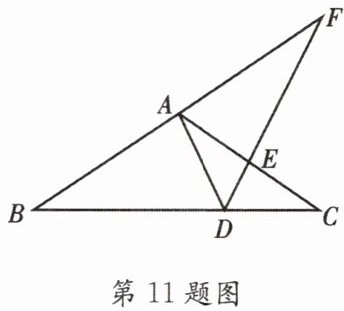
(1)△CDE∽△BDA;
(2)AB=AF.
答案
11. (1) $\because AB=AC, AE=CE$,
$\therefore ∠B=∠C, AB=AC=2CE$.
$\because BD=2CD, \therefore \frac{AB}{CE}=\frac{BD}{CD}=2$.
又 $\because ∠B = ∠C, \therefore △CDE ∽△BDA$.
(2) $\because △CDE∽△BDA$,
$\therefore ∠CED = ∠BAD, \frac{DE}{AD}=\frac{CE}{AB}=\frac{1}{2}$,
$\therefore ∠AED=∠FAD$.
又$\because ∠ADE=∠ADF, \therefore △ADE ∽△FDA$.
$\therefore \frac{AE}{AF}=\frac{DE}{AD}=\frac{1}{2}, \therefore AF=2AE = AB$.
$\therefore ∠B=∠C, AB=AC=2CE$.
$\because BD=2CD, \therefore \frac{AB}{CE}=\frac{BD}{CD}=2$.
又 $\because ∠B = ∠C, \therefore △CDE ∽△BDA$.
(2) $\because △CDE∽△BDA$,
$\therefore ∠CED = ∠BAD, \frac{DE}{AD}=\frac{CE}{AB}=\frac{1}{2}$,
$\therefore ∠AED=∠FAD$.
又$\because ∠ADE=∠ADF, \therefore △ADE ∽△FDA$.
$\therefore \frac{AE}{AF}=\frac{DE}{AD}=\frac{1}{2}, \therefore AF=2AE = AB$.
12. 如图,在$△ ABC$中,已知$∠ ADE=∠ B$,$∠ BAC=∠ DAE$。
(1)求证:$\frac{AD}{AB}=\frac{AE}{AC}$;
(2)当$∠ BAC=90°$时,求证:$EC⊥ BC$。
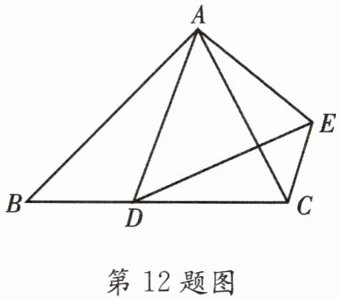
(1)求证:$\frac{AD}{AB}=\frac{AE}{AC}$;
(2)当$∠ BAC=90°$时,求证:$EC⊥ BC$。
答案
12. (1) $\because ∠ADE=∠B, ∠BAC=∠DAE, \therefore △ADE∽△ABC, \therefore \frac{AD}{AB}=\frac{AE}{AC}$.
(2) $\because ∠BAC=∠DAE=90°$,
$\therefore ∠BAD=∠CAE$.
又$\because \frac{AD}{AB}=\frac{AE}{AC}$,
$\therefore △BAD ∽ △CAE, \therefore ∠ADB = ∠AEC$.
$\therefore ∠AEC + ∠ADC = ∠ADB + ∠ADC=180°$.
$\because ∠DAE=90°$,
$\therefore ∠DCE=360°-180°-90°=90°, \therefore EC⊥BC$.
(2) $\because ∠BAC=∠DAE=90°$,
$\therefore ∠BAD=∠CAE$.
又$\because \frac{AD}{AB}=\frac{AE}{AC}$,
$\therefore △BAD ∽ △CAE, \therefore ∠ADB = ∠AEC$.
$\therefore ∠AEC + ∠ADC = ∠ADB + ∠ADC=180°$.
$\because ∠DAE=90°$,
$\therefore ∠DCE=360°-180°-90°=90°, \therefore EC⊥BC$.
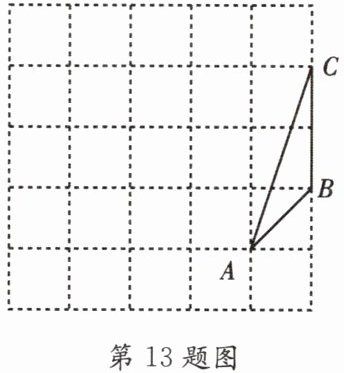
13. 如图,在$5×5$的正方形网格中,已知点A、B、C分别在格点上,请画出一个$△ A_1B_1C_1$,使点$A_1$、$B_1$、$C_1$都在格点上,且$△ A_1B_1C_1$与$△ ABC$相似,相似比不为1,并证明.
答案
解:
画出顶点均在格点上的△A₁B₁C₁,其三边长分别为$2$,$2\sqrt{2}$,$2\sqrt{5}$,图略。
证明:
设每个小正方形的边长为1,由勾股定理得:
在$△ ABC$中,
$AB = \sqrt{1^2+1^2} = \sqrt{2}$,
$BC = 2$,
$AC = \sqrt{1^2+3^2} = \sqrt{10}$。
在$△ A_1B_1C_1$中,
$A_1B_1 = 2$,
$B_1C_1 = \sqrt{2^2+2^2} = 2\sqrt{2}$,
$A_1C_1 = \sqrt{2^2+4^2} = 2\sqrt{5}$。
$\therefore \frac{A_1B_1}{AB} = \frac{2}{\sqrt{2}} = \sqrt{2}$,
$\frac{B_1C_1}{BC} = \frac{2\sqrt{2}}{2} = \sqrt{2}$,
$\frac{A_1C_1}{AC} = \frac{2\sqrt{5}}{\sqrt{10}} = \sqrt{2}$。
$\therefore \frac{A_1B_1}{AB} = \frac{B_1C_1}{BC} = \frac{A_1C_1}{AC}$。
$\therefore △ A_1B_1C_1 ∽ △ ABC$,相似比为$\sqrt{2} ≠ 1$,符合要求。
画出顶点均在格点上的△A₁B₁C₁,其三边长分别为$2$,$2\sqrt{2}$,$2\sqrt{5}$,图略。
证明:
设每个小正方形的边长为1,由勾股定理得:
在$△ ABC$中,
$AB = \sqrt{1^2+1^2} = \sqrt{2}$,
$BC = 2$,
$AC = \sqrt{1^2+3^2} = \sqrt{10}$。
在$△ A_1B_1C_1$中,
$A_1B_1 = 2$,
$B_1C_1 = \sqrt{2^2+2^2} = 2\sqrt{2}$,
$A_1C_1 = \sqrt{2^2+4^2} = 2\sqrt{5}$。
$\therefore \frac{A_1B_1}{AB} = \frac{2}{\sqrt{2}} = \sqrt{2}$,
$\frac{B_1C_1}{BC} = \frac{2\sqrt{2}}{2} = \sqrt{2}$,
$\frac{A_1C_1}{AC} = \frac{2\sqrt{5}}{\sqrt{10}} = \sqrt{2}$。
$\therefore \frac{A_1B_1}{AB} = \frac{B_1C_1}{BC} = \frac{A_1C_1}{AC}$。
$\therefore △ A_1B_1C_1 ∽ △ ABC$,相似比为$\sqrt{2} ≠ 1$,符合要求。
