

 登录
登录
Ⅰ. 看图完成练习。
任务一:根据图片和首字母提示完成图中1—3题的单词。
good or bad
plastic bag
1. b
2. g
3. t
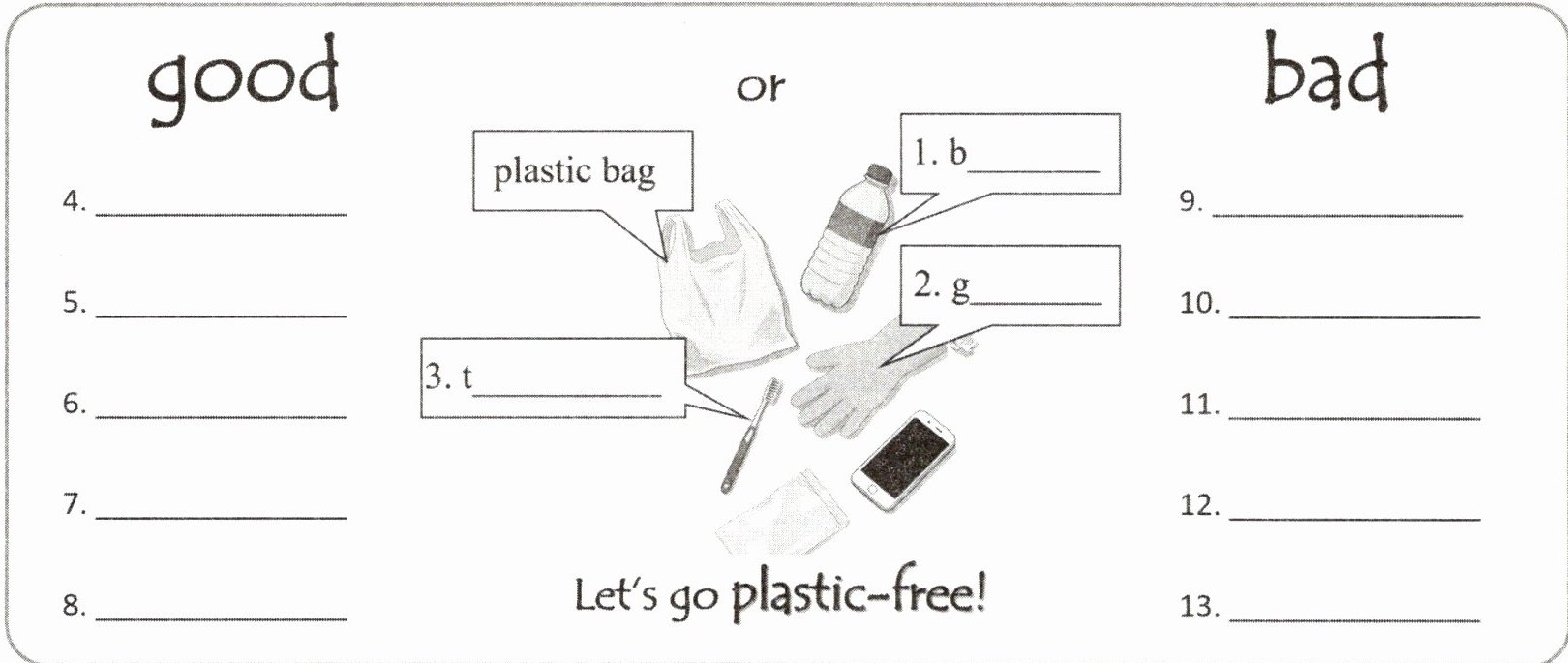
Let’s go plastic-free!
4.
5.
6.
7.
8.
9.
10.
11.
12.
13.
任务二:从方框中选择恰当的单词填入上图中4—13题的空格中。
light cheap dangerous convenient kill sea animals
humans eat plastic thousands of uses easy to shape
hard to break down cause air pollution
任务一:根据图片和首字母提示完成图中1—3题的单词。
good or bad
plastic bag
1. b
ottle
2. g
love
3. t
oothbrush
Let’s go plastic-free!
4.
light
5.
cheap
6.
convenient
7.
thousands of uses
8.
easy to shape
9.
dangerous
10.
humans eat plastic
11.
hard to break down
12.
cause air pollution
13.
kill sea animals
任务二:从方框中选择恰当的单词填入上图中4—13题的空格中。
light cheap dangerous convenient kill sea animals
humans eat plastic thousands of uses easy to shape
hard to break down cause air pollution
答案
1. bottle 2. glove 3. toothbrush 4. light 5. cheap 6. convenient 7. thousands of uses 8. easy to shape 9. dangerous 10. humans eat plastic 11. hard to break down 12. cause air pollution 13. kill sea animals
解析
【分析】
本题分为两个任务:任务一根据图片和首字母提示填写对应物品的英文单词;任务二从给定单词中选择塑料的优点(对应good列)和缺点(对应bad列)填入空格。首先观察1-3题的图片:1是塑料瓶,首字母为b,对应相关物品单词;2是手套,首字母为g;3是牙刷,首字母为t。再结合环保主题,塑料的优点(good)包括轻便、便宜、方便、用途广、易塑形;缺点(bad)包括危险、人类食用塑料、难降解、造成空气污染、杀死海洋动物,据此匹配对应单词。
【解析】
任务一:
1. 图片为塑料瓶,首字母为b,故填bottle;
2. 图片为手套,首字母为g,故填glove;
3. 图片为牙刷,首字母为t,故填toothbrush;
任务二:
good列(塑料优点)依次填入:light、cheap、convenient、thousands of uses、easy to shape;
bad列(塑料缺点)依次填入:dangerous、humans eat plastic、hard to break down、cause air pollution、kill sea animals。
【答案】
1. bottle 2. glove 3. toothbrush 4. light 5. cheap 6. convenient 7. thousands of uses 8. easy to shape 9. dangerous 10. humans eat plastic 11. hard to break down 12. cause air pollution 13. kill sea animals
【知识点】
英语单词拼写、词汇运用、环保常识
【点评】
本题结合图片和环保主题,既考察基础英语单词拼写,又引导学生理解塑料的利弊,题型贴近生活,难度适中。
【难度系数】
0.6
本题分为两个任务:任务一根据图片和首字母提示填写对应物品的英文单词;任务二从给定单词中选择塑料的优点(对应good列)和缺点(对应bad列)填入空格。首先观察1-3题的图片:1是塑料瓶,首字母为b,对应相关物品单词;2是手套,首字母为g;3是牙刷,首字母为t。再结合环保主题,塑料的优点(good)包括轻便、便宜、方便、用途广、易塑形;缺点(bad)包括危险、人类食用塑料、难降解、造成空气污染、杀死海洋动物,据此匹配对应单词。
【解析】
任务一:
1. 图片为塑料瓶,首字母为b,故填bottle;
2. 图片为手套,首字母为g,故填glove;
3. 图片为牙刷,首字母为t,故填toothbrush;
任务二:
good列(塑料优点)依次填入:light、cheap、convenient、thousands of uses、easy to shape;
bad列(塑料缺点)依次填入:dangerous、humans eat plastic、hard to break down、cause air pollution、kill sea animals。
【答案】
1. bottle 2. glove 3. toothbrush 4. light 5. cheap 6. convenient 7. thousands of uses 8. easy to shape 9. dangerous 10. humans eat plastic 11. hard to break down 12. cause air pollution 13. kill sea animals
【知识点】
英语单词拼写、词汇运用、环保常识
【点评】
本题结合图片和环保主题,既考察基础英语单词拼写,又引导学生理解塑料的利弊,题型贴近生活,难度适中。
【难度系数】
0.6
Ⅱ. 根据课本第84~85页的内容,按要求完成下列任务。
When plastic was invented around the 1870s, it was seen as an amazing material. 1 It quickly took the place of wood and other natural materials. Many people believed plastic would make life better. It was even called an "environmental hero".
Today, plastic is everywhere. It is convenient and has thousands of uses. 2
Plastic has become a danger to sea animals. Many animals eat it by mistake and die. It kills more than 100,000 sea animals every year. 3 Birds, bears and cows are hurt by plastic waste. Even humans eat plastic—on average, five grams a week. Small pieces of plastic are found in the air, and even at the North and South Poles.
4 It may take thousands of years. Burning it causes air pollution.
Plastic is not just an environmental problem. 5 There is no Planet B. Let's go plastic-free!
任务一:从方框中选出能填入空白处的最佳选项。其中有一项为多余选项。
A. Plastic is hard to break down.
B. It is a matter of life and death.
C. It also causes problems on land.
D. But over time, it has shown its dark side.
E. It was light, easy to shape, long-lasting and cheap.
F. Many countries have started to stop using plastic bags.
1. 2. 3. 4. 5.
任务二:回答下列问题。
1. What did people call plastic when it was first invented?
2. What does burning plastic cause?
3. Do you agree with the writer that plastic is bad? Why or why not?
When plastic was invented around the 1870s, it was seen as an amazing material. 1 It quickly took the place of wood and other natural materials. Many people believed plastic would make life better. It was even called an "environmental hero".
Today, plastic is everywhere. It is convenient and has thousands of uses. 2
Plastic has become a danger to sea animals. Many animals eat it by mistake and die. It kills more than 100,000 sea animals every year. 3 Birds, bears and cows are hurt by plastic waste. Even humans eat plastic—on average, five grams a week. Small pieces of plastic are found in the air, and even at the North and South Poles.
4 It may take thousands of years. Burning it causes air pollution.
Plastic is not just an environmental problem. 5 There is no Planet B. Let's go plastic-free!
任务一:从方框中选出能填入空白处的最佳选项。其中有一项为多余选项。
A. Plastic is hard to break down.
B. It is a matter of life and death.
C. It also causes problems on land.
D. But over time, it has shown its dark side.
E. It was light, easy to shape, long-lasting and cheap.
F. Many countries have started to stop using plastic bags.
1. 2. 3. 4. 5.
任务二:回答下列问题。
1. What did people call plastic when it was first invented?
2. What does burning plastic cause?
3. Do you agree with the writer that plastic is bad? Why or why not?
答案
任务一:1. E 2. D 3. C 4. A 5. B
任务二:1. They called it an "environmental hero".
2. Burning plastic causes air pollution.
3. I don't fully agree. Plastic is convenient and has thousands of uses in our daily life, which makes our life better. But we should use plastic properly, reduce plastic waste and reuse plastic to avoid its harm to the environment.
任务二:1. They called it an "environmental hero".
2. Burning plastic causes air pollution.
3. I don't fully agree. Plastic is convenient and has thousands of uses in our daily life, which makes our life better. But we should use plastic properly, reduce plastic waste and reuse plastic to avoid its harm to the environment.
解析
【分析】
本题分为任务一(补全短文)和任务二(回答问题)。任务一需结合上下文逻辑关系,选择符合语境的句子:1空前文提到塑料被视为神奇材料,后文说它取代天然材料,需选描述塑料优点的选项;2空前文讲塑料的便利性,后文转折讲其危害,需选转折类选项;3空前文讲塑料对海洋动物的危害,后文讲陆地动物的危害,需选过渡到陆地问题的选项;4空后文提到分解时间长、焚烧污染,需选关于塑料难分解的选项;5空前文说塑料不只是环境问题,后文强调没有替代星球,需选关乎生存的选项。任务二需从原文提取细节信息,第3题是开放题,需结合原文观点合理表达。
【解析】
任务一:1. 分析1空前后语境,前文“amazing material”与后文“took the place of wood...”对应塑料的优点,故选E;2. 2空前后为转折关系,前文讲塑料的好处,后文讲其危害,故选D;3. 3空前后分别讲海洋动物和陆地动物受塑料危害,为过渡到陆地问题的选项,故选C;4. 4空后文“take thousands of years”对应塑料难分解,故选A;5. 5空前文说塑料不只是环境问题,后文强调生存问题,故选B。
任务二:1. 从原文第一段最后一句提取答案;2. 从原文第四段最后一句提取答案;3. 结合原文中塑料的利弊,合理表达观点,既提到塑料的便利用途,又强调需合理使用避免危害。
【答案】
任务一:1. E 2. D 3. C 4. A 5. B
任务二:1. They called it an "environmental hero".
2. Burning plastic causes air pollution.
3. I don't fully agree. Plastic is convenient and has thousands of uses in our daily life, which makes our life better. But we should use plastic properly, reduce plastic waste and reuse plastic to avoid its harm to the environment.
【知识点】
英语完形填空(上下文逻辑)、英语阅读理解(信息提取与观点表达)
【点评】
本题为英语任务型阅读理解题,既考查学生对上下文逻辑的把握能力,又考查从原文提取细节信息、合理表达观点的能力,贴近生活实际,难度适中。
【难度系数】
0.5
本题分为任务一(补全短文)和任务二(回答问题)。任务一需结合上下文逻辑关系,选择符合语境的句子:1空前文提到塑料被视为神奇材料,后文说它取代天然材料,需选描述塑料优点的选项;2空前文讲塑料的便利性,后文转折讲其危害,需选转折类选项;3空前文讲塑料对海洋动物的危害,后文讲陆地动物的危害,需选过渡到陆地问题的选项;4空后文提到分解时间长、焚烧污染,需选关于塑料难分解的选项;5空前文说塑料不只是环境问题,后文强调没有替代星球,需选关乎生存的选项。任务二需从原文提取细节信息,第3题是开放题,需结合原文观点合理表达。
【解析】
任务一:1. 分析1空前后语境,前文“amazing material”与后文“took the place of wood...”对应塑料的优点,故选E;2. 2空前后为转折关系,前文讲塑料的好处,后文讲其危害,故选D;3. 3空前后分别讲海洋动物和陆地动物受塑料危害,为过渡到陆地问题的选项,故选C;4. 4空后文“take thousands of years”对应塑料难分解,故选A;5. 5空前文说塑料不只是环境问题,后文强调生存问题,故选B。
任务二:1. 从原文第一段最后一句提取答案;2. 从原文第四段最后一句提取答案;3. 结合原文中塑料的利弊,合理表达观点,既提到塑料的便利用途,又强调需合理使用避免危害。
【答案】
任务一:1. E 2. D 3. C 4. A 5. B
任务二:1. They called it an "environmental hero".
2. Burning plastic causes air pollution.
3. I don't fully agree. Plastic is convenient and has thousands of uses in our daily life, which makes our life better. But we should use plastic properly, reduce plastic waste and reuse plastic to avoid its harm to the environment.
【知识点】
英语完形填空(上下文逻辑)、英语阅读理解(信息提取与观点表达)
【点评】
本题为英语任务型阅读理解题,既考查学生对上下文逻辑的把握能力,又考查从原文提取细节信息、合理表达观点的能力,贴近生活实际,难度适中。
【难度系数】
0.5
