

 登录
登录
四、任务型阅读(每小题 1.5 分,满分 15 分)
阅读下面短文,并根据所读内容在文章后的表格里填入最恰当的单词,每个空格只填一个单词。
In old myths(神话)or new ones, whether from Asia, Africa, the Americas or Europe, the world's hero stories all have the same basic shape. The details of the stories may change, but every hero story has the same three parts.
In the first part of any hero story, the hero starts a journey. Often the hero does not, at first, want to go on this journey. But in the end, he finally agrees to do so. He leaves the safety of his home, friends and family to go to this new place. This place is very different from the hero's home and is often dangerous. Sometimes there is someone who helps the hero to understand this new place. The person gives the hero the information he needs to succeed(成功).
The second part of the hero story is the most exciting. This is when the hero must pass some kind of test or overcome a challenge. A common example of such a test is when the hero has to fight a monster with much bigger size and greater strength. The hero does not, at first, believe that he will be able to kill the monster. Other common challenges include solving a problem or having to face one's fears(恐惧). In any challenge, the hero must use his strength, intelligence and bravery to pass the test. He must kill a character with terrible and wicked power, answer the question or trust in one's abilities. Of course, in the end, the hero always succeeds.
In the end, in the last part of the hero story, the hero returns home. He is a better person now—one who has the lessons he has learnt from what he has experienced along his journey—wealth and knowledge—to share with family and friends.
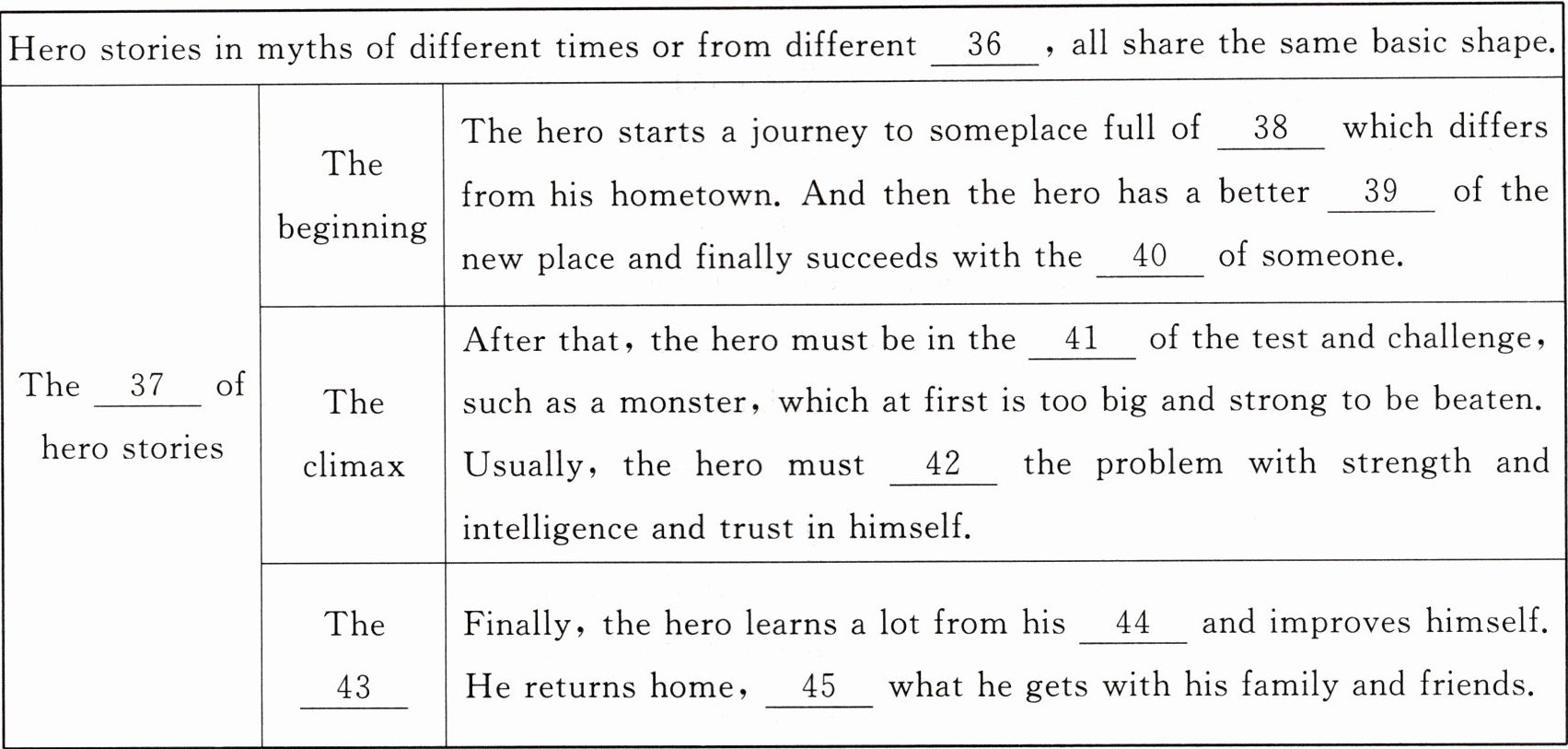
36.
41.
阅读下面短文,并根据所读内容在文章后的表格里填入最恰当的单词,每个空格只填一个单词。
In old myths(神话)or new ones, whether from Asia, Africa, the Americas or Europe, the world's hero stories all have the same basic shape. The details of the stories may change, but every hero story has the same three parts.
In the first part of any hero story, the hero starts a journey. Often the hero does not, at first, want to go on this journey. But in the end, he finally agrees to do so. He leaves the safety of his home, friends and family to go to this new place. This place is very different from the hero's home and is often dangerous. Sometimes there is someone who helps the hero to understand this new place. The person gives the hero the information he needs to succeed(成功).
The second part of the hero story is the most exciting. This is when the hero must pass some kind of test or overcome a challenge. A common example of such a test is when the hero has to fight a monster with much bigger size and greater strength. The hero does not, at first, believe that he will be able to kill the monster. Other common challenges include solving a problem or having to face one's fears(恐惧). In any challenge, the hero must use his strength, intelligence and bravery to pass the test. He must kill a character with terrible and wicked power, answer the question or trust in one's abilities. Of course, in the end, the hero always succeeds.
In the end, in the last part of the hero story, the hero returns home. He is a better person now—one who has the lessons he has learnt from what he has experienced along his journey—wealth and knowledge—to share with family and friends.
36.
places
37. plot
38. danger/dangers
39. understanding
40. help
41.
face
42. solve
43. end
44. experiences
45. sharing
答案
【文章大意】本文是一篇说明文,主要介绍了在古老的神话或新的神话中,英雄故事的三个相同部分。
36. places 37. plot 38. danger/dangers 39. understanding
40. help 41. face 42. solve 43. end 44. experiences
45. sharing
36. places 37. plot 38. danger/dangers 39. understanding
40. help 41. face 42. solve 43. end 44. experiences
45. sharing
解析
【分析】
这是一篇信息匹配类的任务型阅读,解题思路如下:
1. 先通读全文,梳理文章核心脉络:文章总述不同时代、不同地域的神话中的英雄故事都有共通的基础框架,且所有英雄故事都分为三个固定部分展开,后续分别介绍了故事的开端、高潮、结局三个阶段的内容。
2. 逐个定位空格对应的原文内容,结合词性、固定搭配、句式转换的要求,筛选匹配最合适的单词,同时保证每个空格仅填一个词:
36空对应原文第一段列举的亚洲、非洲等不同地域,different后接可数名词复数,填入表示地点的复数名词;
37空对应表格下划分的开端、高潮、结局三个故事发展阶段,对应英雄故事的情节构成,匹配对应词汇;
38空对应原文提到陌生新地点通常很危险,full of后接名词,转换形容词dangerous为名词形式;
39空对应有人帮助英雄了解新地点,转换为固定搭配have a better understanding of;
40空对应他人给英雄提供信息助力成功,匹配固定搭配with the help of;
41空对应英雄要直面考验挑战,匹配固定短语in the face of;
42空对应英雄需要解决问题,情态动词must后接动词原形solve;
43空对应第三个故事阶段,在开端、高潮之后的结局部分;
44空对应英雄从自身的旅途经历中收获成长,填入表示经历的复数名词;
45空对应英雄回家后和亲友分享所得,此处用现在分词作伴随状语,填入share的动名词形式。
【解析】
36. 原文第一段提到英雄故事来自亚洲、非洲、美洲、欧洲等不同区域,different后接可数名词复数,故填places。
37. 表格下划分了故事的开端、高潮、结局三个情节发展阶段,整体介绍英雄故事的情节构成,故填plot。
38. 原文第二段提到英雄前往的新地点和家乡完全不同,通常十分危险,full of后可接不可数名词danger或者可数名词复数dangers,故填danger/dangers。
39. 原文第二段提到有人会帮助英雄了解新环境,转换为固定搭配have a better understanding of,意为"对……有更好的了解",故填understanding。
40. 原文第二段提到他人会给英雄提供成功所需的信息,也就是英雄在某人的帮助下取得成功,固定搭配with the help of sb. 意为"在某人的帮助下",故填help。
41. 原文第三段提到英雄必须通过考验、克服挑战,固定短语in the face of 意为"面对",符合语境,故填face。
42. 原文第三段提到常见挑战包括解决问题,情态动词must后接动词原形,solve the problem意为"解决问题",故填solve。
43. 表格前两个部分分别是开端、高潮,第三个部分对应故事的结局阶段,故填end。
44. 原文最后一段提到英雄从旅途的所有经历中学到很多、提升自我,此处表示多段经历,用复数experiences,故填experiences。
45. 原文最后一段提到英雄回家后和亲友分享自己的收获,此处用现在分词作伴随状语,故填sharing。
【答案】
36. places
37. plot
38. danger/dangers
39. understanding
40. help
41. face
42. solve
43. end
44. experiences
45. sharing
【知识点】
任务型阅读信息提取;固定短语搭配;词性转换
【点评】
本题难度适中,所有空格的答案都可以从原文找到对应依据,重点考察学生快速定位原文信息、结合固定搭配进行词性转换的能力,需要学生注意空格前后的语法要求,比如名词单复数、非谓语动词形式等细节,避免出现形式错误。
【难度系数】
0.6
这是一篇信息匹配类的任务型阅读,解题思路如下:
1. 先通读全文,梳理文章核心脉络:文章总述不同时代、不同地域的神话中的英雄故事都有共通的基础框架,且所有英雄故事都分为三个固定部分展开,后续分别介绍了故事的开端、高潮、结局三个阶段的内容。
2. 逐个定位空格对应的原文内容,结合词性、固定搭配、句式转换的要求,筛选匹配最合适的单词,同时保证每个空格仅填一个词:
36空对应原文第一段列举的亚洲、非洲等不同地域,different后接可数名词复数,填入表示地点的复数名词;
37空对应表格下划分的开端、高潮、结局三个故事发展阶段,对应英雄故事的情节构成,匹配对应词汇;
38空对应原文提到陌生新地点通常很危险,full of后接名词,转换形容词dangerous为名词形式;
39空对应有人帮助英雄了解新地点,转换为固定搭配have a better understanding of;
40空对应他人给英雄提供信息助力成功,匹配固定搭配with the help of;
41空对应英雄要直面考验挑战,匹配固定短语in the face of;
42空对应英雄需要解决问题,情态动词must后接动词原形solve;
43空对应第三个故事阶段,在开端、高潮之后的结局部分;
44空对应英雄从自身的旅途经历中收获成长,填入表示经历的复数名词;
45空对应英雄回家后和亲友分享所得,此处用现在分词作伴随状语,填入share的动名词形式。
【解析】
36. 原文第一段提到英雄故事来自亚洲、非洲、美洲、欧洲等不同区域,different后接可数名词复数,故填places。
37. 表格下划分了故事的开端、高潮、结局三个情节发展阶段,整体介绍英雄故事的情节构成,故填plot。
38. 原文第二段提到英雄前往的新地点和家乡完全不同,通常十分危险,full of后可接不可数名词danger或者可数名词复数dangers,故填danger/dangers。
39. 原文第二段提到有人会帮助英雄了解新环境,转换为固定搭配have a better understanding of,意为"对……有更好的了解",故填understanding。
40. 原文第二段提到他人会给英雄提供成功所需的信息,也就是英雄在某人的帮助下取得成功,固定搭配with the help of sb. 意为"在某人的帮助下",故填help。
41. 原文第三段提到英雄必须通过考验、克服挑战,固定短语in the face of 意为"面对",符合语境,故填face。
42. 原文第三段提到常见挑战包括解决问题,情态动词must后接动词原形,solve the problem意为"解决问题",故填solve。
43. 表格前两个部分分别是开端、高潮,第三个部分对应故事的结局阶段,故填end。
44. 原文最后一段提到英雄从旅途的所有经历中学到很多、提升自我,此处表示多段经历,用复数experiences,故填experiences。
45. 原文最后一段提到英雄回家后和亲友分享自己的收获,此处用现在分词作伴随状语,故填sharing。
【答案】
36. places
37. plot
38. danger/dangers
39. understanding
40. help
41. face
42. solve
43. end
44. experiences
45. sharing
【知识点】
任务型阅读信息提取;固定短语搭配;词性转换
【点评】
本题难度适中,所有空格的答案都可以从原文找到对应依据,重点考察学生快速定位原文信息、结合固定搭配进行词性转换的能力,需要学生注意空格前后的语法要求,比如名词单复数、非谓语动词形式等细节,避免出现形式错误。
【难度系数】
0.6
