

 登录
登录
3. 阅读对话,完成以下任务。
Peter: What is the Spring Festival, Xiaoming?
Xiaoming: It is a big festival in China. It's Chinese New Year.
Peter: What do you do during the Spring Festival?
Xiaoming: We buy flowers and put them in our homes. Mum and Dad cook delicious food for the family. We have a big dinner.
Peter: Do you have a party?
Xiaoming: No, we don't. But we meet the family and friends and get lucky money.
Peter: What is lucky money?
Xiaoming: The old people put money in the red packets and give them to children.
Peter: Cool! I want the lucky money, too!
Task 1:根据对话内容填空。
What do people do during the Spring Festival?
(1) They buy
(2) They cook
(3) They meet
(4) They give
Task 2:判读句子是否符合对话内容。如符合,在括号内写“T”,否则写“F”。
(
(
(
(
Task 3:春节期间,中国人的餐桌上会摆满各式各样的食物,这些食物常常被赋予美好的寓意。下图是春节期间常见的食物,请将美好的寓意与对应食物连线。
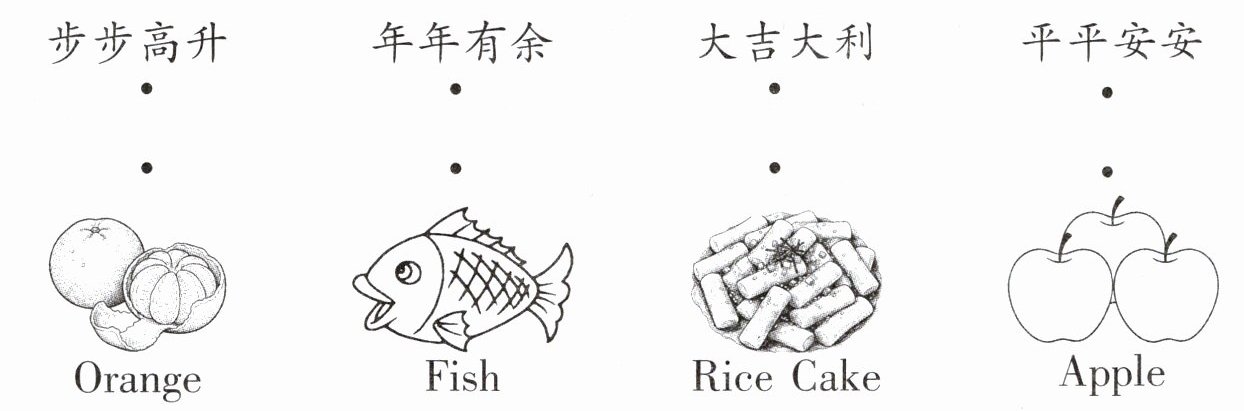
Peter: What is the Spring Festival, Xiaoming?
Xiaoming: It is a big festival in China. It's Chinese New Year.
Peter: What do you do during the Spring Festival?
Xiaoming: We buy flowers and put them in our homes. Mum and Dad cook delicious food for the family. We have a big dinner.
Peter: Do you have a party?
Xiaoming: No, we don't. But we meet the family and friends and get lucky money.
Peter: What is lucky money?
Xiaoming: The old people put money in the red packets and give them to children.
Peter: Cool! I want the lucky money, too!
Task 1:根据对话内容填空。
What do people do during the Spring Festival?
(1) They buy
flowers and put them in their homes
.(2) They cook
delicious food for the family
.(3) They meet
family and friends
.(4) They give
lucky money to children
.Task 2:判读句子是否符合对话内容。如符合,在括号内写“T”,否则写“F”。
(
F
) (1) During the Spring Festival, people grow flowers at home.(
F
) (2) During the Spring Festival, people have a big party.(
T
) (3) During the Spring Festival, the old people put money in the red packets.(
T
) (4) During the Spring Festival, children get lucky money.Task 3:春节期间,中国人的餐桌上会摆满各式各样的食物,这些食物常常被赋予美好的寓意。下图是春节期间常见的食物,请将美好的寓意与对应食物连线。
答案
3. Task 1: (1) flowers and put them in their homes
(2) delicious food for the family
(3) family and friends
(4) lucky money to children
Task 2: (1) F (2) F (3) T (4) T
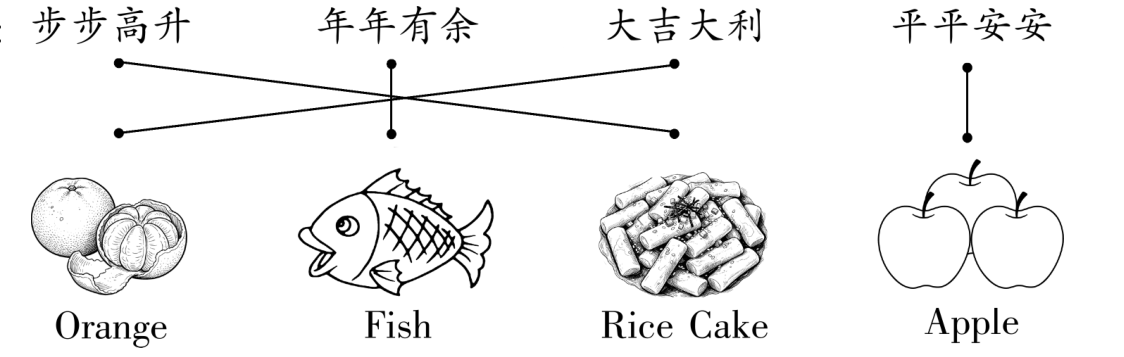
Task 3:
解析
【分析】
本题是围绕春节话题的英语阅读理解题,解题思路:1. 先通读对话,掌握春节相关的活动、压岁钱等核心信息;2. Task1需从对话中提取对应春节活动的完整短语,注意原句表述;3. Task2要对比每个句子与对话原文的细节,判断是否相符;4. Task3结合春节食物的寓意完成连线,按要求呈现结果。
【解析】
Task1:根据对话内容:
(1) 由“We buy flowers and put them in our homes.”可知,人们买花并放在家里,故填flowers and put them in their homes;
(2) 由“Mum and Dad cook delicious food for the family.”可知,家人为家庭做美味食物,故填delicious food for the family;
(3) 由“But we meet the family and friends...”可知,人们会见家人和朋友,故填family and friends;
(4) 由“The old people put money in the red packets and give them to children.”可知,长辈给孩子压岁钱,故填lucky money to children。
Task2:
(1) 对话是“买花”而非“种花”,不符合,填F;
(2) 对话明确说没有聚会,不符合,填F;
(3) 与对话中长辈把钱放红包的表述一致,符合,填T;
(4) 对话提到孩子会得到压岁钱,符合,填T。
Task3:结合春节食物寓意连线,结果为。
【答案】
Task 1: (1) flowers and put them in their homes (2) delicious food for the family (3) family and friends (4) lucky money to children
Task 2: (1) F (2) F (3) T (4) T
Task 3:
【知识点】
英语阅读理解,春节话题词汇,细节信息提取
【点评】
本题围绕春节主题,考查学生对英语对话细节的理解与信息提取能力,题目贴近生活,难度适中,适合巩固基础英语阅读技能。
【难度系数】
0.2
本题是围绕春节话题的英语阅读理解题,解题思路:1. 先通读对话,掌握春节相关的活动、压岁钱等核心信息;2. Task1需从对话中提取对应春节活动的完整短语,注意原句表述;3. Task2要对比每个句子与对话原文的细节,判断是否相符;4. Task3结合春节食物的寓意完成连线,按要求呈现结果。
【解析】
Task1:根据对话内容:
(1) 由“We buy flowers and put them in our homes.”可知,人们买花并放在家里,故填flowers and put them in their homes;
(2) 由“Mum and Dad cook delicious food for the family.”可知,家人为家庭做美味食物,故填delicious food for the family;
(3) 由“But we meet the family and friends...”可知,人们会见家人和朋友,故填family and friends;
(4) 由“The old people put money in the red packets and give them to children.”可知,长辈给孩子压岁钱,故填lucky money to children。
Task2:
(1) 对话是“买花”而非“种花”,不符合,填F;
(2) 对话明确说没有聚会,不符合,填F;
(3) 与对话中长辈把钱放红包的表述一致,符合,填T;
(4) 对话提到孩子会得到压岁钱,符合,填T。
Task3:结合春节食物寓意连线,结果为
。【答案】
Task 1: (1) flowers and put them in their homes (2) delicious food for the family (3) family and friends (4) lucky money to children
Task 2: (1) F (2) F (3) T (4) T
Task 3:
【知识点】
英语阅读理解,春节话题词汇,细节信息提取
【点评】
本题围绕春节主题,考查学生对英语对话细节的理解与信息提取能力,题目贴近生活,难度适中,适合巩固基础英语阅读技能。
【难度系数】
0.2
