

 登录
登录
Online Courses
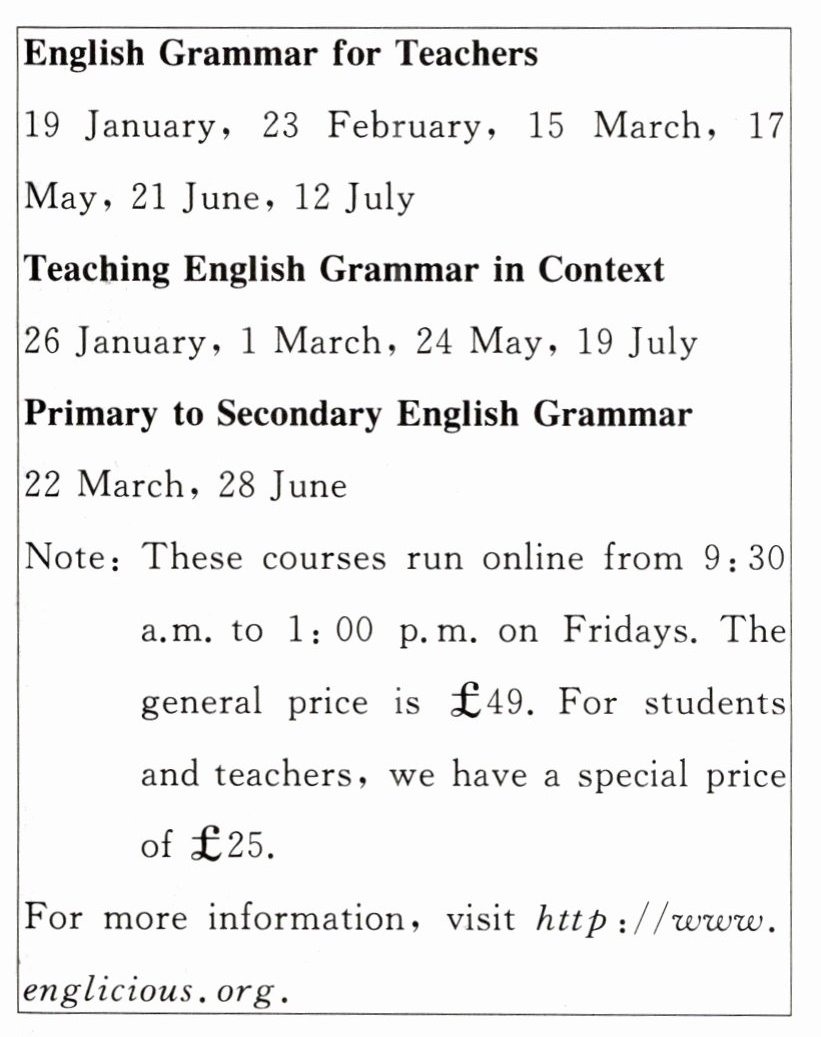
Here is the latest information of our online, half-day English courses for you to add to your learning calendars. We cover the English grammar knowledge required by the National Curriculum(课程)as well as useful and helpful teaching techniques, all taught by experts at UCL.
1. What are the courses about?
A. Pronunciation.
B. Grammar.
C. Reading.
D. Writing.
2. When can you take the courses above?
A. On 25 January.
B. On 24 February.
C. On 23 March.
D. On 21 June.
3. Which of the following is TRUE according to the passage?
A. The courses are free.
B. The courses are provided online.
C. The courses are only for teachers.
D. The courses are offered in the evening.
Here is the latest information of our online, half-day English courses for you to add to your learning calendars. We cover the English grammar knowledge required by the National Curriculum(课程)as well as useful and helpful teaching techniques, all taught by experts at UCL.
1. What are the courses about?
A. Pronunciation.
B. Grammar.
C. Reading.
D. Writing.
2. When can you take the courses above?
A. On 25 January.
B. On 24 February.
C. On 23 March.
D. On 21 June.
3. Which of the following is TRUE according to the passage?
A. The courses are free.
B. The courses are provided online.
C. The courses are only for teachers.
D. The courses are offered in the evening.
答案
Passage 5
1. B 细节理解题。根据“We cover the English grammar knowledge required by the National Curriculum(课程)as well as useful and helpful teaching techniques,all taught by experts at UCL.”可知,课程教授语法知识和有用的教学技能。故选B。
2. D 细节理解题。根据“English Grammar for Teachers:19 January,23 February,15 March,17 May,21 June,12 July”并结合选项可知,6月21日可以上教师英语语法课。故选D。
3. B 细节理解题。根据“Here is the latest information of our online,half-day English courses for you to add to your learning calendars.”可知,课程是网上在线课程。故选B。
1. B 细节理解题。根据“We cover the English grammar knowledge required by the National Curriculum(课程)as well as useful and helpful teaching techniques,all taught by experts at UCL.”可知,课程教授语法知识和有用的教学技能。故选B。
2. D 细节理解题。根据“English Grammar for Teachers:19 January,23 February,15 March,17 May,21 June,12 July”并结合选项可知,6月21日可以上教师英语语法课。故选D。
3. B 细节理解题。根据“Here is the latest information of our online,half-day English courses for you to add to your learning calendars.”可知,课程是网上在线课程。故选B。
解析
【解析】
1. 第1题为细节理解题,根据文中“We cover the English grammar knowledge required by the National Curriculum(课程)as well as useful and helpful teaching techniques,all taught by experts at UCL.”可知,课程围绕英语语法知识展开,因此选B。
2. 第2题为细节理解题,查看课程安排,“English Grammar for Teachers”的开课日期包含21 June,选项中只有该日期在开课列表内,因此选D。
3. 第3题为细节理解题,根据文中“Here is the latest information of our online,half-day English courses for you to add to your learning calendars.”以及备注里的“These courses run online”可知课程为线上课程;A选项,文中明确给出课程价格,并非免费,错误;C选项,文中提到学生可享优惠价,说明课程并非仅面向教师,错误;D选项,课程时间是上午9:30到下午1:00,并非晚上,错误。因此选B。
【答案】
1. B;2. D;3. B
【知识点】
细节理解题,信息提取,英语阅读理解
【点评】
本文是一则线上英语语法课程的招生广告,三道题目均为细节理解题,需要学生快速定位文中关键信息进行判断,主要考查学生从文本中提取有效信息的能力。
【难度系数】
0.7
1. 第1题为细节理解题,根据文中“We cover the English grammar knowledge required by the National Curriculum(课程)as well as useful and helpful teaching techniques,all taught by experts at UCL.”可知,课程围绕英语语法知识展开,因此选B。
2. 第2题为细节理解题,查看课程安排,“English Grammar for Teachers”的开课日期包含21 June,选项中只有该日期在开课列表内,因此选D。
3. 第3题为细节理解题,根据文中“Here is the latest information of our online,half-day English courses for you to add to your learning calendars.”以及备注里的“These courses run online”可知课程为线上课程;A选项,文中明确给出课程价格,并非免费,错误;C选项,文中提到学生可享优惠价,说明课程并非仅面向教师,错误;D选项,课程时间是上午9:30到下午1:00,并非晚上,错误。因此选B。
【答案】
1. B;2. D;3. B
【知识点】
细节理解题,信息提取,英语阅读理解
【点评】
本文是一则线上英语语法课程的招生广告,三道题目均为细节理解题,需要学生快速定位文中关键信息进行判断,主要考查学生从文本中提取有效信息的能力。
【难度系数】
0.7
Ghaffar Pourazar, a British man, has learned the necessary skills to perform Beijing opera and he has become popular with his lively performance of the Monkey King.

Born in Iran, Ghaffar has been a big fan of Chinese culture since he was a child. And he is interested in China.
In 1993, he happened to watch Beijing opera performed in London by professionals from Beijing. Ghaffar fell in love with the beautiful voices, colorful costumes, excellent shows and so on. So after a year, he arrived in China alone and became a student of Beijing opera at a school in Beijing.
At the age of 32, he had to learn with teenage students every day, starting from the most basic training of the legs and waist. At that time, he was mostly troubled by the dialogue in Beijing opera. To him, it was the biggest problem. But he never gave up.
Four years later, he began to learn to perform the Monkey King, a traditional character from the Chinese classic story *Journey to the West*. He usually arrived at the workroom an hour earlier than the other performers, and he also bought books and CDs to understand the character better.
Ghaffar is not only good at speaking Beijing dialect(方言)but also has won the world reputation for Beijing opera. He once won a top international prize for performing the Monkey King.
To help more people enjoy Beijing opera, Ghaffar often teaches the traditional art form in schools in the United States, Britain and other countries. When he found that the language was difficult to understand, he started to translate the lyrics of Beijing opera. Ghaffar led a group of actors to perform 66 times in a month and a half in the United States. He also led a 48-member team to perform in Malaysia. In the past 10 years, he has performed in more than 400 shows.
1. Why did Ghaffar start learning Beijing opera?
A. Because he loved Beijing opera after watching one.
B. Because his parents asked him to learn it.
C. Because his friend advised him to learn it.
D. Because he wanted to be an actor and made lots of money.
2. How old was Ghaffar when he started to learn to perform the Monkey King?
A. 30.
B. 32.
C. 34.
D. 36.
3. What does the underlined word "reputation" in Paragraph 6 mean?
A. Business.
B. Fame.
C. Power.
D. Time.
4. Put the events about Ghaffar into the correct order.
a. He got basic training with teenage students.
b. He watched a Beijing opera performance in London.
c. He bought books and CDs about the Monkey King.
d. He won an international prize for performing the Monkey King.
A. a-b-c-d
B. a-b-d-c
C. b-a-c-d
D. b-a-d-c
5. What can we know about Ghaffar from the passage?
A. He likes to teach his children to speak Beijing dialect.
B. He is a patient teacher and teaches students to perform Beijing opera well.
C. He has made an influence on Beijing opera in other countries.
D. He isn't able to solve any problem about Beijing opera by himself.
Born in Iran, Ghaffar has been a big fan of Chinese culture since he was a child. And he is interested in China.
In 1993, he happened to watch Beijing opera performed in London by professionals from Beijing. Ghaffar fell in love with the beautiful voices, colorful costumes, excellent shows and so on. So after a year, he arrived in China alone and became a student of Beijing opera at a school in Beijing.
At the age of 32, he had to learn with teenage students every day, starting from the most basic training of the legs and waist. At that time, he was mostly troubled by the dialogue in Beijing opera. To him, it was the biggest problem. But he never gave up.
Four years later, he began to learn to perform the Monkey King, a traditional character from the Chinese classic story *Journey to the West*. He usually arrived at the workroom an hour earlier than the other performers, and he also bought books and CDs to understand the character better.
Ghaffar is not only good at speaking Beijing dialect(方言)but also has won the world reputation for Beijing opera. He once won a top international prize for performing the Monkey King.
To help more people enjoy Beijing opera, Ghaffar often teaches the traditional art form in schools in the United States, Britain and other countries. When he found that the language was difficult to understand, he started to translate the lyrics of Beijing opera. Ghaffar led a group of actors to perform 66 times in a month and a half in the United States. He also led a 48-member team to perform in Malaysia. In the past 10 years, he has performed in more than 400 shows.
1. Why did Ghaffar start learning Beijing opera?
A. Because he loved Beijing opera after watching one.
B. Because his parents asked him to learn it.
C. Because his friend advised him to learn it.
D. Because he wanted to be an actor and made lots of money.
2. How old was Ghaffar when he started to learn to perform the Monkey King?
A. 30.
B. 32.
C. 34.
D. 36.
3. What does the underlined word "reputation" in Paragraph 6 mean?
A. Business.
B. Fame.
C. Power.
D. Time.
4. Put the events about Ghaffar into the correct order.
a. He got basic training with teenage students.
b. He watched a Beijing opera performance in London.
c. He bought books and CDs about the Monkey King.
d. He won an international prize for performing the Monkey King.
A. a-b-c-d
B. a-b-d-c
C. b-a-c-d
D. b-a-d-c
5. What can we know about Ghaffar from the passage?
A. He likes to teach his children to speak Beijing dialect.
B. He is a patient teacher and teaches students to perform Beijing opera well.
C. He has made an influence on Beijing opera in other countries.
D. He isn't able to solve any problem about Beijing opera by himself.
答案
Passage 6
1. A 细节理解题。根据“In 1993,he happened to watch Beijing opera…Ghaffar fell in love with the beautiful voices,colorful costumes,excellent shows and so on.”可知,他看了一场京剧之后就爱上了京剧。故选A。
2. D 推理判断题。根据“At the age of 32,he had to learn with teenage students every day”和“Four years later,he began to learn to perform the Monkey King”可知,32岁时,他每天都要和十几岁的学生一起学习,四年后,他开始学习表演《西游记》中的传统角色孙悟空,也就是在36岁时。故选D。
3. B 词义猜测题。根据“Ghaffar is not only good at speaking Beijing dialect(方言)but also has won the world reputation for Beijing opera.”以及“To help more people enjoy Beijing opera,Ghaffar often teaches…and other countries.”可知,为了帮助更多的人欣赏京剧,Ghaffar经常在美国、英国和其他国家的学校教授传统艺术形式。所以Ghaffar不仅会说北京话,而且为京剧赢得了世界的声誉。所以reputation表示“名声”,和fame同义。故选B。
4. C 细节理解题。根据“In 1993,he happened to watch Beijing opera…Beijing.”“At the age of 32,he had to learn with teenage students every day”“He usually arrived…and he also bought books and CDs to understand the character better.”以及“He once won a top international prize for performing the Monkey King.”可知,正确的顺序是:他在伦敦看了一场京剧演出→他和十几岁的学生一起接受基础训练→他买了关于孙悟空的书和光盘→他表演孙悟空获得了国际大奖。故选C。
5. C 推理判断题。根据“To help more people enjoy Beijing opera…other countries.”可知,为了帮助更多的人欣赏京剧,Ghaffar经常在美国、英国和其他国家的学校教授京剧。故选C。
1. A 细节理解题。根据“In 1993,he happened to watch Beijing opera…Ghaffar fell in love with the beautiful voices,colorful costumes,excellent shows and so on.”可知,他看了一场京剧之后就爱上了京剧。故选A。
2. D 推理判断题。根据“At the age of 32,he had to learn with teenage students every day”和“Four years later,he began to learn to perform the Monkey King”可知,32岁时,他每天都要和十几岁的学生一起学习,四年后,他开始学习表演《西游记》中的传统角色孙悟空,也就是在36岁时。故选D。
3. B 词义猜测题。根据“Ghaffar is not only good at speaking Beijing dialect(方言)but also has won the world reputation for Beijing opera.”以及“To help more people enjoy Beijing opera,Ghaffar often teaches…and other countries.”可知,为了帮助更多的人欣赏京剧,Ghaffar经常在美国、英国和其他国家的学校教授传统艺术形式。所以Ghaffar不仅会说北京话,而且为京剧赢得了世界的声誉。所以reputation表示“名声”,和fame同义。故选B。
4. C 细节理解题。根据“In 1993,he happened to watch Beijing opera…Beijing.”“At the age of 32,he had to learn with teenage students every day”“He usually arrived…and he also bought books and CDs to understand the character better.”以及“He once won a top international prize for performing the Monkey King.”可知,正确的顺序是:他在伦敦看了一场京剧演出→他和十几岁的学生一起接受基础训练→他买了关于孙悟空的书和光盘→他表演孙悟空获得了国际大奖。故选C。
5. C 推理判断题。根据“To help more people enjoy Beijing opera…other countries.”可知,为了帮助更多的人欣赏京剧,Ghaffar经常在美国、英国和其他国家的学校教授京剧。故选C。
解析
【解析】
1. 细节理解题。根据文章第三段"In 1993,he happened to watch Beijing opera performed in London by professionals from Beijing. Ghaffar fell in love with the beautiful voices,colorful costumes,excellent shows and so on."可知,Ghaffar在观看一场京剧表演后爱上了京剧,因此开始学习京剧,故选A。
2. 推理判断题。根据文章第四段"At the age of 32,he had to learn with teenage students every day"和第五段"Four years later,he began to learn to perform the Monkey King"可知,32岁时他开始基础训练,四年后即36岁时开始学习表演美猴王,故选D。
3. 词义猜测题。根据文章第六段"Ghaffar is not only good at speaking Beijing dialect(方言)but also has won the world reputation for Beijing opera."以及后文他在多国教授京剧的内容可知,他为京剧赢得了世界范围的名声,reputation与fame(名声)意思相近,故选B。
4. 细节理解题。根据文章时间线:1993年他在伦敦观看京剧表演(b)→32岁时和青少年学生一起进行基础训练(a)→学习表演美猴王时购买相关书籍和光盘(c)→后来表演美猴王获得国际大奖(d),正确顺序为b-a-c-d,故选C。
5. 推理判断题。根据文章最后一段"To help more people enjoy Beijing opera, Ghaffar often teaches the traditional art form in schools in the United States, Britain and other countries."等内容可知,Ghaffar在其他国家教授京剧,对京剧在海外的传播有影响,故选C。
【答案】
1. A
2. D
3. B
4. C
5. C
【知识点】
细节理解、推理判断、词义猜测
【点评】
本文介绍了英国男子Ghaffar Pourazar学习京剧并传播京剧的经历,题目围绕文章细节、推理、词义猜测展开,考查学生对文章信息的提取和理解能力,需学生精准定位原文内容进行分析判断。
【难度系数】
0.6
1. 细节理解题。根据文章第三段"In 1993,he happened to watch Beijing opera performed in London by professionals from Beijing. Ghaffar fell in love with the beautiful voices,colorful costumes,excellent shows and so on."可知,Ghaffar在观看一场京剧表演后爱上了京剧,因此开始学习京剧,故选A。
2. 推理判断题。根据文章第四段"At the age of 32,he had to learn with teenage students every day"和第五段"Four years later,he began to learn to perform the Monkey King"可知,32岁时他开始基础训练,四年后即36岁时开始学习表演美猴王,故选D。
3. 词义猜测题。根据文章第六段"Ghaffar is not only good at speaking Beijing dialect(方言)but also has won the world reputation for Beijing opera."以及后文他在多国教授京剧的内容可知,他为京剧赢得了世界范围的名声,reputation与fame(名声)意思相近,故选B。
4. 细节理解题。根据文章时间线:1993年他在伦敦观看京剧表演(b)→32岁时和青少年学生一起进行基础训练(a)→学习表演美猴王时购买相关书籍和光盘(c)→后来表演美猴王获得国际大奖(d),正确顺序为b-a-c-d,故选C。
5. 推理判断题。根据文章最后一段"To help more people enjoy Beijing opera, Ghaffar often teaches the traditional art form in schools in the United States, Britain and other countries."等内容可知,Ghaffar在其他国家教授京剧,对京剧在海外的传播有影响,故选C。
【答案】
1. A
2. D
3. B
4. C
5. C
【知识点】
细节理解、推理判断、词义猜测
【点评】
本文介绍了英国男子Ghaffar Pourazar学习京剧并传播京剧的经历,题目围绕文章细节、推理、词义猜测展开,考查学生对文章信息的提取和理解能力,需学生精准定位原文内容进行分析判断。
【难度系数】
0.6
