

 登录
登录
一、任务型阅读。
阅读下面短文,从 A—E 中选出适当的选项填在横线上,并回答第 5 小题。有一项多余。
We all think we have good table manners. 1.
Slurping (啜食) is good. 2.
3.
Don't eat with a fork, please. In Thai culture, fork is used to move food from your plate onto your spoon. 4.
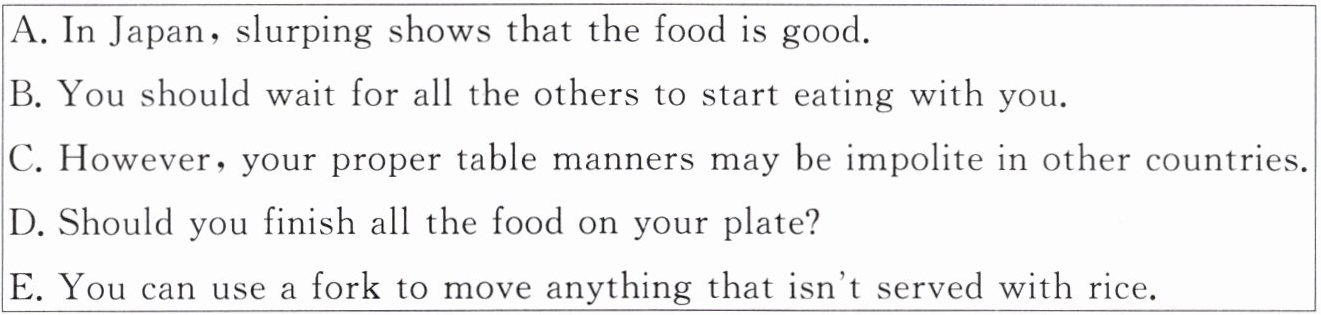
5. Do you think it's necessary to learn other countries' table manners before going there? Why? (回答不多于 15 词)
阅读下面短文,从 A—E 中选出适当的选项填在横线上,并回答第 5 小题。有一项多余。
We all think we have good table manners. 1.
C
Let's see some strange table manners around the world.Slurping (啜食) is good. 2.
A
You'll look strange if you don't slurp when you eat noodles. But be careful. Slurping is impolite in most cultures. In Thailand and in some parts of China, it's accepted to slurp but not really encouraged.3.
D
In some cultures, like Thai culture, finishing all your food on your plate is a sign. It shows that your host doesn't provide you with enough food. However, for Japanese people, finishing the food shows that you like the meal.Don't eat with a fork, please. In Thai culture, fork is used to move food from your plate onto your spoon. 4.
E
People in India, Nepal and some countries are different. They don't even use forks but eat with their hands.5. Do you think it's necessary to learn other countries' table manners before going there? Why? (回答不多于 15 词)
Yes, I do. Because it can help us behave properly.(合理即可)
答案
1—4. CADE
5. Yes, I do. Because it can help us behave properly.(合理即可)
5. Yes, I do. Because it can help us behave properly.(合理即可)
解析
【分析】
解题时需先通读全文,把握文章主旨是介绍不同国家的餐桌礼仪差异,再根据上下文语境逐一匹配选项:
1. 第1空:前文提及“我们都认为自己有良好的餐桌礼仪”,后文引出“世界各地奇怪的餐桌礼仪”,需要转折句衔接,引出“自认为得体的礼仪在他国可能失礼”的内容,对应选项C。
2. 第2空:前文点出“啜食是好的”,后文围绕日本吃面条的啜食礼仪展开,需选介绍日本啜食含义的选项,对应A。
3. 第3空:后文围绕“吃完盘中食物”在不同文化中的不同意义展开,需选提出该话题的问句作为段落引导,对应D。
4. 第4空:前文介绍泰国叉子的用法,此处需补充说明叉子的使用场景,对应E。
5. 第5题:需结合实际给出简洁回答,表明学习他国餐桌礼仪的必要性,控制在15词以内即可。
【解析】
1. 第1空:前文表明人们对自身餐桌礼仪的认知,后文引出不同国家的特殊礼仪,C选项“然而,你认为得体的餐桌礼仪在其他国家可能是不礼貌的”起到转折衔接的作用,故填C。
2. 第2空:前文提出“啜食是好的”,后文举例日本吃面条的礼仪,A选项“在日本,啜食表明食物很好吃”与语境契合,故填A。
3. 第3空:后文讲述不同文化中吃完盘中食物的不同含义,D选项“你应该吃完盘子里所有的食物吗?”作为段落主题句,引出下文内容,故填D。
4. 第4空:前文介绍泰国叉子的用法,E选项“你可以用叉子移动任何不配米饭的食物”补充说明叉子的使用场景,衔接自然,故填E。
5. 第5题:回答需明确态度并给出简短合理理由,示例:Yes, I do. Because it helps us behave properly.(符合要求即可)
【答案】
1—4. CADE
5. Yes, I do. Because it can help us behave properly.(合理即可)
【知识点】
1. 语境推理
2. 跨文化餐桌礼仪
3. 任务型阅读匹配技巧
【点评】
本题考查任务型阅读的语境匹配能力,同时融入不同国家的餐桌礼仪文化,既考查语言运用能力,也引导学生了解跨文化差异,培养跨文化意识。
【难度系数】
0.6
解题时需先通读全文,把握文章主旨是介绍不同国家的餐桌礼仪差异,再根据上下文语境逐一匹配选项:
1. 第1空:前文提及“我们都认为自己有良好的餐桌礼仪”,后文引出“世界各地奇怪的餐桌礼仪”,需要转折句衔接,引出“自认为得体的礼仪在他国可能失礼”的内容,对应选项C。
2. 第2空:前文点出“啜食是好的”,后文围绕日本吃面条的啜食礼仪展开,需选介绍日本啜食含义的选项,对应A。
3. 第3空:后文围绕“吃完盘中食物”在不同文化中的不同意义展开,需选提出该话题的问句作为段落引导,对应D。
4. 第4空:前文介绍泰国叉子的用法,此处需补充说明叉子的使用场景,对应E。
5. 第5题:需结合实际给出简洁回答,表明学习他国餐桌礼仪的必要性,控制在15词以内即可。
【解析】
1. 第1空:前文表明人们对自身餐桌礼仪的认知,后文引出不同国家的特殊礼仪,C选项“然而,你认为得体的餐桌礼仪在其他国家可能是不礼貌的”起到转折衔接的作用,故填C。
2. 第2空:前文提出“啜食是好的”,后文举例日本吃面条的礼仪,A选项“在日本,啜食表明食物很好吃”与语境契合,故填A。
3. 第3空:后文讲述不同文化中吃完盘中食物的不同含义,D选项“你应该吃完盘子里所有的食物吗?”作为段落主题句,引出下文内容,故填D。
4. 第4空:前文介绍泰国叉子的用法,E选项“你可以用叉子移动任何不配米饭的食物”补充说明叉子的使用场景,衔接自然,故填E。
5. 第5题:回答需明确态度并给出简短合理理由,示例:Yes, I do. Because it helps us behave properly.(符合要求即可)
【答案】
1—4. CADE
5. Yes, I do. Because it can help us behave properly.(合理即可)
【知识点】
1. 语境推理
2. 跨文化餐桌礼仪
3. 任务型阅读匹配技巧
【点评】
本题考查任务型阅读的语境匹配能力,同时融入不同国家的餐桌礼仪文化,既考查语言运用能力,也引导学生了解跨文化差异,培养跨文化意识。
【难度系数】
0.6
二、完形填空。
We'd never been to China before. So my parents took us to Beijing for a 6. Then I decided to buy my father a book called *China: Know Before You Go*.
"It looks very interesting, but we don't 7 that," he said. How 8 he was!
Our first evening in Beijing began at about ten o'clock. We walked past a restaurant. The staff (员工) were 9 tables and were about to go home.
"This looks good," said my father. "I think it's about to close," I said. "People here eat 10 than those in the UK. It says so in my book." "Oh, terrible!" said my father. "The night is young!" Then we came in. The staff looked a bit unhappy but still 11 us to a table. A young woman handed us a 12, all in Chinese. My father pointed to a few things. "That's what we want," he said. My father picked up the chopsticks 13 he started tapping (敲击) the bowl like playing the drums. "Don't do that, Dad," I said. "It's not polite in China."
After a while, one very large plate of food arrived in the middle of the table. My father took it and started eating. "Where's the 14 of the food?" he said to the waitress. "Dad," I said, "everyone 15 food here. That dish you're eating is for 16."
After we finished the meal, my father asked for the bill. He 17 and handed the waiter 20 yuan before leaving.
The waiter looked quite 18. "What are you doing?" I said. "People don't give tips in China." I have never felt so 19 in all my life.
The food and the 20 were fantastic and I'll surely go back to China. Next time I'll ask my father to read the book carefully before our visit.
(
B. holiday
C. ticket
D. room
(
B. make
C. mind
D. read
(
B. kind
C. wrong
D. serious
(
B. beating
C. cleaning
D. painting
(
B. better
C. later
D. earlier
(
B. showed
C. asked
D. told
(
B. menu
C. list
D. paper
(
B. and
C. but
D. unless
(
B. name
C. price
D. choice
(
B. buys
C. shares
D. cooks
(
B. somebody
C. nobody
D. anybody
(
B. received
C. refused
D. paid
(
B. embarrassed
C. worried
D. sad
(
B. impolite
C. successful
D. confused
(
B. service
C. weather
D. story
We'd never been to China before. So my parents took us to Beijing for a 6. Then I decided to buy my father a book called *China: Know Before You Go*.
"It looks very interesting, but we don't 7 that," he said. How 8 he was!
Our first evening in Beijing began at about ten o'clock. We walked past a restaurant. The staff (员工) were 9 tables and were about to go home.
"This looks good," said my father. "I think it's about to close," I said. "People here eat 10 than those in the UK. It says so in my book." "Oh, terrible!" said my father. "The night is young!" Then we came in. The staff looked a bit unhappy but still 11 us to a table. A young woman handed us a 12, all in Chinese. My father pointed to a few things. "That's what we want," he said. My father picked up the chopsticks 13 he started tapping (敲击) the bowl like playing the drums. "Don't do that, Dad," I said. "It's not polite in China."
After a while, one very large plate of food arrived in the middle of the table. My father took it and started eating. "Where's the 14 of the food?" he said to the waitress. "Dad," I said, "everyone 15 food here. That dish you're eating is for 16."
After we finished the meal, my father asked for the bill. He 17 and handed the waiter 20 yuan before leaving.
The waiter looked quite 18. "What are you doing?" I said. "People don't give tips in China." I have never felt so 19 in all my life.
The food and the 20 were fantastic and I'll surely go back to China. Next time I'll ask my father to read the book carefully before our visit.
(
B
)6. A. presentB. holiday
C. ticket
D. room
(
A
)7. A. needB. make
C. mind
D. read
(
C
)8. A. cleverB. kind
C. wrong
D. serious
(
C
)9. A. sellingB. beating
C. cleaning
D. painting
(
D
)10. A. fasterB. better
C. later
D. earlier
(
B
)11. A. helpedB. showed
C. asked
D. told
(
B
)12. A. noteB. menu
C. list
D. paper
(
B
)13. A. soB. and
C. but
D. unless
(
A
)14. A. restB. name
C. price
D. choice
(
C
)15. A. tastesB. buys
C. shares
D. cooks
(
A
)16. A. everybodyB. somebody
C. nobody
D. anybody
(
D
)17. A. spentB. received
C. refused
D. paid
(
A
)18. A. surprisedB. embarrassed
C. worried
D. sad
(
A
)19. A. embarrassedB. impolite
C. successful
D. confused
(
B
)20. A. tableB. service
C. weather
D. story
答案
二、6—10. BACCD 11—15. BBBAC 16—20. ADAAB
【文章大意】本文是一篇记叙文。文章主要讲述了作者和父母第一次去北京度假,结果在就餐过程中因不懂中国礼仪闹了笑话的故事。
6. B【思路点拨】考查名词辨析。根据上文“We’d never been to China before... to Beijing”可知,父母带我们去北京度假。故选 B。
7. A【思路点拨】考查动词辨析。根据上文“but we don’t...”及语境可知,父亲认为不需要这本书。故选 A。
8. C【思路点拨】考查形容词辨析。根据下文父亲实际遇到的礼仪问题可知,父亲的想法是错误的。故选 C。
9. C【思路点拨】考查动词辨析。根据下文“were about to go home”及常识可知,员工正在清理桌子准备回家。故选 C。
10. D【思路点拨】考查副词比较级辨析。根据上文“it’s about to close”及语境可知,中国的就餐时间比英国更早。故选 D。
11. B【思路点拨】考查动词辨析。根据语境可知,员工还是把作者和作者的父母引到了餐桌旁。故选 B。
12. B【思路点拨】考查名词辨析。根据下文“all in Chinese”及语境可知,是递给作者和父母全中文的菜单。故选 B。
13. B【思路点拨】考查连词辨析。根据上文“My father picked up the chopsticks”及下文“he started tapping the bowl like playing the drum”可知,两个动作是先后进行的。故选 B。
14. A【思路点拨】考查名词辨析。根据下文“everyone shares food here”可知,父亲询问的是剩下的食物。故选 A。
15. C【思路点拨】考查动词辨析。根据常识可知,在中国是大家一起分享一道菜。故选 C。
16. A【思路点拨】考查代词辨析。根据上文“everyone”可知,这道菜是给所有人的。故选 A。
17. D【思路点拨】考查动词辨析。根据上文“asked for the bill”可知,父亲付了钱。故选 D。
18. A【思路点拨】考查形容词辨析。根据下文“People don’t give tips in China”可知,服务员对父亲给小费的行为感到惊讶。故选 A。
19. A【思路点拨】考查形容词辨析。根据全文父亲多次因不懂中国的礼仪闹笑话的经历可知,作者感到非常尴尬。故选 A。
20. B【思路点拨】考查名词辨析。根据上文“the food and”和下文“the... were fantastic”及语境可知,食物和服务都很棒。故选 B。
【文章大意】本文是一篇记叙文。文章主要讲述了作者和父母第一次去北京度假,结果在就餐过程中因不懂中国礼仪闹了笑话的故事。
6. B【思路点拨】考查名词辨析。根据上文“We’d never been to China before... to Beijing”可知,父母带我们去北京度假。故选 B。
7. A【思路点拨】考查动词辨析。根据上文“but we don’t...”及语境可知,父亲认为不需要这本书。故选 A。
8. C【思路点拨】考查形容词辨析。根据下文父亲实际遇到的礼仪问题可知,父亲的想法是错误的。故选 C。
9. C【思路点拨】考查动词辨析。根据下文“were about to go home”及常识可知,员工正在清理桌子准备回家。故选 C。
10. D【思路点拨】考查副词比较级辨析。根据上文“it’s about to close”及语境可知,中国的就餐时间比英国更早。故选 D。
11. B【思路点拨】考查动词辨析。根据语境可知,员工还是把作者和作者的父母引到了餐桌旁。故选 B。
12. B【思路点拨】考查名词辨析。根据下文“all in Chinese”及语境可知,是递给作者和父母全中文的菜单。故选 B。
13. B【思路点拨】考查连词辨析。根据上文“My father picked up the chopsticks”及下文“he started tapping the bowl like playing the drum”可知,两个动作是先后进行的。故选 B。
14. A【思路点拨】考查名词辨析。根据下文“everyone shares food here”可知,父亲询问的是剩下的食物。故选 A。
15. C【思路点拨】考查动词辨析。根据常识可知,在中国是大家一起分享一道菜。故选 C。
16. A【思路点拨】考查代词辨析。根据上文“everyone”可知,这道菜是给所有人的。故选 A。
17. D【思路点拨】考查动词辨析。根据上文“asked for the bill”可知,父亲付了钱。故选 D。
18. A【思路点拨】考查形容词辨析。根据下文“People don’t give tips in China”可知,服务员对父亲给小费的行为感到惊讶。故选 A。
19. A【思路点拨】考查形容词辨析。根据全文父亲多次因不懂中国的礼仪闹笑话的经历可知,作者感到非常尴尬。故选 A。
20. B【思路点拨】考查名词辨析。根据上文“the food and”和下文“the... were fantastic”及语境可知,食物和服务都很棒。故选 B。
解析
【分析】
这是一篇记叙文,讲述了作者和父母第一次去北京度假,父亲拒绝参考作者买的中国礼仪相关书籍,在就餐过程中因不了解中国餐桌礼仪闹了不少笑话的故事。解题时可按以下思路进行:
1. 先通读全文,把握文章整体大意,明确故事背景和人物行为逻辑。
2. 针对每道小题,结合上下文语境、词汇词义辨析以及生活常识判断答案。比如第6题,根据“从未去过中国”“父母带我们去北京”的背景,可推断是去度假;第10题,从餐厅即将关门的细节,结合中西方就餐时间差异的常识,可知中国人吃饭更早。
3. 注意固定搭配和逻辑连词的使用,比如第11题“show sb. to a table”是固定表达,意为“引某人到餐桌旁”;第13题,拿起筷子和敲碗是顺承动作,所以用连词and。
【解析】
6. B 考查名词辨析。根据上文“We'd never been to China before. So my parents took us to Beijing”可知,父母带家人去北京是度假,present(礼物)、ticket(票)、room(房间)均不符合语境,故选B。
7. A 考查动词辨析。根据前文作者给父亲买书,父亲说“It looks very interesting, but we don't...”,结合后文父亲因不懂礼仪闹笑话的情节,可知父亲认为不需要这本书,make(制作)、mind(介意)、read(阅读)不符合语境,故选A。
8. C 考查形容词辨析。根据下文父亲在就餐时多次违反中国礼仪的行为,可知父亲之前认为不需要书的想法是错误的,clever(聪明的)、kind(善良的)、serious(严肃的)不符合语境,故选C。
9. C 考查动词辨析。根据下文“were about to go home”及常识,餐厅员工下班前会清理桌子,selling(售卖)、beating(击打)、painting(绘画)不符合语境,故选C。
10. D 考查副词比较级辨析。根据上文“it's about to close”可知,中国餐厅关门早,说明中国人吃饭比英国人更早,faster(更快)、better(更好)、later(更晚)不符合语境,故选D。
11. B 考查动词辨析。根据语境,员工虽有点不高兴,但还是把作者一家引到餐桌旁,“show sb. to a table”是固定搭配,help(帮助)、ask(询问)、tell(告诉)不符合搭配,故选B。
12. B 考查名词辨析。在餐厅里,服务员递给顾客的是菜单,且是全中文的,note(便条)、list(清单)、paper(纸)不符合语境,故选B。
13. B 考查连词辨析。上文“拿起筷子”和下文“像打鼓一样敲碗”是顺承的动作,so(因此)表因果,but(但是)表转折,unless(除非)表条件,均不符合逻辑,故选B。
14. A 考查名词辨析。根据下文“everyone shares food here”,父亲以为还有剩下的食物,name(名字)、price(价格)、choice(选择)不符合语境,故选A。
15. C 考查动词辨析。根据中国餐桌常识,大家是一起分享食物的,taste(品尝)、buy(买)、cook(烹饪)不符合语境,故选C。
16. A 考查代词辨析。根据上文“everyone shares food here”,可知这道菜是给所有人的,somebody(某人)、nobody(没人)、anybody(任何人,多用于否定句)不符合语境,故选A。
17. D 考查动词辨析。根据上文“asked for the bill”(要账单),可知父亲付了钱,spend(花费,主语为人,常用spend...on)、receive(收到)、refuse(拒绝)不符合语境,故选D。
18. A 考查形容词辨析。根据下文“People don't give tips in China”,中国没有给小费的习惯,所以服务员对父亲给小费的行为感到惊讶,embarrassed(尴尬的)、worried(担心的)、sad(难过的)不符合语境,故选A。
19. A 考查形容词辨析。父亲多次因不懂中国礼仪闹笑话,作者因此感到非常尴尬,impolite(不礼貌的)、successful(成功的)、confused(困惑的)不符合语境,故选A。
20. B 考查名词辨析。根据上文“the food and”及下文“were fantastic”,可知是食物和服务都很棒,table(桌子)、weather(天气)、story(故事)不符合语境,故选B。
【答案】
6—10. BACCD;11—15. BBBAC;16—20. ADAAB
【知识点】
词汇辨析;语境推理;文化常识
【点评】
本文以第一次去中国度假的经历为背景,将中西方餐桌礼仪差异融入故事中,既考查了词汇的辨析能力,又要求学生结合语境和文化常识进行推理。做题时需先把握文章整体脉络,再逐题结合上下文细节判断答案,同时要积累不同文化背景下的生活常识,提升完形填空的解题能力。
【难度系数】
0.6
这是一篇记叙文,讲述了作者和父母第一次去北京度假,父亲拒绝参考作者买的中国礼仪相关书籍,在就餐过程中因不了解中国餐桌礼仪闹了不少笑话的故事。解题时可按以下思路进行:
1. 先通读全文,把握文章整体大意,明确故事背景和人物行为逻辑。
2. 针对每道小题,结合上下文语境、词汇词义辨析以及生活常识判断答案。比如第6题,根据“从未去过中国”“父母带我们去北京”的背景,可推断是去度假;第10题,从餐厅即将关门的细节,结合中西方就餐时间差异的常识,可知中国人吃饭更早。
3. 注意固定搭配和逻辑连词的使用,比如第11题“show sb. to a table”是固定表达,意为“引某人到餐桌旁”;第13题,拿起筷子和敲碗是顺承动作,所以用连词and。
【解析】
6. B 考查名词辨析。根据上文“We'd never been to China before. So my parents took us to Beijing”可知,父母带家人去北京是度假,present(礼物)、ticket(票)、room(房间)均不符合语境,故选B。
7. A 考查动词辨析。根据前文作者给父亲买书,父亲说“It looks very interesting, but we don't...”,结合后文父亲因不懂礼仪闹笑话的情节,可知父亲认为不需要这本书,make(制作)、mind(介意)、read(阅读)不符合语境,故选A。
8. C 考查形容词辨析。根据下文父亲在就餐时多次违反中国礼仪的行为,可知父亲之前认为不需要书的想法是错误的,clever(聪明的)、kind(善良的)、serious(严肃的)不符合语境,故选C。
9. C 考查动词辨析。根据下文“were about to go home”及常识,餐厅员工下班前会清理桌子,selling(售卖)、beating(击打)、painting(绘画)不符合语境,故选C。
10. D 考查副词比较级辨析。根据上文“it's about to close”可知,中国餐厅关门早,说明中国人吃饭比英国人更早,faster(更快)、better(更好)、later(更晚)不符合语境,故选D。
11. B 考查动词辨析。根据语境,员工虽有点不高兴,但还是把作者一家引到餐桌旁,“show sb. to a table”是固定搭配,help(帮助)、ask(询问)、tell(告诉)不符合搭配,故选B。
12. B 考查名词辨析。在餐厅里,服务员递给顾客的是菜单,且是全中文的,note(便条)、list(清单)、paper(纸)不符合语境,故选B。
13. B 考查连词辨析。上文“拿起筷子”和下文“像打鼓一样敲碗”是顺承的动作,so(因此)表因果,but(但是)表转折,unless(除非)表条件,均不符合逻辑,故选B。
14. A 考查名词辨析。根据下文“everyone shares food here”,父亲以为还有剩下的食物,name(名字)、price(价格)、choice(选择)不符合语境,故选A。
15. C 考查动词辨析。根据中国餐桌常识,大家是一起分享食物的,taste(品尝)、buy(买)、cook(烹饪)不符合语境,故选C。
16. A 考查代词辨析。根据上文“everyone shares food here”,可知这道菜是给所有人的,somebody(某人)、nobody(没人)、anybody(任何人,多用于否定句)不符合语境,故选A。
17. D 考查动词辨析。根据上文“asked for the bill”(要账单),可知父亲付了钱,spend(花费,主语为人,常用spend...on)、receive(收到)、refuse(拒绝)不符合语境,故选D。
18. A 考查形容词辨析。根据下文“People don't give tips in China”,中国没有给小费的习惯,所以服务员对父亲给小费的行为感到惊讶,embarrassed(尴尬的)、worried(担心的)、sad(难过的)不符合语境,故选A。
19. A 考查形容词辨析。父亲多次因不懂中国礼仪闹笑话,作者因此感到非常尴尬,impolite(不礼貌的)、successful(成功的)、confused(困惑的)不符合语境,故选A。
20. B 考查名词辨析。根据上文“the food and”及下文“were fantastic”,可知是食物和服务都很棒,table(桌子)、weather(天气)、story(故事)不符合语境,故选B。
【答案】
6—10. BACCD;11—15. BBBAC;16—20. ADAAB
【知识点】
词汇辨析;语境推理;文化常识
【点评】
本文以第一次去中国度假的经历为背景,将中西方餐桌礼仪差异融入故事中,既考查了词汇的辨析能力,又要求学生结合语境和文化常识进行推理。做题时需先把握文章整体脉络,再逐题结合上下文细节判断答案,同时要积累不同文化背景下的生活常识,提升完形填空的解题能力。
【难度系数】
0.6
