

 登录
登录
三、阅读短文,从方框中选出最佳选项填入对应空白处,使短文通顺、连贯。(选项中有一项多余)
Winter is the season that comes after autumn and before spring. 1 It brings cold, snow and ice. Here are some different ways to know it's winter.
2 The winter solstice (冬至) is the day of the year with the fewest hours of daylight.
The sun doesn't seem warm in winter. 3 People and animals don't like to go outside.
Trees and plants usually go to sleep or go away. So when you look outside, you'll see a lot of brown things, not the green ones. 4 Some animals hibernate (冬眠), but others keep food in autumn to eat in winter, because it is difficult to find food. Many birds fly from the north to warm places for the winter. This is called migration (迁徙). 5
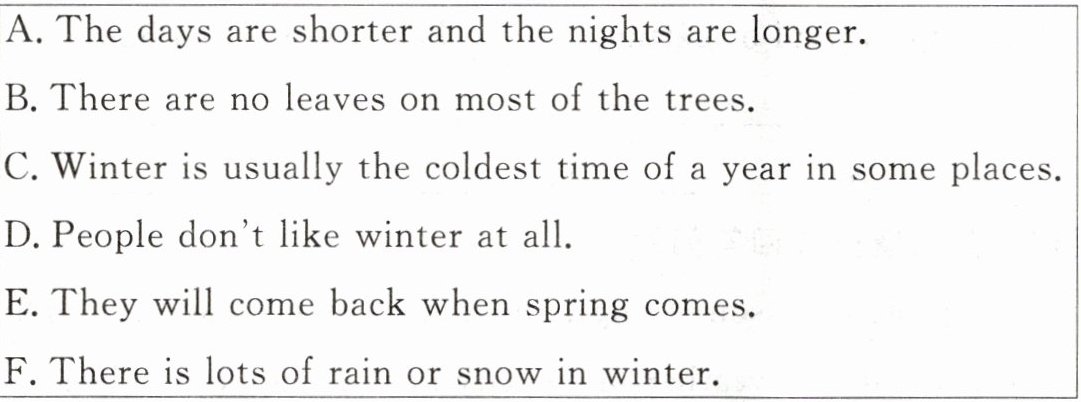
A. The days are shorter and the nights are longer.
B. There are no leaves on most of the trees.
C. Winter is usually the coldest time of a year in some places.
D. People don't like winter at all.
E. They will come back when spring comes.
F. There is lots of rain or snow in winter.
1.
2.
3.
4.
5.
Winter is the season that comes after autumn and before spring. 1 It brings cold, snow and ice. Here are some different ways to know it's winter.
2 The winter solstice (冬至) is the day of the year with the fewest hours of daylight.
The sun doesn't seem warm in winter. 3 People and animals don't like to go outside.
Trees and plants usually go to sleep or go away. So when you look outside, you'll see a lot of brown things, not the green ones. 4 Some animals hibernate (冬眠), but others keep food in autumn to eat in winter, because it is difficult to find food. Many birds fly from the north to warm places for the winter. This is called migration (迁徙). 5
A. The days are shorter and the nights are longer.
B. There are no leaves on most of the trees.
C. Winter is usually the coldest time of a year in some places.
D. People don't like winter at all.
E. They will come back when spring comes.
F. There is lots of rain or snow in winter.
1.
2.
3.
4.
5.
答案
1. C 2. A 3. F 4. B 5. E
解析
我们可以根据上下文逻辑逐一匹配选项:
1. 空1前介绍冬天的时间属性,空后提到冬天带来寒冷、冰雪,C选项“在部分地区冬天通常是一年中最冷的时段”可以自然衔接前后内容,符合语境。
2. 空2后介绍冬至是一年中日照时长最短的日子,对应A选项“白天更短、夜晚更长”,整段围绕冬季昼夜时长的特点展开,逻辑匹配。
3. 空3前提到冬季的太阳看起来没有暖意,空后提到人和动物都不愿意出门,F选项“冬季有大量的降雨或者降雪”补充了冬季天气恶劣的特点,顺承后文人们不愿外出的描述。
4. 空4前提到冬季户外大多是棕褐色的景物,没有绿意,B选项“大多数树木上都没有叶子”刚好对应前文描述的冬季户外没有绿植的特点,衔接通顺。
5. 空5前提到鸟类会从北方飞往温暖的区域过冬,这一行为叫做迁徙,E选项“春天到来的时候它们就会飞回来”中的they指代前文迁徙的鸟类,符合逻辑。
多余选项D“人们一点也不喜欢冬天”和全文内容不匹配,为多余项。
1. 空1前介绍冬天的时间属性,空后提到冬天带来寒冷、冰雪,C选项“在部分地区冬天通常是一年中最冷的时段”可以自然衔接前后内容,符合语境。
2. 空2后介绍冬至是一年中日照时长最短的日子,对应A选项“白天更短、夜晚更长”,整段围绕冬季昼夜时长的特点展开,逻辑匹配。
3. 空3前提到冬季的太阳看起来没有暖意,空后提到人和动物都不愿意出门,F选项“冬季有大量的降雨或者降雪”补充了冬季天气恶劣的特点,顺承后文人们不愿外出的描述。
4. 空4前提到冬季户外大多是棕褐色的景物,没有绿意,B选项“大多数树木上都没有叶子”刚好对应前文描述的冬季户外没有绿植的特点,衔接通顺。
5. 空5前提到鸟类会从北方飞往温暖的区域过冬,这一行为叫做迁徙,E选项“春天到来的时候它们就会飞回来”中的they指代前文迁徙的鸟类,符合逻辑。
多余选项D“人们一点也不喜欢冬天”和全文内容不匹配,为多余项。
四、短文填空。
heavily wet wear when rise cloudy lightning me seem question
On Sunday, John gets a new raincoat (雨衣) from his mother. It's blue, and it's his favourite colour. He likes it very much.
“Mum, can I 1 it now?” asks John.
“No, my dear. You can wear it only 2 it is rainy,” says Mum.
The next morning, the sun 3. “Will it rain today, Mum? I hope to wear 4 raincoat,” says John.
“No, it 5 a sunny day today. If you wear it, you'll look very funny!” says Mum.
On Tuesday, when John's mother is preparing breakfast for him, he asks her the same 6.
“Sorry, I don't know. You can hope for the rain and maybe it will come,” says Mum.
It is 7 on Wednesday. “Mum, why doesn't it rain? I really hope it will rain soon,” says John.
“Dear, I think it will rain soon,” says Mum.
On Thursday, John is still waiting for the rain. Suddenly, he sees the 8 and then hears the thunder (雷声). It seems that there will be a huge storm. Soon the rain is pouring down.
“Wow! It's raining! It's raining 9!” John runs into the rain happily.
“Hey, John. Come back!” His mum runs after him with an umbrella and John's raincoat. But John isn't afraid of getting 10 because he is so happy.
1. 2. 3. 4. 5.
6. 7. 8. 9. 10.
heavily wet wear when rise cloudy lightning me seem question
On Sunday, John gets a new raincoat (雨衣) from his mother. It's blue, and it's his favourite colour. He likes it very much.
“Mum, can I 1 it now?” asks John.
“No, my dear. You can wear it only 2 it is rainy,” says Mum.
The next morning, the sun 3. “Will it rain today, Mum? I hope to wear 4 raincoat,” says John.
“No, it 5 a sunny day today. If you wear it, you'll look very funny!” says Mum.
On Tuesday, when John's mother is preparing breakfast for him, he asks her the same 6.
“Sorry, I don't know. You can hope for the rain and maybe it will come,” says Mum.
It is 7 on Wednesday. “Mum, why doesn't it rain? I really hope it will rain soon,” says John.
“Dear, I think it will rain soon,” says Mum.
On Thursday, John is still waiting for the rain. Suddenly, he sees the 8 and then hears the thunder (雷声). It seems that there will be a huge storm. Soon the rain is pouring down.
“Wow! It's raining! It's raining 9!” John runs into the rain happily.
“Hey, John. Come back!” His mum runs after him with an umbrella and John's raincoat. But John isn't afraid of getting 10 because he is so happy.
1. 2. 3. 4. 5.
6. 7. 8. 9. 10.
答案
1. wear
2. when
3. rises
4. my
5. seems
6. question
7. cloudy
8. lightning
9. heavily
10. wet
2. when
3. rises
4. my
5. seems
6. question
7. cloudy
8. lightning
9. heavily
10. wet
解析
我们结合方框内给出的词汇和上下文语境逐一分析:
1. 情态动词can后需接动词原形,前文提到John非常喜欢新雨衣,这里他询问妈妈能不能现在穿上雨衣,因此填wear。
2. 此处引导时间状语从句,表达“只有下雨的时候你才能穿它”的含义,因此填when。
3. 句子主语the sun是第三人称单数,时态为一般现在时,表达“太阳升起”的含义,动词rise要变为第三人称单数形式rises。
4. 此处修饰名词raincoat,表达“我的雨衣”的含义,人称代词me要变为形容词性物主代词my。
5. 主语it是第三人称单数,时态为一般现在时,表达“今天似乎是个晴天”的含义,动词seem要变为第三人称单数形式seems。
6. 此处表达“他问了妈妈同一个问题”,the same后接名词单数,因此填question。
7. 此处放在be动词is后作表语,描述周三的天气状况,含义为“多云的”,因此填cloudy。
8. 根据后文“然后听到雷声”,可知这里是先看到闪电,因此填lightning。
9. 此处修饰动词rain,需要用副词,表达“雨下得很大”的含义,因此填heavily。
10. 固定搭配get wet表示“淋湿”,符合语境“John不怕被淋湿”,因此填wet。
1. 情态动词can后需接动词原形,前文提到John非常喜欢新雨衣,这里他询问妈妈能不能现在穿上雨衣,因此填wear。
2. 此处引导时间状语从句,表达“只有下雨的时候你才能穿它”的含义,因此填when。
3. 句子主语the sun是第三人称单数,时态为一般现在时,表达“太阳升起”的含义,动词rise要变为第三人称单数形式rises。
4. 此处修饰名词raincoat,表达“我的雨衣”的含义,人称代词me要变为形容词性物主代词my。
5. 主语it是第三人称单数,时态为一般现在时,表达“今天似乎是个晴天”的含义,动词seem要变为第三人称单数形式seems。
6. 此处表达“他问了妈妈同一个问题”,the same后接名词单数,因此填question。
7. 此处放在be动词is后作表语,描述周三的天气状况,含义为“多云的”,因此填cloudy。
8. 根据后文“然后听到雷声”,可知这里是先看到闪电,因此填lightning。
9. 此处修饰动词rain,需要用副词,表达“雨下得很大”的含义,因此填heavily。
10. 固定搭配get wet表示“淋湿”,符合语境“John不怕被淋湿”,因此填wet。
