

 登录
登录
人无礼则不立。请以“How to Be a Person with Good Manners”为题,根据以下要点为学校的英语演讲比赛写一篇演讲稿。
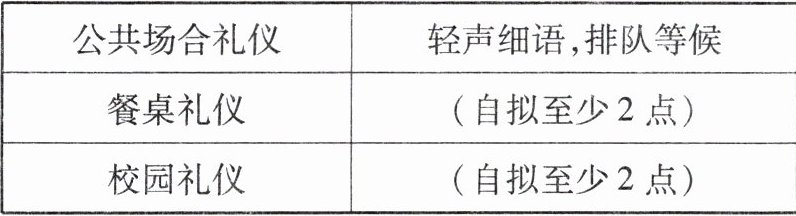
要求:
1.要点齐全,条理清楚,表达准确,语句通顺,意思连贯;
2.适当发挥,80词左右,短文开头和结尾已给出,不计入总词数;
3.短文中不得使用真实姓名、校名和地名等。
How to Be a Person with Good Manners
As the saying goes, "Manners make the man." A person with good manners behaves politely. As teenagers, what should we do to show good manners?
Let's practise good manners to make ourselves better people!
要求:
1.要点齐全,条理清楚,表达准确,语句通顺,意思连贯;
2.适当发挥,80词左右,短文开头和结尾已给出,不计入总词数;
3.短文中不得使用真实姓名、校名和地名等。
How to Be a Person with Good Manners
As the saying goes, "Manners make the man." A person with good manners behaves politely. As teenagers, what should we do to show good manners?
Above all, when in public places, it's polite of us to keep our voice down. We should be patient enough to queue for our turns.
What's more, it's important for us to have good table manners. When we are sitting at the table, we should not start eating until everyone is ready. It's polite to wait for everyone to finish before we leave the table.
At school, we must follow all the school rules. It's a good habit to greet teachers with a warm smile. We should respect our classmates.
Let's practise good manners to make ourselves better people!
答案
Above all, when in public places, it's polite of us to keep our voice down. We should be patient enough to queue for our turns.
What's more, it's important for us to have good table manners. When we are sitting at the table, we should not start eating until everyone is ready. It's polite to wait for everyone to finish before we leave the table.
At school, we must follow all the school rules. It's a good habit to greet teachers with a warm smile. We should respect our classmates.
What's more, it's important for us to have good table manners. When we are sitting at the table, we should not start eating until everyone is ready. It's polite to wait for everyone to finish before we leave the table.
At school, we must follow all the school rules. It's a good habit to greet teachers with a warm smile. We should respect our classmates.
解析
【分析】
本题要求以“How to Be a Person with Good Manners”为题写英语演讲稿,需结合公共场合、餐桌、校园三类礼仪的要点展开。首先对应公共场合礼仪(轻声说话、排队等候),接着写餐桌礼仪(等所有人准备好再用餐、等所有人吃完再离席),最后写校园礼仪(遵守校规、问候老师、尊重同学),用合适的连接词串联,确保要点齐全、语句通顺,符合演讲稿语气和字数要求。
【解析】
写作时,先用“Above all”引出公共场合礼仪:保持低声说话、耐心排队;再用“What's more”过渡到餐桌礼仪:等所有人准备好再用餐、等所有人吃完后再离席;最后用“At school”说明校园礼仪:遵守校规、微笑问候老师、尊重同学。注意用词准确,语句连贯,控制在80词左右,不使用真实信息。
【答案】
Above all, when in public places, it's polite of us to keep our voice down. We should be patient enough to queue for our turns.
What's more, it's important for us to have good table manners. When we are sitting at the table, we should not start eating until everyone is ready. It's polite to wait for everyone to finish before we leave the table.
At school, we must follow all the school rules. It's a good habit to greet teachers with a warm smile. We should respect our classmates.
【知识点】
英语应用文写作、礼仪英语表达
【点评】
本题结合生活实际,考查学生运用英语表达礼仪常识的能力,贴近学生日常,要求紧扣给定要点写作,难度适中,能有效考查学生的语言运用能力。
【难度系数】
0.6
本题要求以“How to Be a Person with Good Manners”为题写英语演讲稿,需结合公共场合、餐桌、校园三类礼仪的要点展开。首先对应公共场合礼仪(轻声说话、排队等候),接着写餐桌礼仪(等所有人准备好再用餐、等所有人吃完再离席),最后写校园礼仪(遵守校规、问候老师、尊重同学),用合适的连接词串联,确保要点齐全、语句通顺,符合演讲稿语气和字数要求。
【解析】
写作时,先用“Above all”引出公共场合礼仪:保持低声说话、耐心排队;再用“What's more”过渡到餐桌礼仪:等所有人准备好再用餐、等所有人吃完后再离席;最后用“At school”说明校园礼仪:遵守校规、微笑问候老师、尊重同学。注意用词准确,语句连贯,控制在80词左右,不使用真实信息。
【答案】
Above all, when in public places, it's polite of us to keep our voice down. We should be patient enough to queue for our turns.
What's more, it's important for us to have good table manners. When we are sitting at the table, we should not start eating until everyone is ready. It's polite to wait for everyone to finish before we leave the table.
At school, we must follow all the school rules. It's a good habit to greet teachers with a warm smile. We should respect our classmates.
【知识点】
英语应用文写作、礼仪英语表达
【点评】
本题结合生活实际,考查学生运用英语表达礼仪常识的能力,贴近学生日常,要求紧扣给定要点写作,难度适中,能有效考查学生的语言运用能力。
【难度系数】
0.6
1. manner
A. n. 方式 B. n. (pl. manners) 礼仪
(1)The manner in which we greet people differs across cultures.
(2)Learning about table manners in other countries is important.
A. n. 方式 B. n. (pl. manners) 礼仪
(1)The manner in which we greet people differs across cultures.
A
(2)Learning about table manners in other countries is important.
B
答案
1. (1)A (2)B
解析
【分析】首先明确manner的两种核心词义:单数形式作名词时表示“方式、方法”,复数形式manners表示“礼仪、礼貌”。解题时需结合句子语境判断manner的形式对应的词义:第(1)句描述的是问候他人的“方式”,对应单数词义;第(2)句中“table manners”是固定表达,对应复数词义。
【解析】先梳理manner的词义:①单数n. 方式;②复数manners n. 礼仪。再分析句子:(1)句中“the manner in which we greet people”指问候的方式,故选A;(2)句中“table manners”是固定搭配,意为餐桌礼仪,故选B。
【答案】(1)A (2)B
【知识点】名词词义辨析,可数名词单复数词义差异
【点评】本题考查基础名词manner的单复数不同词义,结合语境即可判断,属于词汇基础题,难度较低。
【难度系数】0.3
【解析】先梳理manner的词义:①单数n. 方式;②复数manners n. 礼仪。再分析句子:(1)句中“the manner in which we greet people”指问候的方式,故选A;(2)句中“table manners”是固定搭配,意为餐桌礼仪,故选B。
【答案】(1)A (2)B
【知识点】名词词义辨析,可数名词单复数词义差异
【点评】本题考查基础名词manner的单复数不同词义,结合语境即可判断,属于词汇基础题,难度较低。
【难度系数】0.3
2. serving
A. adj. 分菜用的 B. n. 一份食物
(1) This restaurant offers a large serving of rice with every meal.
(2) Please pass me the serving spoon for the noodles.
A. adj. 分菜用的 B. n. 一份食物
(1) This restaurant offers a large serving of rice with every meal.
B
(2) Please pass me the serving spoon for the noodles.
A
答案
2. (1)B (2)A
解析
【分析】
这道题考查多义词serving的词义辨析,解题思路为:先明确serving的两种常见含义及词性,再结合每个句子中serving的语法成分判断其词性,进而匹配对应的词义。
【解析】
(1) 句中“a large ____ of rice”,serving位于不定冠词a和形容词large之后,在句中作名词,“a serving of...”是固定搭配,意为“一份...”,对应含义为“n. 一份食物”,故选B;
(2) 句中“the ____ spoon”,serving修饰名词spoon,在句中作定语,词性为形容词,对应含义为“adj. 分菜用的”,故选A。
【答案】
(1)B (2)A
【知识点】
名词词义辨析、形容词词义辨析
【点评】
本题考查基础词汇serving的不同词性及词义,需结合句子语法成分判断词性,属于词汇基础题,难度较低。
【难度系数】
0.8
这道题考查多义词serving的词义辨析,解题思路为:先明确serving的两种常见含义及词性,再结合每个句子中serving的语法成分判断其词性,进而匹配对应的词义。
【解析】
(1) 句中“a large ____ of rice”,serving位于不定冠词a和形容词large之后,在句中作名词,“a serving of...”是固定搭配,意为“一份...”,对应含义为“n. 一份食物”,故选B;
(2) 句中“the ____ spoon”,serving修饰名词spoon,在句中作定语,词性为形容词,对应含义为“adj. 分菜用的”,故选A。
【答案】
(1)B (2)A
【知识点】
名词词义辨析、形容词词义辨析
【点评】
本题考查基础词汇serving的不同词性及词义,需结合句子语法成分判断词性,属于词汇基础题,难度较低。
【难度系数】
0.8
3. nicely
A. adv. 漂亮地 B. adv. 令人愉快地
(1) The international students were nicely treated by the host family.
(2) She dressed nicely for the international culture fair.
4. correctly
A. adv. 正确地 B. adv. 得体地
(1) If you can't pronounce the word correctly, just try your best.
(2) He was looking correctly grave(严肃的).
A. adv. 漂亮地 B. adv. 令人愉快地
(1) The international students were nicely treated by the host family.
B
(2) She dressed nicely for the international culture fair.
A
4. correctly
A. adv. 正确地 B. adv. 得体地
(1) If you can't pronounce the word correctly, just try your best.
A
(2) He was looking correctly grave(严肃的).
B
答案
3. (1)B (2)A
4. (1)A (2)B
4. (1)A (2)B
解析
【分析】
本题考查副词的词义辨析,需结合句子语境判断单词的具体含义。先明确每个副词的两个释义,再代入句子中,根据句意匹配对应选项即可。
【解析】
3. (1) 句意为“留学生被寄宿家庭友好对待”,此处nicely表示“令人愉快地”,对应选项B;
(2) 句意为“她为国际文化展穿得漂亮”,此处nicely表示“漂亮地”,对应选项A;
4. (1) 句意为“如果不能正确发音”,此处correctly表示“正确地”,对应选项A;
(2) 句意为“他看起来得体地严肃”,此处correctly表示“得体地”,对应选项B。
【答案】
3. (1)B (2)A
4. (1)A (2)B
【知识点】
副词词义辨析、语境理解
【点评】
本题围绕副词的多义性展开,需结合具体句子语境判断单词含义,属于基础词义辨析题,难度适中。
【难度系数】
0.6
本题考查副词的词义辨析,需结合句子语境判断单词的具体含义。先明确每个副词的两个释义,再代入句子中,根据句意匹配对应选项即可。
【解析】
3. (1) 句意为“留学生被寄宿家庭友好对待”,此处nicely表示“令人愉快地”,对应选项B;
(2) 句意为“她为国际文化展穿得漂亮”,此处nicely表示“漂亮地”,对应选项A;
4. (1) 句意为“如果不能正确发音”,此处correctly表示“正确地”,对应选项A;
(2) 句意为“他看起来得体地严肃”,此处correctly表示“得体地”,对应选项B。
【答案】
3. (1)B (2)A
4. (1)A (2)B
【知识点】
副词词义辨析、语境理解
【点评】
本题围绕副词的多义性展开,需结合具体句子语境判断单词含义,属于基础词义辨析题,难度适中。
【难度系数】
0.6
5. false
A. adj. 错误的 . adj. 不真实的
(1) He spread a false story about the origin of the custom.
(2) It is false to believe that all cultures use chopsticks.
A. adj. 错误的
. adj. 不真实的(1) He spread a false story about the origin of the custom.
B
(2) It is false to believe that all cultures use chopsticks.
A
答案
5. (1)B (2)A
解析
【分析】首先明确单词false的两个形容词含义:A选项意为“错误的”,B选项意为“不真实的”。解题时需结合每个句子的语境,判断“false”修饰的对象对应的词义:(1)句中“false”修饰“story”,故事的属性是“不真实的”;(2)句中“false”描述“认为所有文化都用筷子”这一观点,该观点是“错误的”,据此匹配选项。
【解析】false作为形容词有两个核心含义:①错误的;②不真实的。(1)句中“false”修饰“story”,表示故事是不真实的,对应选项B;(2)句中“false”描述“认为所有文化都用筷子”的观点,该观点是错误的,对应选项A。
【答案】(1)B (2)A
【知识点】形容词词义辨析,false的词义
【点评】本题考查基础形容词false的多义性在具体语境中的运用,需结合修饰对象和语义逻辑判断词义,属于词汇基础应用类题目。
【难度系数】0.4
【解析】false作为形容词有两个核心含义:①错误的;②不真实的。(1)句中“false”修饰“story”,表示故事是不真实的,对应选项B;(2)句中“false”描述“认为所有文化都用筷子”的观点,该观点是错误的,对应选项A。
【答案】(1)B (2)A
【知识点】形容词词义辨析,false的词义
【点评】本题考查基础形容词false的多义性在具体语境中的运用,需结合修饰对象和语义逻辑判断词义,属于词汇基础应用类题目。
【难度系数】0.4
