

 登录
登录
[2025 湖南中考]
(
A. Ramona Kaiser. B. Jason Smith.
C. William White.
(
A. Biking skills. B. A health report.
C. A safety guide.
(
A. In a primary school.
B. In a middle school.
C. In a university.
(
A
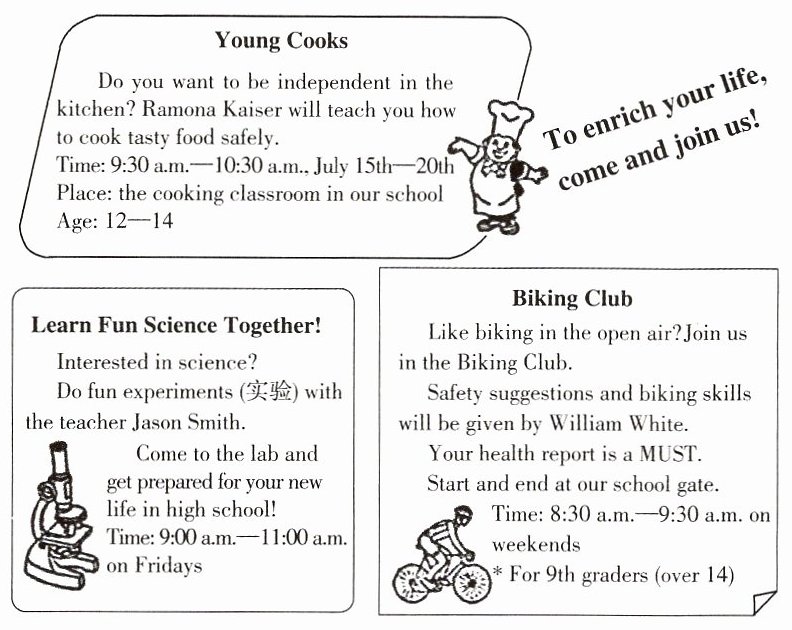
)1. Who will teach students to cook?A. Ramona Kaiser. B. Jason Smith.
C. William White.
(
B
)2. What is a must for students to join the Biking Club?A. Biking skills. B. A health report.
C. A safety guide.
(
B
)3. 新考法文章出处 Where can we read the text most probably?A. In a primary school.
B. In a middle school.
C. In a university.
答案
1 A 细节理解题。根据Young Cooks下的“Ramona Kaiser will teach you how to cook tasty food safely.”可知选A项。
2 B 细节理解题。根据Biking Club下的“Your health report is a MUST.”可知,学生加入骑行俱乐部时,健康报告是必不可少的。故选B项。
3 B 推理判断题。根据“12—14”“For 9th graders(over 14)”以及“…get prepared for your new life in high school!”可推断出,本文是面向中学生的,因此最可能在中学读到。故选B项。
2 B 细节理解题。根据Biking Club下的“Your health report is a MUST.”可知,学生加入骑行俱乐部时,健康报告是必不可少的。故选B项。
3 B 推理判断题。根据“12—14”“For 9th graders(over 14)”以及“…get prepared for your new life in high school!”可推断出,本文是面向中学生的,因此最可能在中学读到。故选B项。
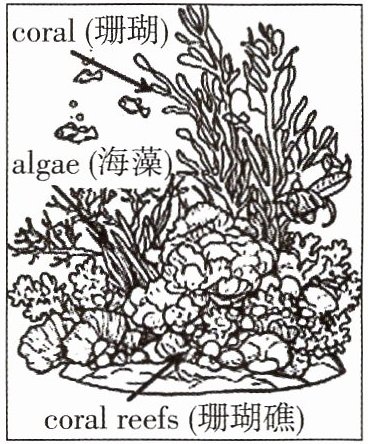
[2025 福建中考·改编]Deep under the Pacific Ocean lie coral reefs colored by some algae that live with coral. Coral usually provides nitrogen(氮)to algae, and in return it gets carbon(碳), which gives it energy.
In the early 1980s, a huge heat wave turned more than 90 percent of the coral pale, lifeless white. And it was believed that about 50 percent of reefs with beautiful coral might disappear by 2030.
Heat waves warmed up the same Pacific waters in the late 1990s and again in 2015—2016, but scientists noticed that these heat waves didn’t influence the reefs as badly as the first. Maybe coral has found a way to adapt(适应).
Swimming to cooler waters is not a good choice for coral, for it makes coral easily hurt by the changing climate. But coral is able to adapt. Some coral turns to those algae that can deal well with heat. Other coral can use rows of tiny hairs on its bodies to “fan” away too much harmful oxygen($\ce{O_2}$)let out by stressed-out algae. Certain baby coral changes its own metabolisms(新陈代谢)in order to fight the warming waters. But all these adaptations can protect themselves only to some degree.
After studying and understanding these adaptations, scientists are trying to find ways to help coral fight. If researchers can make coral accept algae that can deal with heat pressure or if they energize genes(基因)that can deal with heat pressure, it will raise the coral’s chance of living through future ocean heat waves.
“When I go down to the sea and see a beautiful healthy reef with the colorful coral, I feel this pleasure of being in this underwater world,” a famous biologist says. “It will be really sad to see it dead. But that does drive you to want to use your skills and your love to help fight.”
(
A. Coral makes algae more colorful.
B. Algae provide room for coral to live in.
C. Coral and algae depend on each other.
D. Algae produce nitrogen to influence coral.
(
A. The heat wave in the early 1980s.
B. The heat wave in the late 1990s.
C. The Pacific waters in 2015—2016.
D. The reefs’ disappearance by 2030.
(
A. It cannot completely adapt to heat waves.
B. It cannot change its own metabolisms.
C. It has no ability to swim to cooler waters.
D. It has no ability to drive away harmful oxygen.
(
A. It’s necessary to live with coral.
B. The ocean has become unhealthy.
C. We should try our best to save coral.
D. Making a study of the ocean is a must.
(
A. Coral Dies Out
B. Coral Fights Back
C. Coral Breaks Down
D. Coral Comes into Being
In the early 1980s, a huge heat wave turned more than 90 percent of the coral pale, lifeless white. And it was believed that about 50 percent of reefs with beautiful coral might disappear by 2030.
Heat waves warmed up the same Pacific waters in the late 1990s and again in 2015—2016, but scientists noticed that these heat waves didn’t influence the reefs as badly as the first. Maybe coral has found a way to adapt(适应).
Swimming to cooler waters is not a good choice for coral, for it makes coral easily hurt by the changing climate. But coral is able to adapt. Some coral turns to those algae that can deal well with heat. Other coral can use rows of tiny hairs on its bodies to “fan” away too much harmful oxygen($\ce{O_2}$)let out by stressed-out algae. Certain baby coral changes its own metabolisms(新陈代谢)in order to fight the warming waters. But all these adaptations can protect themselves only to some degree.
After studying and understanding these adaptations, scientists are trying to find ways to help coral fight. If researchers can make coral accept algae that can deal with heat pressure or if they energize genes(基因)that can deal with heat pressure, it will raise the coral’s chance of living through future ocean heat waves.
“When I go down to the sea and see a beautiful healthy reef with the colorful coral, I feel this pleasure of being in this underwater world,” a famous biologist says. “It will be really sad to see it dead. But that does drive you to want to use your skills and your love to help fight.”
(
C
)1. What can we know from Paragraph 1?A. Coral makes algae more colorful.
B. Algae provide room for coral to live in.
C. Coral and algae depend on each other.
D. Algae produce nitrogen to influence coral.
(
A
)2. What does the underlined part “the first” in Paragraph 2 refer to?A. The heat wave in the early 1980s.
B. The heat wave in the late 1990s.
C. The Pacific waters in 2015—2016.
D. The reefs’ disappearance by 2030.
(
A
)3. What difficulty does coral face?A. It cannot completely adapt to heat waves.
B. It cannot change its own metabolisms.
C. It has no ability to swim to cooler waters.
D. It has no ability to drive away harmful oxygen.
(
C
)4. What can we infer from the last paragraph?A. It’s necessary to live with coral.
B. The ocean has become unhealthy.
C. We should try our best to save coral.
D. Making a study of the ocean is a must.
(
B
)5. Which would be the best title for the text?A. Coral Dies Out
B. Coral Fights Back
C. Coral Breaks Down
D. Coral Comes into Being
答案
1 C 细节理解题。根据第一段的“Coral usually provides nitrogen to algae, and in return it gets carbon, which gives it energy.”可知,珊瑚和藻类相互依存。故选C项。
2 A 词义猜测题。根据第二段的“In the early 1980s, a huge heat wave turned more than 90 percent of the coral pale, lifeless white… but scientists noticed that these heat waves didn’t influence the reefs as badly as the first.”可知,the first指的是20世纪80年代初的热浪。故选A项。
3 A 细节理解题。根据第三段的“But all these adaptations can protect themselves only to some degree.”可知,珊瑚只能在某种程度上保护自己,不能完全适应热浪。故选A项。
4 C 推理判断题。根据最后一段的“It will be really sad to see it dead. But that does drive you to want to use your skills and your love to help fight.”可知,生物学家认为看到珊瑚死去很令人伤心,那会驱使自己用技能和热爱去抗争,所以我们应该尽力拯救珊瑚。故选C项。
5 B 主旨大意题。文章围绕珊瑚可能具有的适应热浪的能力和科学家帮助珊瑚应对未来海洋热浪的研究展开,B项(珊瑚反击)最符合文章主旨。故选B项。
2 A 词义猜测题。根据第二段的“In the early 1980s, a huge heat wave turned more than 90 percent of the coral pale, lifeless white… but scientists noticed that these heat waves didn’t influence the reefs as badly as the first.”可知,the first指的是20世纪80年代初的热浪。故选A项。
3 A 细节理解题。根据第三段的“But all these adaptations can protect themselves only to some degree.”可知,珊瑚只能在某种程度上保护自己,不能完全适应热浪。故选A项。
4 C 推理判断题。根据最后一段的“It will be really sad to see it dead. But that does drive you to want to use your skills and your love to help fight.”可知,生物学家认为看到珊瑚死去很令人伤心,那会驱使自己用技能和热爱去抗争,所以我们应该尽力拯救珊瑚。故选C项。
5 B 主旨大意题。文章围绕珊瑚可能具有的适应热浪的能力和科学家帮助珊瑚应对未来海洋热浪的研究展开,B项(珊瑚反击)最符合文章主旨。故选B项。
