

 登录
Ⅲ. Read and complete the tasks.
China’s space history is a moving story of continuous hard work and amazing achievements. It all started in 1970, when China successfully sent its first man-made satellite Dongfanghong Ⅰ into space. This historic achievement made China the fifth country in the world that can develop and launch satellites independently.
In 2003, Shenzhou Ⅴ carried Yang Liwei, China’s first astronaut, into space smoothly. It was a big step for China’s manned space programme. Later, Shenzhou Ⅶ helped Chinese astronauts realize the long-held dream of walking in outer space. In 2013, Chang’e Ⅲ landed safely on the moon with Yutu, China’s first lunar rover, opening a new chapter of our lunar exploration.
In recent years, China has made rapid and steady progress. The Beidou Navigation System was fully completed in 2020, providing reliable services for people all over the world. In 2024, Chang’e Ⅵ brought back the first lunar samples from the far side of the moon in the world. Now China’s Tiangong space station runs well in space, with astronauts carrying out long-term research tasks.
From a small artificial satellite to a large space station, China’s space dream has never stopped. It fully shows Chinese wisdom and great courage, and encourages every young Chinese to hold on to their own dreams bravely.
A. Complete the table.
| Time | China’s Achievements |
| --- | --- |
| 1.
| In 2003 | 2.
| 3.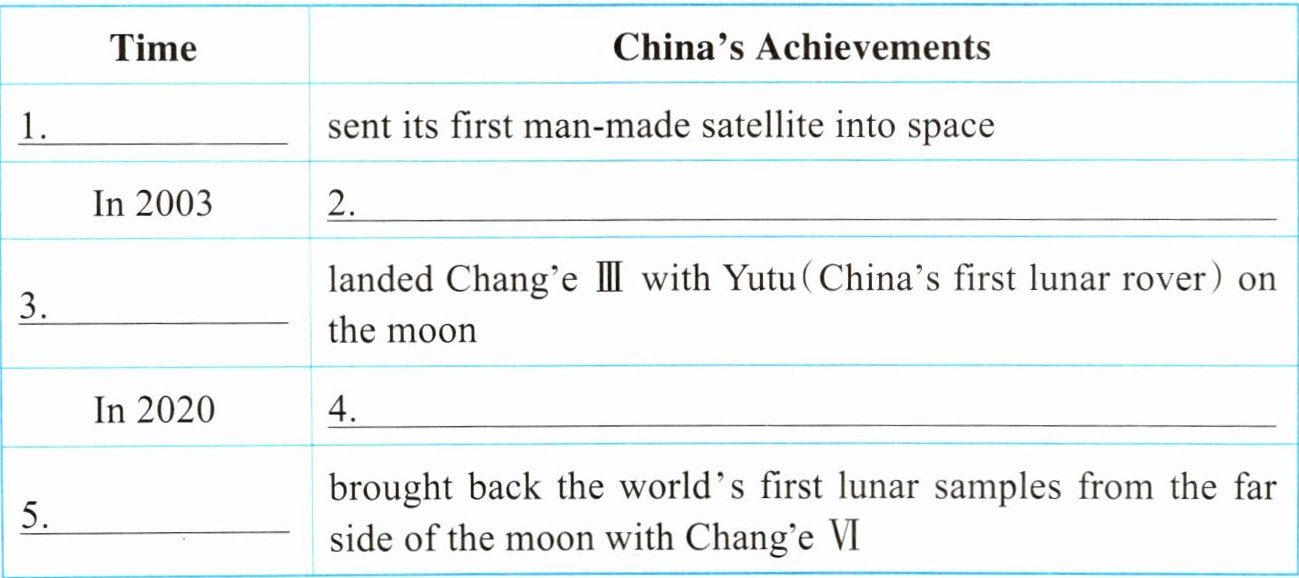 |
| In 2020 | 4.
| 5.
B. Answer the questions.
(
A. In a storybook.
B. In a travel guide.
C. In a science magazine.
D. In a fashion newspaper.
(
A. China’s First Astronaut
B. History of Lunar Exploration
C. China’s Progress in Space
D. Introduction of Tiangong Station
China’s space history is a moving story of continuous hard work and amazing achievements. It all started in 1970, when China successfully sent its first man-made satellite Dongfanghong Ⅰ into space. This historic achievement made China the fifth country in the world that can develop and launch satellites independently.
In 2003, Shenzhou Ⅴ carried Yang Liwei, China’s first astronaut, into space smoothly. It was a big step for China’s manned space programme. Later, Shenzhou Ⅶ helped Chinese astronauts realize the long-held dream of walking in outer space. In 2013, Chang’e Ⅲ landed safely on the moon with Yutu, China’s first lunar rover, opening a new chapter of our lunar exploration.
In recent years, China has made rapid and steady progress. The Beidou Navigation System was fully completed in 2020, providing reliable services for people all over the world. In 2024, Chang’e Ⅵ brought back the first lunar samples from the far side of the moon in the world. Now China’s Tiangong space station runs well in space, with astronauts carrying out long-term research tasks.
From a small artificial satellite to a large space station, China’s space dream has never stopped. It fully shows Chinese wisdom and great courage, and encourages every young Chinese to hold on to their own dreams bravely.
A. Complete the table.
| Time | China’s Achievements |
| --- | --- |
| 1.
In 1970
| sent its first man-made satellite into space || In 2003 | 2.
(Shenzhou Ⅴ) carried Yang Liwei into space smoothly
|| 3.
In 2013
| landed Chang’e Ⅲ with Yutu (China’s first lunar rover) on the moon || In 2020 | 4.
the Beidou Navigation System was fully completed
|| 5.
In 2024
| brought back the world’s first lunar samples from the far side of the moon with Chang’e Ⅵ |B. Answer the questions.
(
C
)1. Where can we probably find the article?A. In a storybook.
B. In a travel guide.
C. In a science magazine.
D. In a fashion newspaper.
(
C
)2. What is the best title for the passage?A. China’s First Astronaut
B. History of Lunar Exploration
C. China’s Progress in Space
D. Introduction of Tiangong Station
答案
A. 1. In 1970 2. (Shenzhou Ⅴ) carried Yang Liwei into space smoothly
3. In 2013 4. the Beidou Navigation System was fully completed
5. In 2024
B. 1. C 2. C
3. In 2013 4. the Beidou Navigation System was fully completed
5. In 2024
B. 1. C 2. C
解析
【分析】本题为英语阅读理解题,包含补全表格和选择最佳选项两部分。解题时,需先明确题目要求:补全表格需对应原文中时间与中国航天成就的匹配信息,选择题需判断文章出处和主旨。具体步骤:1. 补全表格时,定位原文各时间节点的对应事件,如1970年对应发射首颗人造卫星,2003年对应神舟五号载杨利伟进入太空等;2. 选择题部分,根据文章内容判断出处(科学类)和主旨(中国航天的进步)。
【解析】A部分:1. 从原文第一段“It all started in 1970, when China successfully sent its first man-made satellite...”可知,对应时间为In 1970;2. 原文第二段“In 2003, Shenzhou Ⅴ carried Yang Liwei, China’s first astronaut, into space smoothly.”,对应成就为Shenzhou Ⅴ carried Yang Liwei into space smoothly;3. 原文第二段“In 2013, Chang’e Ⅲ landed safely on the moon with Yutu...”,对应时间为In 2013;4. 原文第三段“The Beidou Navigation System was fully completed in 2020...”,对应成就为the Beidou Navigation System was fully completed;5. 原文第三段“In 2024, Chang’e Ⅵ brought back the first lunar samples...”,对应时间为In 2024。B部分:1. 文章介绍中国航天领域的成就,属于科学内容,故选择C(In a science magazine);2. 全文围绕中国航天的发展进步展开,故最佳标题为C(China’s Progress in Space)。
【答案】A. 1. In 1970 2. Shenzhou Ⅴ carried Yang Liwei into space smoothly 3. In 2013 4. the Beidou Navigation System was fully completed 5. In 2024;B. 1. C 2. C
【知识点】英语阅读理解,信息匹配,主旨大意
【点评】本题考查学生对英语文章细节信息的提取和主旨的理解能力,需仔细阅读原文定位关键内容,难度适中。
【难度系数】0.6
