

 登录
Ⅳ. 补全对话
根据对话内容,从方框中选择恰当的选项补全对话。
1. A: Look at the sky! It's pouring!
B:
2. A: The cook prepared a special dish for us.
B:
3. A: I just finished reading this novel.
B:
4. A: Do you remember our first day at middle school?
B: Yes! Now we're in the final year.
5. A: Hi, long time no see!
B:
A. How time flies!
B. What a heavy rain!
C. What an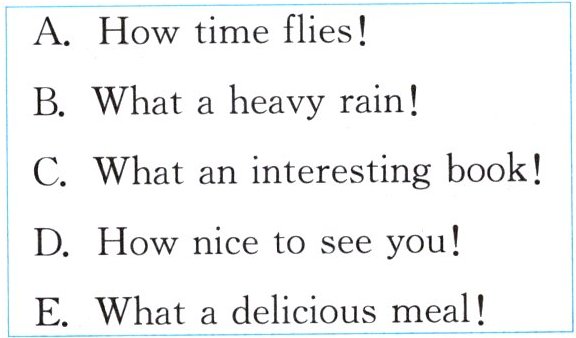 interesting book!
D. How nice to see you!
E. What a delicious meal!
根据对话内容,从方框中选择恰当的选项补全对话。
1. A: Look at the sky! It's pouring!
B:
B
Let's stay indoors.2. A: The cook prepared a special dish for us.
B:
E
I want to learn the recipe (食谱)!3. A: I just finished reading this novel.
B:
C
I couldn't put it down.4. A: Do you remember our first day at middle school?
B: Yes! Now we're in the final year.
A
5. A: Hi, long time no see!
B:
D
I miss you so much.A. How time flies!
B. What a heavy rain!
C. What an
interesting book!D. How nice to see you!
E. What a delicious meal!
答案
1. B 2. E 3. C 4. A 5. D
解析
【分析】
这是一道情景交际补全对话题,解题思路是先理解每句对话的语境,抓住关键词,再结合方框中各感叹句的含义,匹配最符合语境的选项。具体来说,先分析每小题的对话内容,找到对应的核心信息,再匹配对应的感叹句,完成补全。
【解析】
1. 第1题中A提到“天在倾盆大雨”,B需要回应关于大雨的感叹,对应选项B“What a heavy rain!”,故选B;
2. 第2题中A说厨师准备了特别的菜,B想学习食谱,对应选项E“What a delicious meal!”,故选E;
3. 第3题中A说刚读完小说,B表示放不下,对应选项C“What an interesting book!”,故选C;
4. 第4题中A提到中学第一天到最后一年,感慨时间流逝,对应选项A“How time flies!”,故选A;
5. 第5题中A说好久不见,B回应想念对方,对应选项D“How nice to see you!”,故选D。
【答案】1.B 2.E 3.C 4.A 5.D
【知识点】感叹句用法、情景交际
【点评】本题考查英语感叹句在日常情景对话中的运用,需要学生结合语境匹配合适的感叹句,属于基础情景交际题,难度适中。
【难度系数】0.7
Ⅴ. 阅读理解
There are many kinds of food across the world, and scientists have spent a great deal of time studying them. They say that there are some kinds of food people must eat every day. For example, people must eat some green and yellow vegetables. We
also need to eat some fruits, bread and rice. Of course our bodies need some water and milk, too.
Scientists also find that food cultures vary greatly around the world. People in different countries and places not only eat different kinds of food but also cook them in different ways. In some Asian countries, people often use stir-frying, while in Western countries, baking and grilling are popular. Eating times are different too. In some places, people might have only one or two meals a day, while in other places, people usually have three meals. But scientists point out that when to eat and how many times to eat are not important. What we eat is the most important thing.
Nowadays, the world faces two problems. In some parts of Africa, many people are suffering from hunger. They don't have enough food to eat, which leads to many health problems. On the other hand, in some developed areas, more and more people are having junk food like hamburgers, fries, and sugary drinks. These foods are harmful to our health. Therefore, it is our duty to ensure that everyone has enough to eat and to encourage healthy eating habits, making the world a better and healthier place for all.
1. What food must we have according to the passage?
A. Fruits and pizza.
B. Vegetables and rice.
C. Hamburgers and milk.
D. Rice and sugary drinks.
2. What is important about the food?
A. How to cook.
B. When to eat.
C. What to eat.
D. Where to eat.
3. What does the second paragraph tell us?
A. Different eating times.
B. Different ways of cooking.
C. Food safety in some countries.
D. Food cultures around the world.
4. What can we learn from this passage?
A. People in Eastern countries baked food more.
B. People in some areas are suffering from hunger.
C. People in developed countries have healthy food.
D. People in some places have four or five meals a day.
5. Where may we read this passage?
A. On a menu.
B. In a story.
C. In a sports newspaper.
D. In a health magazine.
答案
1. B 2. C 3. D 4. B 5. D
解析
【分析】做此类阅读理解题,需先明确题目要求,再回原文定位对应信息,通过对比选项与原文内容逐一排除错误选项,得出正确答案。第1题需定位“必须吃的食物”相关内容;第2题找“重要的饮食因素”;第3题概括第二段主旨;第4题提取原文细节;第5题判断文章出处。
【解析】1. 定位第一段:“people must eat some green and yellow vegetables. We also need to eat some fruits, bread and rice. Of course our bodies need some water and milk, too.” 选项中仅B(蔬菜和米饭)符合原文提及的必须食用的食物;2. 定位第二段最后一句:“But scientists point out that when to eat and how many times to eat are not important. What we eat is the most important thing.” 明确“吃什么”最重要,选C;3. 第二段首句点明主旨:“Scientists also find that food cultures vary greatly around the world.” 后续内容围绕不同地区的饮食文化(食物种类、烹饪方式、用餐时间)展开,选D;4. 定位第三段:“In some parts of Africa, many people are suffering from hunger.” 对应选项B,A项亚洲常用炒而非烤,C项发达国家吃垃圾食品,D项部分地区是1-2或3餐,均错误;5. 文章围绕健康饮食、全球饮食问题展开,属于健康类内容,故最可能出自健康杂志,选D。
【答案】1.B 2.C 3.D 4.B 5.D
【知识点】阅读理解、健康饮食常识
【点评】本题为阅读理解题,考查学生快速定位原文信息、概括主旨及判断文章出处的能力,文章主题贴近生活,难度适中。
【难度系数】0.6
