

 登录
登录
一、用括号内所给单词的适当形式填空
1. The inksticks
2. The soft and well-made brush allows us
3. Unlike
4. As the old man moves the brush, the beauty of the writing
5.
(calligraphy)
1. The inksticks
used
(use) in ancient China are now valuable cultural treasures.2. The soft and well-made brush allows us
to create
(create) wonderful works we like easily.3. Unlike
bottled
(bottle) ink, which is easy to buy, inksticks require careful handwork.4. As the old man moves the brush, the beauty of the writing
unfolds
(unfold) little by little.5.
Calligraphers
must be patient and focused because practising calligraphy
requires a lot of effort.(calligraphy)
答案
1. used
2. to create
3. bottled
4. unfolds
5. Calligraphers; calligraphy
2. to create
3. bottled
4. unfolds
5. Calligraphers; calligraphy
解析
【分析】
本题为英语单词适当形式填空题,需结合语法规则、固定搭配、词性转换等知识解题:
1. 第1题:inksticks与动词use是被动关系(墨被使用),需用过去分词作后置定语表被动完成;
2. 第2题:考查固定搭配allow sb to do sth,意为“允许某人做某事”,需用不定式作宾语补足语;
3. 第3题:bottle作动词意为“装瓶”,ink与bottle是被动关系(墨水被装瓶),需用过去分词作定语;
4. 第4题:主语the beauty是第三人称单数,句子为一般现在时,谓语动词需用第三人称单数形式;
5. 第5题:第一空需作主语,指“书法家”(与calligraphy相关的人),用名词复数;第二空作practising的宾语,用名词“书法”。
【解析】
1. 第1题:inksticks与use为被动关系,故填过去分词used作定语;
2. 第2题:根据固定搭配allow sb to do sth,填不定式to create;
3. 第3题:bottle作动词,ink与bottle被动,填过去分词bottled作定语;
4. 第4题:主语the beauty为单数,一般现在时谓语用第三人称单数unfolds;
5. 第5题:第一空作主语指人,填calligraphers;第二空作practising的宾语,填名词calligraphy。
【答案】
1. used
2. to create
3. bottled
4. unfolds
5. Calligraphers; calligraphy
【知识点】
非谓语动词、固定搭配、主谓一致
【点评】
本题考查英语基础语法与词汇变形,涵盖核心基础考点,难度适中,侧重学生对基础知识点的掌握与运用。
【难度系数】
0.5
本题为英语单词适当形式填空题,需结合语法规则、固定搭配、词性转换等知识解题:
1. 第1题:inksticks与动词use是被动关系(墨被使用),需用过去分词作后置定语表被动完成;
2. 第2题:考查固定搭配allow sb to do sth,意为“允许某人做某事”,需用不定式作宾语补足语;
3. 第3题:bottle作动词意为“装瓶”,ink与bottle是被动关系(墨水被装瓶),需用过去分词作定语;
4. 第4题:主语the beauty是第三人称单数,句子为一般现在时,谓语动词需用第三人称单数形式;
5. 第5题:第一空需作主语,指“书法家”(与calligraphy相关的人),用名词复数;第二空作practising的宾语,用名词“书法”。
【解析】
1. 第1题:inksticks与use为被动关系,故填过去分词used作定语;
2. 第2题:根据固定搭配allow sb to do sth,填不定式to create;
3. 第3题:bottle作动词,ink与bottle被动,填过去分词bottled作定语;
4. 第4题:主语the beauty为单数,一般现在时谓语用第三人称单数unfolds;
5. 第5题:第一空作主语指人,填calligraphers;第二空作practising的宾语,填名词calligraphy。
【答案】
1. used
2. to create
3. bottled
4. unfolds
5. Calligraphers; calligraphy
【知识点】
非谓语动词、固定搭配、主谓一致
【点评】
本题考查英语基础语法与词汇变形,涵盖核心基础考点,难度适中,侧重学生对基础知识点的掌握与运用。
【难度系数】
0.5
二、从方框中选择适当的短语并用其正确形式填空
provide...for date back to try practising be different from prefer...to...
1. Why not calligraphy with a real inkstick? You may find it very relaxing.
2. Modern bottled ink the traditional inkstick in both taste and feel.
3. The City Wall of Nanjing, one of the largest and best-preserved ancient city walls in the world, the Ming Dynasty.
4. Xuanzhi ______ a perfect surface ______ beginners to practise calligraphy on.
5. As an experienced calligrapher, my uncle still the hand-made ink from an inkstick the ready-made bottled ink.
provide...for date back to try practising be different from prefer...to...
1. Why not calligraphy with a real inkstick? You may find it very relaxing.
2. Modern bottled ink the traditional inkstick in both taste and feel.
3. The City Wall of Nanjing, one of the largest and best-preserved ancient city walls in the world, the Ming Dynasty.
4. Xuanzhi ______ a perfect surface ______ beginners to practise calligraphy on.
5. As an experienced calligrapher, my uncle still the hand-made ink from an inkstick the ready-made bottled ink.
答案
1. try practising
2. is different from
3. dates back to
4. provides; for
5. prefers; to
2. is different from
3. dates back to
4. provides; for
5. prefers; to
解析
【分析】
本题为短语填空题型,需先明确方框内各短语的含义与用法,再结合句子的语境、固定句型、主谓一致及时态等要求,选择短语并调整为正确形式。首先梳理短语:provide...for(为……提供)、date back to(追溯到)、try practising(尝试练习)、be different from(与……不同)、prefer...to...(比起……更喜欢……),再逐个分析句子匹配:
1. 句型Why not后接动词原形,结合语境选try practising;
2. 主语为单数名词短语,时态用一般现在时,be动词随主语用is,对应be different from;
3. 主语为单数,date back to无被动,用一般现在时第三人称单数形式;
4. 主语为单数,短语provide...for需用一般现在时第三人称单数形式;
5. 主语为单数,短语prefer...to...需用一般现在时第三人称单数形式。
【解析】
1. 固定句型Why not + 动词原形,表建议,故填try practising;
2. 主语Modern bottled ink为单数,一般现在时中be动词用is,短语be different from表示“与……不同”,故填is different from;
3. 主语The City Wall of Nanjing为单数,date back to用于一般现在时表“追溯到”,故填dates back to;
4. 主语Xuanzhi为单数,一般现在时谓语用第三人称单数形式,短语provide sth. for sb.表“为某人提供某物”,故填provides; for;
5. 主语my uncle为单数,一般现在时谓语用第三人称单数形式,短语prefer A to B表“比起B更喜欢A”,故填prefers; to。
【答案】
1. try practising
2. is different from
3. dates back to
4. provides; for
5. prefers; to
【知识点】
动词短语用法、一般现在时、固定句型搭配
【点评】
本题侧重考查常用动词短语的词义辨析及正确形式的运用,需掌握短语含义、固定句型规则和主谓一致,属于基础题型,适合巩固英语短语知识。
【难度系数】
0.5
本题为短语填空题型,需先明确方框内各短语的含义与用法,再结合句子的语境、固定句型、主谓一致及时态等要求,选择短语并调整为正确形式。首先梳理短语:provide...for(为……提供)、date back to(追溯到)、try practising(尝试练习)、be different from(与……不同)、prefer...to...(比起……更喜欢……),再逐个分析句子匹配:
1. 句型Why not后接动词原形,结合语境选try practising;
2. 主语为单数名词短语,时态用一般现在时,be动词随主语用is,对应be different from;
3. 主语为单数,date back to无被动,用一般现在时第三人称单数形式;
4. 主语为单数,短语provide...for需用一般现在时第三人称单数形式;
5. 主语为单数,短语prefer...to...需用一般现在时第三人称单数形式。
【解析】
1. 固定句型Why not + 动词原形,表建议,故填try practising;
2. 主语Modern bottled ink为单数,一般现在时中be动词用is,短语be different from表示“与……不同”,故填is different from;
3. 主语The City Wall of Nanjing为单数,date back to用于一般现在时表“追溯到”,故填dates back to;
4. 主语Xuanzhi为单数,一般现在时谓语用第三人称单数形式,短语provide sth. for sb.表“为某人提供某物”,故填provides; for;
5. 主语my uncle为单数,一般现在时谓语用第三人称单数形式,短语prefer A to B表“比起B更喜欢A”,故填prefers; to。
【答案】
1. try practising
2. is different from
3. dates back to
4. provides; for
5. prefers; to
【知识点】
动词短语用法、一般现在时、固定句型搭配
【点评】
本题侧重考查常用动词短语的词义辨析及正确形式的运用,需掌握短语含义、固定句型规则和主谓一致,属于基础题型,适合巩固英语短语知识。
【难度系数】
0.5
(
A.have dated back
B.was dated back
C.dating back to
D.dates back
D
)1. The Grand Canal, a world-famous heritage site connecting the north and the south of China,dates back
more than 2,500 years.A.have dated back
B.was dated back
C.dating back to
D.dates back
答案
1. D
解析
【分析】
这道题考查英语谓语动词的用法、固定短语及主谓一致。首先判断空格处需作谓语,排除非谓语形式;其次掌握固定短语date back to无被动语态的特点;最后结合主语单复数和时态确定正确形式。
【解析】
句子主语是单数名词The Grand Canal,空格处需作谓语,因此先排除不能作谓语的非谓语形式C选项;固定短语date back to意为“追溯到”,无被动语态,排除被动形式的B选项;句子描述客观事实,用一般现在时,主语是第三人称单数,谓语动词应用第三人称单数形式,A选项have为复数形式,不符合要求,故选D。
【答案】
D
【知识点】
一般现在时;动词短语;主谓一致
【点评】
本题为基础语法题,需掌握date back to的用法、主谓一致及时态的基本规则,难度适中。
【难度系数】
0.5
这道题考查英语谓语动词的用法、固定短语及主谓一致。首先判断空格处需作谓语,排除非谓语形式;其次掌握固定短语date back to无被动语态的特点;最后结合主语单复数和时态确定正确形式。
【解析】
句子主语是单数名词The Grand Canal,空格处需作谓语,因此先排除不能作谓语的非谓语形式C选项;固定短语date back to意为“追溯到”,无被动语态,排除被动形式的B选项;句子描述客观事实,用一般现在时,主语是第三人称单数,谓语动词应用第三人称单数形式,A选项have为复数形式,不符合要求,故选D。
【答案】
D
【知识点】
一般现在时;动词短语;主谓一致
【点评】
本题为基础语法题,需掌握date back to的用法、主谓一致及时态的基本规则,难度适中。
【难度系数】
0.5
(
A.and; to write
B.but; to write
C.but; to write on
D.and; to write on
C
)2. Xuanzhi feels quite soft in the hand is very strong, making it an ideal choice for calligraphers .A.and; to write
B.but; to write
C.but; to write on
D.and; to write on
答案
2. C
解析
【分析】
这道题考查连词和不定式的用法,解题分两步:第一步判断第一空的连词,根据前后分句的逻辑关系选转折连词;第二步判断第二空的不定式,结合不定式作定语的逻辑搭配确定介词。
【解析】
1. 第一空:前半句“触感柔软”和后半句“非常结实”是转折关系,需用转折连词but,排除表并列的and的A、D选项;
2. 第二空:不定式作定语修饰calligraphers,逻辑是“书法家在(宣纸)上写”,write是不及物动词,接宾语时需加介词on,排除缺少介词的B选项;
综上,答案为C。
【答案】C
【知识点】转折连词but;不定式作定语;介词搭配
【点评】本题结合语境考查连词与不定式的用法,核心是掌握不定式作定语时的逻辑搭配(不及物动词需加相应介词),易错点易忽略write on的介词,需结合语境分析逻辑关系。
【难度系数】0.5
这道题考查连词和不定式的用法,解题分两步:第一步判断第一空的连词,根据前后分句的逻辑关系选转折连词;第二步判断第二空的不定式,结合不定式作定语的逻辑搭配确定介词。
【解析】
1. 第一空:前半句“触感柔软”和后半句“非常结实”是转折关系,需用转折连词but,排除表并列的and的A、D选项;
2. 第二空:不定式作定语修饰calligraphers,逻辑是“书法家在(宣纸)上写”,write是不及物动词,接宾语时需加介词on,排除缺少介词的B选项;
综上,答案为C。
【答案】C
【知识点】转折连词but;不定式作定语;介词搭配
【点评】本题结合语境考查连词与不定式的用法,核心是掌握不定式作定语时的逻辑搭配(不及物动词需加相应介词),易错点易忽略write on的介词,需结合语境分析逻辑关系。
【难度系数】0.5
(
—. They not only show wonderful art skills but also carry thousands of years of Chinese culture.
A.Not necessarily
B.Exactly
C.With pleasure
D.That’s not the case
B
)3. —Many foreign friends consider the four treasures of the study to be the soul of traditional Chinese calligraphy.—. They not only show wonderful art skills but also carry thousands of years of Chinese culture.
A.Not necessarily
B.Exactly
C.With pleasure
D.That’s not the case
答案
3. B
解析
【分析】本题为情景交际题,需结合对话上下文语境判断答语。首先理解对话逻辑:上文提出外国朋友对文房四宝的看法,下文补充说明文房四宝的价值,是对上文观点的肯定,因此需选择表赞同的交际用语。再逐一分析选项含义,排除不符合语境的选项即可得出答案。
【解析】对话中,上文表达“很多外国朋友认为文房四宝是中国传统书法的灵魂”,下文进一步说明文房四宝的价值(展示艺术技巧、承载中华文化),是对上文观点的肯定。A项Not necessarily意为“不一定”,表否定,不符合语境;B项Exactly意为“正是;完全正确”,表赞同,符合语境;C项With pleasure意为“乐意效劳”,用于回应请求,不适合此处;D项That’s not the case意为“情况不是这样”,表否定,不符合语境。因此选B。
【答案】B
【知识点】情景交际;日常用语
【点评】本题考查基础日常情景交际用语,需结合上下文逻辑判断答语,难度较低,重点是掌握常见交际用语的含义与用法。
【难度系数】0.8
【解析】对话中,上文表达“很多外国朋友认为文房四宝是中国传统书法的灵魂”,下文进一步说明文房四宝的价值(展示艺术技巧、承载中华文化),是对上文观点的肯定。A项Not necessarily意为“不一定”,表否定,不符合语境;B项Exactly意为“正是;完全正确”,表赞同,符合语境;C项With pleasure意为“乐意效劳”,用于回应请求,不适合此处;D项That’s not the case意为“情况不是这样”,表否定,不符合语境。因此选B。
【答案】B
【知识点】情景交际;日常用语
【点评】本题考查基础日常情景交际用语,需结合上下文逻辑判断答语,难度较低,重点是掌握常见交际用语的含义与用法。
【难度系数】0.8
四、 ★★★ [中华传统文化 文房四宝]阅读表达
In China, writing brushes, inksticks, paper and inkstones are called the Four Treasures of the Study.
Among the high-quality treasures, the writing brush produced in Huzhou, the inkstick produced in Huizhou, the xuanzhi made in Xuancheng and the inkstone made in Duanxi are the best-known.
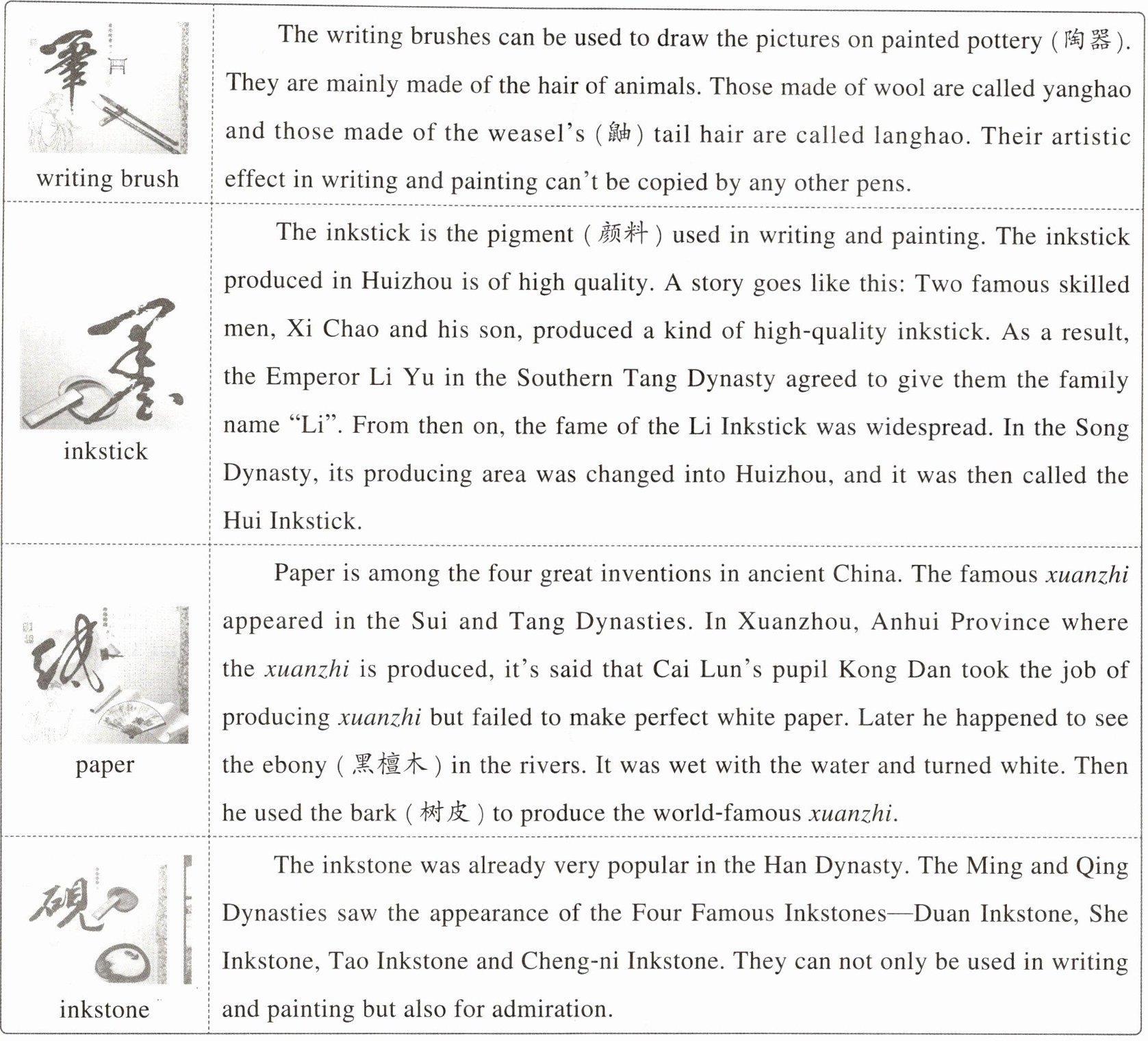
1. What are the writing brushes mainly made of?
2. Why did Xi Chao and his son get the family name from the Emperor Li Yu?
3. How did Kong Dan find the way to make the famous xuanzhi by accident?
4. When did the Four Famous Inkstones appear?
5. [新考法+开放题] What can you do to pass on the Four Treasures of the Study?
In China, writing brushes, inksticks, paper and inkstones are called the Four Treasures of the Study.
Among the high-quality treasures, the writing brush produced in Huzhou, the inkstick produced in Huizhou, the xuanzhi made in Xuancheng and the inkstone made in Duanxi are the best-known.
1. What are the writing brushes mainly made of?
The hair of animals.
2. Why did Xi Chao and his son get the family name from the Emperor Li Yu?
Because they produced a kind of high-quality inkstick.
3. How did Kong Dan find the way to make the famous xuanzhi by accident?
He happened to see the ebony in the rivers. It was wet with the water and turned white. Then he used the bark to produce the world-famous xuanzhi.
4. When did the Four Famous Inkstones appear?
They appeared in the Ming and Qing Dynasties.
5. [新考法+开放题] What can you do to pass on the Four Treasures of the Study?
I can learn to use them in calligraphy or painting classes, introduce them to my friends, and share their stories online.(开放性问题,言之有理即可。)
答案
【主旨大意】本文主要介绍了文房四宝。
1. The hair of animals.
2. Because they produced a kind of high-quality inkstick.
3. He happened to see the ebony in the rivers. It was wet with the water and turned white. Then he used the bark to produce the world-famous xuanzhi.
4. They appeared in the Ming and Qing Dynasties.
5. I can learn to use them in calligraphy or painting classes, introduce them to my friends, and share their stories online.(开放性问题,言之有理即可。)
1. The hair of animals.
2. Because they produced a kind of high-quality inkstick.
3. He happened to see the ebony in the rivers. It was wet with the water and turned white. Then he used the bark to produce the world-famous xuanzhi.
4. They appeared in the Ming and Qing Dynasties.
5. I can learn to use them in calligraphy or painting classes, introduce them to my friends, and share their stories online.(开放性问题,言之有理即可。)
解析
【分析】
本题是关于中国文房四宝的阅读理解题,包含细节理解题和开放题。解题时,针对细节题需先定位问题关键词,回到原文对应段落查找答案;针对开放题结合文房四宝的文化内涵,给出合理可行的做法即可。
【解析】
1. 问题询问毛笔的主要制作材料,定位到毛笔相关段落第二句,可知毛笔主要由动物的毛发制成;
2. 问题询问奚超父子获李煜赐姓的原因,定位到墨相关段落,因他们制作出高品质的墨锭,故获赐姓;
3. 问题询问孔丹偶然找到宣纸制作方法的过程,定位到纸相关段落,他偶然看到河里的黑檀木遇水变白,便用树皮制作出宣纸;
4. 问题询问四大名砚的出现时间,定位到砚相关段落,可知其出现于明清时期;
5. 开放题围绕传承文房四宝展开,结合实际给出合理做法即可。
【答案】
1. The hair of animals.
2. Because they produced a kind of high-quality inkstick.
3. He happened to see the ebony in the rivers. It was wet with the water and turned white. Then he used the bark to produce the world-famous xuanzhi.
4. They appeared in the Ming and Qing Dynasties.
5. I can learn to use them in calligraphy or painting classes, introduce them to my friends, and share their stories online.(开放性问题,言之有理即可。)
【知识点】
阅读理解;细节理解;开放表达
【点评】
本题以中国传统文化“文房四宝”为主题设题,既考查学生提取文本细节信息的能力,又引导学生思考传统文化的传承方式,兼具文化性与实用性。
【难度系数】
0.7
本题是关于中国文房四宝的阅读理解题,包含细节理解题和开放题。解题时,针对细节题需先定位问题关键词,回到原文对应段落查找答案;针对开放题结合文房四宝的文化内涵,给出合理可行的做法即可。
【解析】
1. 问题询问毛笔的主要制作材料,定位到毛笔相关段落第二句,可知毛笔主要由动物的毛发制成;
2. 问题询问奚超父子获李煜赐姓的原因,定位到墨相关段落,因他们制作出高品质的墨锭,故获赐姓;
3. 问题询问孔丹偶然找到宣纸制作方法的过程,定位到纸相关段落,他偶然看到河里的黑檀木遇水变白,便用树皮制作出宣纸;
4. 问题询问四大名砚的出现时间,定位到砚相关段落,可知其出现于明清时期;
5. 开放题围绕传承文房四宝展开,结合实际给出合理做法即可。
【答案】
1. The hair of animals.
2. Because they produced a kind of high-quality inkstick.
3. He happened to see the ebony in the rivers. It was wet with the water and turned white. Then he used the bark to produce the world-famous xuanzhi.
4. They appeared in the Ming and Qing Dynasties.
5. I can learn to use them in calligraphy or painting classes, introduce them to my friends, and share their stories online.(开放性问题,言之有理即可。)
【知识点】
阅读理解;细节理解;开放表达
【点评】
本题以中国传统文化“文房四宝”为主题设题,既考查学生提取文本细节信息的能力,又引导学生思考传统文化的传承方式,兼具文化性与实用性。
【难度系数】
0.7
