

 登录
C
In the early 1800s, it was difficult for people to communicate over long distances. Messages to far-off places were carried on horseback. Then Samuel Morse developed the electric telegraph and the Morse code (摩斯电码).
Morse code is a series of dots and dashes. The dashes are about three times longer than the dots. Here is the code for the letters of the alphabet (字母表).
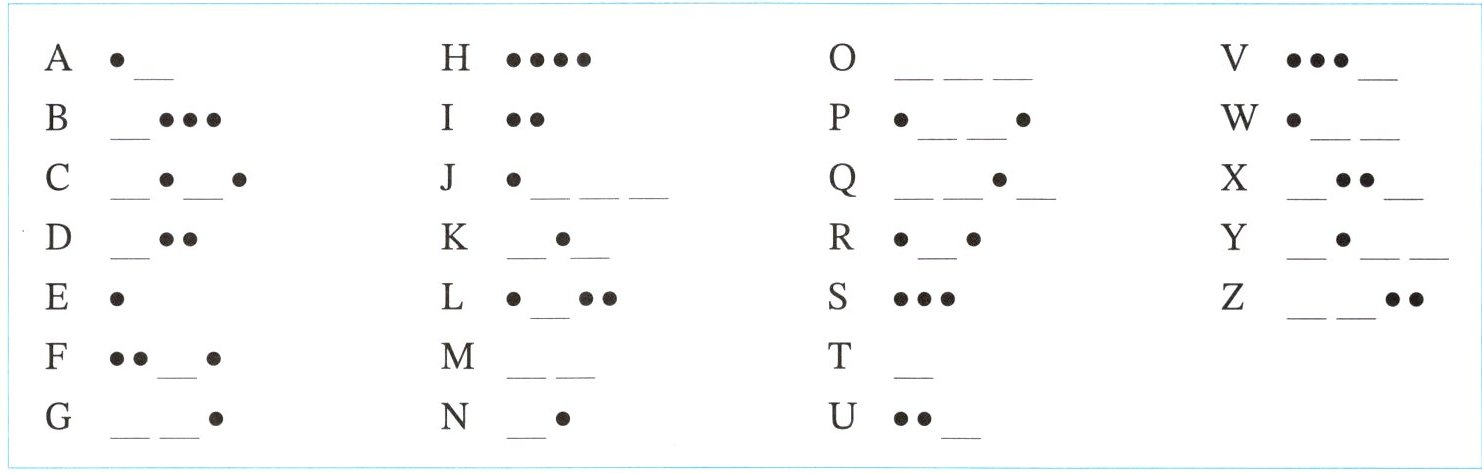
The Morse code also includes codes for numbers and punctuation signs (标点符号). Like texting, it also has groups of letters that stand for phrases. For example, the letters CUL stand for “see you later”. And the famous SOS signal, originally chosen for its simple Morse code pattern, is often remembered as “save our souls”.
The electric telegraph could send messages using electricity. The worker at one end used a machine to tap out a special code for each letter of the alphabet. The system changed the tapping into electrical signals and sent them to another place. Then they were changed back into the code at the receiving end. The code was printed on a paper tape which was set on another machine. The worker on the receiving end used the code to change the message back into words. Later, workers learnt to translate the code just by listening.
Messages can be sent by Morse code using light too. A flashing light can send the same dots and dashes and they can be translated by someone watching.
Today Morse code is used mostly by radio operators. Some navigation beacons (导航信标) like lighthouses still identify themselves using Morse code. Pilots flying by instruments (仪表) use these beacons to determine their plane’s location. But perhaps the most exciting use of Morse code is helping people with disabilities communicate. There have been cases in which people have learnt to communicate using their eyelids to blink messages in Morse code. Or they have used a finger to tap out messages.
(
A. Because there might not be enough horses to carry messages.
B. Because communication wasn’t easy for people who lived far away.
C. Because modern electronic products were not invented at that time.
D. Because it was not easy for people to use the electric telegraph.
(
A. LUCK. B. LOVE. C. LIKE. D. LOSE.
(
A. The dots are three times longer than the dashes.
B. Morse code also includes codes for phrases.
C. Messages can be sent by Morse code using electricity or heat.
D. Before the code was printed, the message was changed back into words.
(
A. Sending secret messages with heat.
B. Helping lighthouses show their own identities.
C. Helping disabled people listen to the radio easily.
D. Taking the place of all modern communication tools.
In the early 1800s, it was difficult for people to communicate over long distances. Messages to far-off places were carried on horseback. Then Samuel Morse developed the electric telegraph and the Morse code (摩斯电码).
Morse code is a series of dots and dashes. The dashes are about three times longer than the dots. Here is the code for the letters of the alphabet (字母表).
The Morse code also includes codes for numbers and punctuation signs (标点符号). Like texting, it also has groups of letters that stand for phrases. For example, the letters CUL stand for “see you later”. And the famous SOS signal, originally chosen for its simple Morse code pattern, is often remembered as “save our souls”.
The electric telegraph could send messages using electricity. The worker at one end used a machine to tap out a special code for each letter of the alphabet. The system changed the tapping into electrical signals and sent them to another place. Then they were changed back into the code at the receiving end. The code was printed on a paper tape which was set on another machine. The worker on the receiving end used the code to change the message back into words. Later, workers learnt to translate the code just by listening.
Messages can be sent by Morse code using light too. A flashing light can send the same dots and dashes and they can be translated by someone watching.
Today Morse code is used mostly by radio operators. Some navigation beacons (导航信标) like lighthouses still identify themselves using Morse code. Pilots flying by instruments (仪表) use these beacons to determine their plane’s location. But perhaps the most exciting use of Morse code is helping people with disabilities communicate. There have been cases in which people have learnt to communicate using their eyelids to blink messages in Morse code. Or they have used a finger to tap out messages.
(
B
) 28. Why did Samuel Morse invent the Morse code?A. Because there might not be enough horses to carry messages.
B. Because communication wasn’t easy for people who lived far away.
C. Because modern electronic products were not invented at that time.
D. Because it was not easy for people to use the electric telegraph.
(
A
) 29. What does the code “• ••/•• / • • / • ” stand for?A. LUCK. B. LOVE. C. LIKE. D. LOSE.
(
B
) 30. What can we learn about Morse code from the passage?A. The dots are three times longer than the dashes.
B. Morse code also includes codes for phrases.
C. Messages can be sent by Morse code using electricity or heat.
D. Before the code was printed, the message was changed back into words.
(
B
) 31. What is one use of Morse code nowadays?A. Sending secret messages with heat.
B. Helping lighthouses show their own identities.
C. Helping disabled people listen to the radio easily.
D. Taking the place of all modern communication tools.
答案
28. B 29. A 30. B 31. B
解析
【分析】
先通读全文,明确摩斯电码的背景、规则及用途,针对各问题定位原文信息:
1. 第28题:问Samuel Morse发明摩斯电码的原因,定位原文第一段“1800年代初人们远距离交流困难,Samuel Morse因此开发了电报和摩斯电码”,对应选项。
2. 第29题:需结合摩斯电码对应字母,拆分题干电码后匹配选项单词,得出对应结果。
3. 第30题:逐一核对选项与原文表述,排除错误选项后确定答案。
4. 第31题:定位原文关于摩斯电码现代用途的内容,匹配选项得出答案。
【解析】
28题:原文第一段指出19世纪初人们远距离交流困难,Samuel Morse为解决该问题发明了摩斯电码,选项B符合文意;A、C、D均未在原文提及,故选B。
29题:根据摩斯电码规则,拆分题干电码依次对应字母L、U、C、K,组成单词LUCK,对应选项A,故选A。
30题:A选项与原文“dashes are three times longer than dots”相悖;B选项与原文“摩斯电码包含代表短语的字母组”一致;C选项原文提到用电、光发送,未提热;D选项原文是先变回代码再打印,故选B。
31题:原文提到现在摩斯电码用于灯塔等导航信标标识自身,对应选项B;A、C、D均与原文不符,故选B。
【答案】
28. B 29. A 30. B 31. B
【知识点】
英语阅读理解、摩斯电码常识、细节定位
【点评】
本题围绕摩斯电码的相关内容设置题目,需准确提取原文信息,结合摩斯电码的对应规则解题,注重细节理解,难度适中。
【难度系数】
0.5
