

 登录
登录
任务型阅读
阅读短文,用英文填空或回答问题。(注意每小题的词数要求)
Have you ever felt stuck in your studies, wondering if you can really improve? You are not alone. Many students face challenges in learning, but research shows that everyone has the ability to succeed. The key is to use the right strategies.
First, your mindset matters a lot. Psychologist(心理学家)Carol Dweck found that students with a “growth mindset” believe their abilities can be developed through hard work. They see challenges as chances to grow, and they don't give up easily after failures. On the other hand, students with a “fixed mindset” think their intelligence is set and cannot change much. They often avoid difficulties for fear of looking silly.
Next, the way you practise is important. It's not enough to just repeat what you already know. Effective learning involves practising new and difficult things. This kind of “deep practice” might feel harder at first, but it helps your brain build stronger connections. Getting feedback from teachers is also necessary because they can point out your mistakes and guide you towards better methods.
Also, don't learn alone. Studying with classmates who are serious can encourage you. You can share ideas, explain things to each other, and stay motivated together. Learning is social.
Finally, be a smart user of resources. Today, we have so many learning materials online, such as educational videos, apps, and websites. The challenge is to choose the most useful ones and use them efficiently. Ask yourself whether this resource really helps you understand the topic. Are you using it actively or just watching passively?
Becoming a better learner is a journey. It requires the right mindset, smart practice, good company, and wise use of tools. With these steps, you can turn your learning challenges into opportunities for growth.
★Fill in the blanks according to the passage.
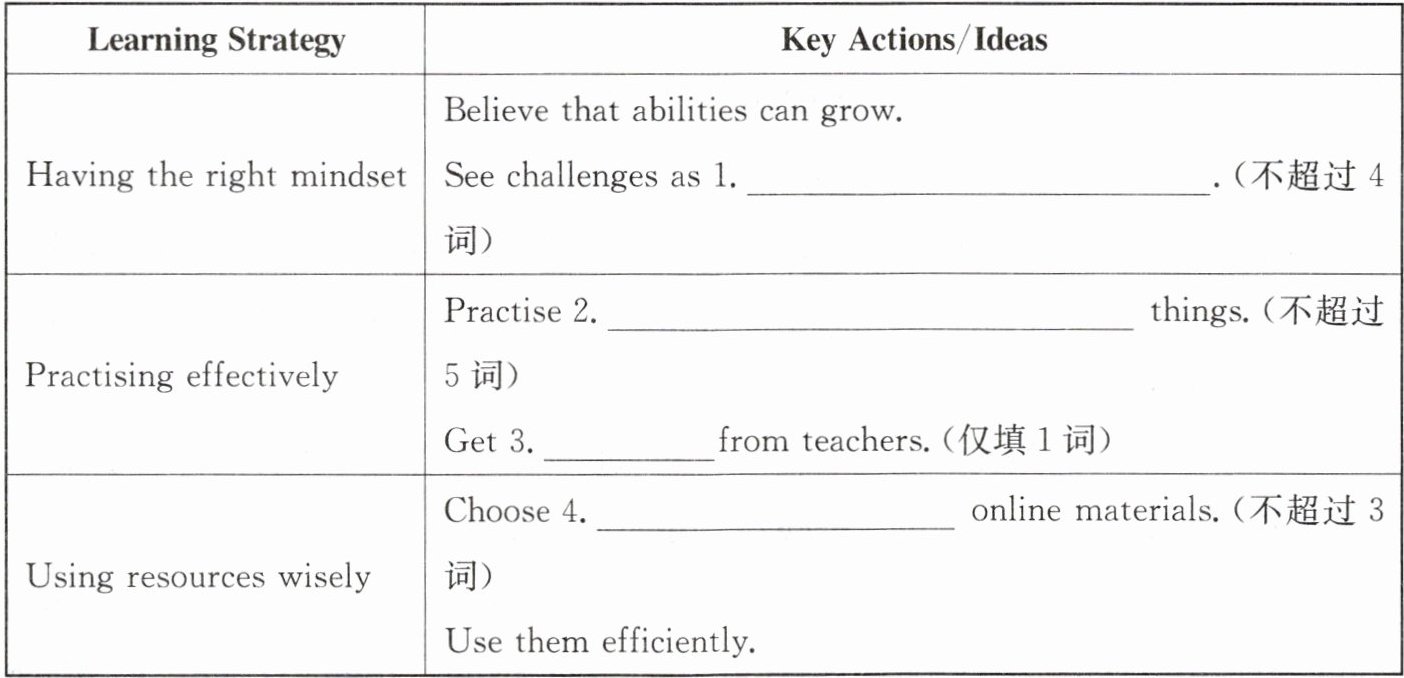
5. What is the main difference between students with a “growth mindset” and those with a “fixed mindset” when facing challenges?
(不超过25词)
6. What is one specific thing you can do to practise effectively according to the passage?
(结合自身实际,不超过15词)
阅读短文,用英文填空或回答问题。(注意每小题的词数要求)
Have you ever felt stuck in your studies, wondering if you can really improve? You are not alone. Many students face challenges in learning, but research shows that everyone has the ability to succeed. The key is to use the right strategies.
First, your mindset matters a lot. Psychologist(心理学家)Carol Dweck found that students with a “growth mindset” believe their abilities can be developed through hard work. They see challenges as chances to grow, and they don't give up easily after failures. On the other hand, students with a “fixed mindset” think their intelligence is set and cannot change much. They often avoid difficulties for fear of looking silly.
Next, the way you practise is important. It's not enough to just repeat what you already know. Effective learning involves practising new and difficult things. This kind of “deep practice” might feel harder at first, but it helps your brain build stronger connections. Getting feedback from teachers is also necessary because they can point out your mistakes and guide you towards better methods.
Also, don't learn alone. Studying with classmates who are serious can encourage you. You can share ideas, explain things to each other, and stay motivated together. Learning is social.
Finally, be a smart user of resources. Today, we have so many learning materials online, such as educational videos, apps, and websites. The challenge is to choose the most useful ones and use them efficiently. Ask yourself whether this resource really helps you understand the topic. Are you using it actively or just watching passively?
Becoming a better learner is a journey. It requires the right mindset, smart practice, good company, and wise use of tools. With these steps, you can turn your learning challenges into opportunities for growth.
★Fill in the blanks according to the passage.
5. What is the main difference between students with a “growth mindset” and those with a “fixed mindset” when facing challenges?
(不超过25词)
6. What is one specific thing you can do to practise effectively according to the passage?
(结合自身实际,不超过15词)
答案
1. chances to grow
2. new and difficult
3. feedback
4. the most useful
5. Growth-mindset students see challenges as growth chances, while fixed-mindset ones avoid difficulties.
6. I will practise difficult English exercises actively.
2. new and difficult
3. feedback
4. the most useful
5. Growth-mindset students see challenges as growth chances, while fixed-mindset ones avoid difficulties.
6. I will practise difficult English exercises actively.
解析
1. 定位原文第二段第三句"They see challenges as chances to grow",结合不超过4词的要求得出对应答案。
2. 定位原文第三段第三句"Effective learning involves practising new and difficult things",结合不超过5词的要求得出对应答案。
3. 定位原文第三段第五句"Getting feedback from teachers is also necessary",结合仅填1词的要求得出对应答案。
4. 定位原文第五段第三句"The challenge is to choose the most useful ones and use them efficiently",此处ones指代online materials,结合不超过3词的要求得出对应答案。
5. 对比第二段中成长型思维和固定型思维学生面对挑战的不同表现,在25词的限制内整理出核心差异即可。
6. 结合自身学习实际,围绕有效练习的要求,写出符合词数限制的合理具体做法即可。
2. 定位原文第三段第三句"Effective learning involves practising new and difficult things",结合不超过5词的要求得出对应答案。
3. 定位原文第三段第五句"Getting feedback from teachers is also necessary",结合仅填1词的要求得出对应答案。
4. 定位原文第五段第三句"The challenge is to choose the most useful ones and use them efficiently",此处ones指代online materials,结合不超过3词的要求得出对应答案。
5. 对比第二段中成长型思维和固定型思维学生面对挑战的不同表现,在25词的限制内整理出核心差异即可。
6. 结合自身学习实际,围绕有效练习的要求,写出符合词数限制的合理具体做法即可。
