

 登录
登录
三、阅读还原。
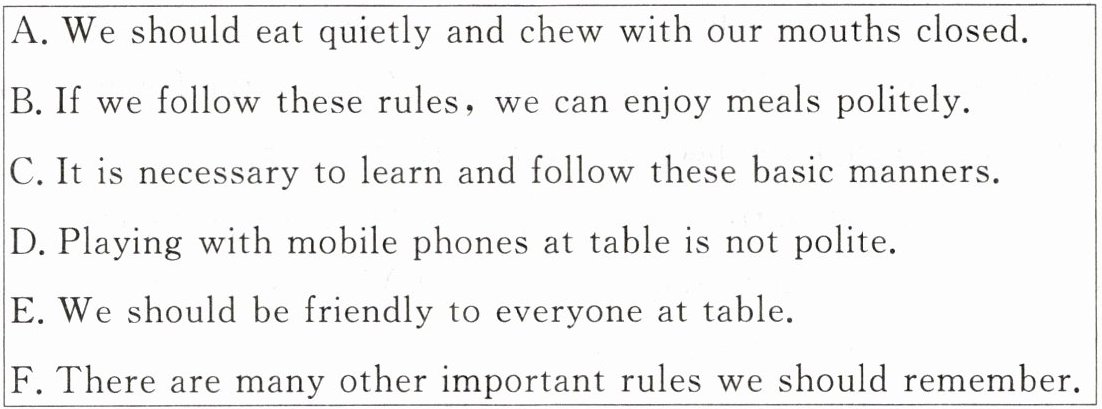
Table manners are an important part of traditional Chinese culture. They show our respect for hosts, elders and other guests. Learning basic rules helps us behave well at the dinner table.
In China, people usually wait for the elders to start eating first. We should use chopsticks properly. Do not play with chopsticks, point at others, or knock on bowls. 1
Chinese people often share dishes together. It is polite to take proper food each time and not to be greedy. 2 Making loud noises while eating is considered rude.
When having meals, we should pay attention to our behaviours(行为). 3 It is also impolite to talk with food in your mouth. Besides, we should thank others when they serve us food.
4 We should value food and never waste it. 5 Different cultures have different customs, but respect is always the key.
Good table manners not only make meals more pleasant but also help us pass on our traditional culture.
1. 2. 3. 4. 5.
Table manners are an important part of traditional Chinese culture. They show our respect for hosts, elders and other guests. Learning basic rules helps us behave well at the dinner table.
In China, people usually wait for the elders to start eating first. We should use chopsticks properly. Do not play with chopsticks, point at others, or knock on bowls. 1
Chinese people often share dishes together. It is polite to take proper food each time and not to be greedy. 2 Making loud noises while eating is considered rude.
When having meals, we should pay attention to our behaviours(行为). 3 It is also impolite to talk with food in your mouth. Besides, we should thank others when they serve us food.
4 We should value food and never waste it. 5 Different cultures have different customs, but respect is always the key.
Good table manners not only make meals more pleasant but also help us pass on our traditional culture.
1. 2. 3. 4. 5.
答案
1. C 2. A 3. D 4. F 5. B
解析
我们根据上下文逻辑逐一分析:
1. 空1前文介绍了中国餐桌礼仪里等长辈先动筷、正确使用筷子的基础规则,C选项“学习并遵守这些基本礼仪是很有必要的”承接上文内容,符合语境。
2. 空2后文提到吃饭发出大的声响被认为是粗鲁的,A选项“我们应该安静用餐,闭着嘴咀嚼”和后文内容呼应,衔接自然。
3. 空3后文出现"It is also impolite(这也是不礼貌的)",说明前文提到了一种不礼貌的行为,D选项“在餐桌上玩手机是不礼貌的”符合此处逻辑,和后文的also对应。
4. 空4前文已经介绍了多条餐桌礼仪,后文引出要珍惜食物不浪费的新规则,F选项“我们还要记住很多其他重要的规则”起到过渡作用,符合语境。
5. 空5前文列举了多条餐桌礼仪要求,B选项“如果我们遵守这些规则,就可以礼貌地享用用餐”对前文的规则进行总结,引出后文不同文化都以尊重为核心的内容,逻辑通顺。
剩余E选项不符合文中各处语境,为干扰项。
1. 空1前文介绍了中国餐桌礼仪里等长辈先动筷、正确使用筷子的基础规则,C选项“学习并遵守这些基本礼仪是很有必要的”承接上文内容,符合语境。
2. 空2后文提到吃饭发出大的声响被认为是粗鲁的,A选项“我们应该安静用餐,闭着嘴咀嚼”和后文内容呼应,衔接自然。
3. 空3后文出现"It is also impolite(这也是不礼貌的)",说明前文提到了一种不礼貌的行为,D选项“在餐桌上玩手机是不礼貌的”符合此处逻辑,和后文的also对应。
4. 空4前文已经介绍了多条餐桌礼仪,后文引出要珍惜食物不浪费的新规则,F选项“我们还要记住很多其他重要的规则”起到过渡作用,符合语境。
5. 空5前文列举了多条餐桌礼仪要求,B选项“如果我们遵守这些规则,就可以礼貌地享用用餐”对前文的规则进行总结,引出后文不同文化都以尊重为核心的内容,逻辑通顺。
剩余E选项不符合文中各处语境,为干扰项。
四、短文填空。
write make them from follow building manner if be help
Good manners are something that helps make yourself and others feel good.
No matter what you do or where you are, having good manners is important.
Opening a door for others when you enter a room or a 1 is thought to be good. 2 thank-you notes to people who help you is also good. Having good 3 means thinking about how others are feeling. People who have good manners always think for others before they do something. They try to 4 others feel happy and comfortable.
5 you have good manners, you are showing your good behaviours to people around you. You are setting good examples to 6. You are 7 them to be nice.
Rules about what good and bad manners 8 different 9 person to person and from culture to culture. However, there is one rule that people all over the world share. That is to treat others in the same way you want to be treated. And it's not difficult to 10.
1. 2. 3. 4. 5.
6. 7. 8. 9. 10.
write make them from follow building manner if be help
Good manners are something that helps make yourself and others feel good.
No matter what you do or where you are, having good manners is important.
Opening a door for others when you enter a room or a 1 is thought to be good. 2 thank-you notes to people who help you is also good. Having good 3 means thinking about how others are feeling. People who have good manners always think for others before they do something. They try to 4 others feel happy and comfortable.
5 you have good manners, you are showing your good behaviours to people around you. You are setting good examples to 6. You are 7 them to be nice.
Rules about what good and bad manners 8 different 9 person to person and from culture to culture. However, there is one rule that people all over the world share. That is to treat others in the same way you want to be treated. And it's not difficult to 10.
1. 2. 3. 4. 5.
6. 7. 8. 9. 10.
答案
1. building 2. Writing 3. manners 4. make 5. If 6. them 7. helping 8. are 9. from 10. follow
解析
本题考查选词填空,需要结合语境、固定搭配和八年级所学语法规则,将给出的词进行适当变形填入空格:
1. 空前有不定冠词a,需要接可数名词单数,和并列的room对应,选building,意为“建筑物”,指进入房间或建筑时为他人开门是得体的行为。
2. 此处作句子主语,需要将动词write变为动名词形式Writing,Writing thank-you notes 意为“写感谢信”,动名词作主语符合语法要求。
3. 固定搭配good manners意为“有礼貌”,是本单元核心常用表达,manner变为复数manners。
4. 固定结构try to do sth. 后接动词原形,结合固定用法make sb. feel... 意为“让某人感到……”,填make。
5. 此处引导条件状语从句,表达“如果”的含义,选If,句首首字母大写。
6. 介词to后接人称代词宾格,指代前文提到的身边的人,选them,意为“你正在给他们树立好榜样”。
7. 此处是现在进行时结构be+doing,结合固定搭配help sb. to do sth. 意为“帮助某人做某事”,help变为现在分词helping。
8. 句子主语Rules是复数,对应的be动词用are,意为“关于得体和不得体行为的准则是不同的”。
9. 固定搭配from person to person 意为“人与人之间”,和后文的from culture to culture结构对应,选from。
10. 固定句型it's +形容词+to do sth. 后接动词原形,结合语境表示遵守这条共通的准则并不难,选follow。
1. 空前有不定冠词a,需要接可数名词单数,和并列的room对应,选building,意为“建筑物”,指进入房间或建筑时为他人开门是得体的行为。
2. 此处作句子主语,需要将动词write变为动名词形式Writing,Writing thank-you notes 意为“写感谢信”,动名词作主语符合语法要求。
3. 固定搭配good manners意为“有礼貌”,是本单元核心常用表达,manner变为复数manners。
4. 固定结构try to do sth. 后接动词原形,结合固定用法make sb. feel... 意为“让某人感到……”,填make。
5. 此处引导条件状语从句,表达“如果”的含义,选If,句首首字母大写。
6. 介词to后接人称代词宾格,指代前文提到的身边的人,选them,意为“你正在给他们树立好榜样”。
7. 此处是现在进行时结构be+doing,结合固定搭配help sb. to do sth. 意为“帮助某人做某事”,help变为现在分词helping。
8. 句子主语Rules是复数,对应的be动词用are,意为“关于得体和不得体行为的准则是不同的”。
9. 固定搭配from person to person 意为“人与人之间”,和后文的from culture to culture结构对应,选from。
10. 固定句型it's +形容词+to do sth. 后接动词原形,结合语境表示遵守这条共通的准则并不难,选follow。
