

 登录
登录
阅读量:166词 难度: ★★★★★ 建议用时:9分钟 正确率: /5
除了吃月饼、赏月,在你的家乡,中秋节这天有什么不一样的习俗吗?
In Guangzhou, there is a lovely tradition called "Shu Zhongqiu". Families use bamboo strips to make lanterns. The lanterns are shaped like fish, dragons, birds or fruits. At night, people light candles inside and raise the lanterns high. The whole town becomes a twinkling sea of lights.
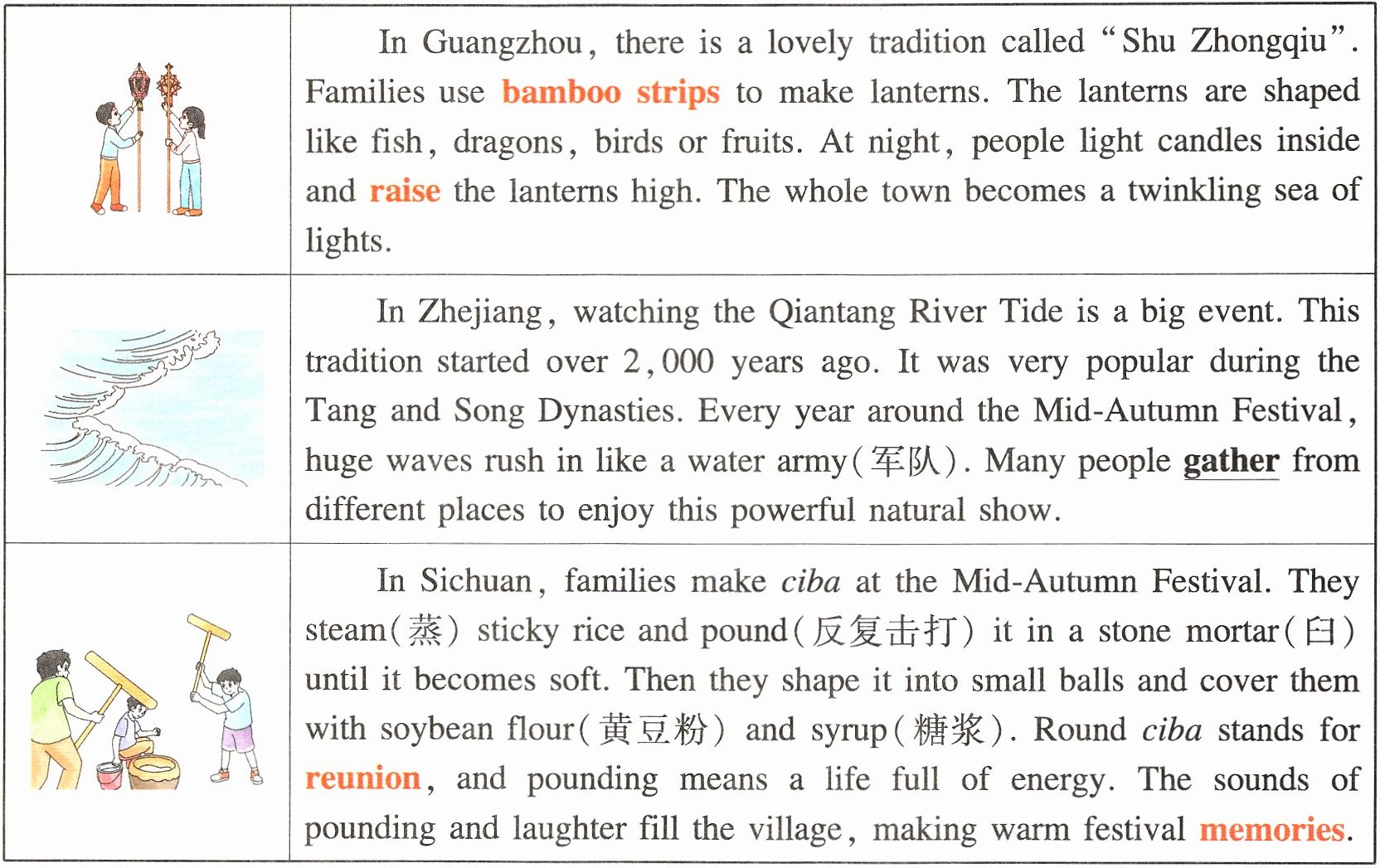 In Zhejiang, watching the Qiantang River Tide is a big event. This tradition started over 2,000 years ago. It was very popular during the Tang and Song Dynasties. Every year around the Mid-Autumn Festival, huge waves rush in like a water army(军队). Many people gather from different places to enjoy this powerful natural show.
In Sichuan, families make ciba at the Mid-Autumn Festival. They steam(蒸) sticky rice and pound(反复击打) it in a stone mortar(臼) until it becomes soft. Then they shape it into small balls and cover them with soybean flour(黄豆粉) and syrup(糖浆). Round ciba stands for reunion, and pounding means a life full of energy. The sounds of pounding and laughter fill the village, making warm festival memories.
思维新题
根据文章内容,选择正确答案。
(
A. planting trees
B. raising the lanterns
C. watching the sea of lights
(

(
A. 聚集
B. 观看
C. 分散
(
A. To wish for an energetic life.
B. To make memories for the festival.
C. To sell it at the market for money.
(
A. the history of "Shu Zhongqiu"
B. the height of the Qiantang River Tide
C. the process of making ciba
日积月累
bamboo strip 竹条
raise /reɪz/ 举起
reunion /ˌriːˈjuːniən/ 团聚
memory /ˈmeməri/ 回忆;记忆
除了吃月饼、赏月,在你的家乡,中秋节这天有什么不一样的习俗吗?
In Guangzhou, there is a lovely tradition called "Shu Zhongqiu". Families use bamboo strips to make lanterns. The lanterns are shaped like fish, dragons, birds or fruits. At night, people light candles inside and raise the lanterns high. The whole town becomes a twinkling sea of lights.
In Zhejiang, watching the Qiantang River Tide is a big event. This tradition started over 2,000 years ago. It was very popular during the Tang and Song Dynasties. Every year around the Mid-Autumn Festival, huge waves rush in like a water army(军队). Many people gather from different places to enjoy this powerful natural show. In Sichuan, families make ciba at the Mid-Autumn Festival. They steam(蒸) sticky rice and pound(反复击打) it in a stone mortar(臼) until it becomes soft. Then they shape it into small balls and cover them with soybean flour(黄豆粉) and syrup(糖浆). Round ciba stands for reunion, and pounding means a life full of energy. The sounds of pounding and laughter fill the village, making warm festival memories.
思维新题
根据文章内容,选择正确答案。
(
B
)1. "Shu Zhongqiu" means "B
" at the Mid-Autumn Festival.A. planting trees
B. raising the lanterns
C. watching the sea of lights
(
C
)2. Which shape of lanterns is not mentioned in the passage?(
A
)3. The underlined word "gather" means "A
" in Chinese. 考点 词义猜测A. 聚集
B. 观看
C. 分散
(
A
)4. Why do people make ciba at the Mid-Autumn Festival?A. To wish for an energetic life.
B. To make memories for the festival.
C. To sell it at the market for money.
(
C
)5. We can know C
from the passage.A. the history of "Shu Zhongqiu"
B. the height of the Qiantang River Tide
C. the process of making ciba
日积月累
bamboo strip 竹条
raise /reɪz/ 举起
reunion /ˌriːˈjuːniən/ 团聚
memory /ˈmeməri/ 回忆;记忆
答案
答案详解
1. B 【细节理解】由文章中的"Families use bamboo strips to make lanterns."和"At night, people light candles inside and raise the lanterns high."可知,"树中秋"指的是"在中秋节时高举灯笼"。
2. C 【细节理解】由文章中的"The lanterns are shaped like fish, dragons, birds or fruits."可知,这些灯笼有鱼、龙、鸟或水果的形状,没有提及兔子的形状。
3. A 【词义猜测】由画线单词所在句可知,不同地方的人来到同一地点观看钱塘江大湖。由此可推知,gather意为"聚集"。
4. A 【细节理解】由文章中的"Round ciba stands for reunion, and pounding means a life full of energy."可知,糍粑象征着团圆和充满活力的生活,因此制作糍粑是为了期盼充满活力的生活。
5. C 【细节理解】通读文章最后一部分内容可知,从这篇文章中我们可以了解到制作糍粑的过程。
1. B 【细节理解】由文章中的"Families use bamboo strips to make lanterns."和"At night, people light candles inside and raise the lanterns high."可知,"树中秋"指的是"在中秋节时高举灯笼"。
2. C 【细节理解】由文章中的"The lanterns are shaped like fish, dragons, birds or fruits."可知,这些灯笼有鱼、龙、鸟或水果的形状,没有提及兔子的形状。
3. A 【词义猜测】由画线单词所在句可知,不同地方的人来到同一地点观看钱塘江大湖。由此可推知,gather意为"聚集"。
4. A 【细节理解】由文章中的"Round ciba stands for reunion, and pounding means a life full of energy."可知,糍粑象征着团圆和充满活力的生活,因此制作糍粑是为了期盼充满活力的生活。
5. C 【细节理解】通读文章最后一部分内容可知,从这篇文章中我们可以了解到制作糍粑的过程。
解析
【分析】
1. 第1题是细节理解题,需定位文章中“Shu Zhongqiu”的相关描述,匹配对应选项;
2. 第2题是细节理解题,需查找文章提及的灯笼形状,排除未涉及的选项;
3. 第3题是词义猜测题,结合所在句子的语境推断单词含义;
4. 第4题是细节理解题,定位文章中制作糍粑的原因相关语句,匹配选项;
5. 第5题是细节理解题,逐一核对选项与文章内容,排除无依据选项,找到符合的内容。
【解析】
1. 第1题:根据文章第一段,“Shu Zhongqiu”相关描述为“Families use bamboo strips to make lanterns... At night, people light candles inside and raise the lanterns high”,可知其含义是“高举灯笼”,对应选项B;
2. 第2题:根据第一段“The lanterns are shaped like fish, dragons, birds or fruits”,提到的灯笼形状有鱼、龙、鸟、水果,未提及兔子形状,对应选项C;
3. 第3题:画线词所在句为“Many people gather from different places to enjoy this powerful natural show”,结合语境“来自不同地方的人来到同一地点”,可推断“gather”意为“聚集”,对应选项A;
4. 第4题:根据第三段“pounding means a life full of energy”,可知制作糍粑是为了期盼充满活力的生活,对应选项A;
5. 第5题:A选项“树中秋的历史”文章未提及;B选项“钱塘江潮的高度”文章未涉及;C选项“制作糍粑的过程”在第三段有详细描述,对应选项C。
【答案】
1. B 2. C 3. A 4. A 5. C
【知识点】
英语阅读理解细节理解、词义猜测
【点评】
本题是介绍中国不同地区中秋节特色习俗的英语阅读理解题,考查学生查找细节、猜测词义的能力,内容贴近生活,能帮助学生了解地域文化差异。
【难度系数】
0.6
1. 第1题是细节理解题,需定位文章中“Shu Zhongqiu”的相关描述,匹配对应选项;
2. 第2题是细节理解题,需查找文章提及的灯笼形状,排除未涉及的选项;
3. 第3题是词义猜测题,结合所在句子的语境推断单词含义;
4. 第4题是细节理解题,定位文章中制作糍粑的原因相关语句,匹配选项;
5. 第5题是细节理解题,逐一核对选项与文章内容,排除无依据选项,找到符合的内容。
【解析】
1. 第1题:根据文章第一段,“Shu Zhongqiu”相关描述为“Families use bamboo strips to make lanterns... At night, people light candles inside and raise the lanterns high”,可知其含义是“高举灯笼”,对应选项B;
2. 第2题:根据第一段“The lanterns are shaped like fish, dragons, birds or fruits”,提到的灯笼形状有鱼、龙、鸟、水果,未提及兔子形状,对应选项C;
3. 第3题:画线词所在句为“Many people gather from different places to enjoy this powerful natural show”,结合语境“来自不同地方的人来到同一地点”,可推断“gather”意为“聚集”,对应选项A;
4. 第4题:根据第三段“pounding means a life full of energy”,可知制作糍粑是为了期盼充满活力的生活,对应选项A;
5. 第5题:A选项“树中秋的历史”文章未提及;B选项“钱塘江潮的高度”文章未涉及;C选项“制作糍粑的过程”在第三段有详细描述,对应选项C。
【答案】
1. B 2. C 3. A 4. A 5. C
【知识点】
英语阅读理解细节理解、词义猜测
【点评】
本题是介绍中国不同地区中秋节特色习俗的英语阅读理解题,考查学生查找细节、猜测词义的能力,内容贴近生活,能帮助学生了解地域文化差异。
【难度系数】
0.6
