

 登录
阅读短文,用英文填空或回答问题。
To Plan or Not to Plan When Traveling
People travel in different ways. Some plan the travel carefully before they set out, while others just like to go and see where the wind takes them. Now let's look at both sides of the coin!
To Plan
Planning can help you save money. By planning in advance, you have the time to find the cheapest tickets or hotels. Planning can also help you save time. You can plan your routes and make the most of your time. Planning can make sure you see all the attractions. Before you go traveling, you usually make a list of places that you would like to see! Some attractions might only be open on certain days or certain hours. Some might need a booking. With a plan, you will not miss any of them.
Not to Plan
Without any plans, you have much freedom(自由). You can change your routes at once! You can do anything you want to and go anywhere with anyone you want at any time! You will be happy when you get surprises during your trip. Without any plans, nothing can go wrong. So you don't have to worry when a bus doesn't come on time, or when you get on the wrong train. Just relax and go with the flow(顺其自然).
There is no right or wrong way to travel with a plan or not. I think the more important thing is to find the right balance between the two and finding out which one works better for you.
1. The text mainly talks about
2. Fill in the blanks according to the text.
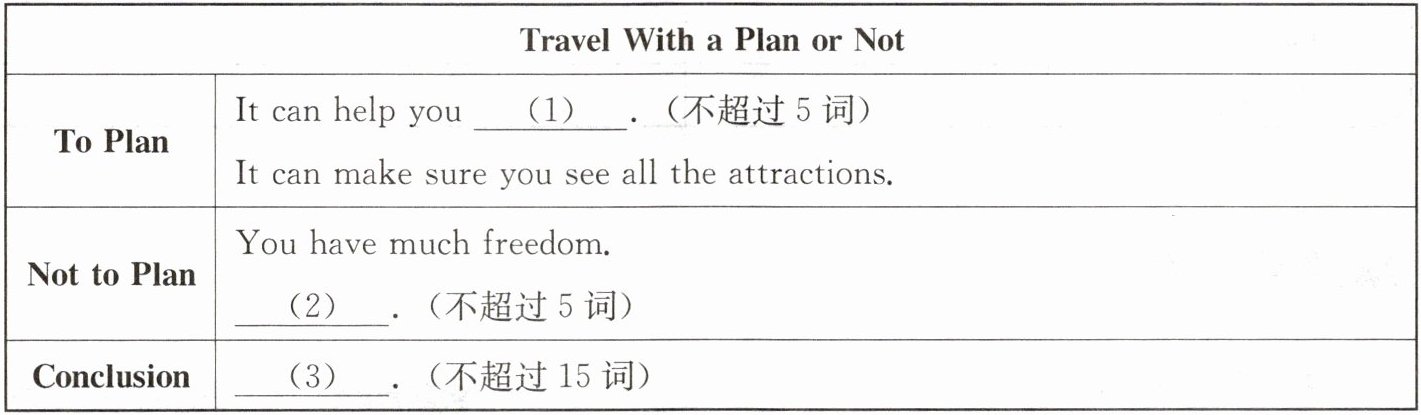
(1)
(3)
3. Which do you like better, traveling with a plan or not? And why?(结合自身实际作答,不超过15词)
To Plan or Not to Plan When Traveling
People travel in different ways. Some plan the travel carefully before they set out, while others just like to go and see where the wind takes them. Now let's look at both sides of the coin!
To Plan
Planning can help you save money. By planning in advance, you have the time to find the cheapest tickets or hotels. Planning can also help you save time. You can plan your routes and make the most of your time. Planning can make sure you see all the attractions. Before you go traveling, you usually make a list of places that you would like to see! Some attractions might only be open on certain days or certain hours. Some might need a booking. With a plan, you will not miss any of them.
Not to Plan
Without any plans, you have much freedom(自由). You can change your routes at once! You can do anything you want to and go anywhere with anyone you want at any time! You will be happy when you get surprises during your trip. Without any plans, nothing can go wrong. So you don't have to worry when a bus doesn't come on time, or when you get on the wrong train. Just relax and go with the flow(顺其自然).
There is no right or wrong way to travel with a plan or not. I think the more important thing is to find the right balance between the two and finding out which one works better for you.
1. The text mainly talks about
travel plan / traveling plan
.(不超过2词)2. Fill in the blanks according to the text.
(1)
save time and money
(2) Nothing can go wrong
(3)
There is no right or wrong to travel with a plan or not.
3. Which do you like better, traveling with a plan or not? And why?(结合自身实际作答,不超过15词)
I prefer traveling with a plan. Because it can help me save time.
答案
1. travel plan / traveling plan
2. (1) save time and money
(2) Nothing can go wrong
(3) There is no right or wrong to travel with a plan or not.
3. One possible answer: I prefer traveling with a plan. Because it can help me save time.
