

 登录
1. (1)如图①,$△ ABC$是等边三角形,D是边BC下方一点,$∠ BDC=120°$,探索线段DA,DB,DC之间的数量关系.
(2)如图②,$△ ABC$是等边三角形,直线$a// AB$,D为边BC上一点,$∠ ADE$交直线a于点E,且$∠ ADE=60°$,求证:$CD+CE=CA$.
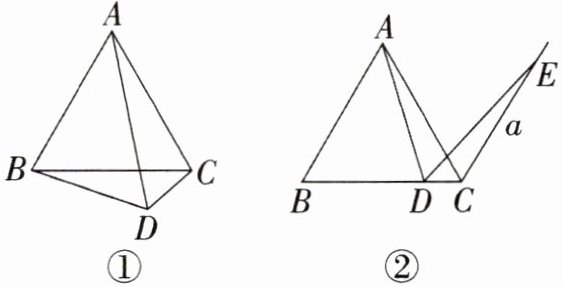
(2)如图②,$△ ABC$是等边三角形,直线$a// AB$,D为边BC上一点,$∠ ADE$交直线a于点E,且$∠ ADE=60°$,求证:$CD+CE=CA$.
答案
1. (1) $DA=DC+DB$,理由如下:
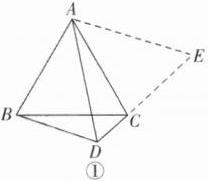
如图①,延长 DC 到点 E,使 $CE=BD$,连接 AE.$\because △ABC$ 是等边三角形, $\therefore AB = AC$, $∠BAC = 60°$. $\because ∠BDC = 120°$, $\therefore ∠ABD+ ∠ACD = 180°$. 又 $\because ∠ACE + ∠ACD = 180°$, $\therefore ∠ABD=∠ACE$.
在$△ABD$ 和 $△ACE$ 中,$\begin{cases} AB=AC, \\ ∠ABD=∠ACE, \\ BD=CE, \end{cases}$$\therefore △ABD≌△ACE$(SAS), $\therefore AD = AE$, $∠BAD = ∠CAE$. $\because ∠BAC = 60°$,即$∠BAD+∠DAC = 60°$,$\therefore ∠DAC+∠CAE = 60°$,即$∠DAE = 60°$,$\therefore △ADE$ 是等边三角形,$\therefore DA = DE = DC+CE = DC+DB$,即 $DA=DC+DB$.
(2)
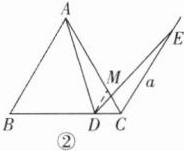
如图②,在 AC 上截取 $CM=CD$,连接 DM.$\because △ABC$ 是等边三角形,$\therefore ∠ACB=60°$,$\therefore △CDM$ 是等边三角形,$\therefore MD=CD=CM$,$∠CMD=∠CDM=60°$,$\therefore ∠AMD=120°$.$\because ∠ADE=60°$,$\therefore ∠ADE = ∠MDC$,$\therefore ∠ADM = ∠EDC$. $\because$ 直线 $a // AB$,$\therefore ∠ACE = ∠BAC = 60°$,$\therefore ∠DCE = 120° = ∠AMD$. 在$△ADM$ 和 $△EDC$ 中,$\begin{cases} ∠ADM=∠EDC, \\ MD=CD, \\ ∠AMD=∠ECD, \end{cases}$ $\therefore △ADM≌△EDC$(ASA),$\therefore AM = EC$,$\therefore CA = CM + AM = CD + CE$, 即 $CD+CE=CA$.
2. (2025·东营期末)【问题初探】
如图①,已知△ABC为等边三角形,点D为边BC上一动点(点D不与点B,C重合).以AD为边向右侧作等边三角形ADE,连接CE.
(1)求证:△ABD≌△ACE;
(2)猜想(无需证明):①AB与CE的位置关系;
②线段CE,AC,CD之间的数量关系.
【类比探究】
(3)如图②,若点D在边BC的延长线上,其他条件不变,随着动点D的位置变化,猜想(2)中的两个结论是否还成立?若成立,说明理由;若不成立,请写出正确的结论,并说明理由.
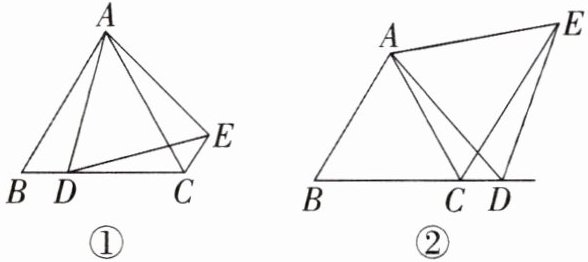
如图①,已知△ABC为等边三角形,点D为边BC上一动点(点D不与点B,C重合).以AD为边向右侧作等边三角形ADE,连接CE.
(1)求证:△ABD≌△ACE;
(2)猜想(无需证明):①AB与CE的位置关系;
②线段CE,AC,CD之间的数量关系.
【类比探究】
(3)如图②,若点D在边BC的延长线上,其他条件不变,随着动点D的位置变化,猜想(2)中的两个结论是否还成立?若成立,说明理由;若不成立,请写出正确的结论,并说明理由.
答案
2. (1) $\because △ABC$ 和 $△ADE$ 是等边三角形, $\therefore AB = AC$, $AD = AE$, $∠BAC = ∠DAE = 60°$, $\therefore ∠BAC - ∠DAC = ∠DAE - ∠DAC$,即 $∠BAD = ∠CAE$. 在$△ABD$ 和 $△ACE$ 中,$\begin{cases} AB=AC, \\ ∠BAD=∠CAE, \\ AD=AE, \end{cases}$$\therefore △ABD≌△ACE(\mathrm{SAS})$.
(2) ①$AB// CE$;②$CE=AC-CD$.
解析:①由(1)得 $△ABD≌△ACE(\mathrm{SAS})$,$\therefore ∠B = ∠ACE = 60°$,$CE = BD$,$\therefore ∠BAC = ∠ACE = 60°$,$\therefore AB// CE$.②$\because CE = BD$,$AC=BC$,$\therefore CE = BD = BC-CD = AC-CD$.
(3) ①平行成立,②数量关系不成立,应为 $CE=AC+CD$.
理由: $\because △ABC$ 和 $△ADE$ 是等边三角形, $\therefore AB = AC$, $AD=AE$,$∠BAC=∠DAE=60°$.$\because ∠BAC=∠DAE$,$\therefore ∠BAC+∠DAC = ∠DAE+∠DAC$,即 $∠BAD = ∠CAE$. 在 $△ABD$ 和 $△ACE$ 中,$\begin{cases} AB=AC, \\ ∠BAD=∠CAE, \\ AD=AE, \end{cases}$$\therefore △ABD≌△ACE(\mathrm{SAS})$,
$\therefore ∠B = ∠ACE = 60°$,$CE = BD$,$\therefore ∠BAC = ∠ACE = 60°$,$\therefore AB// CE$. $\because CE = BD$,$AC = BC$,$\therefore CE = BD = BC+CD = AC+CD$.
3. 等边三角形的三条边都相等,三个内角都相等,并且都等于$60°$,由此可得等边三角形的每一个外角都等于$120°$,等边三角形与$120°$的角是否还有某些特殊关系,请你完成证明过程或解答过程.
(1)如图①,$△ ABC$是等边三角形,点$D$, $E$分别在$CB$和$BC$的延长线上,且$∠ DAE=120°$,当$∠ D$的度数确定时,$∠ E$的度数也随之确定.
①若$∠ D=26°$,则$∠ E$的度数为________;
②求证:$∠ D=∠ EAC$.
(2)如图②,$△ ABC$是等边三角形,点$P$是三角形内一点,且$∠ APB=120°$,延长$AP$交$BC$于点$D$,延长$BP$交$AC$于点$E$,求证:$AD=BE$.
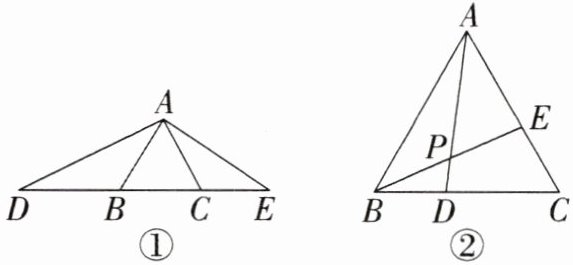
(1)如图①,$△ ABC$是等边三角形,点$D$, $E$分别在$CB$和$BC$的延长线上,且$∠ DAE=120°$,当$∠ D$的度数确定时,$∠ E$的度数也随之确定.
①若$∠ D=26°$,则$∠ E$的度数为________;
②求证:$∠ D=∠ EAC$.
(2)如图②,$△ ABC$是等边三角形,点$P$是三角形内一点,且$∠ APB=120°$,延长$AP$交$BC$于点$D$,延长$BP$交$AC$于点$E$,求证:$AD=BE$.
答案
3. (1)① 34
解析: $\because ∠DAE=120°$,$∠D=26°$,$\therefore ∠E=180°-∠DAE-∠D=34°$.
②$\because △ABC$ 是等边三角形,$\therefore ∠ACB = ∠E+∠EAC = 60°$.
$\because ∠DAE=120°$,$\therefore ∠D+∠E=60°$,$\therefore ∠D=∠EAC$.
(2) $\because △ABC$ 是等边三角形,$\therefore AB = BC$,$∠ABD = ∠BCE = 60°$,$\therefore ∠EBC+∠BEC = 120°$.$\because ∠APB=120°$,$\therefore ∠EBC+∠ADB=120°$,$\therefore ∠BEC = ∠ADB$. 在 $△ABD$ 和 $△BCE$ 中,$\begin{cases} ∠ADB=∠BEC, \\ ∠ABD=∠BCE, \\ AB=BC \end{cases}$$\therefore △ABD≌△BCE(\mathrm{AAS})$,$\therefore AD=BE$.
