

 登录
Ⅴ. Read the passage and complete the following tasks.
The year 2026 marks the 90th anniversary of the victory of the Long March (长征). To remember this great event, a group of 30 young people from Macao travelled to Ruijin, Jiangxi—the starting point. They walked old Red Army paths and visited the historic sites, getting a special new experience.
The Long March took place from 1934 to 1936. The Red Army had to break through enemy lines and march across China to escape the enemy's pursuit. Over 86,000 soldiers started the journey. They climbed 18 snow mountains, crossed 24 rivers, and walked through dangerous swamps. By the time they reached safety, over 40,000 soldiers had died for the revolution.
How did the Red Army succeed against great odds? Their strong will. They carried heavy things like guns and cooking pots, slept outdoors and ate wild plants. Hunger and cold never made them give up. Historians believe that the soldiers' strong discipline(纪律) and good unity were the keys to survival.
Today, over 600,000 people visit the Long March memorial sites. Young people learn about it in new ways. Some watch 5D movies. Some take part in "living-history walks", where they sleep on the ground and eat simple meals like the Red Army did. These activities help them better understand the hardships.
What can we learn from the Long March? A local guide said, "The Long March was full of suffering, but also full of hope." The Long March teaches an important lesson: no matter how hard life gets, if you keep your faith and never give up, you can get through any difficulty. The spirit of the Long March lives on, encouraging new generations to face the "mountains and rivers" in their own lives.
Task 1 Choose the correct answer.
()1. Why did young people from Macao go to Ruijin?
A. To make a new film.
B. To celebrate the 90th anniversary of Long March victory.
C. To build a history museum.
D. To climb local high mountains.
()2. What helped Red Army finish the Long March?
A. Enough food and warm clothes.
B. Help from foreign countries.
C. Strong mind, strict rules and teamwork.
D. Modern weapons and maps.
()3. How do young people learn Long March history nowadays?
A. By watching new films.
B. By traveling all the old roads.
C. By listening to old soldiers' talks.
D. By taking part in special walks.
()4. What is the main idea of the last paragraph?
A. Few people care about Long March today.
B. The Long March was the longest trip ever.
C. The Long March was full of difficulties.
D. We should carry on the Long March spirit.
Task 2 Complete the notes (No more than three words in each blanks), then answer the question.
90 years of the Long March: We never forget
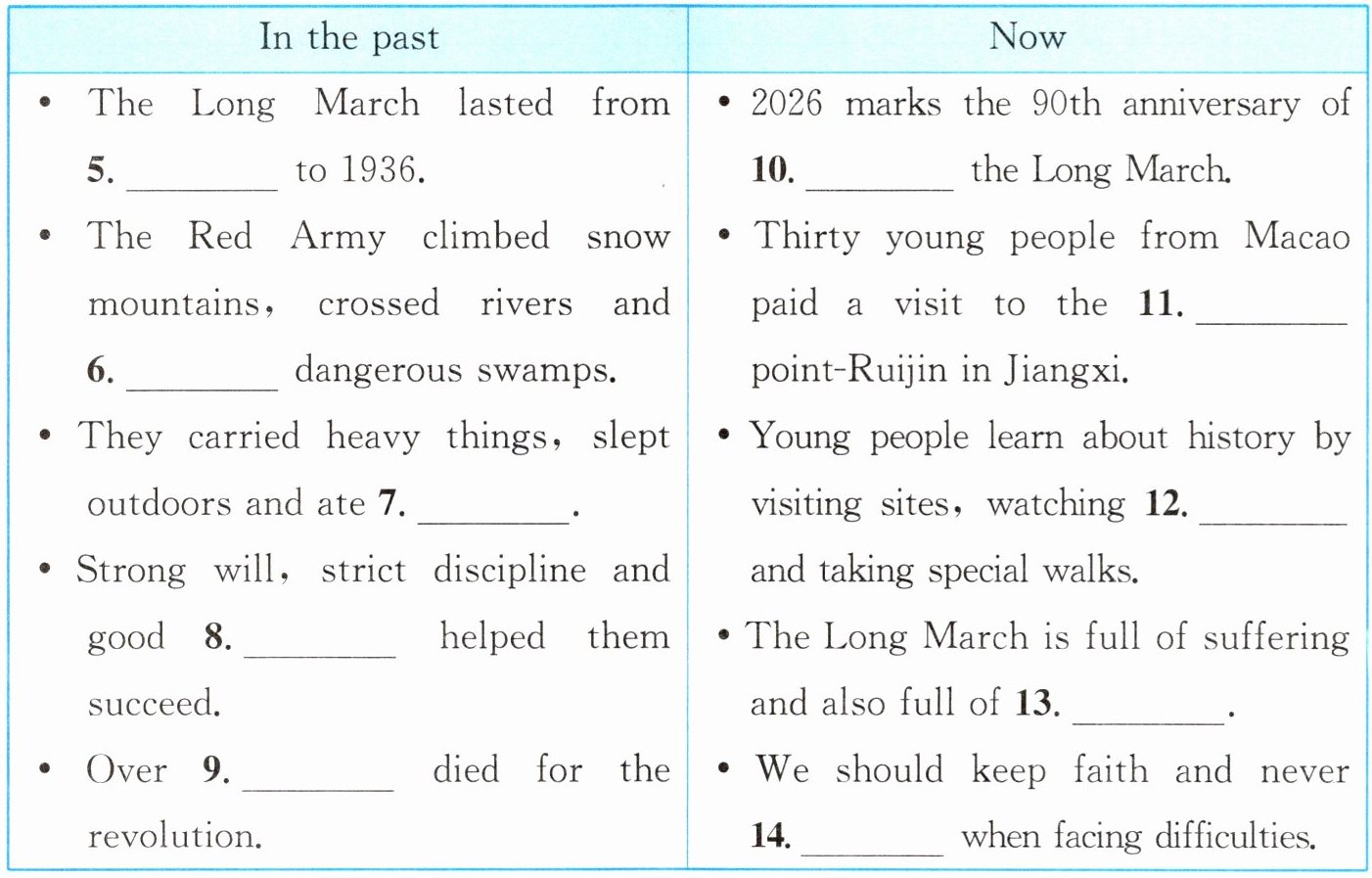
15. What can you learn from the Long March?
The year 2026 marks the 90th anniversary of the victory of the Long March (长征). To remember this great event, a group of 30 young people from Macao travelled to Ruijin, Jiangxi—the starting point. They walked old Red Army paths and visited the historic sites, getting a special new experience.
The Long March took place from 1934 to 1936. The Red Army had to break through enemy lines and march across China to escape the enemy's pursuit. Over 86,000 soldiers started the journey. They climbed 18 snow mountains, crossed 24 rivers, and walked through dangerous swamps. By the time they reached safety, over 40,000 soldiers had died for the revolution.
How did the Red Army succeed against great odds? Their strong will. They carried heavy things like guns and cooking pots, slept outdoors and ate wild plants. Hunger and cold never made them give up. Historians believe that the soldiers' strong discipline(纪律) and good unity were the keys to survival.
Today, over 600,000 people visit the Long March memorial sites. Young people learn about it in new ways. Some watch 5D movies. Some take part in "living-history walks", where they sleep on the ground and eat simple meals like the Red Army did. These activities help them better understand the hardships.
What can we learn from the Long March? A local guide said, "The Long March was full of suffering, but also full of hope." The Long March teaches an important lesson: no matter how hard life gets, if you keep your faith and never give up, you can get through any difficulty. The spirit of the Long March lives on, encouraging new generations to face the "mountains and rivers" in their own lives.
Task 1 Choose the correct answer.
()1. Why did young people from Macao go to Ruijin?
A. To make a new film.
B. To celebrate the 90th anniversary of Long March victory.
C. To build a history museum.
D. To climb local high mountains.
()2. What helped Red Army finish the Long March?
A. Enough food and warm clothes.
B. Help from foreign countries.
C. Strong mind, strict rules and teamwork.
D. Modern weapons and maps.
()3. How do young people learn Long March history nowadays?
A. By watching new films.
B. By traveling all the old roads.
C. By listening to old soldiers' talks.
D. By taking part in special walks.
()4. What is the main idea of the last paragraph?
A. Few people care about Long March today.
B. The Long March was the longest trip ever.
C. The Long March was full of difficulties.
D. We should carry on the Long March spirit.
Task 2 Complete the notes (No more than three words in each blanks), then answer the question.
90 years of the Long March: We never forget
15. What can you learn from the Long March?
答案
1. B 2. C 3. D 4. D 5. 1934 6. walked through 7. wild plants
8. unity 9. 40,000 soldiers 10. the victory of 11. starting 12. 5D movies
13. hope 14. give up
15. One possible version: No matter how hard life gets, if I keep my faith and never give up, I can get through any difficulty.
8. unity 9. 40,000 soldiers 10. the victory of 11. starting 12. 5D movies
13. hope 14. give up
15. One possible version: No matter how hard life gets, if I keep my faith and never give up, I can get through any difficulty.
解析
【分析】
本题是围绕长征主题的阅读理解题,包含选择题、填空任务和开放问答。解题思路为:1. 先通读全文,把握长征的时间、过程、意义及当代传承的核心内容;2. 针对选择题,定位每个问题对应的原文细节,对比选项选出正确答案;3. 针对填空任务,根据原文句子提取符合“不超3词”要求的关键词完成笔记;4. 最后结合原文主旨回答开放性问题。
【解析】
Task1 选择题解析
1. 定位原文第一段:2026年是长征胜利90周年,澳门年轻人去瑞金是纪念该事件,对应选项B。
2. 定位原文第三段:红军的坚强意志、严明纪律和良好团结是成功的关键,对应选项C。
3. 定位原文第四段:当代年轻人通过参加“活历史步行”等特殊活动学习长征历史,对应选项D。
4. 定位最后一段:核心是传承长征精神,对应选项D。
Task2 填空解析
5. 原文第二段明确长征时间是1934到1936年,填1934。
6. 原文第二段提到红军走过危险沼泽,填walked through。
7. 原文第三段提到红军吃野生植物,填wild plants。
8. 原文第三段提到良好团结是生存关键,填unity。
9. 原文第二段提到超4万士兵为革命牺牲,填40,000 soldiers。
10. 原文第一段2026是长征胜利90周年,填the victory of。
11. 原文第一段瑞金是长征起点,填starting。
12. 原文第四段提到年轻人看5D电影,填5D movies。
13. 原文最后一段提到长征充满苦难也充满希望,填hope。
14. 原文最后一段提到要保持信念永不放弃,填give up。
Task2 问题15解析
结合原文最后一段主旨,回答示例:No matter how hard life gets, if I keep my faith and never give up, I can get through any difficulty.
【答案】
1. B 2. C 3. D 4. D 5. 1934 6. walked through 7. wild plants 8. unity 9. 40,000 soldiers 10. the victory of 11. starting 12. 5D movies 13. hope 14. give up 15. No matter how hard life gets, if I keep my faith and never give up, I can get through any difficulty.
【知识点】
阅读理解细节查找;长征历史知识;词汇运用
【点评】
本题结合红色主题考查阅读理解能力,题型全面,既训练细节定位能力,又渗透长征精神教育,难度适中,适合学生巩固阅读技巧。
【难度系数】
0.6
