

 登录
登录
10. (2025·南京中华中学附中期中)如图,在$△ ABC$中,$AB=AC$,点$D,E$分别在$AB,AC$上,且$AD=AE$,$BE,CD$相交于点$O$.求证:
(1)$△ ABE ≌ △ ACD$;
(2)$OB=OC$.
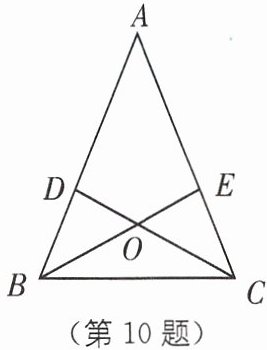
(1)$△ ABE ≌ △ ACD$;
(2)$OB=OC$.
答案
(1)在$△ ABE$ 和$△ ACD$ 中,$\begin{cases} AB=AC, \\ ∠BAE=∠CAD, \\ AE=AD, \end{cases}$
$\therefore △ABE≌△ACD(\mathrm{SAS})$.
(2)$\because △ABE≌△ACD$,
$\therefore ∠ABE=∠ACD$.
$\because AB=AC,\therefore ∠ABC=∠ACB$,
$\therefore ∠ABC-∠ABE=∠ACB-∠ACD$,
$\therefore ∠OBC=∠OCB,\therefore OB=OC$.
$\therefore △ABE≌△ACD(\mathrm{SAS})$.
(2)$\because △ABE≌△ACD$,
$\therefore ∠ABE=∠ACD$.
$\because AB=AC,\therefore ∠ABC=∠ACB$,
$\therefore ∠ABC-∠ABE=∠ACB-∠ACD$,
$\therefore ∠OBC=∠OCB,\therefore OB=OC$.
11. (2025·苏州工业园区期中) 如图, 在 $△ ABC$ 中, $M$,$N$ 分别是 $BC$ 与 $EF$ 的中点, $CF ⊥ AB, BE ⊥$ $AC$.
(1)求证:$MN ⊥ EF$;
(2) 已知 $BC=8$, 当 $∠ A=60°$ 时, 求 $EF$ 的长.
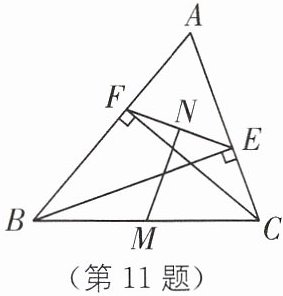
(1)求证:$MN ⊥ EF$;
(2) 已知 $BC=8$, 当 $∠ A=60°$ 时, 求 $EF$ 的长.
答案
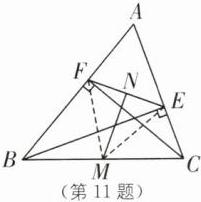
(1)如图,连接 $FM,EM$,
$\because CF⊥AB,BE⊥AC,\therefore ∠CEB=∠CFB=90°$.
$\because M$ 是 $BC$ 的中点,
$\therefore BM=FM=\dfrac{1}{2}BC,CM=EM=\dfrac{1}{2}BC$,
$\therefore FM=EM$.
又 $N$ 是 $EF$ 的中点.$\therefore MN⊥EF$.
(2)$\because ∠A=60°$,
$\therefore ∠ABC+∠ACB=180°-∠A=120°$.
$\because BM=FM=\dfrac{1}{2}BC=4,CM=EM=\dfrac{1}{2}BC=4$,
$\therefore ∠ABC=∠BFM,∠ACB=∠CEM$,
$\therefore ∠BFM+∠CEM=120°$,
$\therefore ∠FMB + ∠EMC = 360° - (∠ABC + ∠ACB + ∠BFM+∠CEM)=120°$,
$\therefore ∠EMF=180°-(∠FMB+∠EMC)=60°$.
$\because FM=EM=4,MN⊥EF$,
$\therefore ∠EMN=∠FMN=30°$,
$\therefore EN=\dfrac{1}{2}EM=2,FN=\dfrac{1}{2}FM=2$,
$\therefore EF=EN+FN=4$.
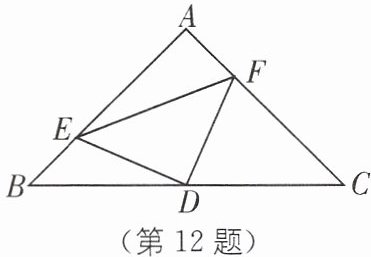
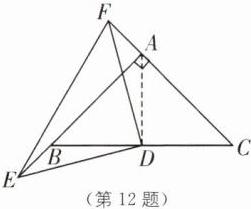
12. 在 $△ ABC$ 中, 已知 $∠ A = 90°, AB = AC, D$ 为 $BC$ 的中点.
(1) 如图, $E, F$ 分别是 $AB, AC$ 上的点, 且 $BE = AF$, 则 $△ DEF$ 为等腰直角三角形吗?请说明理由.
(2) 若 $E, F$ 分别为 $AB, CA$ 延长线上的点, 仍有 $BE = AF$, 其他条件不变, 那么 $△ DEF$ 是否仍为等腰直角三角形? 若是, 请说明理由.
精题详解
(1) 如图, $E, F$ 分别是 $AB, AC$ 上的点, 且 $BE = AF$, 则 $△ DEF$ 为等腰直角三角形吗?请说明理由.
(2) 若 $E, F$ 分别为 $AB, CA$ 延长线上的点, 仍有 $BE = AF$, 其他条件不变, 那么 $△ DEF$ 是否仍为等腰直角三角形? 若是, 请说明理由.
精题详解
答案
(1)$△DEF$ 是等腰直角三角形.理由如下:
连接 $AD$.$\because AB=AC,∠BAC=90°$,$D$ 为 $BC$ 的中点,
$\therefore AD⊥BC,BD=AD$,
$\therefore ∠B=∠DAB=∠DAC=45°$.
又 $BE=AF,\therefore △BDE≌△ADF(\mathrm{SAS})$,
$\therefore ED=FD,∠BDE=∠ADF$,
$\therefore ∠EDF = ∠EDA + ∠ADF = ∠EDA + ∠BDE = ∠BDA=90°$,$\therefore △DEF$ 是等腰直角三角形.
(2)$△DEF$ 仍是等腰直角三角形.理由如下:
如图,连接 $AD$.
$\because AB=AC,∠BAC=90°$,$D$ 为 $BC$ 的中点,
$\therefore AD=BD,AD⊥BC$,
$\therefore ∠DAC=∠ABD=45°$,
$\therefore ∠DAF=∠DBE=135°$.
又 $AF=BE,\therefore △DAF≌△DBE(\mathrm{SAS})$,
$\therefore FD=ED,∠FDA=∠EDB$,
$\therefore ∠EDF=∠EDB+∠FDB=∠FDA+∠FDB=∠ADB=90°$,
$\therefore △DEF$ 是等腰直角三角形.
13. (2024·巴中中考) 如图,在$△ ABC$中,$D$是$AC$的中点,$CE ⊥ AB$,$BD$与$CE$交于点$O$,且$BE=CD$. 下列说法错误的是(
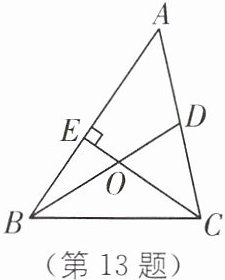
A.$BD$的垂直平分线一定与$AB$相交于点$E$
B.$∠ BDC=3∠ ABD$
C.当$E$为$AB$中点时,$△ ABC$是等边三角形
D.当$E$为$AB$中点时,$\dfrac{S_{△ BOC}}{S_{△ ABC}}=\dfrac{3}{4}$
D
).A.$BD$的垂直平分线一定与$AB$相交于点$E$
B.$∠ BDC=3∠ ABD$
C.当$E$为$AB$中点时,$△ ABC$是等边三角形
D.当$E$为$AB$中点时,$\dfrac{S_{△ BOC}}{S_{△ ABC}}=\dfrac{3}{4}$
答案
D
