

 登录
一、今天,你听到了许多与自然有关的声音。请根据左边单词画线部分的发音,在右边所给出的三个选项中找出含有相同发音的单词,将编号写在括号内。
My dress flies in the cool wind,
This path goes under the trees,
We walk past flowers so tall,
And ski where soft lights fall,
Bright stars shine for us all.
(
(
(
(
(
My dress flies in the cool wind,
This path goes under the trees,
We walk past flowers so tall,
And ski where soft lights fall,
Bright stars shine for us all.
(
B
) 1. A. exercise B. clock C. nice(
A
) 2. A. thing B. them C. than(
C
) 3. A. move B. grow C. warm(
B
) 4. A. whose B. white C. who(
B
) 5. A. schoolbag B. shall C. schedule答案
1.B 2.A 3.C 4.B 5.B
解析
【分析】
本题考查英语单词中字母及字母组合的发音,解题思路为:先确定题干单词划线部分的音标,再逐一分析每个选项单词划线部分的音标,选出与题干划线部分发音一致的选项即可。
【解析】
1. 题干中cool的划线字母c发音为/k/。A选项exercise中c发音为/s/;B选项clock中c发音为/k/;C选项nice中c发音为/s/,因此选B。
2. 题干中path的划线字母组合th发音为/θ/。A选项thing中th发音为/θ/;B选项them中th发音为/ð/;C选项than中th发音为/ð/,因此选A。
3. 题干中walk的划线字母w发音为/w/。A选项move中w不发音;B选项grow中w不发音;C选项warm中w发音为/w/,因此选C。
4. 题干中where的划线字母组合wh发音为/w/。A选项whose中wh发音为/h/;B选项white中wh发音为/w/;C选项who中wh发音为/h/,因此选B。
5. 题干中shine的划线字母组合sh发音为/ʃ/。A选项schoolbag中sch发音为/sk/;B选项shall中sh发音为/ʃ/;C选项schedule中sch发音为/sk/,因此选B。
【答案】
1.B 2.A 3.C 4.B 5.B
【知识点】
英语字母发音、英语字母组合发音
【点评】
本题为英语基础语音题,聚焦字母及字母组合的常见发音,考查学生对基础音标的掌握情况,难度适中,是英语学习中需夯实的基础考点。
【难度系数】
0.6
二、阅读对话,从方框中选择正确的选项,将对话补充完整,并回答问题。
Mum: Tom, please come here.
Tom: Mum, where are you?
Mum: I’m in the garden.
Tom: What’s wrong, Mum?
Mum: Look the plant. It needs water.
Tom: Oh! I forgot to water it.
Mum: Plants are living things. They need water to .
Tom: We need water too. Water is important. Does my toy robot water?
Mum: No, it doesn’t. Your toy robot is not a living thing. It doesn’t need food, air water.
Tom: I see, Mum. I will the plant.
(
(
(
(
(
6. Can Tom’s plant move by itself?
7. What non-living things do you see every day?
Mum: Tom, please come here.
Tom: Mum, where are you?
Mum: I’m in the garden.
Tom: What’s wrong, Mum?
Mum: Look the plant. It needs water.
Tom: Oh! I forgot to water it.
Mum: Plants are living things. They need water to .
Tom: We need water too. Water is important. Does my toy robot water?
Mum: No, it doesn’t. Your toy robot is not a living thing. It doesn’t need food, air water.
Tom: I see, Mum. I will the plant.
(
C
) 1. A. around B. in C. at(
B
) 2. A. move B. grow C. get(
B
) 3. A. needs B. need C. to need(
B
) 4. A. and B. or C. with(
C
) 5. A. take turns to B. get ready for C. take care of6. Can Tom’s plant move by itself?
No, it can’t.
7. What non-living things do you see every day?
I see my books, my pens and my schoolbag.
答案
1.C 2.B 3.B 4.B 5.C
6. No, it can’t.
7. I see my books, my pens and my schoolbag.
6. No, it can’t.
7. I see my books, my pens and my schoolbag.
解析
【分析】
本题为英语情景补全对话及常识问答,解题时需先通读对话把握语境,再结合固定搭配、语法规则(如动词形式、连词用法)选择合适选项,最后根据对话中“生物与非生物的区别”回答问题,确保答案符合语境和常识。
【解析】
1. 固定搭配look at意为“看”,符合语境,故选C;
2. 植物作为生物需要水来生长,grow(生长)符合逻辑,故选B;
3. 助动词does后需接动词原形,故用need,选B;
4. 否定句中连接并列成分用or,故选B;
5. take care of意为“照顾”,符合Tom要照顾植物的语境,选C;
6. 对话中明确植物是生物,但植物不能自行移动,故回答No, it can’t;
7. 日常所见非生物可举例书、笔、书包等,符合要求即可。
【答案】
1.C 2.B 3.B 4.B 5.C
6. No, it can’t.
7. I see my books, my pens and my schoolbag.
【知识点】
固定搭配、情景交际、名词分类
【点评】
本题结合情景对话与基础常识,考查英语常用短语、语法及生物与非生物的概念,难度适中,适合基础阶段学生巩固知识。
【难度系数】
0.6
三、读一读,从所给的句子中选出合适的完成对话,并回答问题。
Tom: Lily, let’s go to the museum this Sunday morning!
Lily: Good idea! 1.
Tom: We’ll see some fossils(化石) of some animals.
Lily: Sounds great! 2.
Tom: No, they aren’t.
Lily: Can they change?
Tom: Yes, they can. They can become dirty or broken.
3.
Lily: That’s right. 4.
Tom: Sure. What are you going to buy there?
Lily: I’m going to buy a straw hat. Straw begins as wheat. Wheat is a living thing.
A. Are those fossils living things?
B. Shall we go to the shop on Sunday afternoon?
C. So some living things can become non-living things.
D. We should take good care of them.
E. What will we see there?
Tom: 5.
6. What other non-living things come from living things? Name one, please.
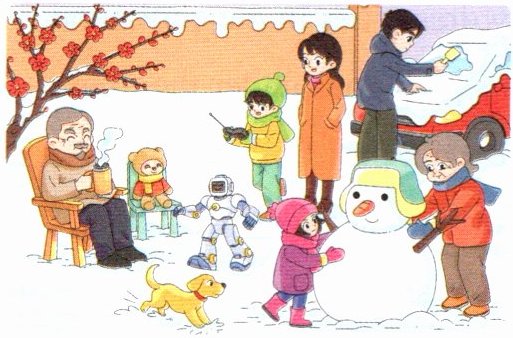
四、下面是小男孩Pengpeng一家的活动照片。看图,判断下面的句子是否符合图片内容,如符合写“A”,不符合写“B”。
() 1. The little dog is moving in the snow.
() 2. The robot can move by itself.
() 3. The snowman is a non-living thing.
() 4. The snowman can change.
() 5. The flowers can grow, but they cannot change or move.
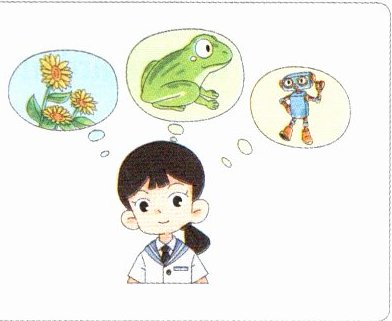
五、孩子们在玩游戏,他们要迅速说出自己想到的三个事物。下面是小女孩Shasha想到的三个事物,请任选一种,介绍该事物,不少于五句话。
Reading
Tom: Lily, let’s go to the museum this Sunday morning!
Lily: Good idea! 1.
Tom: We’ll see some fossils(化石) of some animals.
Lily: Sounds great! 2.
Tom: No, they aren’t.
Lily: Can they change?
Tom: Yes, they can. They can become dirty or broken.
3.
Lily: That’s right. 4.
Tom: Sure. What are you going to buy there?
Lily: I’m going to buy a straw hat. Straw begins as wheat. Wheat is a living thing.
A. Are those fossils living things?
B. Shall we go to the shop on Sunday afternoon?
C. So some living things can become non-living things.
D. We should take good care of them.
E. What will we see there?
Tom: 5.
6. What other non-living things come from living things? Name one, please.
四、下面是小男孩Pengpeng一家的活动照片。看图,判断下面的句子是否符合图片内容,如符合写“A”,不符合写“B”。
() 1. The little dog is moving in the snow.
() 2. The robot can move by itself.
() 3. The snowman is a non-living thing.
() 4. The snowman can change.
() 5. The flowers can grow, but they cannot change or move.
五、孩子们在玩游戏,他们要迅速说出自己想到的三个事物。下面是小女孩Shasha想到的三个事物,请任选一种,介绍该事物,不少于五句话。
Reading
答案
1.E 2.A 3.D 4.B 5.C
6. Chairs. Chairs are made of wood. Wood comes from trees. Trees are living things.
四、1.A 2.B 3.A 4.A 5.B
五、It’s a frog. It’s a living thing. It needs food, water and air. It can jump and swim. It can eat bad bugs. It cannot make food from sunlight, water or air.
6. Chairs. Chairs are made of wood. Wood comes from trees. Trees are living things.
四、1.A 2.B 3.A 4.A 5.B
五、It’s a frog. It’s a living thing. It needs food, water and air. It can jump and swim. It can eat bad bugs. It cannot make food from sunlight, water or air.
解析
【分析】
首先通读对话、选项及题目要求,梳理上下文逻辑:补全对话需结合答语匹配问句,第1空对应询问参观内容,第2空对应be动词开头的一般疑问句,第3空对应爱护化石的建议,第4空对应去商店的提议,第5空总结生物与非生物的转化;第6题需结合“非生物来自生物”的概念举例;第四部分根据图片内容判断生物非生物相关描述;第五部分围绕所选事物用英语介绍。
【解析】
1. 第1空:答语为“We’ll see some fossils...”,对应询问“将看什么”,选E;
2. 第2空:答语是“No, they aren’t.”,为一般疑问句否定回答,选A;
3. 第3空:前文提到化石会变脏或坏,对应建议“爱护化石”,选D;
4. 第4空:答语“Sure.”表同意,结合后文“买东西”,对应提议去商店,选B;
5. 第5空:承接前文观点,总结“生物可转化为非生物”,选C;
6. 第6题:举例非生物来自生物,如椅子,说明其由木头(来自树,树是生物)制成;
四、判断依据:1.小狗在雪中移动→A;2.机器人不能自行移动→B;3.雪人是非生物→A;4.雪人会融化(变化)→A;5.花能生长也能变化→B;
五、围绕青蛙用英语介绍,满足不少于五句话的要求。
【答案】
1.E 2.A 3.D 4.B 5.C
6. Chairs. Chairs are made of wood. Wood comes from trees. Trees are living things.
四、1.A 2.B 3.A 4.A 5.B
五、It’s a frog. It’s a living thing. It needs food, water and air. It can jump and swim. It can eat bad bugs. It cannot make food from sunlight, water or air.
【知识点】
英语补全对话、生物与非生物的概念、英语写作
【点评】
本题结合生活场景考查英语对话理解与补全、生物非生物的区分,以及英语表达能力,题型多样,贴近实际,能有效考查学生的综合英语能力和科学常识。
【难度系数】
0.5
