

 登录
登录
任务型阅读

Many teenagers want to learn how to manage money before going out into the world. The following is some advice.
Make money
Ask parents or neighbours if you can do chores to make pocket money. You may wash a car or send newspapers. You may help them water flowers or a garden.
Name the price
If you do different jobs, you may ask for different prices. In this way, you can also improve your communication skills, which will help when you have a grown-up job, too.
Make money grow
Money can't grow if it's sitting inside a piggy bank. Put your money in the bank and you can get interest(利息). Save your money in the long run. One day you may feel surprised at how much money you have.
Make a plan
If you have a big event, such as a holiday coming up, it might mean you will need to spend more of your pocket money. Try making a plan for spending and saving. Write down how much money you have and what you are spending on. Then it will help you take control of your money.
Spend wisely
Figure out how much you can spend each month. Spend your money on what you truly need. Then try to cut down on spending. For example, rather than eating out, you can choose to cook at home.
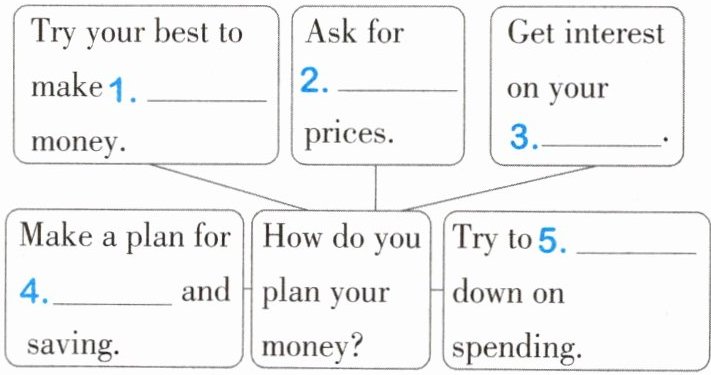
根据短文内容,完成思维导图。
Many teenagers want to learn how to manage money before going out into the world. The following is some advice.
Make money
Ask parents or neighbours if you can do chores to make pocket money. You may wash a car or send newspapers. You may help them water flowers or a garden.
Name the price
If you do different jobs, you may ask for different prices. In this way, you can also improve your communication skills, which will help when you have a grown-up job, too.
Make money grow
Money can't grow if it's sitting inside a piggy bank. Put your money in the bank and you can get interest(利息). Save your money in the long run. One day you may feel surprised at how much money you have.
Make a plan
If you have a big event, such as a holiday coming up, it might mean you will need to spend more of your pocket money. Try making a plan for spending and saving. Write down how much money you have and what you are spending on. Then it will help you take control of your money.
Spend wisely
Figure out how much you can spend each month. Spend your money on what you truly need. Then try to cut down on spending. For example, rather than eating out, you can choose to cook at home.
根据短文内容,完成思维导图。
答案
主题实践阅读
1. pocket 根据第二段中"Ask parents or neighbours if you can do chores to make pocket money."可知,问问父母或邻居,你是否可以做些家务来赚零花钱,所以此处是指尽最大的努力赚零花钱。
2. different 根据第三段中"If you do different jobs, you may ask for different prices."可知,做不同的工作,要求不同的价格。
3. money 根据第四段中"Put your money in the bank and you can get interest."可知,把钱存在银行里,可以得到利息;get interest on one's money 从某人的钱中获得利息。
4. spending 根据第五段中"Try making a plan for spending and saving."可知,试着为消费和储蓄制定一个计划;spend意为"花费",动词,空前有介词for,这里应用动名词形式spending,并与saving形成并列关系。
5. cut 根据最后一段中"Then try to cut down on spending."可知,要尽量减少开支;空前为动词不定式符号to,所以这里应用动词原形。
1. pocket 根据第二段中"Ask parents or neighbours if you can do chores to make pocket money."可知,问问父母或邻居,你是否可以做些家务来赚零花钱,所以此处是指尽最大的努力赚零花钱。
2. different 根据第三段中"If you do different jobs, you may ask for different prices."可知,做不同的工作,要求不同的价格。
3. money 根据第四段中"Put your money in the bank and you can get interest."可知,把钱存在银行里,可以得到利息;get interest on one's money 从某人的钱中获得利息。
4. spending 根据第五段中"Try making a plan for spending and saving."可知,试着为消费和储蓄制定一个计划;spend意为"花费",动词,空前有介词for,这里应用动名词形式spending,并与saving形成并列关系。
5. cut 根据最后一段中"Then try to cut down on spending."可知,要尽量减少开支;空前为动词不定式符号to,所以这里应用动词原形。
解析
【分析】
本题为任务型阅读的思维导图填空题,需根据短文各段落的核心内容,定位对应信息,结合词性要求提取或转换词汇完成填空。解题时需先明确每个空对应的段落主题,再精准查找原文关键句,同时注意介词后用动名词、不定式后用动词原形等语法规则。
【解析】
1. 对应“Make money”部分,原文提到“do chores to make pocket money”,此处需填“pocket”构成“make pocket money”(赚零花钱),符合语境。
2. 对应“Name the price”部分,原文指出“If you do different jobs, you may ask for different prices”,此处填“different”,匹配原文信息。
3. 对应“Make money grow”部分,原文说明“Put your money in the bank and you can get interest”,此处填“money”,构成“get interest on money”(从钱中获得利息),符合逻辑。
4. 对应“Make a plan”部分,原文提到“Try making a plan for spending and saving”,空前为介词“for”,需用动名词,故填“spending”,与“saving”并列。
5. 对应“Spend wisely”部分,原文指出“try to cut down on spending”,空前为不定式符号“to”,需用动词原形,故填“cut”。
【答案】
1. pocket 2. different 3. money 4. spending 5. cut
【知识点】
任务型阅读、词汇运用、短文细节理解
【点评】
本题聚焦短文细节的提取与词汇形式的正确运用,难度适中,需学生具备快速定位原文信息及基础语法知识,适合巩固任务型阅读的解题能力。
【难度系数】
0.6
本题为任务型阅读的思维导图填空题,需根据短文各段落的核心内容,定位对应信息,结合词性要求提取或转换词汇完成填空。解题时需先明确每个空对应的段落主题,再精准查找原文关键句,同时注意介词后用动名词、不定式后用动词原形等语法规则。
【解析】
1. 对应“Make money”部分,原文提到“do chores to make pocket money”,此处需填“pocket”构成“make pocket money”(赚零花钱),符合语境。
2. 对应“Name the price”部分,原文指出“If you do different jobs, you may ask for different prices”,此处填“different”,匹配原文信息。
3. 对应“Make money grow”部分,原文说明“Put your money in the bank and you can get interest”,此处填“money”,构成“get interest on money”(从钱中获得利息),符合逻辑。
4. 对应“Make a plan”部分,原文提到“Try making a plan for spending and saving”,空前为介词“for”,需用动名词,故填“spending”,与“saving”并列。
5. 对应“Spend wisely”部分,原文指出“try to cut down on spending”,空前为不定式符号“to”,需用动词原形,故填“cut”。
【答案】
1. pocket 2. different 3. money 4. spending 5. cut
【知识点】
任务型阅读、词汇运用、短文细节理解
【点评】
本题聚焦短文细节的提取与词汇形式的正确运用,难度适中,需学生具备快速定位原文信息及基础语法知识,适合巩固任务型阅读的解题能力。
【难度系数】
0.6
