

 登录
一、完形填空 一双筷子,几多文化
素养:文化意识 难度:中 用时:8分钟
When eating in a Western restaurant, you usually need a knife and fork. You hold the knife in your
Chopsticks have a long history, going back around 3,000 years to the Shang Dynasty. No one knows exactly who
During the Qin and Han dynasties, chopsticks were called “zhu”. But “zhu”
Chopsticks carry
What’s more, there are some important table manners. Playing with chopsticks at the table is
Today, about 1.8 billion people around the world use chopsticks. Chinese culture continues to spread far and wide.
1. A. right B. free C. left D. friendly
2. A. bowls B. plates
C. spoons D. chopsticks
3. A. found B. invented
C. discovered D. bought
4. A. farmer B. doctor C. hero D. worker
5. A. looks B. sounds C. tastes D. smells
6. A. what B. where C. who D. why
7. A. cultural B. simple C. funny D. basic
8. A. other B. another C. the other D. either
9. A. breaks into B. depends on
C. searches for D. stands for
10. A. considered B. reported
C. changed D. described
素养:文化意识 难度:中 用时:8分钟
When eating in a Western restaurant, you usually need a knife and fork. You hold the knife in your
A
1 hand and the fork in your left. While in Chinese restaurants, with just a pair of D
2, you can easily enjoy your meal using only one hand.Chopsticks have a long history, going back around 3,000 years to the Shang Dynasty. No one knows exactly who
B
3 them, but there are old stories about their origin (起源). One story says they were first used by Da Yu, a C
4 who overcame a great flood. It is said that while he was busy fighting the flood, he used two tree sticks to pick up hot food to save time.During the Qin and Han dynasties, chopsticks were called “zhu”. But “zhu”
B
5 the same as the word for “stop” in Chinese, which was seen as unlucky. People in the Ming Dynasty started calling them “kuai”, meaning “fast”. That’s B
6 today’s name comes from.Chopsticks carry
A
7 meanings. They are seen as a symbol of Chinese food culture. Have you noticed that one end of chopsticks is square and C
8 end is round? That’s because the round end represents Heaven and the square end represents Earth. Also, chopsticks come in pairs, which in Chinese culture D
9 the balance of yin and yang.What’s more, there are some important table manners. Playing with chopsticks at the table is
A
10 rude. It’s also impolite to tap chopsticks on the edge of your bowl.Today, about 1.8 billion people around the world use chopsticks. Chinese culture continues to spread far and wide.
1. A. right B. free C. left D. friendly
2. A. bowls B. plates
C. spoons D. chopsticks
3. A. found B. invented
C. discovered D. bought
4. A. farmer B. doctor C. hero D. worker
5. A. looks B. sounds C. tastes D. smells
6. A. what B. where C. who D. why
7. A. cultural B. simple C. funny D. basic
8. A. other B. another C. the other D. either
9. A. breaks into B. depends on
C. searches for D. stands for
10. A. considered B. reported
C. changed D. described
答案
【解题导语】 本文主要介绍了筷子蕴含的文化寓意和相关餐桌礼仪。
1 A 根据空后的“the fork in your left”可知,此处是说右手握刀,左手握叉。
2 D 根据空前的“While in Chinese restaurants”可知,此处是说中餐厅的餐具。结合常识和下文对筷子的介绍,此处指“一双筷子”。
3 B 根据空后的“but there are old stories about their origin(起源)”可知,此处与筷子的起源相关。故选B。
4 C 根据空后的“who overcame a great flood”并结合常识可知,大禹是一位英雄。
5 B 此处是说“箸”这个字的发音和表示“停止”的字发音一样,sound“听起来”符合题意。
文化背景
古人称用来夹取食物的两根小棍为梜、箸、筯或柱。箸、筯、柱,皆谐音“住”。住,停止也。吴中河道纵横,水上运输发达。船民皆以船为家,视“住”为不吉利之语,于是反其意改“住”为一帆风顺的“快”,因筷子多为竹制,慢慢演变成加竹字头的“筷”。新文化运动后,“筷”字迅速扩大运用范围,成了人们日常生活用字。
6 B 根据上文内容可知,此处是说“筷子”这个名字的由来。
7 A 根据下文中的“They are seen as a symbol of Chinese food culture”可知,此处是说筷子承载的文化寓意。
8 C 根据空前的“one end of chopsticks is square”可知,此处是说筷子的另一端。表示两者中的另一个,用the other。
9 D 筷子成双成对,在中国文化中代表阴阳平衡。break into“闯入”;depend on“依靠”;search for“寻找”;stand for“代表”。
10 A 根据上文中的“there are some important table manners”可知,此处是说在餐桌上玩筷子被认为是不礼貌的。consider“认为,觉得”符合题意。
解析
【分析】这是一篇介绍筷子文化的完形填空,解题思路为:先通读全文把握主旨(筷子的历史、名称由来、文化寓意及餐桌礼仪);再逐题结合上下文语境、词义辨析、固定搭配及文化常识分析选项;最后验证答案确保逻辑通顺。
【解析】1. 根据空后“the fork in your left”可知,此处指右手拿刀,左手拿叉,故选A。2. 结合语境及下文对筷子的介绍,中餐厅用餐用筷子,故选D。3. 此处涉及筷子的起源,“发明”用invent,故选B。4. 大禹是治水英雄,符合语境,故选C。5. 此处指“箸”的发音与表“停止”的字相同,sound(听起来)符合,故选B。6. 此处说明“筷子”名称的由来,where引导表语从句,故选B。7. 下文提到筷子是中国饮食文化的象征,故此处指承载文化寓意,故选A。8. 筷子有两端,两者中的另一个用the other,故选C。9. 筷子成双代表阴阳平衡,stand for(代表)符合,故选D。10. 此处指在餐桌上玩筷子被认为是不礼貌的,consider(认为)符合,故选A。
【答案】1.A 2.D 3.B 4.C 5.B 6.B 7.A 8.C 9.D 10.A
【知识点】完形填空解题技巧、词汇词义辨析、文化常识运用
【点评】本文围绕筷子文化展开,既考查学生的词汇掌握与语境理解能力,又融入中国传统文化知识,难度适中,有助于提升学生的文化意识。
【难度系数】0.6
二、阅读理解 AI助力旅游业
素养:思维品质 难度:中 用时:7分钟
新素材 Major tourism platforms in China have used AI technologies, while some provinces and cities have launched(推出)their own AI-powered tourism service platforms. On some popular tourism platforms, tourists can give simple instructions, such as asking about attractions for a three-day trip to Shanghai or planning a 15-day tour in Canada. AI usually gives helpful answers within minutes.
Guizhou and Shanghai have introduced AI assistants(助手)for travelers. Guizhou’s “Huang Xiao Xi”, a digital guide in local traditional clothing, creates personalized travel plans in just a few seconds and allows users to order local food with one click. “Hu Xiao You”, a smart tourism service system used in Shanghai, provides real-time updates on public transport, nearby shops, and even toilet locations.
Museums are also using AI. Wearable smart guide devices provide much cheaper private tours than human guides. With new tools like VR, AR and 3D technology, users can “talk” to historical figures and “interact” with cultural relics(文物).
A researcher in Shanghai believes AI brings new ways of working in tourism. Instead of replacing traditional jobs, China uses technology to improve them. For example, AI improves cultural experiences while protecting local cultural heritage(遗产).
1. What can tourism platforms with AI technologies do according to Paragraph 1?
A. Replace human tour guides completely.
B. Provide useful travel suggestions.
C. Offer free travel plans to different companies.
D. Only answer questions about cities in China.
2. 新考法·写作手法题 How does the writer develop Paragraph 2?
A. By describing how tourists share their opinions.
B. By discussing challenges brought by AI in tourism.
C. By giving examples of AI tools for tourism in different places.
D. By comparing modern tourism with the traditional one.
3. What can we know about the application of AI in museums?
A. It makes visiting museums more expensive.
B. It replaces all human guides in big museums.
C. It lets visitors experience history in a lively way.
D. It shows more pictures than real objects.
4. What is Shanghai’s researcher’s opinion about AI in tourism?
A. It kills off traditional jobs with technology.
B. It makes China depend too much on technology.
C. It learns from users’ feedback to offer better service.
D. It improves cultural experiences while protecting local cultural heritage.
5. What would be the best title for this passage?
A. AI Makes Tourism Smarter in China
B. The Rise of Online Travel Agencies
C. Planning a Perfect Trip to Shanghai
D. The Disappearance of Traditional Tourism
拓展设问
新考法·图文转换题 What does “Huang Xiao Xi” look like according to the passage?
A.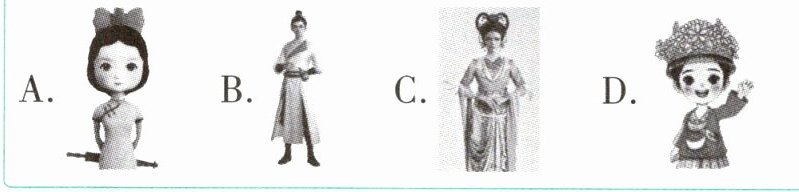 B. C. D.
素养:思维品质 难度:中 用时:7分钟
新素材 Major tourism platforms in China have used AI technologies, while some provinces and cities have launched(推出)their own AI-powered tourism service platforms. On some popular tourism platforms, tourists can give simple instructions, such as asking about attractions for a three-day trip to Shanghai or planning a 15-day tour in Canada. AI usually gives helpful answers within minutes.
Guizhou and Shanghai have introduced AI assistants(助手)for travelers. Guizhou’s “Huang Xiao Xi”, a digital guide in local traditional clothing, creates personalized travel plans in just a few seconds and allows users to order local food with one click. “Hu Xiao You”, a smart tourism service system used in Shanghai, provides real-time updates on public transport, nearby shops, and even toilet locations.
Museums are also using AI. Wearable smart guide devices provide much cheaper private tours than human guides. With new tools like VR, AR and 3D technology, users can “talk” to historical figures and “interact” with cultural relics(文物).
A researcher in Shanghai believes AI brings new ways of working in tourism. Instead of replacing traditional jobs, China uses technology to improve them. For example, AI improves cultural experiences while protecting local cultural heritage(遗产).
1. What can tourism platforms with AI technologies do according to Paragraph 1?
A. Replace human tour guides completely.
B. Provide useful travel suggestions.
C. Offer free travel plans to different companies.
D. Only answer questions about cities in China.
2. 新考法·写作手法题 How does the writer develop Paragraph 2?
A. By describing how tourists share their opinions.
B. By discussing challenges brought by AI in tourism.
C. By giving examples of AI tools for tourism in different places.
D. By comparing modern tourism with the traditional one.
3. What can we know about the application of AI in museums?
A. It makes visiting museums more expensive.
B. It replaces all human guides in big museums.
C. It lets visitors experience history in a lively way.
D. It shows more pictures than real objects.
4. What is Shanghai’s researcher’s opinion about AI in tourism?
A. It kills off traditional jobs with technology.
B. It makes China depend too much on technology.
C. It learns from users’ feedback to offer better service.
D. It improves cultural experiences while protecting local cultural heritage.
5. What would be the best title for this passage?
A. AI Makes Tourism Smarter in China
B. The Rise of Online Travel Agencies
C. Planning a Perfect Trip to Shanghai
D. The Disappearance of Traditional Tourism
拓展设问
新考法·图文转换题 What does “Huang Xiao Xi” look like according to the passage?
A.
B. C. D.答案
1 B 根据第一段中的“On some popular tourism platforms, tourists can give simple instructions ... AI usually gives helpful answers within minutes”可知,AI能够提供有用的旅行建议。
2 C 写作手法题。根据第二段中的“Guizhou’s ‘Huang Xiao Xi’, a digital guide in local traditional clothing”和“‘Hu Xiao You’, a smart tourism service system used in Shanghai”可知,本段列举了两个不同地方的AI旅游助手的例子。
3 C 推理判断题。根据第三段中的“With new tools like VR, AR, and 3D technology, users can ‘talk’ to historical figures and ‘interact’ with cultural relics(文物)”可知,博物馆用VR、AR等技术让游客与历史人物“对话”并与文物“互动”,AI的应用能够让游客以生动的方式体验历史。
4 D 细节理解题。根据最后一段中的“For example, AI improves cultural experiences while protecting local cultural heritage(遗产)”可知,AI能够在保护当地文化遗产的同时提升文化体验。
5 A 标题归纳题。通读全文可知,文章围绕AI在中国旅游业的应用展开。故选A。
【拓展设问】
D 图文转换题。根据第二段中的“Guizhou’s ‘Huang Xiao Xi’, a digital guide in local traditional clothing”可知,黄小西身着贵州民族服饰。故选D。
解析
【分析】
本题为阅读理解的图文转换题,解题思路如下:首先定位题干关键词“Huang Xiao Xi”,找到原文中对其的描述;接着提取关键信息“local traditional clothing(当地传统服饰)”,结合贵州的主要少数民族服饰特点,分析四个选项的服饰特征,选出符合描述的选项。
【解析】
拓展设问:根据题干关键词“Huang Xiao Xi”定位到原文第二段“Guizhou’s ‘Huang Xiao Xi’, a digital guide in local traditional clothing”,可知黄小西是身着贵州当地传统服饰的数字导游。贵州的传统服饰以苗族服饰为代表,特点是带有银饰等装饰。分析选项:A为汉族传统服饰旗袍,B为古代男性服饰,C为唐代宫廷服饰,均不符合;D为带有银饰的苗族传统服饰,符合贵州当地传统服饰的特征,故选D。
【答案】
D
【知识点】
阅读理解(图文转换)、少数民族文化常识
【点评】
本题结合阅读理解的图文转换题型,既考查学生提取原文关键信息的能力,又涉及中国少数民族服饰的文化常识,需要学生准确结合两方面内容解题,难度适中。
【难度系数】
0.6
