

 登录
登录
B
文化意识 文化鉴赏 Chinese wooden arch bridges with covered walkways are often called “Mu Gong Lang Qiao” in Chinese. They are a wonderful part of China's cultural heritage(遗产). With a history of over 900 years, these bridges are more than just tools for crossing rivers—they are a symbol of the peace between people and nature. It has been on UNESCO’s List of Intangible Cultural Heritage for several years, showing the world pays attention to its special value.
These bridges are mostly in mountain areas of Fujian and Zhejiang. With many rivers and mountains there, local people created the bridges to cross them. What’s amazing about the bridges is their special structure(结构): They use no nails(钉子) at all. Skilled workers join wood pieces firmly with traditional methods like “sunmao” and “mubian”. They make the bridges strong enough to last for hundreds of years even in bad weather.
The covered walkways are more useful than imagined. Besides protecting people from wind and rain, they are great public places for villagers to talk, rest, or hold small festival activities for safety and good luck. For local communities, these bridges are the warm heart of daily life and cultural value.
However, this ancient skill once faced the risk of disappearing. City development has changed local lifestyles. Typhoons and other natural disasters damaged some old bridges. Luckily, years of continuous efforts improved the situation. Local governments took some useful action, old workers taught their skills to young people, and students joined in some activities about it.
Today, these bridges grow with new energy, attracting visitors from all over the world. From connecting small villages to sharing world cultures, Chinese wooden arch bridges are a living part of Chinese heritage, telling us traditional skills can keep shining in the modern world.
6. 新考法 图示理解 Which picture is the Chinese wooden arch bridge?
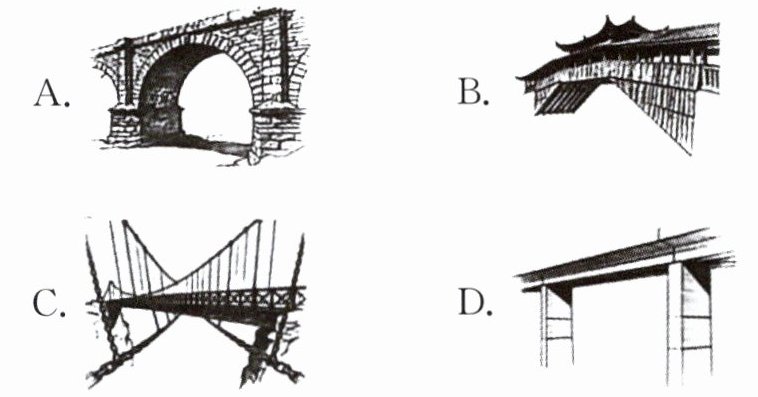
7. Why did local people in Fujian and Zhejiang create wooden arch bridges?
A. To attract tourists from other places.
B. To show workers' skilled handcraft ability.
C. To meet daily needs of crossing rivers and mountains.
D. To get listed as UNESCO’s intangible cultural heritage.
8. The underlined word “disappearing” in Paragraph 4 means “
A. dying out
B. growing up
C. cutting down
D. turning on
9. The following are the uses of the covered walkways EXCEPT
A. bringing the local people good luck
B. keeping people away from wind and rain
C. offering a space to hold festival activities
D. providing a place for villagers for daily talks
10. Which is the best title of the passage?
A. The Long History of the Oldest Bridges in China
B. How to Build Special Wooden Bridges Without Nails
C. Fujian and Zhejiang: Perfect Places for Wooden Bridges
D. Chinese Wooden Arch Bridges: A Living Cultural Treasure
文化意识 文化鉴赏 Chinese wooden arch bridges with covered walkways are often called “Mu Gong Lang Qiao” in Chinese. They are a wonderful part of China's cultural heritage(遗产). With a history of over 900 years, these bridges are more than just tools for crossing rivers—they are a symbol of the peace between people and nature. It has been on UNESCO’s List of Intangible Cultural Heritage for several years, showing the world pays attention to its special value.
These bridges are mostly in mountain areas of Fujian and Zhejiang. With many rivers and mountains there, local people created the bridges to cross them. What’s amazing about the bridges is their special structure(结构): They use no nails(钉子) at all. Skilled workers join wood pieces firmly with traditional methods like “sunmao” and “mubian”. They make the bridges strong enough to last for hundreds of years even in bad weather.
The covered walkways are more useful than imagined. Besides protecting people from wind and rain, they are great public places for villagers to talk, rest, or hold small festival activities for safety and good luck. For local communities, these bridges are the warm heart of daily life and cultural value.
However, this ancient skill once faced the risk of disappearing. City development has changed local lifestyles. Typhoons and other natural disasters damaged some old bridges. Luckily, years of continuous efforts improved the situation. Local governments took some useful action, old workers taught their skills to young people, and students joined in some activities about it.
Today, these bridges grow with new energy, attracting visitors from all over the world. From connecting small villages to sharing world cultures, Chinese wooden arch bridges are a living part of Chinese heritage, telling us traditional skills can keep shining in the modern world.
6. 新考法 图示理解 Which picture is the Chinese wooden arch bridge?
7. Why did local people in Fujian and Zhejiang create wooden arch bridges?
A. To attract tourists from other places.
B. To show workers' skilled handcraft ability.
C. To meet daily needs of crossing rivers and mountains.
D. To get listed as UNESCO’s intangible cultural heritage.
8. The underlined word “disappearing” in Paragraph 4 means “
A
”.A. dying out
B. growing up
C. cutting down
D. turning on
9. The following are the uses of the covered walkways EXCEPT
A
.A. bringing the local people good luck
B. keeping people away from wind and rain
C. offering a space to hold festival activities
D. providing a place for villagers for daily talks
10. Which is the best title of the passage?
A. The Long History of the Oldest Bridges in China
B. How to Build Special Wooden Bridges Without Nails
C. Fujian and Zhejiang: Perfect Places for Wooden Bridges
D. Chinese Wooden Arch Bridges: A Living Cultural Treasure
答案
6.B 7.C 8.A 9.A 10.D
B
【语篇解读】本文是一篇说明文。文章主要介绍了中国传统文化遗产——木拱廊桥。内容涵盖了其悠久的历史、精巧的榫卯结构、遮风挡雨及社交的功能价值,以及在现代社会中如何通过政府与民间的努力对它进行保护与传承。
6. B 解析:图示理解题。根据“Chinese wooden arch bridges with covered walkways are often called ‘Mu Gong Lang Qiao’ in Chinese.”可知,木拱廊桥最显著的特征是“木制拱形”且带有“廊屋(遮盖的走道)”。观察选项图片,B项图片清晰展示了具有木质骨架和房檐覆盖的拱桥形象,符合文中描述。故选B。
7. C 解析:细节理解题。根据“These bridges are mostly in mountain areas of Fujian and Zhejiang. With many rivers and mountains there, local people created the bridges to cross them.”可知,福建和浙江两省多山多水,当地人建造木拱廊桥的初衷是为了跨越江河山峦,解决日常出行的交通问题。故选C。
8. A 解析:词义猜测题。根据画线词所在句“However, this ancient skill once faced the risk of disappearing. City development changed local lifestyles. Typhoons and other natural disasters damaged some old bridges.”可知,由于现代城市化进程、生活方式转变以及自然灾害的损毁,这项古老的技艺曾面临消失的危险。dying out意为“灭绝;消失”,与disappearing意思相近。故选A。
9. A 解析:细节理解题。根据“Besides protecting people from wind and rain, they are great public places for villagers to talk, rest, or hold small festival activities for safety and good luck.”可知,廊屋作为公共场所,具备遮风挡雨、日常交谈以及举办节日活动的功能。文中提到举办节庆活动是为了祈求好运,而并非廊屋本身直接“带来好运”,A项表述存在概念偏差。故选A。
10. D 解析:标题归纳题。通读全文可知,文章由表及里地介绍了木拱廊桥的历史地位、结构之美、社会功能及其保护现状。全文核心旨在说明木拱廊桥是一项“活着的”文化遗产,在现代社会依然焕发活力。选项D“中国木拱廊桥:活着的文化瑰宝”最适合作文章的标题。故选D。
B
【语篇解读】本文是一篇说明文。文章主要介绍了中国传统文化遗产——木拱廊桥。内容涵盖了其悠久的历史、精巧的榫卯结构、遮风挡雨及社交的功能价值,以及在现代社会中如何通过政府与民间的努力对它进行保护与传承。
6. B 解析:图示理解题。根据“Chinese wooden arch bridges with covered walkways are often called ‘Mu Gong Lang Qiao’ in Chinese.”可知,木拱廊桥最显著的特征是“木制拱形”且带有“廊屋(遮盖的走道)”。观察选项图片,B项图片清晰展示了具有木质骨架和房檐覆盖的拱桥形象,符合文中描述。故选B。
7. C 解析:细节理解题。根据“These bridges are mostly in mountain areas of Fujian and Zhejiang. With many rivers and mountains there, local people created the bridges to cross them.”可知,福建和浙江两省多山多水,当地人建造木拱廊桥的初衷是为了跨越江河山峦,解决日常出行的交通问题。故选C。
8. A 解析:词义猜测题。根据画线词所在句“However, this ancient skill once faced the risk of disappearing. City development changed local lifestyles. Typhoons and other natural disasters damaged some old bridges.”可知,由于现代城市化进程、生活方式转变以及自然灾害的损毁,这项古老的技艺曾面临消失的危险。dying out意为“灭绝;消失”,与disappearing意思相近。故选A。
9. A 解析:细节理解题。根据“Besides protecting people from wind and rain, they are great public places for villagers to talk, rest, or hold small festival activities for safety and good luck.”可知,廊屋作为公共场所,具备遮风挡雨、日常交谈以及举办节日活动的功能。文中提到举办节庆活动是为了祈求好运,而并非廊屋本身直接“带来好运”,A项表述存在概念偏差。故选A。
10. D 解析:标题归纳题。通读全文可知,文章由表及里地介绍了木拱廊桥的历史地位、结构之美、社会功能及其保护现状。全文核心旨在说明木拱廊桥是一项“活着的”文化遗产,在现代社会依然焕发活力。选项D“中国木拱廊桥:活着的文化瑰宝”最适合作文章的标题。故选D。
解析
【分析】
1. 第6题(图示理解):先明确文中对中国木拱廊桥的定义——木制拱形结构+带遮盖的廊屋,再匹配选项图片;
2. 第7题(细节理解):定位原文中福建、浙江建桥的原因,找到对应描述即可得出答案;
3. 第8题(词义猜测):结合上下文,古老技艺面临消失风险,“disappearing”与“dying out”语义相近;
4. 第9题(细节理解):定位廊屋用途的描述,逐一核对选项排除不符合项;
5. 第10题(标题归纳):通读全文,抓住核心主旨,匹配最贴合的标题。
【解析】
6. 根据文中“Chinese wooden arch bridges with covered walkways are often called ‘Mu Gong Lang Qiao’ in Chinese”可知,木拱廊桥的特征是木制拱形且带有遮盖的廊屋,观察选项图片,B项符合描述,故选B;
7. 根据文中“These bridges are mostly in mountain areas of Fujian and Zhejiang. With many rivers and mountains there, local people created the bridges to cross them”可知,当地建桥是为了跨越江河山脉,满足日常出行需求,故选C;
8. 根据画线词所在句上下文,古老技艺因城市发展、自然灾害面临消失风险,“disappearing”意为“消失”,与“dying out(灭绝、消失)”意思相近,故选A;
9. 根据文中“Besides protecting people from wind and rain, they are great public places for villagers to talk, rest, or hold small festival activities for safety and good luck”可知,廊屋可遮风挡雨、提供交谈和举办活动的场所,举办活动是为了祈求好运而非廊屋带来好运,A项不符合,故选A;
10. 通读全文,文章围绕中国木拱廊桥的历史、结构、功能及保护展开,核心说明其是“活着的文化瑰宝”,D项最贴合,故选D;
【答案】
6.B 7.C 8.A 9.A 10.D
【知识点】
阅读理解、词义猜测、细节理解
【点评】
本题是结合中国传统文化的英语阅读理解题,既考查学生的语篇阅读能力,又渗透文化意识,帮助学生了解中国传统建筑文化的价值,题型全面,符合初中英语考查要求。
【难度系数】
0.6
1. 第6题(图示理解):先明确文中对中国木拱廊桥的定义——木制拱形结构+带遮盖的廊屋,再匹配选项图片;
2. 第7题(细节理解):定位原文中福建、浙江建桥的原因,找到对应描述即可得出答案;
3. 第8题(词义猜测):结合上下文,古老技艺面临消失风险,“disappearing”与“dying out”语义相近;
4. 第9题(细节理解):定位廊屋用途的描述,逐一核对选项排除不符合项;
5. 第10题(标题归纳):通读全文,抓住核心主旨,匹配最贴合的标题。
【解析】
6. 根据文中“Chinese wooden arch bridges with covered walkways are often called ‘Mu Gong Lang Qiao’ in Chinese”可知,木拱廊桥的特征是木制拱形且带有遮盖的廊屋,观察选项图片,B项符合描述,故选B;
7. 根据文中“These bridges are mostly in mountain areas of Fujian and Zhejiang. With many rivers and mountains there, local people created the bridges to cross them”可知,当地建桥是为了跨越江河山脉,满足日常出行需求,故选C;
8. 根据画线词所在句上下文,古老技艺因城市发展、自然灾害面临消失风险,“disappearing”意为“消失”,与“dying out(灭绝、消失)”意思相近,故选A;
9. 根据文中“Besides protecting people from wind and rain, they are great public places for villagers to talk, rest, or hold small festival activities for safety and good luck”可知,廊屋可遮风挡雨、提供交谈和举办活动的场所,举办活动是为了祈求好运而非廊屋带来好运,A项不符合,故选A;
10. 通读全文,文章围绕中国木拱廊桥的历史、结构、功能及保护展开,核心说明其是“活着的文化瑰宝”,D项最贴合,故选D;
【答案】
6.B 7.C 8.A 9.A 10.D
【知识点】
阅读理解、词义猜测、细节理解
【点评】
本题是结合中国传统文化的英语阅读理解题,既考查学生的语篇阅读能力,又渗透文化意识,帮助学生了解中国传统建筑文化的价值,题型全面,符合初中英语考查要求。
【难度系数】
0.6
