

 登录
登录
1. (2025·苏州石湖中学月考) 如图, 在 $△ ABC$ 中,
$AB=AC$,$D$ 是边 $BC$ 的中点,$P$ 是 $AD$ 上任意一点, $PE ⊥ AB$ 于点 $E$, $PF ⊥ AC$ 于点 $F$.
试说明:
(1)$PE=PF$;
(2)$PB=PC$.
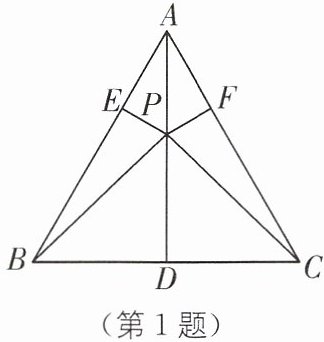
$AB=AC$,$D$ 是边 $BC$ 的中点,$P$ 是 $AD$ 上任意一点, $PE ⊥ AB$ 于点 $E$, $PF ⊥ AC$ 于点 $F$.
试说明:
(1)$PE=PF$;
(2)$PB=PC$.
答案
(1)$\because AB=AC$,D 是边 BC 的中点,
$\therefore AD$ 平分$∠ BAC$. 又 $PE⊥ AB$ 于点 E,$PF⊥ AC$ 于点 F,
$\therefore PE=PF$.
(2)$\because AB=AC$,D 是边 BC 的中点,
$\therefore AD⊥ BC$,$\therefore AD$ 垂直平分 BC.
又 P 是 AD 上任意一点,$\therefore PB=PC$.
$\therefore AD$ 平分$∠ BAC$. 又 $PE⊥ AB$ 于点 E,$PF⊥ AC$ 于点 F,
$\therefore PE=PF$.
(2)$\because AB=AC$,D 是边 BC 的中点,
$\therefore AD⊥ BC$,$\therefore AD$ 垂直平分 BC.
又 P 是 AD 上任意一点,$\therefore PB=PC$.
2. (2024·山东日照东港区期末) 如图, 在 $△ ABC$ 中, $AC>BC,∠ A=45°$, 点 $D$ 是 $AB$ 边上一点,且 $CD=CB$, 过点 $B$ 作 $BF⊥ CD$ 于点 $E$, 与 $AC$ 交于点 $F$.
(1)求证: $∠ ABF=\dfrac{1}{2}∠ BCD$;
(2)判断 $△ BCF$ 的形状, 并说明理由.
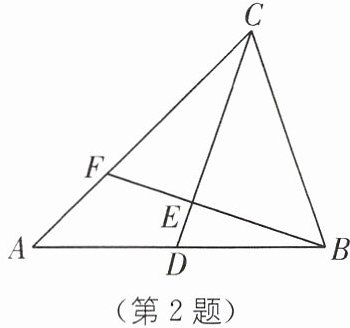
(1)求证: $∠ ABF=\dfrac{1}{2}∠ BCD$;
(2)判断 $△ BCF$ 的形状, 并说明理由.
答案
(1)如图,过点 C 作 $CG⊥ AB$ 于点 G,
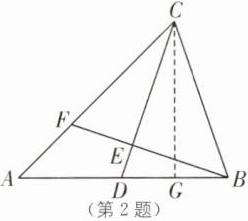
$\therefore ∠ DCG+∠ CDG=90°$.
$\because BC=DC$,
$\therefore ∠ BCG=∠ DCG=\dfrac{1}{2}∠ BCD$.
$\because BF⊥ CD$ 于点 E,
$\therefore ∠ ABF+∠ CDG=90°$,
$\therefore ∠ ABF=∠ DCG=\dfrac{1}{2}∠ BCD$.
(2)$△ BCF$ 是等腰三角形. 理由如下:
$\because ∠ A=45°$,$CG⊥ AB$,$\therefore ∠ ACG=45°$.
$\because ∠ ACB=∠ ACG+∠ BCG$,$∠ BFC=∠ A+∠ ABF$,
$\therefore ∠ ACB=45°+∠ BCG$,$∠ BFC=45°+∠ ABF$.
$\because ∠ BCG=∠ DCG=∠ ABF$,$\therefore ∠ BCF=∠ BFC$,
$\therefore BC=BF$,$\therefore △ BCF$ 是等腰三角形.
3. 如图,在四边形 $ABCD$ 中,$AB// DC$,$AC$ 平分$∠ DAB,CB⊥ AB,CE⊥ AD$ 交 $AD$ 的延长线于点$E$.
(1)求证:$△ ACD$ 是等腰三角形;
(2)连接 $BE$,求证:$AC$ 垂直平分 $BE$.
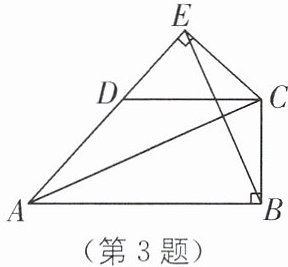
(1)求证:$△ ACD$ 是等腰三角形;
(2)连接 $BE$,求证:$AC$ 垂直平分 $BE$.
答案
(1)$\because AB// DC$,$\therefore ∠ DCA=∠ CAB$.
$\because AC$ 平分$∠ DAB$,$\therefore ∠ DAC=∠ CAB$,
$\therefore ∠ DCA=∠ DAC$,$\therefore DA=DC$,
$\therefore △ ACD$ 是等腰三角形.
(2)$\because AC$ 是$∠ EAB$ 的平分线,$CE⊥ AE$,$CB⊥ AB$,
$\therefore CE=CB$,$∠ CEA=∠ CBA=90°$.
又 $AC=AC$,$\therefore \mathrm{Rt}△ CEA≌\mathrm{Rt}△ CBA(\mathrm{HL})$,
$\therefore AE=AB$,$\therefore$ 点 A,C 在线段 BE 的垂直平分线上,
$\therefore AC$ 垂直平分 BE.
$\because AC$ 平分$∠ DAB$,$\therefore ∠ DAC=∠ CAB$,
$\therefore ∠ DCA=∠ DAC$,$\therefore DA=DC$,
$\therefore △ ACD$ 是等腰三角形.
(2)$\because AC$ 是$∠ EAB$ 的平分线,$CE⊥ AE$,$CB⊥ AB$,
$\therefore CE=CB$,$∠ CEA=∠ CBA=90°$.
又 $AC=AC$,$\therefore \mathrm{Rt}△ CEA≌\mathrm{Rt}△ CBA(\mathrm{HL})$,
$\therefore AE=AB$,$\therefore$ 点 A,C 在线段 BE 的垂直平分线上,
$\therefore AC$ 垂直平分 BE.
4.(2024·北京海淀外国语实验学校期中)在$△ ABC$中,$BE$平分$∠ ABC$,交$AC$边于点$E$.
精题详解
(1)如图(1),过点$E$作$DE// BC$,交$AB$于点$D$,求证:$△ BDE$为等腰三角形;
(2)如图(2),若$AB=AC$,$AF⊥ BD$,$∠ ACD=\dfrac{1}{2}∠ ABC$,判断$BF$,$CD$,$DF$的数量关系,并说明理由.
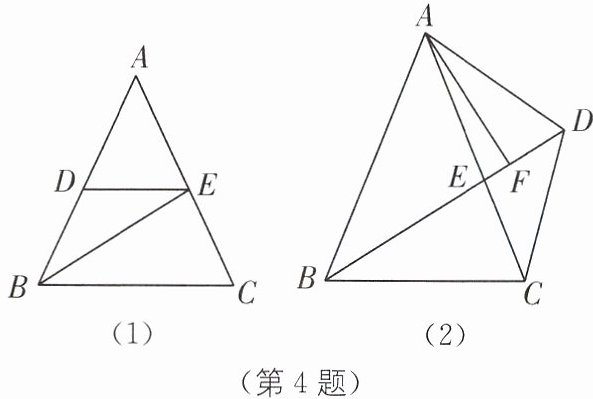
精题详解
(1)如图(1),过点$E$作$DE// BC$,交$AB$于点$D$,求证:$△ BDE$为等腰三角形;
(2)如图(2),若$AB=AC$,$AF⊥ BD$,$∠ ACD=\dfrac{1}{2}∠ ABC$,判断$BF$,$CD$,$DF$的数量关系,并说明理由.
答案
(1)$\because BE$ 平分$∠ ABC$,$\therefore ∠ ABE=∠ EBC$.
$\because DE// BC$,$\therefore ∠ DEB=∠ EBC=∠ ABE$,
$\therefore BD=ED$,$\therefore △ DBE$ 为等腰三角形.
(2)$BF=CD+DF$. 理由如下:如图,延长 CD 到点 M,使得 $CM=BD$,连接 AM,过点 A 作 $AN⊥ CM$ 于点 N.

$\because BE$ 平分$∠ ABC$,$∠ ACD=\dfrac{1}{2}∠ ABC$,
$\therefore ∠ ACM=∠ ABD$.
在$△ ABD$ 和$△ ACM$ 中,$\begin{cases} AB=AC,\\ ∠ ABD=∠ ACM,\\ BD=CM, \end{cases}$
$\therefore △ ABD≌△ ACM(\mathrm{SAS})$,
$\therefore AD=AM$,$∠ ADB=∠ AMC$,
$\therefore ∠ AMD=∠ ADM$,$\therefore ∠ ADF=∠ ADN$.
$\because AN⊥ DM$,$\therefore DN=MN$.
在$△ ADF$ 和$△ ADN$ 中,$\begin{cases} ∠ AFD=∠ AND=90°,\\ ∠ ADF=∠ ADN,\\ AD=AD, \end{cases}$
$\therefore △ ADF≌△ ADN(\mathrm{AAS})$,
$\therefore DF=DN=MN$.
$\because BD=CM$,
$\therefore BF=BD-DF=CM-MN=CN=CD+DN=CD+DF$,即 $BF=CD+DF$.
