

 登录
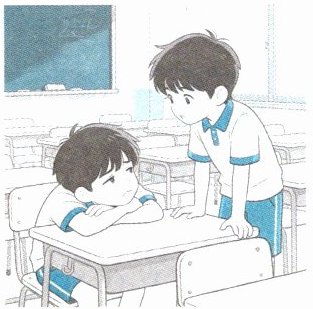
五 选择合适的句子补全对话。
Jerry: Hello, Bob. 1.
Bob: I feel sleepy.
Jerry: What did you do yesterday(昨天) evening?
Bob: I watched a football game and went to bed late.
Jerry: That's not a good habit. 2.
Bob: Yes. I listen carefully in class. 3.
Jerry: I'm never late for school. 4.
Bob: 5.
Jerry: You're right. Good habits are our friends. They help us with work and play.
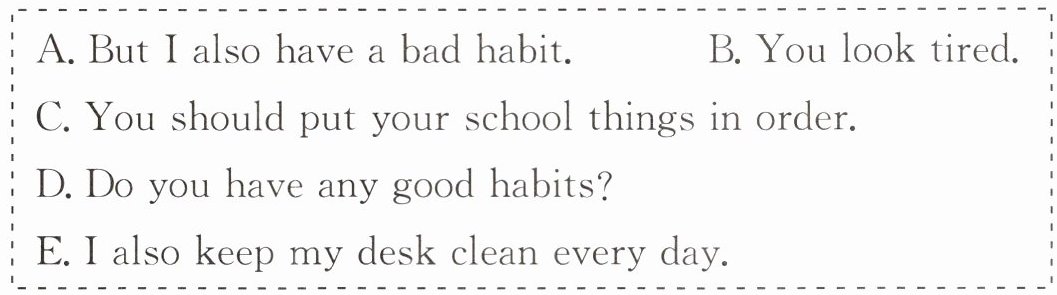
A. But I also have a bad habit.
B. You look tired.
C. You should put your school things in order.
D. Do you have any good habits?
E. I also keep my desk clean every day.
Jerry: Hello, Bob. 1.
B
What's the matter?Bob: I feel sleepy.
Jerry: What did you do yesterday(昨天) evening?
Bob: I watched a football game and went to bed late.
Jerry: That's not a good habit. 2.
D
Bob: Yes. I listen carefully in class. 3.
E
What about you?Jerry: I'm never late for school. 4.
A
I often put my school things everywhere. I can't find them easily.Bob: 5.
C
Jerry: You're right. Good habits are our friends. They help us with work and play.
A. But I also have a bad habit.
B. You look tired.
C. You should put your school things in order.
D. Do you have any good habits?
E. I also keep my desk clean every day.
答案
1. B 2. D 3. E 4. A 5. C
解析
【分析】首先通读对话,理解Jerry与Bob的日常交流语境,结合每空前后句的语义逻辑匹配合适的选项:第1空后询问对方状况,说明Jerry先观察到Bob状态不佳,需选描述状态的句子;第2空后是肯定回答且提及课堂表现,需选询问好习惯的一般疑问句;第3空承接上文说的好习惯,需补充另一个好习惯的句子;第4空后提及自身坏习惯,需选表转折说坏习惯的句子;第5空针对找不到学习用品的问题,需选给出整理建议的句子。
【解析】1. 由后句“What's the matter?”可知,Jerry先发现Bob状态不好,B选项“You look tired.”(你看起来很累)符合语境,故选B;2. 由答语“Yes. I listen carefully in class.”可知,此处是询问是否有好习惯,D选项“Do you have any good habits?”(你有一些好习惯吗?)符合,故选D;3. 此处承接Bob说的好习惯,补充另一个好习惯,E选项“I also keep my desk clean every day.”(我也每天保持我的桌子干净)符合,故选E;4. 由后句说自己的坏习惯可知,此处转折说明自身也有坏习惯,A选项“But I also have a bad habit.”(但我也有一个坏习惯)符合,故选A;5. 由前句说找不到学习用品可知,此处给出整理物品的建议,C选项“You should put your school things in order.”(你应该把你的学习用品整理好)符合,故选C。
【答案】1.B 2.D 3.E 4.A 5.C
【知识点】补全对话、日常交际用语
【点评】本题考查日常交际场景下的补全对话,需结合上下文语境逻辑判断选项,注重基础交际能力的考查,难度适中。
【难度系数】0.8
六 阅读短文,选择正确的答案。
Different people have different habits. Jack and Wang Ming are classmates, but their habits are quite(非常) different. Wang Ming has many good habits. He gets up on time every morning. He walks to school quickly and he is never late for school. In class, he follows the rules and thinks hard. After finishing his homework, he often helps his mother do some chores. Jack is not the same. He sometimes goes to bed very late. He seldom plans his time well. He often leaves his homework until the last minute(最后一刻). His schoolbag is full of messy books and pens. He does not put his things in order. His teacher often tells him to change these bad habits. As students, we must know what habits are good and what are bad. Small daily actions(行动) can help us become better.
(
A. never goes B. always goes C. sometimes goes
(
A. plays games B. watches TV C. helps with chores
(
A. in order B. messy C. clean
(
A. Going to bed late. B. Getting up late. C. Reading in bed.
(
A. develop good habits B. have messy bags C. waste time every day
Different people have different habits. Jack and Wang Ming are classmates, but their habits are quite(非常) different. Wang Ming has many good habits. He gets up on time every morning. He walks to school quickly and he is never late for school. In class, he follows the rules and thinks hard. After finishing his homework, he often helps his mother do some chores. Jack is not the same. He sometimes goes to bed very late. He seldom plans his time well. He often leaves his homework until the last minute(最后一刻). His schoolbag is full of messy books and pens. He does not put his things in order. His teacher often tells him to change these bad habits. As students, we must know what habits are good and what are bad. Small daily actions(行动) can help us become better.
(
B
)1. Wang Ming to school on time.A. never goes B. always goes C. sometimes goes
(
C
)2. Wang Ming often after finishing his homework.A. plays games B. watches TV C. helps with chores
(
B
)3. Jack's school things are .A. in order B. messy C. clean
(
A
)4. Which is Jack's bad habit?A. Going to bed late. B. Getting up late. C. Reading in bed.
(
A
)5. The passage tells us to .A. develop good habits B. have messy bags C. waste time every day
答案
1. B 2. C 3. B 4. A 5. A
解析
【分析】
本题为英语阅读理解细节题,解题思路是:先通读短文把握大意,再针对每个小题的问题,定位短文中对应的关键语句,对比选项选出正确答案。具体需依次定位Wang Ming的上学情况、课后行为,Jack的物品状态、坏习惯,以及短文传达的主旨内容。
【解析】
1. 定位原文关键句“He walks to school quickly and he is never late for school.”,可知Wang Ming总是准时上学,对应选项B。
2. 定位原文关键句“After finishing his homework, he often helps his mother do some chores.”,可知他做完作业后常帮忙做家务,对应选项C。
3. 定位原文关键句“His schoolbag is full of messy books and pens.”,可知Jack的学习用品杂乱,对应选项B。
4. 定位原文关键句“He sometimes goes to bed very late.”,可知晚睡是Jack的坏习惯,对应选项A。
5. 定位原文关键句“As students, we must know what habits are good and what are bad. Small daily actions can help us become better.”,可知短文主旨是告诉我们要养成好习惯,对应选项A。
【答案】
1. B 2. C 3. B 4. A 5. A
【知识点】
英语阅读理解(细节理解)、习惯类短文阅读
【点评】
本题围绕不同人的习惯展开,考查学生从短文中提取细节信息和理解主旨的能力,题目设置直接,只要仔细阅读原文即可轻松解答,适合基础阶段学生练习。
【难度系数】
0.8
