

 登录
句子还原。 ▶“答案与解析”见D3
根据短文内容,从方框内的选项中选出能填入空白处的最佳选项(有两项多余)。
I have a brown goat named Finn. I raise him after finding him in the forest. 1.
One day, I have to make a painting for art homework, so I paint a picture of Finn to show my pet goat. I leave the drawing in the barn(谷仓). 2.
3.
When I show my painting at school, they are all surprised at my artwork. After getting home from school, I make lots of footprints. I hand a page full of footprints to all the people in my class. 5.
(素材来源:Cricket)
A. He isn't healthy.
B. Just then, I have a good idea.
C. The little prints must interest them.
D. But later I find it with s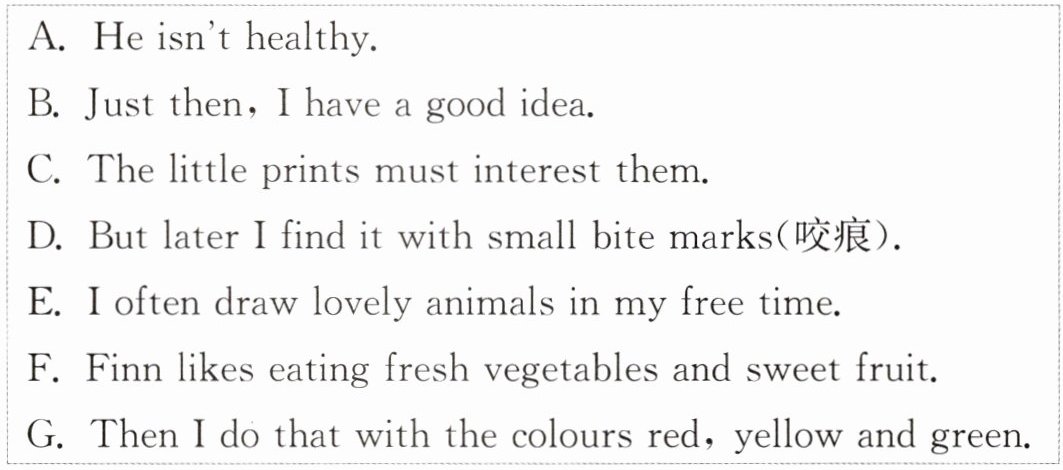 all bite marks(咬痕).
E. I often draw lovely animals in my free time.
F. Finn likes eating fresh vegetables and sweet fruit.
G. Then I do that with the colours red, yellow and green.
6. 拓展迁移 What do we learn from Finn's story?
7. 拓展迁移 How can we turn small problems into fun things in our daily life?
根据短文内容,从方框内的选项中选出能填入空白处的最佳选项(有两项多余)。
I have a brown goat named Finn. I raise him after finding him in the forest. 1.
A
I take him in. I feed him four times every day, and he grows up fast. Soon he runs around and plays with other goats. Sometimes he tries to eat my books and my clothes, and every day he gets more playful.One day, I have to make a painting for art homework, so I paint a picture of Finn to show my pet goat. I leave the drawing in the barn(谷仓). 2.
D
I try to tell him that he shouldn't do that, but he just blinks(眨眼) in surprise.3.
B
I put Finn's feet into my blue paints, and then hold a carrot in front of him so that he has to walk on the paper to get to me. While he eats the carrot, I look down at the paper. I can see two blue footprints like flowers on the paper! 4. G
When I show my painting at school, they are all surprised at my artwork. After getting home from school, I make lots of footprints. I hand a page full of footprints to all the people in my class. 5.
C
And the next day some of them bring more prints from home. They aren't just goat prints. There are cow prints, horse prints, pig prints, chicken prints, and so on. Finn's wonderful art leads other kids to make artworks.(素材来源:Cricket)
A. He isn't healthy.
B. Just then, I have a good idea.
C. The little prints must interest them.
D. But later I find it with s
all bite marks(咬痕).E. I often draw lovely animals in my free time.
F. Finn likes eating fresh vegetables and sweet fruit.
G. Then I do that with the colours red, yellow and green.
6. 拓展迁移 What do we learn from Finn's story?
Bad things can give us new good ideas.
7. 拓展迁移 How can we turn small problems into fun things in our daily life?
Change our idea and make problems fun.
答案
外刊选萃
1. A 前文提到“我在森林里发现了他并把他养大”,后文提到“我收留了他,每天喂他四次”,A项衔接上下文,交代了“我收留并照顾他”的原因。
2. D 前文提到“我把画留在谷仓里”,后文提到“我试着告诉他不该那样做,但他只是惊讶地眨眼”,D项承接上文,引出山羊咬坏画作的情节。
3. B 前文提到“山羊咬坏了我的画”,后文提到“我把Finn的脚放进蓝色颜料里,用胡萝卜引导他在纸上走路”,B项起到过渡作用,引出后续的创意行为。
4. G 前文提到“我看到纸上有像花一样的蓝色脚印”,G项承接上文,说明作者用不同颜色完成了整幅作品。
5. C 前文提到“我把一页满是脚印的纸递给了班上的同学”,后文提到“第二天,一些同学带来了更多的脚印作品”,C项衔接上下文,解释了同学们后续创作的原因。
6. 【拓展迁移】Bad things can give us new good ideas.(答案不唯一)
7. 【拓展迁移】Change our idea and make problems fun.(答案不唯一)
解析
【分析】本题为句子还原题,解题思路如下:首先通读全文,把握文章主旨(作者养山羊Finn,从山羊咬坏画作到创意制作脚印画,带动同学创作的故事);接着分析每个空白处的上下文逻辑关系,结合选项的语义、指代等,筛选出能衔接上下文的句子,注意排除多余选项;最后验证所选答案是否使文章通顺连贯。
【解析】1. 第1空:前文提到在森林发现山羊并收留,后文说每天喂养它,A项(He isn't healthy.)交代了收留照顾山羊的原因,衔接合理,故选A。2. 第2空:前文提到将画留在谷仓,后文说告知山羊不该如此,D项(But later I find it with small bite marks.)承接画被破坏的情节,符合逻辑,故选D。3. 第3空:前文说山羊咬坏画,后文介绍用颜料和胡萝卜引导山羊创作的方法,B项(Just then, I have a good idea.)起到过渡作用,引出后续创意行为,故选B。4. 第4空:前文提到看到蓝色脚印像花,G项(Then I do that with the colours red, yellow and green.)承接上文,说明用其他颜色完成作品,故选G。5. 第5空:前文说将脚印纸递给同学,后文说同学带来更多作品,C项(The little prints must interest them.)解释同学后续创作的原因,衔接自然,故选C。拓展迁移6:从故事中可知,坏事可以带来新的好点子(答案不唯一);拓展迁移7:我们可以改变想法,把小问题变成有趣的事(答案不唯一)。
【答案】1.A 2.D 3.B 4.G 5.C;6.Bad things can give us new good ideas.(答案不唯一);7.Change our idea and make problems fun.(答案不唯一)
【知识点】句子还原题、外刊阅读理解、逻辑衔接
【点评】本题选取贴近生活的外刊素材,考查学生对文章逻辑关系的理解和上下文衔接能力,拓展题注重培养学生的思维迁移能力,难度适中。
【难度系数】0.5
