

 登录
1 如图,在$□ ABCD$中,F是AD上一点,CF交BD于点E,CF的延长线交BA的延长线于点G,$EF=1$,$EC=3$,则$GF$的长为(
A.4
B.6
C.8
D.10
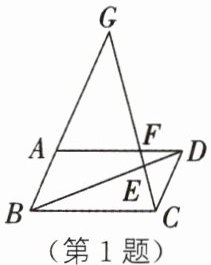 (第1题)
C
)A.4
B.6
C.8
D.10
(第1题)答案
1. C
2 如图,在$△ ABC$中,$DE// AB// FG$,且$FG$到$DE$,$AB$的距离之比为$1:2$.若$△ ABC$的面积为32,$△ CDE$的面积为2,则$△ CFG$的面积为(

A.6
B.8
C.10
D.12
B
)A.6
B.8
C.10
D.12
答案
2. B
3 新情境 学科融合 在初中物理中我们学过凸透镜的成像规律.如图,MN为一凸透镜,F是凸透镜的焦点.在焦点以外的主光轴上垂直放置一蜡烛AB,透过凸透镜后成的像为CD.经过焦点的光线AE通过凸透镜折射后平行于主光轴,并与经过凸透镜光心的光线AO会聚于点C.若焦距$OF=4\ \mathrm{cm}$,物距$OB=6\ \mathrm{cm}$,蜡烛的高度$AB=1\ \mathrm{cm}$,求蜡烛的像CD的长度以及像CD与凸透镜MN之间的距离.

答案
3. 由题意,得 $OE = CD, AB ⊥ BO, EO ⊥ BO, CD ⊥ OD$,
$\therefore ∠ ABO=∠ EOB = ∠ CDO = 90°. \because ∠ AFB = ∠ EFO$,
$\therefore △ ABF ∽ △ EOF. \therefore \dfrac{AB}{EO}=\dfrac{BF}{OF}.$ 设$OE=x\ \mathrm{cm}. \therefore \dfrac{1}{x}=\dfrac{6-4}{4}$,
解得 $x=2$. 经检验,$x=2$ 是原分式方程的解,且符合题意.
$\therefore OE=2\ \mathrm{cm}. \therefore OE = CD = 2\ \mathrm{cm}. \because ∠ AOB = ∠ COD$,
$\therefore △ AOB ∽ △ COD. \therefore \dfrac{AB}{CD}=\dfrac{OB}{OD}.$ 设 $OD=y\ \mathrm{cm}. \therefore \dfrac{1}{2}=\dfrac{6}{y}$,
解得 $y=12$. 经检验,$y=12$ 是原分式方程的解,且符合题意.
$\therefore OD=12\ \mathrm{cm}. \therefore$ 蜡烛的像 $CD$ 的长度为 $2\ \mathrm{cm}$,像 $CD$ 与凸透镜$MN$ 之间的距离为 $12\ \mathrm{cm}$
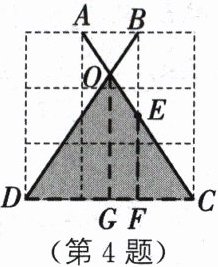
4 如图,网格中每个小正方形的边长均为1,A,B,C,D为格点,且AC,BD相交于点O,则△COD的面积为
$\dfrac{27}{8}$
;若E是AC与竖直网格线的交点,则OE的长为$\dfrac{\sqrt{13}}{4}$
。答案
4. $\dfrac{27}{8}$ $\dfrac{\sqrt{13}}{4}$ 【解析】$\because$ 网格中每个小正方形的边长均为1,
A,B,C,D 为格点,$\therefore AB=1,CD=3,AB// CD,AC=BD=$$\sqrt{2^2+3^2}=\sqrt{13}. \therefore$ 易得 $△ AOB ∽ △ COD. \therefore \dfrac{OB}{OD}=\dfrac{OA}{OC}=$$\dfrac{AB}{CD}=\dfrac{1}{3}. \therefore OC=\dfrac{3}{4}AC=\dfrac{3\sqrt{13}}{4},OD=\dfrac{3}{4}BD=\dfrac{3\sqrt{13}}{4}.$
$\therefore OC=OD. \therefore △ COD$ 为等腰三角形. 如图,过点 $O$ 作 $OG ⊥$$CD$ 于点 $G$,取格点 $F$,连接 $EF,DC$. 易知 $D,G,F,C$ 四点共线.
$\therefore OG// EF,DG=CG=\dfrac{1}{2}CD=\dfrac{3}{2}. \therefore OG=\sqrt{OC^2-CG^2}=$$\sqrt{(\dfrac{3\sqrt{13}}{4})^2-(\dfrac{3}{2})^2}=\dfrac{9}{4}. \therefore S_{△ COD}=\dfrac{1}{2}CD· OG=\dfrac{1}{2}× 3×$$\dfrac{9}{4}=\dfrac{27}{8}. \because OG// EF,\therefore \dfrac{CE}{CO}=\dfrac{CF}{CG}$,即 $\dfrac{CE}{\dfrac{3\sqrt{13}}{4}}=\dfrac{\dfrac{1}{3}}{\dfrac{3}{2}}. \therefore CE=$$\dfrac{\sqrt{13}}{2}. \therefore OE=OC-CE=\dfrac{3\sqrt{13}}{4}-\dfrac{\sqrt{13}}{2}=\dfrac{\sqrt{13}}{4}.$
5 如图,在$△ ABC$中,点D在边BC上,连接AD,$∠ ADB = ∠ CDE$,DE交边AC于点E,延长DE,交BA的延长线于点F,且$AD^2 = ED · FD$。求证:
(1) $△ BFD ∽ △ CAD$;
(2) $BF · ED = AB · AD$。
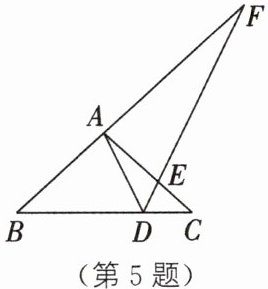 (第5题)
(1) $△ BFD ∽ △ CAD$;
(2) $BF · ED = AB · AD$。
(第5题)答案
5. (1) $\because AD^2 = ED · FD, \therefore \dfrac{AD}{ED} = \dfrac{FD}{AD}.$ 又 $\because ∠ ADF =$$∠ EDA,\therefore △ ADF ∽ △ EDA. \therefore ∠ F = ∠ DAE. \because ∠ ADB =$$∠ CDE,\therefore ∠ ADB+∠ ADF = ∠ CDE+∠ ADF$,即$∠ BDF = ∠ CDA. \therefore △ BFD ∽ △ CAD$
(2) $\because △ BFD ∽ △ CAD$,$\therefore \dfrac{BF}{CA}=\dfrac{FD}{AD}. \because \dfrac{AD}{ED}=\dfrac{FD}{AD},\therefore \dfrac{BF}{CA}=\dfrac{AD}{ED}. \because △ BFD∽ △ CAD$,$\therefore ∠ B=∠ C. \therefore AB=CA. \therefore \dfrac{BF}{AB}=\dfrac{AD}{ED}. \therefore BF · ED=AB · AD$
(2) $\because △ BFD ∽ △ CAD$,$\therefore \dfrac{BF}{CA}=\dfrac{FD}{AD}. \because \dfrac{AD}{ED}=\dfrac{FD}{AD},\therefore \dfrac{BF}{CA}=\dfrac{AD}{ED}. \because △ BFD∽ △ CAD$,$\therefore ∠ B=∠ C. \therefore AB=CA. \therefore \dfrac{BF}{AB}=\dfrac{AD}{ED}. \therefore BF · ED=AB · AD$
