

 登录
18. (镇江中考改编)读取表格信息,解决问题。
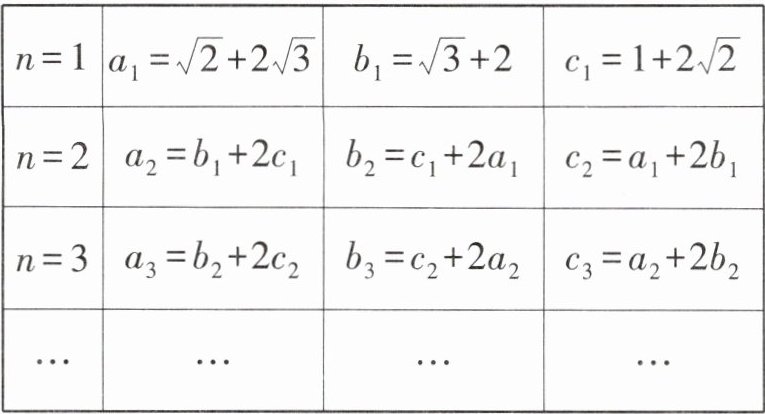
满足$\frac{a_n + b_n + c_n}{\sqrt{3} + \sqrt{2}} ≥ 365 × (\sqrt{3} - \sqrt{2} + 1)$的$n$可以取得的最小整数是
满足$\frac{a_n + b_n + c_n}{\sqrt{3} + \sqrt{2}} ≥ 365 × (\sqrt{3} - \sqrt{2} + 1)$的$n$可以取得的最小整数是
6
。答案
18. 6 解析:由$a_{1}+b_{1}+c_{1}=\sqrt{2}+2\sqrt{3}+\sqrt{3}+2 + 1+2\sqrt{2}=3(\sqrt{3}+\sqrt{2}+1)$,得$a_{2}+b_{2}+c_{2}=9(\sqrt{3}+\sqrt{2}+1)$,…,$a_{n}+b_{n}+c_{n}=3^{n}(\sqrt{3}+\sqrt{2}+1)$.
∵$\dfrac{a_{n}+b_{n}+c_{n}}{\sqrt{3}+\sqrt{2}}≥365×(\sqrt{3}-\sqrt{2}+1)$,
∴$a_{n}+b_{n}+c_{n}≥365×(\sqrt{3}-\sqrt{2}+1)×(\sqrt{3}+\sqrt{2})=365×(\sqrt{3}+\sqrt{2}+1)$,
∴$3^{n}≥365$. 又$3^{5}<365<3^{6}$,
∴$n$可以取得的最小整数是 6.
∵$\dfrac{a_{n}+b_{n}+c_{n}}{\sqrt{3}+\sqrt{2}}≥365×(\sqrt{3}-\sqrt{2}+1)$,
∴$a_{n}+b_{n}+c_{n}≥365×(\sqrt{3}-\sqrt{2}+1)×(\sqrt{3}+\sqrt{2})=365×(\sqrt{3}+\sqrt{2}+1)$,
∴$3^{n}≥365$. 又$3^{5}<365<3^{6}$,
∴$n$可以取得的最小整数是 6.
三、解答题(共 46 分)
19. (8 分)计算:
(1) $\sqrt{18} - \sqrt{\frac{9}{2}} - \frac{\sqrt{3} + \sqrt{6}}{\sqrt{3}} + (\sqrt{3} - 2)^0 + \sqrt{(1 - \sqrt{2})^2}$;
(2) $\frac{25\sqrt{6}}{2\sqrt{3} - \sqrt{2}} + (\sqrt{5} + \sqrt{6})(\sqrt{15} - 2\sqrt{3})$。
19. (8 分)计算:
(1) $\sqrt{18} - \sqrt{\frac{9}{2}} - \frac{\sqrt{3} + \sqrt{6}}{\sqrt{3}} + (\sqrt{3} - 2)^0 + \sqrt{(1 - \sqrt{2})^2}$;
(2) $\frac{25\sqrt{6}}{2\sqrt{3} - \sqrt{2}} + (\sqrt{5} + \sqrt{6})(\sqrt{15} - 2\sqrt{3})$。
答案
19. (1)$\dfrac{3\sqrt{2}}{2}-1$ 解析:$\sqrt{18}-\sqrt{\dfrac{9}{2}}-\dfrac{\sqrt{3}+\sqrt{6}}{\sqrt{3}}+(\sqrt{3}-2)^{0}+\sqrt{(1-\sqrt{2})^{2}}=3\sqrt{2}-\dfrac{3\sqrt{2}}{2}-\dfrac{\sqrt{3}(1+\sqrt{2})}{\sqrt{3}}+1+(\sqrt{2}-1)=3\sqrt{2}-\dfrac{3\sqrt{2}}{2}-1-\sqrt{2}+1+\sqrt{2}-1=\dfrac{3\sqrt{2}}{2}-1$. (2)$9\sqrt{2}+10\sqrt{3}-2\sqrt{15}+3\sqrt{10}$ 解析:$\dfrac{25\sqrt{6}}{2\sqrt{3}-\sqrt{2}}+(\sqrt{5}+\sqrt{6})×(\sqrt{15}-2\sqrt{3})=\dfrac{25\sqrt{6}(2\sqrt{3}+\sqrt{2})}{(2\sqrt{3}-\sqrt{2})(2\sqrt{3}+\sqrt{2})}+\sqrt{5}×\sqrt{15}+\sqrt{6}×\sqrt{15}-\sqrt{5}×2\sqrt{3}-\sqrt{6}×2\sqrt{3}=\dfrac{50(3\sqrt{2}+\sqrt{3})}{10}+5\sqrt{3}+3\sqrt{10}-2\sqrt{15}-6\sqrt{2}=9\sqrt{2}+10\sqrt{3}-2\sqrt{15}+3\sqrt{10}$.
解析
(1) $\sqrt{18} - \sqrt{\frac{9}{2}} - \frac{\sqrt{3} + \sqrt{6}}{\sqrt{3}} + (\sqrt{3} - 2)^0 + \sqrt{(1 - \sqrt{2})^2}$
$= 3\sqrt{2} - \frac{3\sqrt{2}}{2} - \frac{\sqrt{3}(1 + \sqrt{2})}{\sqrt{3}} + 1 + (\sqrt{2} - 1)$
$= 3\sqrt{2} - \frac{3\sqrt{2}}{2} - 1 - \sqrt{2} + 1 + \sqrt{2} - 1$
$= \frac{3\sqrt{2}}{2} - 1$
(2) $\frac{25\sqrt{6}}{2\sqrt{3} - \sqrt{2}} + (\sqrt{5} + \sqrt{6})(\sqrt{15} - 2\sqrt{3})$
$= \frac{25\sqrt{6}(2\sqrt{3} + \sqrt{2})}{(2\sqrt{3})^2 - (\sqrt{2})^2} + \sqrt{5} × \sqrt{15} + \sqrt{6} × \sqrt{15} - \sqrt{5} × 2\sqrt{3} - \sqrt{6} × 2\sqrt{3}$
$= \frac{25\sqrt{6}(2\sqrt{3} + \sqrt{2})}{12 - 2} + 5\sqrt{3} + 3\sqrt{10} - 2\sqrt{15} - 6\sqrt{2}$
$= \frac{25\sqrt{6}(2\sqrt{3} + \sqrt{2})}{10} + 5\sqrt{3} + 3\sqrt{10} - 2\sqrt{15} - 6\sqrt{2}$
$= \frac{5\sqrt{6}(2\sqrt{3} + \sqrt{2})}{2} + 5\sqrt{3} + 3\sqrt{10} - 2\sqrt{15} - 6\sqrt{2}$
$= \frac{5(2\sqrt{18} + \sqrt{12})}{2} + 5\sqrt{3} + 3\sqrt{10} - 2\sqrt{15} - 6\sqrt{2}$
$= \frac{5(6\sqrt{2} + 2\sqrt{3})}{2} + 5\sqrt{3} + 3\sqrt{10} - 2\sqrt{15} - 6\sqrt{2}$
$= 5(3\sqrt{2} + \sqrt{3}) + 5\sqrt{3} + 3\sqrt{10} - 2\sqrt{15} - 6\sqrt{2}$
$= 15\sqrt{2} + 5\sqrt{3} + 5\sqrt{3} + 3\sqrt{10} - 2\sqrt{15} - 6\sqrt{2}$
$= 9\sqrt{2} + 10\sqrt{3} - 2\sqrt{15} + 3\sqrt{10}$
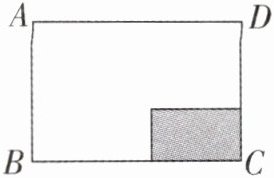
20. (7 分)如图,张大伯家有一块长方形空地$ABCD$,长方形空地的长$BC$为$\sqrt{72}m$,宽$AB$为$\sqrt{32}m$,现要在空地中划出一块长方形地养鸡(即图中阴影部分),其余部分种植蔬菜,长方形养鸡场的长为$(\sqrt{13} + 1)m$,宽为$(\sqrt{13} - 1)m$。
(1) 长方形$ABCD$的周长是多少?(结果化为最简二次根式)
(2) 若市场上某种蔬菜$10$元/千克,张大伯种植该种蔬菜,每平方米可以产$20$千克的蔬菜,张大伯如果将所种蔬菜全部销售完,销售收入为多少元?
(1) 长方形$ABCD$的周长是多少?(结果化为最简二次根式)
(2) 若市场上某种蔬菜$10$元/千克,张大伯种植该种蔬菜,每平方米可以产$20$千克的蔬菜,张大伯如果将所种蔬菜全部销售完,销售收入为多少元?
答案
20. (1)长方形$ABCD$的周长$=2×(\sqrt{72}+\sqrt{32})=2×(6\sqrt{2}+4\sqrt{2})=20\sqrt{2}(\mathrm{m})$. 答:长方形$ABCD$的周长是$20\sqrt{2}\mathrm{ m}$. (2)蔬菜地的面积$=\sqrt{72}×\sqrt{32}-(\sqrt{13}+1)×(\sqrt{13}-1)=48-(13 - 1)=36(\mathrm{m}^{2})$. $36×20×10=7200$(元). 答:张大伯如果将所种蔬菜全部销售完,销售收入为 7200 元.
解析
(1) 长方形$ABCD$的周长$=2×(\sqrt{72}+\sqrt{32})=2×(6\sqrt{2}+4\sqrt{2})=2×10\sqrt{2}=20\sqrt{2}(\mathrm{m})$。答:长方形$ABCD$的周长是$20\sqrt{2}\mathrm{ m}$。
(2) 蔬菜地的面积$=\sqrt{72}×\sqrt{32}-(\sqrt{13}+1)(\sqrt{13}-1)$
$=6\sqrt{2}×4\sqrt{2}-[(\sqrt{13})^{2}-1^{2}]$
$=24×2-(13 - 1)$
$=48 - 12=36(\mathrm{m}^{2})$。
销售收入$=36×20×10=7200$(元)。答:张大伯如果将所种蔬菜全部销售完,销售收入为7200元。
(2) 蔬菜地的面积$=\sqrt{72}×\sqrt{32}-(\sqrt{13}+1)(\sqrt{13}-1)$
$=6\sqrt{2}×4\sqrt{2}-[(\sqrt{13})^{2}-1^{2}]$
$=24×2-(13 - 1)$
$=48 - 12=36(\mathrm{m}^{2})$。
销售收入$=36×20×10=7200$(元)。答:张大伯如果将所种蔬菜全部销售完,销售收入为7200元。
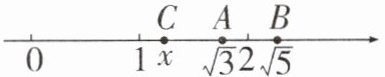
21. (7 分)如图,数轴上与$\sqrt{3}$,$\sqrt{5}$对应的点分别是$A$,$B$,点$B$关于点$A$的对称点为$C$,设点$C$表示的数为$x$。
(1) 求$x$的值;
(2) 求$(17 + 4\sqrt{15})x^2 - (2\sqrt{3} + \sqrt{5})x - 2$的值。
(1) 求$x$的值;
(2) 求$(17 + 4\sqrt{15})x^2 - (2\sqrt{3} + \sqrt{5})x - 2$的值。
答案
21. (1)
∵数轴上与$\sqrt{3}$,$\sqrt{5}$对应的点分别是$A$,$B$,
∴$AB=\sqrt{5}-\sqrt{3}$. 又
∵$AC = AB$,
∴$\sqrt{3}-x=\sqrt{5}-\sqrt{3}$,
∴$x = 2\sqrt{3}-\sqrt{5}$. (2)
∵$x = 2\sqrt{3}-\sqrt{5}$,
∴$x^{2}=(2\sqrt{3}-\sqrt{5})^{2}=17 - 4\sqrt{15}$,
∴$(17 + 4\sqrt{15})x^{2}-(2\sqrt{3}+\sqrt{5})x - 2=(17 + 4\sqrt{15})(17 - 4\sqrt{15})-(2\sqrt{3}+\sqrt{5})(2\sqrt{3}-\sqrt{5})-2=49 - 7 - 2=40$.
22. (8 分)
(1) (2025·福建中考)先化简,再求值:$(2 + \frac{1 - a}{a}) ÷ \frac{a^2 + 2a + 1}{a}$,其中$a = \sqrt{5} - 1$。
(2) 已知$a$,$b$为有理数,且满足等式$a + b\sqrt{3} = \sqrt{6} × \sqrt{1 + \sqrt{4 + 2\sqrt{3}}}$,求$a + b$的值。
(1) (2025·福建中考)先化简,再求值:$(2 + \frac{1 - a}{a}) ÷ \frac{a^2 + 2a + 1}{a}$,其中$a = \sqrt{5} - 1$。
(2) 已知$a$,$b$为有理数,且满足等式$a + b\sqrt{3} = \sqrt{6} × \sqrt{1 + \sqrt{4 + 2\sqrt{3}}}$,求$a + b$的值。
答案
22. (1)$(2+\dfrac{1 - a}{a})÷\dfrac{a^{2}+2a + 1}{a}=\dfrac{2a + 1 - a}{a}·\dfrac{a}{a^{2}+2a + 1}=\dfrac{a + 1}{a}·\dfrac{a}{(a + 1)^{2}}=\dfrac{1}{a + 1}$. 当$a=\sqrt{5}-1$时,原式$=\dfrac{1}{\sqrt{5}-1 + 1}=\dfrac{\sqrt{5}}{5}$. (2)
∵$\sqrt{4+2\sqrt{3}}=\sqrt{(\sqrt{3})^{2}+2\sqrt{3}+1}=\sqrt{(\sqrt{3}+1)^{2}}=\sqrt{3}+1$,
∴$\sqrt{1+\sqrt{4+2\sqrt{3}}}=\sqrt{1+\sqrt{3}+1}=\sqrt{2+\sqrt{3}}=\sqrt{\dfrac{1}{2}×(4+2\sqrt{3})}=\sqrt{\dfrac{1}{2}×(\sqrt{3}+1)^{2}}=\dfrac{\sqrt{2}}{2}×(\sqrt{3}+1)$,则$\sqrt{6}×\sqrt{1+\sqrt{4+2\sqrt{3}}}=\sqrt{6}×\dfrac{\sqrt{2}}{2}×(\sqrt{3}+1)=\sqrt{3}×(\sqrt{3}+1)=3+\sqrt{3}$,
∴$a + b\sqrt{3}=3+\sqrt{3}$.
∵$a$,$b$为有理数,
∴$a = 3$,$b = 1$,
∴$a + b = 4$.
