

 登录
登录
中考趋势 Ⅳ.信息还原(每小题2分,共10分)
从方框中选出能填入空白处的最佳选项。选项中有两项多余。
How long does it take to become an elite(精英) in your field? 1
That's what John Hayes, a cognitive
psychology professor at Carnegie Mell University, wanted to know.
For decades, Hayes has been investigating the role of effort, practice and knowledge in top performers. 2
Let's talk about what Hayes has discovered about world-class performers. And more importantly, let's discuss how you can use these insights to achieve your goals and become your best.
3
Hayes mapped out the timeline of each composer's career. 4
In follow-up studies, Hayes found similar patterns among famous painters and popular poets. These findings have been further confirmed by research from professors like K. Anders Ericsson, who produced research that revealed that you needed to put in "10,000 hours" to become an elite or an expert in your field.
|题中题 052
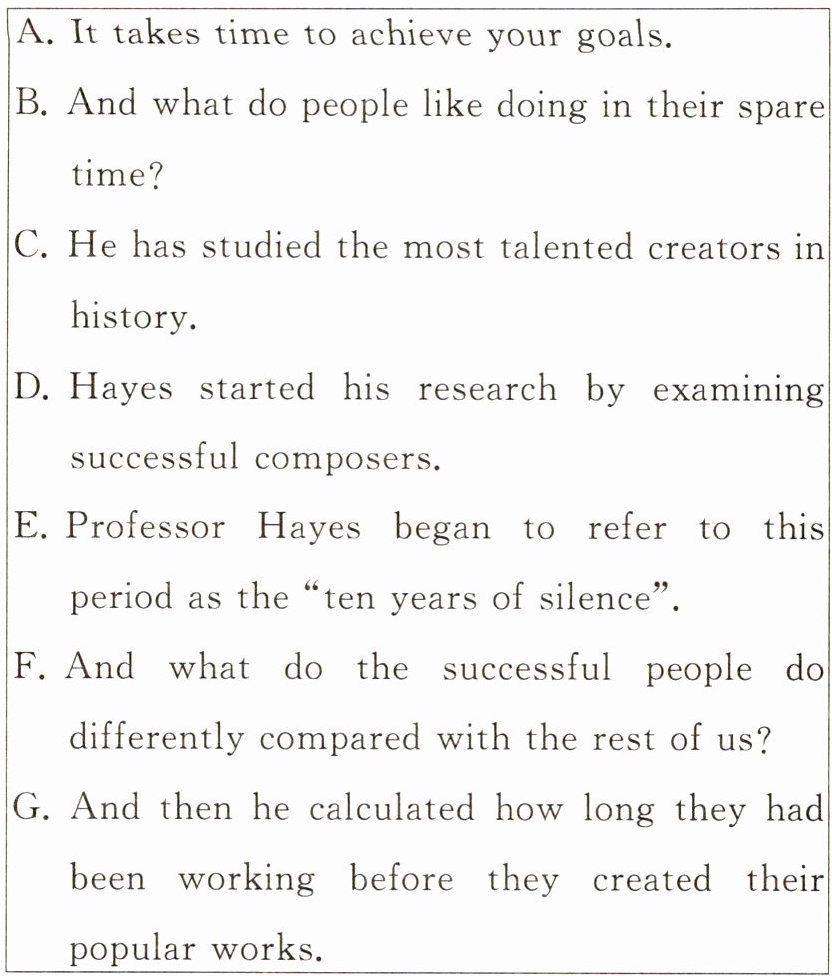
1.
4.
从方框中选出能填入空白处的最佳选项。选项中有两项多余。
How long does it take to become an elite(精英) in your field? 1
F
That's what John Hayes, a cognitive
psychology professor at Carnegie Mell University, wanted to know.
For decades, Hayes has been investigating the role of effort, practice and knowledge in top performers. 2
C
The research focused on people like Mozart and Picasso—to determine how long it took them to become world-class at their craft.Let's talk about what Hayes has discovered about world-class performers. And more importantly, let's discuss how you can use these insights to achieve your goals and become your best.
3
D
He analyzed thousands of musical pieces produced from 1685 to 1900. The central question that drove his work was, "How long after one becomes interested in music is it that one becomes world-class?" Eventually, Hayes developed a list of 500 pieces of "masterworks" in the field, which were created by a total of 76 composers.Hayes mapped out the timeline of each composer's career. 4
G
What he discovered was that virtually every single "masterwork" was written after the tenth year of the composer's career. Not a single person produced incredible work without putting in a decade of practice first. Even a genius like Mozart had to work for at least ten years before he produced something that became popular. 5 E
In follow-up studies, Hayes found similar patterns among famous painters and popular poets. These findings have been further confirmed by research from professors like K. Anders Ericsson, who produced research that revealed that you needed to put in "10,000 hours" to become an elite or an expert in your field.
|题中题 052
1.
F
2. C
3. D
4.
G
5. E
答案
Ⅳ.【文章大意】本文是一篇说明文。文章主要介绍了 John Hayes 教授对于成为顶级精英所需时间的研究。通过分析莫扎特、毕加索等大师的作品,Hayes 发现几乎所有杰作都是在创作者生涯的第十年后诞生的,强调了“十年沉默期”的重要性。
1.F 2.C 3.D 4.G 5.E
1.F 2.C 3.D 4.G 5.E
解析
【分析】这是一道英语信息还原题,需结合上下文逻辑与语境选择衔接紧密的句子。解题思路:先通读全文把握主旨(Hayes教授对成为顶级精英所需时间的研究);再逐个分析空格前后内容,匹配对应选项:1. 前文问成为精英的时间,后文提及Hayes想探究,需选引出成功人士与常人差异的句子;2. 前文讲Hayes研究顶级表演者,后文举创作者例子,需选衔接研究对象的句子;3. 后文讲分析音乐作品,需选引出作曲家研究的句子;4. 前文说规划作曲家生涯时间线,后文讲发现杰作时间,需选衔接时间计算的句子;5. 前文提天才需十年,需选命名该阶段的句子。
【解析】1. 前文提出“成为精英需要多久”的问题,后文说明这是Hayes教授的研究方向,F选项“成功人士和我们其他人有什么不同的做法”承接上文对成功人士的探讨,符合逻辑,故1选F。2. 前文说Hayes研究顶级表演者的努力等因素,后文提到研究聚焦莫扎特、毕加索等创作者,C选项“他研究了历史上最有才华的创作者”衔接前后,引出研究对象,故2选C。3. 后文提到分析1685-1900年的音乐作品,D选项“Hayes通过研究成功的作曲家开始他的研究”引出下文对作曲家的研究,符合语境,故3选D。4. 前文说Hayes规划每个作曲家的生涯时间线,后文说明发现杰作诞生的时间,G选项“然后他计算了他们创作流行作品前工作了多久”承接时间线内容,为下文发现做铺垫,故4选G。5. 前文提到即使莫扎特这样的天才也需要十年,E选项“Hayes教授开始把这个时期称为‘十年沉默期’”总结前文发现,命名该阶段,故5选E。
【答案】1.F 2.C 3.D 4.G 5.E
【知识点】英语信息还原、语篇理解、逻辑衔接
【点评】本题考查学生的语篇理解与上下文逻辑衔接能力,是中考常见题型,要求学生快速把握文章主旨,结合语境匹配句子,难度适中。
【难度系数】0.5
【解析】1. 前文提出“成为精英需要多久”的问题,后文说明这是Hayes教授的研究方向,F选项“成功人士和我们其他人有什么不同的做法”承接上文对成功人士的探讨,符合逻辑,故1选F。2. 前文说Hayes研究顶级表演者的努力等因素,后文提到研究聚焦莫扎特、毕加索等创作者,C选项“他研究了历史上最有才华的创作者”衔接前后,引出研究对象,故2选C。3. 后文提到分析1685-1900年的音乐作品,D选项“Hayes通过研究成功的作曲家开始他的研究”引出下文对作曲家的研究,符合语境,故3选D。4. 前文说Hayes规划每个作曲家的生涯时间线,后文说明发现杰作诞生的时间,G选项“然后他计算了他们创作流行作品前工作了多久”承接时间线内容,为下文发现做铺垫,故4选G。5. 前文提到即使莫扎特这样的天才也需要十年,E选项“Hayes教授开始把这个时期称为‘十年沉默期’”总结前文发现,命名该阶段,故5选E。
【答案】1.F 2.C 3.D 4.G 5.E
【知识点】英语信息还原、语篇理解、逻辑衔接
【点评】本题考查学生的语篇理解与上下文逻辑衔接能力,是中考常见题型,要求学生快速把握文章主旨,结合语境匹配句子,难度适中。
【难度系数】0.5
