

 登录
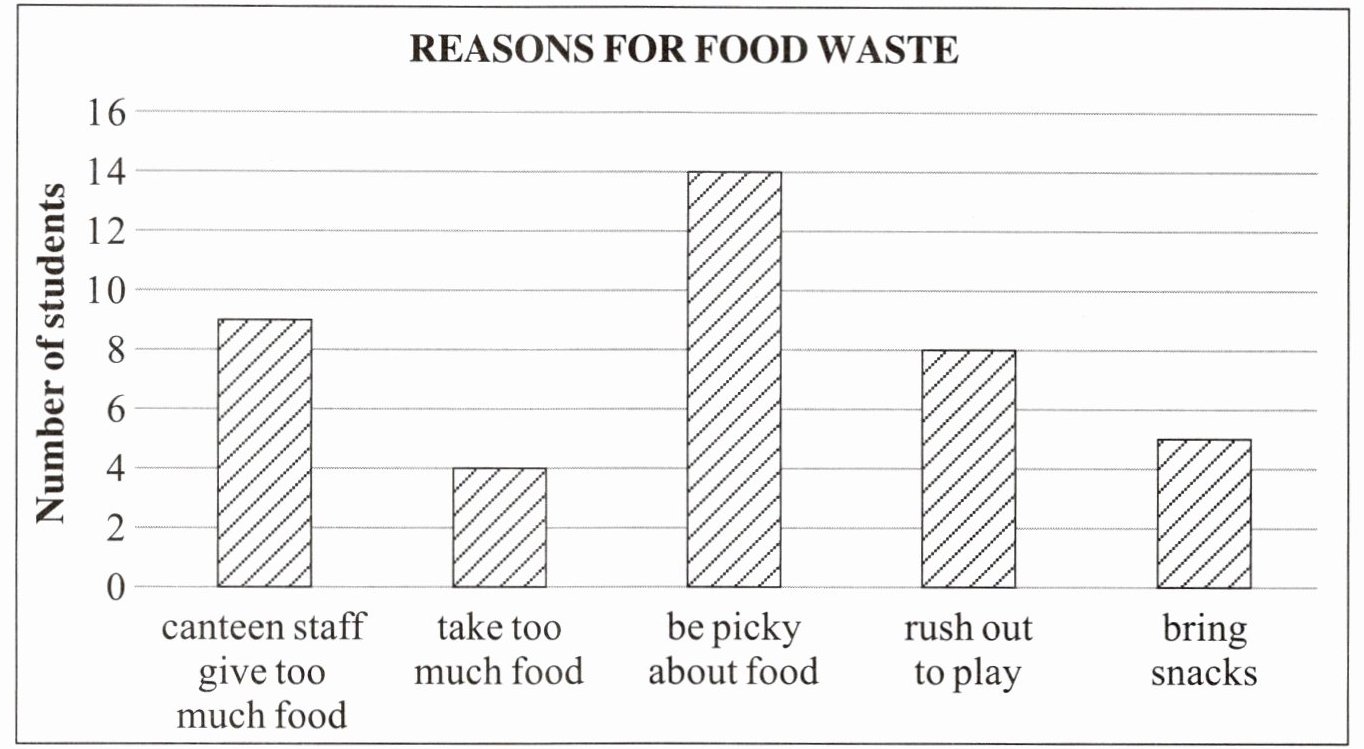
一、【多模态语篇】Xiaoming 在班里做了一项关于食物浪费原因的调查。请根据以下统计表填空。
Xiaoming did a survey in his class to find out why his classmates waste food. Here are the results.
1. There are
2. Nine students said that sometimes the
3.
4.
5. Eight students rush out to
6. Five students bring
7. The most common reason is that
Xiaoming did a survey in his class to find out why his classmates waste food. Here are the results.
1. There are
forty/40
students in Xiaoming’s class.2. Nine students said that sometimes the
canteen staff
give them too much food.3.
Four/4
students feel very hungry at lunch, so they always take too much food.4.
Fourteen/14
students said that they don’t like some of the food. So, they don’t eat it.5. Eight students rush out to
play
during lunch break.6. Five students bring
snacks
to school every day.7. The most common reason is that
they are picky about food
.答案
1. forty/40
2. canteen staff
3. Four/4
4. Fourteen/14
5. play
6. snacks
7. they are picky about food
2. canteen staff
3. Four/4
4. Fourteen/14
5. play
6. snacks
7. they are picky about food
解析
【分析】这道题是基于柱状图的信息提取题,解题思路是:1. 先明确柱状图每个类别对应的学生数量;2. 逐题匹配题目描述与图表中的原因、数量信息;3. 计算总人数时将所有类别学生数相加;4. 找出人数最多的类别作为最常见原因。
【解析】步骤1:读取柱状图数据:“canteen staff give too much food”对应9人,“take too much food”对应4人,“be picky about food”对应14人,“rush out to play”对应8人,“bring snacks”对应5人;步骤2:计算总人数:9+4+14+8+5=40,对应第1题;步骤3:第2题中“给太多食物”的主体是食堂工作人员(canteen staff),数量为9,匹配图表;步骤4:第3题“拿太多食物”的学生数是4;步骤5:第4题“不喜欢食物”对应“be picky about food”,学生数14;步骤6:第5题“rush out to”后接的是play;步骤7:第6题“带的东西”是snacks;步骤8:第7题人数最多的原因是“be picky about food”,对应描述为they are picky about food。
【答案】1. forty/40;2. canteen staff;3. Four/4;4. Fourteen/14;5. play;6. snacks;7. they are picky about food
【知识点】多模态语篇解读、图表信息提取
【点评】本题通过柱状图考查信息匹配与提取能力,属于基础题型,需要准确对应图表与题目描述。
【难度系数】0.5
二、Xiaoming 的同学 Sam 和 Lucas 在课间活动时发生了矛盾。阅读短文,完成下列任务。
Sam and Lucas are good friends. One day, they had a fight. Lucas made fun of Sam’s haircut, and Sam shouted bad words at Lucas. Both of them felt very angry. Later, Yiming helped them talk it out. Sam said he felt hurt when Lucas made fun of him and then everyone laughed. He asked Lucas to put himself in his shoes. Then, Lucas said sorry and explained that he didn’t mean to hurt Sam. However, he also felt angry when Sam shouted at him. In the end, they decided to put this behind them and became friends again.
任务一:根据短文内容,选择最佳答案,把其大写字母编号写在括号内。
(
A. Lucas made fun of his haircut. B. Lucas took his toys. C. Lucas didn’t listen to him.
(
A. Hurt. B. Mad. C. Both A and B.
(
A. Friends should never fight. B. Talking can help solve problems.
C. Making fun of others is okay.
任务二:判断下列句子是否符合短文内容,如符合,在括号内写“T”,否则写“F”。
(
(
(
Sam and Lucas are good friends. One day, they had a fight. Lucas made fun of Sam’s haircut, and Sam shouted bad words at Lucas. Both of them felt very angry. Later, Yiming helped them talk it out. Sam said he felt hurt when Lucas made fun of him and then everyone laughed. He asked Lucas to put himself in his shoes. Then, Lucas said sorry and explained that he didn’t mean to hurt Sam. However, he also felt angry when Sam shouted at him. In the end, they decided to put this behind them and became friends again.
任务一:根据短文内容,选择最佳答案,把其大写字母编号写在括号内。
(
A
)1. Why did Sam get angry?A. Lucas made fun of his haircut. B. Lucas took his toys. C. Lucas didn’t listen to him.
(
B
)2. How did Lucas feel when Sam shouted?A. Hurt. B. Mad. C. Both A and B.
(
B
)3. What can we learn from the story?A. Friends should never fight. B. Talking can help solve problems.
C. Making fun of others is okay.
任务二:判断下列句子是否符合短文内容,如符合,在括号内写“T”,否则写“F”。
(
T
)1. Yiming helped them talk it out.(
F
)2. Sam said sorry first.(
T
)3. They decided to forget the fight and become friends again.答案
任务一:
1. A
【解析】考查细节理解。从文中“Lucas made fun of Sam's haircut, and Sam shouted bad words at Lucas.”可知,Sam 生气是因为 Lucas 取笑他的发型,故选 A。
2. B
【解析】考查同义词替换。从文中“However, he also felt angry when Sam shouted at him.”可知,Lucas 听到 Sam 对他大喊大叫时感到生气,mad 意为“很生气”,与 angry 的意思相近,故选 B。
3. B
【解析】考查归纳总结。Sam 和 Lucas 正是通过“talk it out(把话说开)”,说出自己的感受、道歉、换位思考,才解决了矛盾,重归于好。这告诉我们:沟通是解决问题的有效方式,故选 B。
任务二:
1. T
【解析】考查细节理解。文中明确提到“Later, Yiming helped them talk it out.”,句子符合短文内容,故答案为 T。
2. F
【解析】考查细节理解。文中提到“Then, Lucas said sorry and explained ...”可知是 Lucas 先道歉,句子与短文内容不符,故答案为 F。
3. T
【解析】考查推理判断。文中提到“In the end, they decided to put this behind them and became friends again.”,表明他们决定忘记过去并重新成为朋友,句子与短文内容相符,故答案为 T。
解析
【分析】
本题为英语阅读理解题,包含选择和判断两类题型。解题思路为:先通读短文把握核心内容,再针对每道小题的问题,回到原文定位对应信息,通过对比原文与选项/句子内容,得出正确答案。
【解析】
任务一:
1. 本题考查细节理解。根据原文“Lucas made fun of Sam’s haircut, and Sam shouted bad words at Lucas. Both of them felt very angry.”可知,Sam生气是因为Lucas取笑他的发型,对应选项A。
2. 本题考查细节理解。根据原文“However, he also felt angry when Sam shouted at him.”可知,Sam大喊时Lucas感到生气,mad意为“生气的”,与angry同义,对应选项B。
3. 本题考查主旨归纳。文中两人通过沟通化解矛盾,说明沟通是解决问题的有效方式,对应选项B。
任务二:
1. 本题考查细节理解。原文明确提到“Later, Yiming helped them talk it out.”,句子与原文一致,故填T。
2. 本题考查细节理解。原文提到“Then, Lucas said sorry and explained that he didn’t mean to hurt Sam.”,是Lucas先道歉,并非Sam,故填F。
3. 本题考查细节理解。原文“In the end, they decided to put this behind them and became friends again.”表明他们决定忘记矛盾重归于好,句子与原文一致,故填T。
【答案】
任务一:1.A 2.B 3.B;任务二:1.T 2.F 3.T
【知识点】
英语阅读理解细节理解、主旨归纳
【点评】
本题围绕校园矛盾解决场景命题,考查学生对短文细节的查找和主旨归纳能力,题型基础,贴近学生生活。
【难度系数】
0.7
